Symplisept
Poland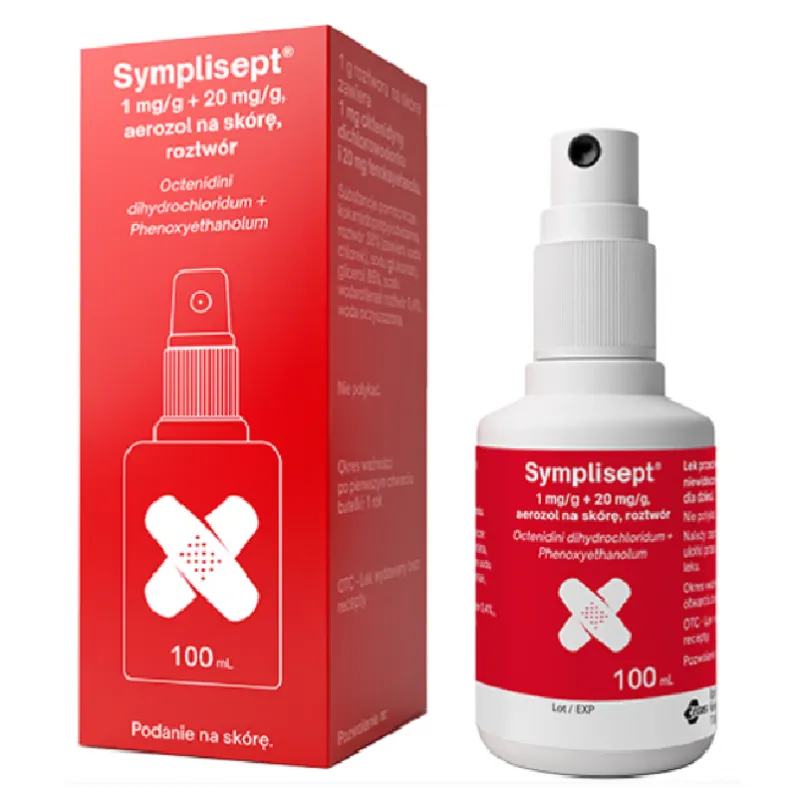
Table of Contents
Package leaflet: Information for the user
Symplisept, 1 mg/g + 20 mg/g, cutaneous spray, solution
Octenidini dihydrochloridum + Phenoxyethanolum
Please read all of this leaflet carefully before using this medicine, because it contains
important information for you.
This medicine should always be used exactly as described in this patient leaflet or as directed by
your doctor or pharmacist.
- Keep this leaflet, so that you can read it again if necessary.
- If you need advice or further information, please consult your pharmacist.
- If you experience any adverse reactions, including any not listed in this leaflet, inform your doctor or pharmacist. See section 4.
- If there is no improvement after 2 weeks, or if you feel worse, you should contact your doctor.
Leaflet contents
- What Symplisept is and what it is used for
- Important information before using Symplisept
- How to use Symplisept
- Possible side effects
- How to store Symplisept
- Contents of the pack and other information
1. What Symplisept is and what it is used for
Symplisept contains the active substances: octenidine dihydrochloride, which acts as an antiseptic and disinfectant, and phenoxyethanol, which has bactericidal properties.
Symplisept is applied to the skin for repeated, short-term supportive antiseptic treatment of minor, superficial wounds in patients of all age groups.
2. Important information before using Symplisept
When not to use Symplisept:
- If the patient is allergic to octenidine dihydrochloride, phenoxyethanol, or any of the other ingredients of this medicine (listed in section 6).
- This medicine must not be used for irrigating the abdominal cavity (during surgery), urinary bladder, or tympanic membrane.
Warnings and precautions
Before starting to use Symplisept, consult your doctor, pharmacist, or nurse.
Do not use larger amounts of this medicine than necessary. Do not swallow it or allow it to enter the bloodstream, for example, by accidental injection.
To prevent possible tissue damage, exercise caution when using this medicine and ensure that it is not applied under pressure or injected into tissues. In deep wounds (larger, deeper wounds with loss of subcutaneous tissue), ensure proper drainage of wound contents (e.g., via drainage or a special wound treatment method known as skin flap technique).
Do not use Symplisept in the eyes. In case of contact with eyes, rinse immediately with a large amount of water.
Children
Use with caution in newborns, especially premature infants. Symplisept may cause severe skin reactions. Excess product should be removed, and care must be taken to ensure that the solution does not remain on the skin longer than necessary (this also applies to materials soaked with the solution that are in direct contact with the patient).
The use of Symplisept in children under 6 years of age should be limited to a few days.
Symplisept and other medicines
Tell your doctor or pharmacist about all medicines the patient is currently taking or has recently taken, including medicines available without a prescription.
Do not use this medicine simultaneously with skin antiseptics based on povidone-iodine on adjacent areas of the body, as this may lead to strong brown or violet skin discolorations.
Do not use Symplisept simultaneously with anionic surfactants (e.g., soap, detergents, or cleaning agents), as this may reduce or eliminate the antimicrobial effect of the medicine.
Pregnancy and breastfeeding
If the patient is pregnant or breastfeeding, suspects she may be pregnant, or is planning to have a baby, she should consult her doctor or pharmacist before using this medicine.
Pregnancy
Do not use Symplisept during pregnancy.
Breastfeeding
It is very unlikely that this medicine passes into human milk.
During breastfeeding, do not apply Symplisept to the breast area.
Driving and operating machinery
Symplisept has no effect or a negligible effect on the ability to drive and operate machinery.
3. How to use Symplisept
This medicine should always be used exactly as described in this patient information leaflet or as directed by a doctor or pharmacist. If in doubt, consult a doctor or pharmacist.
The medicine is for topical use on the skin (it is intended for external use only). Symplisept in aerosol form should be applied to the affected area of skin until it is completely moistened.
After application, wait at least 1 to 2 minutes before taking any further steps, such as applying a dressing. This time is necessary to achieve the desired effect of the medicine.
To ensure effectiveness, these instructions must be followed carefully.
Symplisept should be used no more than 3 times a day.
Do not use this medicine for longer than 2 weeks without consulting a doctor.
Use in children and adolescents
Due to its topical application, Symplisept should be used in the same way in adults, adolescents, and children.
In children under 6 years of age, Symplisept should be used for only a few days.
Overdose (use of more than the recommended dose)
Overdose with a topically applied medicine is highly unlikely. In case of doubt, consult a doctor or pharmacist.
If Symplisept is accidentally swallowed, seek medical advice immediately.
If you have any further doubts about the use of this medicine, consult a doctor or pharmacist.
4. Possible adverse reactions
Like all medicines, this medicine can cause adverse reactions, although not everybody gets them.
Rare (may affect up to 1 in 1,000 people):
In rare cases, burning, redness, itching, and a sensation of warmth may occur at the site of application.
Very rare (may affect up to 1 in 10,000 people):
Local skin irritation (reactions due to contact allergy) is possible, for example transient redness of the treated skin.
If Symplisept enters the oral cavity, it may cause a transient bitter taste in the mouth.
Additional adverse reactions in children and adolescents
Use of this medicine in premature newborns may cause transient skin rash (erythematous reaction).
The frequency, type, and severity of adverse reactions in children and adolescents are considered to be the same as in adults.
Reporting of adverse reactions
If any adverse reactions occur, including any adverse reactions not listed in this leaflet, inform your doctor or pharmacist.
Adverse reactions can be reported directly to the Department of Monitoring Adverse Drug Reactions of the Office for Registration of Medicinal Products, Medical Devices and Biocidal Products:
Al. Jerozolimskie 181C, 02-222 Warsaw
Tel.: +48 22 49 21 301
Fax: +48 22 49 21 309
Website: https://smz.ezdrowie.gov.pl
Adverse reactions can also be reported to the marketing authorization holder.
Reporting adverse reactions helps to provide more information on the safety of the medicine.
5. How to store Symplisept
Keep the medicine out of the sight and reach of children.
Do not use this medicine after the expiry date stated on the bottle and the cardboard box after "EXP". The expiry date refers to the last day of the stated month.
30 mL bottle:
Do not store above 30°C.
Usable period after first opening: 6 months.
50 mL and 100 mL bottles:
No special storage precautions required.
Usable period after first opening: 1 year.
Medicines should not be disposed of down the drain or in household waste. Ask your pharmacist how to dispose of medicines no longer in use. This will help protect the environment.
6. Contents of the package and other information
What Symplisept contains
- The active substances are octenidine dihydrochloride and phenoxyethanol. 1 g of cutaneous aerosol solution contains 1 mg of octenidine dihydrochloride and 20 mg of phenoxyethanol.
- Other ingredients are: cocamidopropyl betaine, 38% solution (containing sodium chloride), sodium gluconate, glycerol 85%, 0.4% sodium hydroxide solution (for pH adjustment), and purified water.
What Symplisept looks like and contents of the pack
Symplisept is a clear, almost odourless solution, free from particles or sediment,
packed in white bottles made of high-density polyethylene (HD-PE), equipped with a spray pump and a polypropylene cap.
Pack sizes are 30 mL, 50 mL and 100 mL.
The 50 mL aerosol pack contains over 400 doses (please consider limitations regarding use (see section 3)).
Not all pack sizes may be marketed.
Marketing Authorisation Holder and Manufacturer
Marketing Authorisation Holder:
Egis Pharmaceuticals PLC
Kereszturi ut 30-38
1106 Budapest
Hungary
Manufacturer:
Dr. August Wolff GmbH & Co KG Arzneimittel
Sudbrackstraße 56
33611 Bielefeld
Germany
Egis Pharmaceuticals PLC, Site 3
9900 Körmend, Mátyás király u. 65
Hungary
This medicinal product is authorised in the European Economic Area under the following names:
Hungary Octizy 1 mg/g / 20 mg/g cutaneous solution spray
Czech Republic Octizy
Slovakia Octizy
Latvia Octezy 1 mg/g / 20 mg/g uz ādas lietojams aerosols, šķīdums
Lithuania Octezy 1 mg/g / 20 mg/g odos purškalas (tirpalas)
Poland Symplisept
Bulgaria Симплисепт 1 mg/g / 20 mg/g спрей за кожа, разтвор
Symplisept 1 mg/g / 20 mg/g cutaneous spray, solution
Romania Octizy 1 mg/g / 20 mg/g spray cutanat, soluție
For further information about this medicinal product, please contact the local representative of the Marketing Authorisation Holder:
EGIS Polska Sp. z o.o.
ul. Komitetu Obrony Robotników 45D
02-146 Warsaw
Tel.: +48 22 417 92 00