Symex
Poland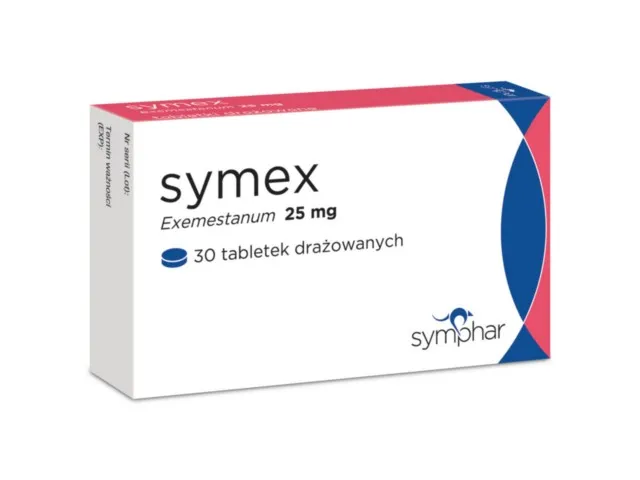
Table of Contents
Patient Information Leaflet
Symex, 25 mg, coated tablets
Exemestanum
Please read the entire leaflet carefully before using the medicine, as it contains
important information for the patient.
- Keep this leaflet for future reference.
- If you have any further questions, please consult your doctor or pharmacist.
- This medicine has been prescribed for a specific individual. Do not give it to others. The medicine may harm another person, even if their symptoms are the same.
- If you experience any adverse reactions, including any not listed in this leaflet, inform your doctor or pharmacist. See section 4.
Table of Contents
- What Symex is and what it is used for
- Important information before taking Symex
- How to take Symex
- Possible side effects
- How to store Symex
- Contents of the pack and other information
1. What Symex is and what it is used for
This medicine contains the active substance exemestane. Exemestane belongs to a group of medicines known as aromatase inhibitors. These medicines act on a substance called aromatase, which is essential for the production of female sex hormones, estrogens, particularly in postmenopausal women. Reducing estrogen levels in the body is a method of treating hormone-dependent breast cancer. Exemestane is used:
- in the treatment of early hormone-dependent breast cancer in postmenopausal women who have completed 2–3 years of tamoxifen therapy.
- in the treatment of advanced hormone-dependent breast cancer in postmenopausal women in whom prior hormonal therapy has not been sufficiently effective.
2. Important information before using Symex
When not to use Symex
- if the patient is allergic to exemestane or any of the other ingredients of this medicine (listed in section 6),
- if the patient is not yet postmenopausal, e.g. menstruation has not yet stopped,
- if the patient is pregnant or may be pregnant,
- if the patient is breastfeeding.
Warnings and precautions
Before starting treatment with Symex, discuss this with your doctor or pharmacist.
- Before using Symex, your doctor may perform blood tests to confirm that you are postmenopausal.
- Before starting treatment, your doctor may recommend routine testing of vitamin D levels, as these may be very low in the early stages of breast cancer. Women with vitamin D deficiency should receive supplementation to correct the deficiency.
- Inform your doctor about any existing liver or kidney disorders before taking Symex.
- Inform your doctor if you have had or currently have any condition affecting bone strength. Your doctor may recommend a bone density test before or during treatment with Symex. This is due to the effect of drugs in this class on reducing the activity of female sex hormones, which may lead to loss of minerals from bones and reduced bone strength.
Symex and other medicines
Tell your doctor about all medicines you are currently taking or have recently taken, as well as any medicines you plan to take.
Symex must not be used concomitantly with hormone replacement therapy (HRT).
The following medicines should be used with caution during treatment with Symex. The patient should inform the doctor if she is taking medicines such as:
- rifampicin (an antibiotic),
- carbamazepine or phenytoin (antiepileptic medicines used in the treatment of epilepsy),
- herbal products containing St John's wort (Hypericum perforatum) or preparations containing St John's wort.
Symex and food
Symex should preferably be taken after a meal.
Pregnancy and breastfeeding
Do not take Symex if you are pregnant or breastfeeding.
If you are pregnant or breastfeeding, suspect you may be pregnant, or are planning to have a child, you should consult your doctor before using this medicine.
Discuss contraception with your doctor if there is a possibility of becoming pregnant.
Driving and operating machinery
If you experience drowsiness, dizziness or weakness while taking Symex, you should not attempt to drive or operate machinery.
Symex contains sucrose
If you have previously been diagnosed with intolerance to certain sugars, consult your doctor before taking this medicine.
3. How to use Symex
This medicine should always be taken exactly as prescribed by the doctor. If in doubt, consult
your doctor.
Dosage
The recommended dose is one 25 mg tablet per day.
Method of administration
Symex should be taken orally, after a meal, approximately at the same time each day.
The doctor will inform the patient how and for how long the medicine should be taken.
If hospitalization is necessary during treatment with exemestane, inform the medical
staff at the hospital about any medicines currently being taken.
Use in children
Symex is not indicated for use in children.
Taking more Symex than recommended
If more medicine has been taken than recommended, contact your doctor immediately or go to the
nearest hospital. Bring the Symex packaging with you.
Missed dose of Symex
Do not take a double dose to make up for a missed tablet.
Take the missed dose as soon as possible. If it is almost time for the next dose, take the next dose
at the usual time.
Stopping Symex
Do not stop taking this medicine even if you feel well, unless your doctor advises otherwise.
4. Possible adverse reactions
Like all medicines, this medicine can cause adverse reactions, although not everyone will experience them.
Symex is generally well tolerated, and the adverse reactions observed in patients treated with Symex are mostly mild or moderate in intensity.
Most of the adverse reactions are related to estrogen deficiency (e.g. hot flushes).
The following adverse reactions may occur: hypersensitivity, hepatitis, and cholangitis, which causes yellowing of the skin (cholestatic hepatitis). Symptoms include: general malaise, nausea, jaundice (yellowing of the skin and eyes), itching, abdominal pain on the right side, and loss of appetite. If any of these symptoms occur, patients should contact their doctor immediately to obtain medical assistance.
Very common adverse reactions (may occur in more than 1 in 10 patients):
- Depression
- Insomnia
- Headache
- Hot flushes
- Dizziness
- Nausea
- Increased sweating
- Muscle and joint pain (including osteoarthritis, back pain, joint inflammation and stiffness)
- Fatigue
- Decreased number of white blood cells
- Abdominal pain
- Increased liver enzyme activity
- Increased concentration of hemoglobin breakdown products in blood
- Increased blood concentration of enzymes due to liver damage
- Pain
Common adverse reactions (may occur in less than 1 in 10 patients):
- Loss of appetite
- Carpal tunnel syndrome (simultaneous tingling, numbness, and pain in the entire hand except the little finger) or skin tingling/burning
- Abdominal pain, vomiting, constipation, indigestion, diarrhea
- Hair loss
- Rash, urticaria, and itching
- Bone demineralization, which may reduce bone strength (osteoporosis), leading in some cases to fractures (fractures or cracks)
- Pain, swelling of hands and feet
- Decreased platelet count
- Muscle weakness
Uncommon adverse reactions (may occur in less than 1 in 100 patients):
- Hypersensitivity
Rare adverse reactions (may occur in less than 1 in 1000 patients):
- Transformation of small skin vesicles into a rash
- Somnolence
- Hepatitis
- Cholangitis causing yellowing of the skin
Frequency unknown (cannot be estimated from available data):
- Low number of certain white blood cells
Changes in peripheral blood may also occur: in the number of certain blood cells (lymphocytes) and platelets, particularly in patients who had lymphopenia (reduced number of lymphocytes in blood) prior to starting treatment.
Reporting of adverse reactions
If any adverse reactions occur, including any adverse reactions not listed in this leaflet, patients should inform their doctor or pharmacist. Adverse reactions can be reported directly to the Department of Monitoring of Adverse Drug Reactions at the Office for Registration of Medicinal Products, Medical Devices and Biocidal Products:
Al. Jerozolimskie 181C, 02-222 Warsaw
Tel.: +48 22 49 21 301, fax: +48 22 49 21 309, website: https://smz.ezdrowie.gov.pl
Adverse reactions can also be reported to the marketing authorization holder.
Reporting adverse reactions helps provide more information on the safety of this medicine.
5. How to store Symex
Keep this medicine out of the sight and reach of children.
Do not use this medicine after the expiry date stated on the carton and blisters after:
EXP. The expiry date refers to the last day of the stated month.
Do not store above 30°C.
Medicines should not be disposed of via wastewater or household waste. Ask your pharmacist how to dispose of medicines no longer required. This helps protect the environment.
6. Contents of the pack and other information
What Symex contains
- The active substance is exemestane. Each coated tablet contains 25 mg of exemestane.
- Other ingredients are: microcrystalline cellulose, crospovidone XL 10, polysorbate 80, mannitol, colloidal anhydrous silica, magnesium stearate, sucrose, spray-dried arabic gum, talc, titanium dioxide (E 171), Opaglos 6000: anhydrous ethanol, shellac, white wax, carnauba wax.
What Symex looks like and contents of the pack
Symex is a white or almost white, round, biconvex coated tablet without an imprint.
Symex is available in PVC/PVDC/Aluminium/PVDC blisters containing 10, 15, 20, 30, 90, 100, 105 and 120 tablets.
Not all pack sizes may be marketed.
Marketing Authorisation Holder and Manufacturer
Marketing Authorisation Holder
Symphar Sp. z o.o.
ul. Koszykowa 65
00-667 Warsaw
tel.: +48 22 822 93 06
e-mail: [email protected]
Manufacturer/Importer
Symphar Sp. z o.o.
ul. Chełmżyńska 249
04-458 Warsaw