Suprane
Poland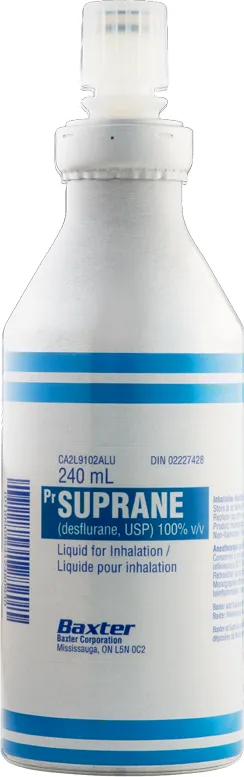
Table of Contents
Package leaflet: Information for the user
SUPRANE, inhalation liquid
Desfluranum
Please read all of this leaflet carefully before the medicine is administered, as it contains
important information for the patient.
- Keep this leaflet so that you can read it again if necessary.
- If you have any questions, please consult your doctor or nurse.
- If any of the side effects worsen or if you notice any side effects not listed in this leaflet, including any adverse reactions, tell your doctor or nurse. See section 4.
Table of contents
- What the medicine is and what it is used for
- Important information before the medicine is administered
- How the medicine will be administered
- Possible side effects
- How to store the medicine
- Contents of the pack and other information
1. What the medicine is and what it is used for
The medicine contains desflurane. It is a general anaesthetic used in surgery.
It is an inhaled anaesthetic (administered to the patient as a vapour to be inhaled).
Inhaling desflurane vapour causes a deep, pain-free sleep. This medicine also allows
maintenance of a deep, pain-free state (i.e. general anaesthesia), during which a surgical
procedure can be performed. In adults, the medicine is used both for induction and
maintenance of anaesthesia. In infants and children, this medicine is used only for
maintenance of anaesthesia.
2. Important information before using the medicine
When NOT to use the medicine:
- if the patient is allergic (hypersensitive) to desflurane or other inhalational anaesthetic medicines such as isoflurane, sevoflurane, halothane, and enflurane;
- if there are medical reasons why the patient should not undergo general anaesthesia;
- if the patient or a family member is susceptible to malignant hyperthermia. Malignant hyperthermia is a life-threatening condition characterized by a sudden increase in body temperature during or shortly after surgery when the patient has been anaesthetized by inhalation. Cases of malignant hyperthermia, including fatal outcomes, have been reported with the use of desflurane;
- if the patient previously developed liver disease (hepatitis) following administration of desflurane or another inhalational anaesthetic such as isoflurane, sevofluran, halothane, or enflurane, or if unexplained mild to severe liver problems (liver function abnormalities, e.g. jaundice associated with fever and/or eosinophilia) occurred after anaesthesia with desflurane or another inhalational anaesthetic such as isoflurane, sevoflurane, halothane, or enflurane.
When it is not allowed to use the medicine for induction (initiation) of anaesthesia:
- if the patient is at risk of coronary artery disease; coronary artery disease occurs when blood vessels supplying the heart muscle do not deliver sufficient blood and oxygen;
- if the physician considers potential side effects of the medicine undesirable, e.g.:
- increased heart rate,
- elevated blood pressure.
- in infants and children due to frequent occurrence of coughing, breathing difficulties, respiratory disturbances, and excessive secretions.
If any of these conditions apply to a given patient, inform the doctor,
surgeon, or anaesthesiologist before starting administration of this medicine.
Warnings and precautions
The doctor will exercise particular caution when using the medicine if:
- the patient has a brain tumour;
- the patient previously experienced unexplained liver problems after anaesthesia, including:
- jaundice (yellowing of the skin and whites of the eyes),
- fever,
- liver necrosis, in some cases with fatal outcome;
- the patient has changes in the electrical activity of the heart known as "QT interval prolongation".
The doctor may need to administer a lower dose of the medicine if:
- the patient has low blood volume (hypovolemia),
- the patient has low blood pressure (hypotension),
- the patient is weakened (exhausted).
The doctor may decide not to use the medicine if the patient suffers from:
- liver cirrhosis (alcoholic liver disease),
- viral hepatitis (liver disease caused by viruses),
- other types of liver disease. In such cases, the doctor may use another anaesthetic medicine.
In patients with heart vessel disease, measures should be taken to prevent reduced
blood flow to the heart. For this purpose, the doctor will, among other things, monitor pulse and arterial
blood pressure. For induction of anaesthesia in patients at risk of heart vessel disease and in individuals
in whom increases in heart rate or blood pressure are undesirable, the medicine should be used
in combination with other drugs, preferably intravenous narcotic and hypnotic agents.
The doctor should pay special attention if the patient has previously received
an inhalational anaesthetic, particularly if it was administered more than once within a short period
(repeated administration).
Inform the doctor, surgeon, or anaesthesiologist if the patient has recently undergone
general anaesthesia.
Recovery from anaesthesia induced by the medicine is rapid. The doctor will administer pain-relieving
medicines if postoperative pain is expected. This may occur at the end of surgery or during awakening
after surgery.
The medicine may cause malignant hyperthermia (during or shortly after surgery, the patient suddenly
develops a rapid, dangerous rise in body temperature).
The medicine very rarely may cause increased potassium concentration in blood serum
during or immediately after administration. In most, but not all, such cases, a muscle relaxant called suxamethonium was also administered simultaneously. High potassium levels in blood serum may contribute to cardiac arrhythmias, some of which may be severe or even fatal. Patients with muscle disorders or muscular dystrophy, particularly those with Duchenne muscular dystrophy, appear to be at highest risk of developing high potassium levels.
Use in children
- Desflurane should be used cautiously in children with asthma or those who have or recently had upper respiratory tract infections, due to the risk of airway constriction and breathing difficulties.
- In children, emergence from anaesthesia may cause a brief period of agitation, which may interfere with cooperation.
- In infants and children (i.e. patients under 12 years of age), the medicine should not be used for induction (initiation) of anaesthesia, as this may lead to undesirable effects such as:
- coughing,
- respiratory arrest,
- apnoea,
- spasm of the vocal cord muscles (larynx), known as laryngospasm,
- increased secretion in the airways.
- The medicine should not be used for maintenance of anaesthesia in children unless they have been intubated. Intubation involves placing a tube in the airway to assist breathing. The doctor should exercise caution when using desflurane for maintenance of anaesthesia with a laryngeal mask, particularly in children under 6 years of age, due to increased risk of adverse respiratory reactions such as coughing and laryngospasm, especially if the laryngeal mask is removed under deep anaesthesia.
If any of the above conditions apply to the patient (including a child), contact the
doctor, nurse, or pharmacist. Careful evaluation of the patient and adjustment of treatment may be necessary.
Other medicines
Inform the doctor, nurse, or anaesthesiologist about all medicines currently taken or recently used,
as well as medicines the patient plans to take, including over-the-counter medicines. This also includes herbal remedies, vitamins, and minerals.
- Medicines or active substances listed below may affect the action of the medicine when used concomitantly. Some of these medicines are administered to the patient during surgery by the anaesthesiologist, as indicated in the description.
- Muscle relaxants (e.g. suxamethonium, pancuronium, atracurium, vecuronium): these medicines are used during general anaesthesia to relax the patient's muscles. The anaesthesiologist may need to adjust the dose of these medicines.
- Opioids (e.g. fentanyl, morphine, remifentanil): these are strong pain-relieving medicines frequently used during general anaesthesia. The patient may use these pain-relieving medicines in other situations and should inform the doctor about any such use.
- Benzodiazepines (e.g. midazolam, diazepam, nitrazepam): these are calming medicines used when the patient is anxious, e.g. before surgery. The patient may use these calming medicines in other situations. Inform the doctor about the use of any of these medicines before administration of the medicine.
- Nitrous oxide: this is a medicine used during general anaesthesia that induces sleep and relieves pain.
Food and drink
The medicine induces and maintains sleep, allowing the patient to undergo surgery. Ask the doctor, surgeon, or anaesthesiologist when and what you may eat and drink after recovery.
Pregnancy, breastfeeding, and fertility
The medicine should not be administered to pregnant women or women who are breastfeeding.
During pregnancy or breastfeeding, or if pregnancy is suspected or planned, consult the doctor, surgeon, or anaesthesiologist before using this medicine.
Driving and operating machinery
Taking an anaesthetic medicine may affect the patient's alertness, which may impair the ability to perform normal tasks. Do not drive or operate tools and machinery for 24 hours after surgery with this medicine.
3. How the medicine will be administered
The medicine will be administered to the patient by an anaesthetist, who will decide how much medicine the patient needs and when it should be given. The dose will depend on the patient's age, body weight, and the type of surgery being performed. During anaesthesia, the anaesthetist will monitor the patient's arterial blood pressure and heart rate. This will help in adjusting the dose if necessary.
The medicine is obtained from liquid desflurane using a vapouriser. The patient may receive the medicine in one of two ways:
- before administering the medicine via a mask, the patient may be given another anaesthetic medicine by injection to induce sleep. This method of administration is used most frequently, or
- the patient may be asked to inhale desflurane vapour through a mask to induce sleep. The patient will fall asleep quickly and very easily. This method of administration is used less frequently.
After the operation, the anaesthetist will stop administering the medicine. Within a few minutes, the patient will wake up.
If more medicine than intended is given
If too much medicine is administered, the administration of the medicine will be stopped immediately. The patient will be given pure oxygen. Blood pressure and heart function will be closely monitored during the patient's awakening.
4. Possible adverse reactions
Like any medicinal product, this medicine may cause adverse reactions.
It may cause dose-dependent depression of respiratory and cardiovascular function.
Nausea and vomiting, common consequences of surgery and general anaesthesia, have been observed after surgical procedures. There may be several causes:
use of an inhaled anaesthetic, other anaesthetic agents, or other administered drugs, or the post-surgical condition. Most of these adverse reactions are transient and mild.
Very common (occurs in more than 1 in 10 patients):
- nausea and vomiting. These reactions occurred during induction and maintenance of anaesthesia with this medicine.
Common (occurs in not more than 1 in 10 patients):
- sore throat;
- respiratory arrest. This reaction occurred during induction and maintenance of anaesthesia with this medicine;
- headache;
- inflammation of the lining of the eyelid (conjunctivitis);
- irregular heartbeat (nodal arrhythmia);
- slow heart rate (bradycardia);
- fast heart rate (tachycardia);
- high blood pressure (hypertension);
- cessation of breathing (apnoea), cough, increased salivation (excessive salivation). These reactions occurred during induction and maintenance of anaesthesia with this medicine;
- laryngospasm. This reaction occurred during induction of anaesthesia with this medicine;
- increased blood levels of an enzyme called creatine phosphokinase;
- abnormal electrocardiogram (abnormal ECG recording).
Uncommon (occurs in not more than 1 in 100 patients):
- motor restlessness (agitation);
- dizziness;
- heart attack (myocardial infarction);
- lack of blood supply to the heart muscle (myocardial ischaemia);
- irregular heartbeat (arrhythmia);
- dilation of blood vessels;
- inadequate oxygen delivery to the body (hypoxia). This reaction occurred during induction and maintenance of anaesthesia with this medicine;
- muscle pain (myalgia).
Frequency not known (frequency cannot be estimated from the available data):
- blood clotting disorders (coagulopathy);
- high potassium levels in the blood (hyperkalaemia);
- low potassium levels in the blood (hypokalaemia);
- excessive acid production by the body (metabolic acidosis);
- disturbances in consciousness;
- seizures (convulsions);
- yellowing of the eyes (jaundice of the sclera);
- suppression of heartbeat (cardiac arrest);
- life-threatening irregular heartbeat (torsade de pointes);
- failure of both heart ventricles (ventricular failure);
- impaired function of both heart ventricles (ventricular hypokinesia);
- irregular heartbeat (atrial fibrillation);
- very high blood pressure (malignant hypertension);
- bleeding (haemorrhage);
- low blood pressure (hypotension);
- condition in which body tissues do not receive adequate blood supply (shock);
- cessation of breathing (respiratory arrest);
- condition in which breathing fails to provide sufficient oxygen to the body (respiratory failure, respiratory exhaustion);
- sudden constriction of the airways (bronchospasm);
- coughing up blood (haemoptysis);
- sudden inflammatory condition of the pancreas (acute pancreatitis);
- abdominal pain;
- liver failure;
- death of liver tissue (liver necrosis);
- inflammation of the liver (hepatitis, cytolytic hepatitis);
- condition in which bile does not flow properly (cholestasis);
- yellowing of the skin or eyes (jaundice);
- abnormal liver function;
- disturbances in liver function;
- urticaria;
- redness (erythema);
- muscle disease (rhabdomyolysis);
- malignant hyperthermia – a life-threatening condition occurring during or shortly after surgery, characterized by:
- rapidly increasing high temperature (fever),
- elevated carbon dioxide levels in the blood (hypercapnia),
- muscle rigidity,
- increased heart rate (tachycardia),
- increased respiratory rate (rapid breathing),
- bluish discoloration of the skin (cyanosis),
- irregular heartbeat,
- increased or decreased blood pressure.
- weakness (asthenia);
- general malaise (general feeling of discomfort);
- changes in heart recording (ST-T segment changes in ECG);
- changes in heart recording (T-wave inversion in ECG);
- increased liver enzyme activity (increased alanine aminotransferase and aspartate aminotransferase activity);
- blood clotting disorders;
- elevated ammonia levels;
- elevated bilirubin levels in the blood;
- postoperative agitation.
The following adverse reactions have been reported after accidental exposure of this medicine
to individuals who were not patients:
- dizziness;
- severe headache (migraine);
- irregular and rapid heartbeat (tachyarrhythmia);
- awareness of one's own heartbeat (palpitations);
- burning sensation in the eye;
- temporary (transient) blindness;
- brain disorder (encephalopathy);
- corneal ulcer (corneal ulceration);
- bloodshot eyes (conjunctival hyperaemia);
- vision problems (blurred vision);
- eye irritation;
- eye pain;
- fatigue;
- skin burning sensation.
Patients should inform their doctor or pharmacist if they notice any changes
in their health status after receiving this medicine. Some adverse reactions may require
medical treatment.
Reporting of adverse reactions
If any adverse symptoms occur, including any adverse symptoms not listed
in this leaflet, patients should inform their doctor or nurse. Adverse reactions can be reported
directly to the Department of Monitoring of Adverse Drug Reactions
of the Office for Registration of Medicinal Products, Medical Devices and Biocidal Products
Al. Jerozolimskie 181C
02-222 Warsaw
tel.: +48 22 49 21 301
fax: +48 22 49 21 309
website: https://smz.ezdrowie.gov.pl
Adverse reactions can also be reported to the marketing authorisation holder.
Reporting adverse reactions helps provide more information on the safety of this medicine.
5. How to store the medicine
Keep the medicine out of the sight and reach of children.
Do not use the medicine after the expiry date stated on the container and
outer packaging after: "Expiry date". The expiry date refers to the last day of the stated month.
Store the medicine in a tightly closed container, kept in an upright position.
Medicines must not be disposed of via wastewater or household waste.
Ask your pharmacist how to dispose of medicines no longer in use. This will help protect the environment.
6. Contents of the pack and other information
What the medicine contains
Active substance: one bottle contains 240 ml of desflurane.
It does not contain any excipients.
What the medicine looks like and contents of the pack
The medicine, a liquid for inhalation, is supplied in amber glass bottles fitted with a crimped valve closure system or in aluminium bottles internally coated with epoxyphenolic resin, fitted with a crimped valve closure system, packed in a cardboard box.
Pack sizes: 1 or 6 bottles of 240 ml in a cardboard box.
Not all pack sizes may be marketed.
Marketing Authorisation Holder
Baxter Polska Sp. z o.o.
ul. Kruczkowskiego 8
00-380 Warsaw
tel. 22 488 37 77
Manufacturer
Baxter S.A., Boulevard René Branquart 80, 7860 Lessines, Belgium
Baxter and Suprane are trademarks of Baxter International Inc.