Sumamed
Poland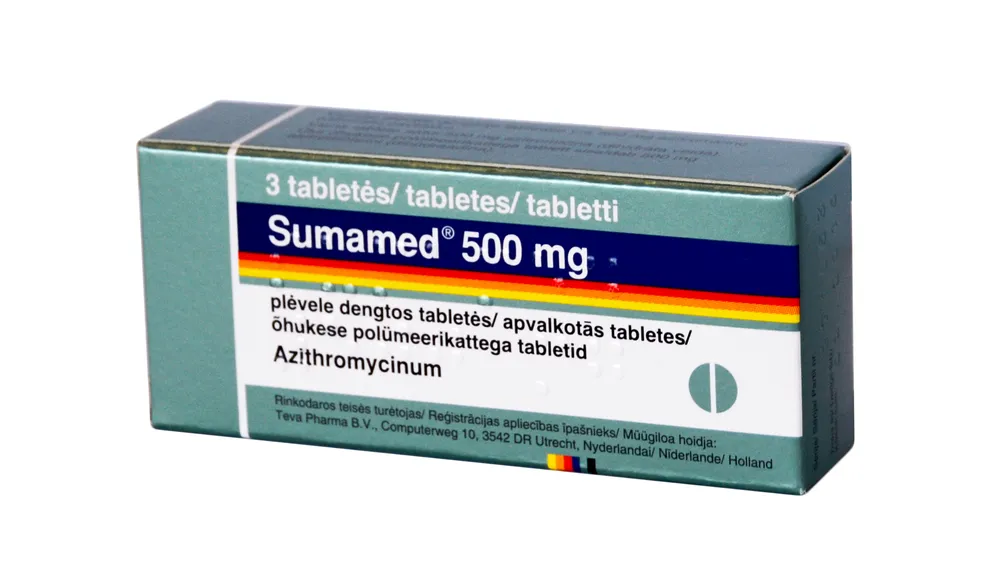
Table of Contents
Package leaflet: information for the patient
Warning! Keep the leaflet! Information on the immediate packaging is in a foreign language.
Sumamed (Azimed), 500 mg, film-coated tablets
Azithromycinum
Sumamed and Azimed are different trade names for the same medicinal product.
Please read the following information carefully before using the medicine, as it contains
important information for the patient.
- Keep this leaflet, so that you may read it again if necessary.
- If you have any doubts, consult your doctor or pharmacist.
- This medicine has been prescribed for a specific individual. Do not pass it on to others. The medicine may harm other people, even if their symptoms are identical.
- If you experience any adverse reactions, including any not listed in this leaflet, inform your doctor or pharmacist. See section 4.
Table of contents of the leaflet
- What Sumamed is and what it is used for
- Important information before taking Sumamed
- How to take Sumamed
- Possible side effects
- How to store Sumamed
- Contents of the pack and other information
1. What Sumamed is and what it is used for
Sumamed contains azithromycin as the active substance, which is an azalide antibiotic from the macrolide group with broad-spectrum activity. It acts bactericidal against susceptible microorganisms.
Sumamed 500 mg film-coated tablets are indicated for the treatment of the following infections caused by microorganisms sensitive to azithromycin.
- Upper respiratory tract infections: bacterial pharyngitis, tonsillitis, sinusitis (see also section 2).
- Acute otitis media.
- Lower respiratory tract infections: acute bronchitis, exacerbation of chronic bronchitis, mild to moderate pneumonia, including interstitial pneumonia.
- Skin and soft tissue infections: erysipelas, cellulitis, and secondary purulent skin infections; erythema migrans – the first sign of Lyme disease; moderate acne vulgaris, in adults only.
- Sexually transmitted infections: uncomplicated infections caused by Chlamydia trachomatis.
2. Important information before using Sumamed
When not to use Sumamed
- If the patient is allergic to azithromycin, other macrolide antibiotics, or to any of the other ingredients of this medicine (listed in section 6).
Warnings and precautions
Before starting treatment with Sumamed, discuss with your doctor or pharmacist if:
- the patient has conditions that may predispose to heart rhythm disorders (particularly relevant in women and elderly patients):
- congenital or previous history of cardiac arrhythmias (visible on ECG – electrocardiogram, a test measuring the heart's electrical activity),
- severe heart failure,
- very slow heart rate (called bradycardia),
- electrolyte imbalances in the blood, especially low levels of potassium and magnesium,
- taking other medicines that may cause QT interval prolongation on ECG (see section "Sumamed with other medicines");
- the patient has severe kidney function impairment;
- the patient has severe liver function impairment: the doctor may monitor liver function or discontinue treatment;
- the patient develops a new infection (this may indicate overgrowth of resistant microorganisms or a fungal infection);
- the patient has neurological or psychiatric disorders;
- the patient has a sexually transmitted infection: the doctor should ensure that syphilis is not present;
- the patient is taking ergot derivatives (ergot alkaloids);
- the patient has infected burn wounds.
Please also refer to the warnings contained in section 4.
If, despite treatment, symptoms of infection do not improve or new infection symptoms appear,
e.g. fungal infection, consult your doctor again.
Streptococcal infections
For the treatment of streptococcal pharyngitis and tonsillitis, penicillin is usually the drug of choice.
Pseudomembranous colitis
If diarrhea occurs, it should be reported immediately to the doctor, as it may be a sign of pseudomembranous colitis—a complication that may occasionally occur during treatment with macrolide antibiotics. Physicians should consider this diagnosis in patients who develop diarrhea after starting azithromycin therapy. In cases of pseudomembranous colitis due to azithromycin use, discontinuation of Sumamed and initiation of appropriate treatment may be necessary. Antiperistaltic agents are contraindicated.
Long-term use
There is a lack of data on the safety and efficacy of long-term use of azithromycin for the indications listed above. In cases of rapidly recurring infections, the doctor may consider treatment with another antibacterial agent.
Myasthenia gravis
Worsening of myasthenia symptoms or development of a myasthenic syndrome has been observed during azithromycin treatment (see section "Possible side effects").
Children and adolescents
Sumamed 500 mg coated tablets are recommended for use in children only if body weight is at least 45 kg. For other pediatric groups, Sumamed oral suspension or 125 mg coated tablets are recommended.
Sumamed with other medicines
Inform your doctor or pharmacist about all medicines currently used, recently taken, or planned for use.
If the patient is taking any of the following medicines, it is especially important to inform the doctor or pharmacist:
- medicines affecting the QT interval, such as
- quinidine, procainamide, dofetilide, amiodarone, sotalol (used to treat cardiac arrhythmias),
- hydroxychloroquine (used to treat rheumatological diseases or malaria),
- cisapride (used for gastric disorders),
- terfenadine (used to treat allergies),
- antipsychotics, e.g. pimozide,
- antidepressants, e.g. citalopram,
- fluoroquinolones (used for infections), e.g. moxifloxacin, levofloxacin;
- antacids (Sumamed should be taken at least 1 hour before or 2 hours after antacids);
- oral anticoagulants, e.g. warfarin;
- ergot alkaloids (used for migraine or reducing blood flow), e.g. ergotamine: co-administration with azithromycin may lead to ergotism (symptoms: peripheral vasoconstriction and ischemia);
- digoxin (used for heart disorders) and colchicine (used to treat gout and familial Mediterranean fever);
- cyclosporine (used for skin diseases, rheumatoid arthritis, or after organ transplantation);
- atorvastatin (a medicine used to lower cholesterol levels);
- rifabutin (used in the treatment of HIV or tuberculosis).
Sumamed with food and drink
Sumamed 500 mg coated tablets can be taken regardless of meals.
Pregnancy, breastfeeding, and fertility
If the patient is pregnant, breastfeeding, suspects she might be pregnant, or is planning to have a child, she should consult her doctor or pharmacist before using this medicine.
Pregnancy
This medicine may be used during pregnancy only if, in the doctor’s opinion, the benefit to the mother outweighs the risk to the fetus.
Breastfeeding
Azithromycin passes into human milk. Breastfeeding is not recommended during treatment with azithromycin unless otherwise advised by the doctor.
Fertility
Fertility studies in rodents showed a reduced pregnancy rate after administration of azithromycin. The relevance of these findings to humans is unknown.
Driving and operating machinery
There are no data on the effect of Sumamed on the ability to drive or operate machinery. However, when performing such activities, consider the possibility of side effects such as dizziness and convulsions.
Sumamed contains sodium
This medicine contains less than 1 mmol (23 mg) of sodium per dose, meaning it is considered "sodium-free."
3. How to use Sumamed
This medicine should always be taken as prescribed by your doctor. If in doubt, consult your
doctor or pharmacist.
This medicine is for oral use.
Dosage for adults, including elderly patients, and for children and adolescents with body weight
above 45 kg
Upper and lower respiratory tract infections, otitis media, skin and soft tissue infections (except
erythema migrans and acne vulgaris)
The total dose of azithromycin is 1.5 g over 3 days (500 mg as a single daily dose).
Alternatively, the same total dose (1500 mg) may also be administered over 5 days: 500 mg on the
first day of treatment and 250 mg daily from the second to the fifth day of treatment.
Erythema migrans
The total dose is 3 g, to be taken according to the following regimen: 1 g on the first day (2 film-coated tablets of 500 mg), followed by 500 mg (1 film-coated tablet) daily from the second to the fifth day, as single daily doses.
Moderate acne vulgaris – in adults only
The total dose is 6 g, recommended to be administered according to the following regimen: 1 film-coated tablet of 500 mg once daily for 3 days, followed by 1 film-coated tablet of 500 mg once weekly for the next 9 weeks. In the second week of treatment, the dose should be taken 7 days after the first dose, and the subsequent eight doses should be taken at 7-day intervals.
Due to the administration of a high dose of azithromycin in the above regimen for moderate acne vulgaris, monitoring of liver enzyme activity is required before starting and during the course of azithromycin treatment.
The above cyclic regimen for moderate acne vulgaris (3 days + 9 weeks) may be applied only once in an individual patient, as there are no controlled clinical trials demonstrating the safety and efficacy of repeating this treatment regimen for acne vulgaris.
Uncomplicated infections caused by Chlamydia trachomatis
1 g (2 film-coated tablets of 500 mg) as a single dose.
Patients with renal or hepatic impairment
If a patient has impaired kidney or liver function, this should be reported to the doctor, as a dose reduction may be necessary. This medicine should not be used in patients with severe hepatic insufficiency.
Method of administration
Azithromycin should be taken orally, once daily.
Sumamed 500 mg film-coated tablets may be taken with or without food.
The tablets should be swallowed whole.
Taking more Sumamed than prescribed
Adverse effects observed after taking higher than recommended doses were similar to those reported with correct dosing. Characteristic symptoms following overdose of macrolide antibiotics include transient hearing loss, severe nausea, vomiting, and diarrhea.
If an overdose is taken, seek immediate medical advice from a doctor or pharmacist. In case of overdose, administration of activated charcoal is recommended, along with symptomatic treatment and, if necessary, supportive measures to maintain vital functions.
Missed dose of Sumamed
If a dose is missed, it should be taken as soon as possible, and subsequent doses should be taken according to the prescribed dosing schedule. A double dose should not be taken to make up for the missed dose.
4. Possible adverse reactions
Like all medicines, this medicine can cause adverse reactions, although not everyone will experience them.
If any of the following adverse reactions occur, stop taking the
Sumamed and immediately contact a doctor or go to the emergency department of the
nearest hospital:
- Severe hypersensitivity reaction (sudden breathing and swallowing difficulties, swelling of the lips, tongue, face and neck, itchy rash, especially if widespread).
- Severe skin reactions: skin eruption characterized by rapidly appearing red skin areas covered with small blisters (vesicles filled with white or yellow fluid); severe skin rash causing redness and peeling; severe blistering and bleeding of the lips, eyes, mouth, nose and genitals, associated with high fever and joint pain. These may indicate "acute generalized exanthematous pustulosis" (AGEP), "erythema multiforme", "bullous erythema multiforme (Stevens-Johnson syndrome)" or "toxic epidermal necrolysis".
- Severe hypersensitivity reaction possibly including fever, skin rash, organ swelling, increased levels of a certain type of white blood cells (eosinophilia), and inflammation of internal organs (drug reaction with eosinophilia and systemic symptoms (DRESS)).
You should also stop taking Sumamed and immediately contact a doctor if you notice:
- Severe or prolonged diarrhoea with blood or mucus. This symptom may occur during or after treatment and may indicate a serious intestinal inflammation.
- Weakness, yellowing of the skin or whites of the eyes, and dark-coloured urine.
- Unusual tendency to bruise or bleed.
- Rapid (ventricular tachycardia) or irregular heartbeat, or changes in heart rhythm on electrocardiogram (ECG) (prolongation of the QT interval and torsade de pointes-type arrhythmias).
The following adverse reactions have been reported:
Very common (may occur in more than 1 in 10 patients):
- Diarrhoea.
Common (may occur in up to 1 in 10 patients):
- Headache;
- Vomiting, abdominal pain, nausea;
- Changes in white blood cell count;
- Decreased bicarbonate levels in blood.
Uncommon (may occur in up to 1 in 100 patients):
- Fungal infections (candidiasis), vaginal infection, pneumonia, fungal infection, bacterial infection, sore throat, gastritis and enteritis, respiratory disorders, rhinitis, oral candidiasis;
- Changes in white blood cell count (leukopenia, neutropenia, eosinophilia);
- Angioedema (swelling of the face and throat, possibly causing breathing difficulties), hypersensitivity;
- Loss of appetite (anorexia);
- Nervousness, insomnia, dizziness, drowsiness, taste disturbances, unusual skin sensations such as tingling and numbness of limbs (paresthesia);
- Visual disturbances;
- Ear disorders, balance disorders;
- Palpitations;
- Hot flushes;
- Dyspnoea, nosebleeds;
- Constipation, bloating with flatulence, dyspepsia, inflammation of the gastric mucosa, swallowing difficulties (dysphagia), abdominal distension, dry mouth, regurgitation with vomiting, oral ulcers, excessive salivation;
- Rash, itching, urticaria, dermatitis, dry skin, excessive sweating;
- Arthropathy, muscle pain, back pain, neck pain;
- Urinary disorders (dysuria), kidney pain;
- Uterine haemorrhage, testicular disorders;
- Oedema, weakness (asthenia), malaise, fatigue, facial swelling, chest pain, fever, pain, peripheral oedema;
- Abnormal laboratory test results (e.g. blood tests, liver function parameters, glucose, electrolytes);
- Post-procedural complications.
Rare (may occur in up to 1 in 1000 patients):
- Restlessness;
- Liver function disorders, cholestatic jaundice (cholestatic jaundice);
- Photosensitivity, severe skin reactions: skin eruption characterized by rapidly appearing red skin areas covered with small blisters (vesicles filled with white or yellow fluid).
Frequency not known (frequency cannot be estimated from available data):
- Pseudomembranous colitis;
- Thrombocytopenia (reduced platelet count), reduced number of red blood cells (hemolytic anaemia);
- Anaphylactic reaction (generalized allergic reaction, rarely leading to death; may present with symptoms such as swelling of the lips, face or neck leading to severe breathing difficulties, skin rash or urticaria);
- Aggressive behaviour, anxiety, delirium, hallucinations;
- Loss of consciousness (fainting), seizures, sensory disturbances (hypoesthesia), excessive psychomotor activity, loss of smell, loss of taste, olfactory disturbances, rapid muscle fatigue (myasthenia);
- Hearing disorders including deafness and/or tinnitus;
- Cardiac rhythm disorders (including torsade de pointes-type arrhythmias and ventricular tachycardia), QT interval prolongation on electrocardiogram (ECG);
- Hypotension;
- Pancreatitis, tongue discoloration;
- Liver failure (rarely leading to death), fulminant hepatitis, liver necrosis;
- Severe skin reactions: bullous erythema multiforme (Stevens-Johnson syndrome), toxic epidermal necrolysis, erythema multiforme, drug reaction with eosinophilia and systemic symptoms (DRESS);
- Joint pain;
- Acute renal failure, interstitial nephritis.
Adverse reactions probably or possibly related to the use of azithromycin in the treatment
or prevention of infections caused by Mycobacterium avium complex organisms, observed
during clinical trials and after marketing authorization
Very common (may occur in more than 1 in 10 patients):
- Diarrhoea;
- Abdominal pain;
- Nausea;
- Bloating;
- Abdominal discomfort;
- Loose stools.
Common (may occur in up to 1 in 10 patients):
- Anorexia;
- Dizziness;
- Headache;
- Unusual skin sensations such as tingling and numbness of limbs (paresthesia);
- Taste disturbances;
- Visual disturbances;
- Deafness;
- Rash, itching;
- Joint pain;
- Fatigue.
Uncommon (may occur in up to 1 in 100 patients):
- Sensory disturbances (hypoesthesia);
- Hearing disorders, tinnitus;
- Palpitations;
- Hepatitis;
- Bullous erythema multiforme (Stevens-Johnson syndrome (severe skin reaction)), photosensitivity;
- Weakness (asthenia), malaise.
Reporting of adverse reactions
If any adverse effects occur, including any adverse effects not listed
in this leaflet, inform your doctor or pharmacist. Adverse reactions can
be reported directly to the Department of Monitoring Adverse Reactions to Medicinal Products, Office for Registration of Medicinal Products, Medical Devices and Biocidal Products, Al. Jerozolimskie 181C, 02-222 Warsaw, tel.: + 48 22 49 21 301,
fax: + 48 22 49 21 309, website: https://smz.ezdrowie.gov.pl.
Reporting adverse reactions helps to provide more information on the safety of the medicine.
5. How to store Sumamed
- Keep this medicine out of sight and reach of children.
- No special storage conditions apply.
- Do not use this medicine after the expiry date stated on the container. The expiry date refers to the last day of the specified month. Medicines must not be disposed of via wastewater or household waste. Ask your pharmacist how to dispose of medicines no longer required. These measures will help protect the environment.
6. Contents of the packaging and other information
What Sumamed contains
- The active substance is azithromycin in the form of azithromycin dihydrate. Each coated tablet contains 500 mg of azithromycin.
- Other components of the medicinal product are: tablet core: anhydrous calcium hydrogen phosphate, hypromellose, maize starch, pregelatinized starch, microcrystalline cellulose, sodium lauryl sulfate, magnesium stearate; coating: hypromellose, indigo carmine, lac (E 132), titanium dioxide (E 171), polysorbate 80, talc.
What Sumamed looks like and contents of the packaging
Sumamed is a light blue, elongated, biconvex, film-coated tablet.
On one side of the tablet is embossed the marking 'PLIVA', and on the other side '500'.
The packaging contains 3, 6 or 12 film-coated tablets in a cardboard box.
For more detailed information, please contact the marketing authorisation holder or the parallel importer.
Marketing authorisation holder in Croatia, the country of export:
PLIVA HRVATSKA d.o.o.
Prilaz baruna Filipovića 25
10 000 Zagreb, Croatia
Manufacturer:
PLIVA HRVATSKA d.o.o.
Prilaz baruna Filipovića 25
10 000 Zagreb, Croatia
Parallel importer:
InPharm Sp. z o.o.
ul. Strumykowa 28/11
03-138 Warsaw, Poland
Repackaged in:
InPharm Sp. z o.o. Services sp. k.
ul. Chełmżyńska 249
04-458 Warsaw, Poland
Marketing authorisation number in Croatia, the country of export: HR-H-453231145-01
Parallel import authorisation number: 313/22