Sulovas
Poland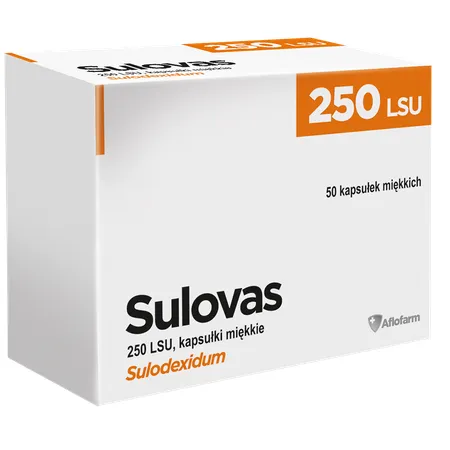
Table of Contents
Patient Information Leaflet
Sulovas, 250 LSU, soft capsules
Sulodexidum
Please read this leaflet carefully before taking this medicine, as it contains
important information for the patient.
- Keep this leaflet for future reference.
- If you have any questions, consult your doctor or pharmacist.
- This medicine has been prescribed for a specific individual. Do not pass it on to others. It may harm others, even if their symptoms are the same.
- If you experience any adverse reactions, including those not listed in this leaflet, inform your doctor or pharmacist. See section 4.
Leaflet Contents
- What Sulovas is and what it is used for
- Important information before taking Sulovas
- How to take Sulovas
- Possible side effects
- How to store Sulovas
- Contents of the pack and other information
1. What Sulovas is and what it is used for
Sulovas contains sulodexide – a substance which, by acting on certain factors involved in the blood coagulation process, exerts an antithrombotic effect within both arterial and venous vessels. Sulodexide also normalizes increased blood viscosity in patients with vascular changes and thrombotic risk, and reduces lipid concentrations.
Indications for Sulovas
- Symptomatic treatment of primary and secondary chronic venous insufficiency.
- Long-term secondary prophylaxis of venous thromboembolic disease in patients who have completed standard anticoagulant therapy due to deep vein thrombosis or pulmonary embolism.
- Treatment of hard exudates in patients with non-proliferative mild to moderate diabetic retinopathy.
- Treatment of venous leg ulcers, as an adjunct to local therapy – continuation of initial parenteral treatment.
- Symptomatic treatment of moderate chronic obstructive arterial disease of the lower limbs (Fontaine stage II) – continuation of initial parenteral therapy.
2. Important information before taking Sulovas
When not to take Sulovas
- If the patient is allergic to sulodexide or any of the other ingredients of this medicine (listed in section 6), or to heparin or heparin-like drugs.
- If the patient has a bleeding tendency (bleeding disorders) or diseases associated with bleeding.
- If the patient is taking heparin or other anticoagulant medicines (including oral anticoagulants).
- If the patient has a known hypersensitivity to peanuts or soya.
Warnings and precautions
Before starting Sulovas, discuss this with your doctor or pharmacist.
Sulovas and other medicines
Inform your doctor about all medicines currently taken or recently taken, as well as any medicines the patient intends to take.
- Sulovas may enhance the effect of concomitantly administered heparin and oral anticoagulants (e.g. warfarin) (see above section: "When not to take Sulovas").
Taking Sulovas with food and drink
Do not take the medicine at the same time as meals.
Pregnancy and breastfeeding
If the patient is pregnant or breastfeeding, suspects she may be pregnant, or is planning to have a baby, she should consult her doctor or pharmacist before using this medicine.
The use of Sulovas is not recommended during pregnancy.
The use of Sulovas is not recommended during breastfeeding.
Driving and operating machinery
Sulovas has no influence on the ability to drive or operate machinery.
Sulovas contains ethyl parahydroxybenzoate, propyl parahydroxybenzoate and sodium
Ethyl parahydroxybenzoate, propyl parahydroxybenzoate
This medicine may cause allergic reactions (including delayed-type reactions).
Sodium
The medicine contains 2.79 mg of sodium per capsule.
The medicine contains less than 1 mmol (23 mg) of sodium per capsule, meaning the medicine is considered "sodium-free".
3. How to take Sulovas
This medicine should always be taken according to the doctor's or pharmacist's instructions.
If in doubt, consult your doctor or pharmacist.
Recommended dose
-
Symptomatic treatment of primary and secondary chronic venous insufficiency:
- 2 capsules (500 LSU) twice daily between meals.
-
Extended secondary prophylaxis of venous thromboembolic disease in patients who have completed standard anticoagulant therapy due to deep vein thrombosis or pulmonary embolism:
- 2 capsules (500 LSU) twice daily between meals.
-
Treatment of hard exudates in patients with non-proliferative mild to moderate diabetic retinopathy:
- 1 capsule (250 LSU) twice daily between meals.
Continuation of initial parenteral therapy
Note: Sulovas is available only in oral form. During the initial parenteral phase of treatment, another product containing sulodexide for parenteral administration should be used.
-
Continuation of parenteral treatment of venous leg ulcers, as an adjunct to local therapy:
- 2 capsules (500 LSU) twice daily between meals for 30–70 days.
-
Continuation of parenteral symptomatic treatment of moderate chronic obstructive arterial disease of the lower limbs (Fontaine classification stage II):
- 2 capsules (500 LSU) twice daily between meals for 6 months.
Method of administration
For oral use.
Do not take the medicine at the same time as meals.
If you take more Sulovas than you should
In case of overdose, bleeding may occur.
If you have taken more than the recommended dose of Sulovas, you should immediately contact your doctor, who will initiate appropriate treatment if necessary.
If you forget to take Sulovas
Do not take a double dose to make up for a missed dose.
If you miss a dose at the scheduled time, take it as soon as possible. However, if it is almost time for the next dose, skip the missed dose.
Stopping Sulovas
Discontinuation of Sulovas does not cause adverse effects, except for possible worsening of symptoms of the disease for which it is being used.
If you have any further questions about the use of this medicine, consult your doctor or pharmacist.
4. Possible adverse reactions
Like all medicines, this medicine can cause adverse reactions, although not everyone experiences them.
You should immediately inform your doctor or go to the nearest hospital if any of the following occur:
- Angioedema (a severe allergic reaction – sudden swelling of the face, limbs, or joints without itching or pain). Swelling in the head and neck area may cause difficulty in swallowing and breathing.
The following adverse reactions may occur:
Common (occur in 1 to 10 out of 100 patients):
- dizziness;
- abdominal pain;
- diarrhoea;
- stomach pain;
- nausea;
- rash (itchy, red bumps on the skin).
Uncommon (occur in 1 to 10 out of 1,000 patients):
- discomfort in the abdominal cavity;
- dyspepsia (indigestion), bloating, vomiting;
- headache;
- skin eruption;
- erythema (localised redness of the skin);
- urticaria (pinkish, itchy wheals on the skin).
Very rare (occur in 1 out of 10,000 patients):
- gastrointestinal bleeding;
- oedema (swelling);
- loss of consciousness;
- anaemia;
- abdominal pain;
- gastrointestinal disorders;
- melaena (black, tarry stools);
- disturbances in blood plasma protein metabolism;
- swelling and redness in the genital organs;
- frequent menstruation;
- petechiae (small red or purple spots on the skin).
Reporting of adverse reactions
If any adverse reactions occur, including any not listed in this leaflet, you should inform your doctor or pharmacist. Adverse reactions can be reported directly to the Department of Monitoring Adverse Drug Reactions at the Office for Registration of Medicinal Products, Medical Devices and Biocidal Products:
Al. Jerozolimskie 181C, 02-222 Warsaw
Tel.: +48 22 49 21 301
Fax: +48 22 49 21 309
Website: https://smz.ezdrowie.gov.pl
Adverse reactions can also be reported to the marketing authorisation holder.
Reporting adverse reactions helps to provide more information on the safety of the medicine.
5. How to store Sulovas
Keep this medicine out of sight and reach of children.
Do not store above 25°C.
Do not use this medicine after the expiry date (EXP) stated on the blister pack and cardboard
box after EXP. The expiry date refers to the last day of the stated month.
Medicines should not be disposed of via wastewater or household waste. Ask your
pharmacist how to dispose of medicines no longer required. This will help protect
the environment.
6. Contents of the pack and other information
What Sulovas contains
- The active substance is sulodexide. One soft capsule contains 250 LSU of sulodexide.
- The other ingredients are: sodium lauryl sulfate, yellow wax E 901, refined soybean oil.
The capsule shell contains: gelatin, glycerol E 422, purified water, ethyl parahydroxybenzoate, propyl parahydroxybenzoate, titanium dioxide (E 171), yellow iron oxide (E 172), red iron oxide (E 172), brown iron oxide (E 172).
What Sulovas looks like and contents of the pack
Sulovas is in the form of red to reddish-brown, oval, gelatin soft capsules.
PVC/Aluminium blister pack in a cardboard box. The pack contains 10 or 50 soft capsules.
Marketing Authorisation Holder
Aflofarm Farmacja Polska Sp. z o.o.
ul. Partyzancka 133/151
95-200 Pabianice
Tel. +48 42 22 53 100
Manufacturer
Catalent Italy S.p.A.
Via Nettunense Km 20,100
04011 Aprilia (Italy)