Sulfarinol
Poland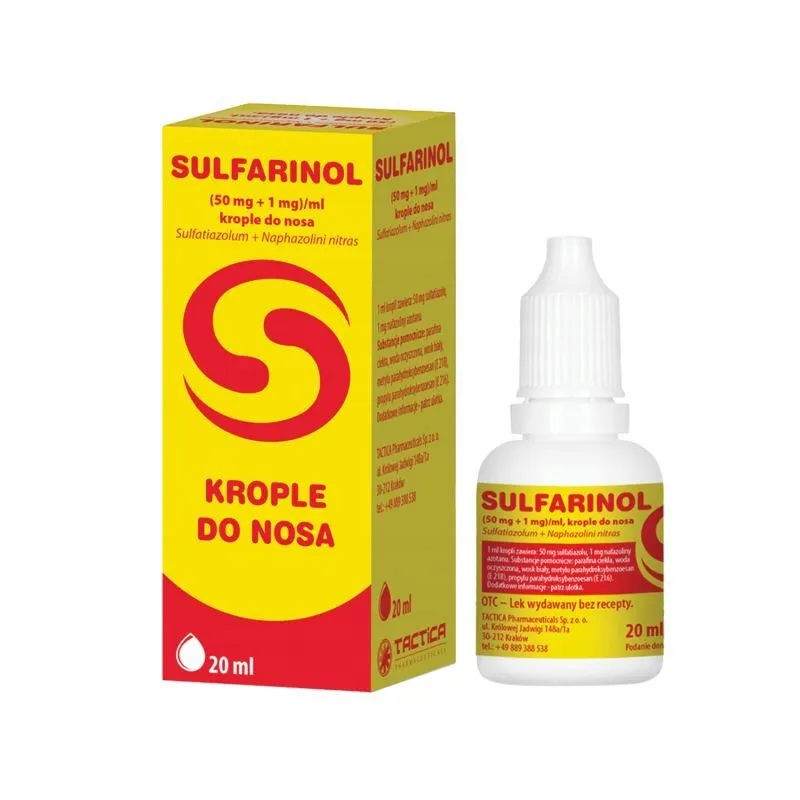
Table of Contents
Package leaflet: Information for the user
SULFARINOL, (50 mg + 1 mg)/ml, nasal drops
Sulfathiazole + Naphazoline nitrate
Please read this leaflet carefully before using this medicine, because it contains
important information for the patient.
This medicine should always be used exactly as described in this patient leaflet or as directed by a doctor or pharmacist.
- Keep this leaflet so that you can read it again if necessary.
- If you need advice or further information, please consult your pharmacist.
- If you experience any adverse reactions, including any possible adverse reactions not listed in this leaflet, inform your doctor or pharmacist. See section 4.
- If there is no improvement after 5 days or if symptoms worsen, consult a doctor.
Table of contents
- What Sulfarinol is and what it is used for
- Important information before using Sulfarinol
- How to use Sulfarinol
- Possible side effects
- How to store Sulfarinol
- Contents of the pack and other information
1. What Sulfarinol is and what it is used for
Sulfarinol nasal drops are a white, oily liquid containing two active substances:
sulfathiazole at a concentration of 50 mg/1 ml and naphazoline nitrate at a concentration of 1 mg/1 ml.
Sulfathiazole is a sulfonamide with short-acting bacteriostatic activity against Gram-positive and Gram-negative bacteria.
Naphazoline is an imidazole derivative with adrenergic activity (stimulating the sympathetic nervous system).
When applied locally to the nasal mucosa, it causes vasoconstriction of dilated blood vessels within approximately 5 minutes, thereby reducing inflammatory symptoms such as swelling and exudation (nasal discharge). This facilitates drainage of exudate from the paranasal sinuses and improves nasal breathing. Intranasal administration may also help to open the Eustachian tube. The medicine acts primarily on symptoms. The therapeutic effect lasts from 6 to 8 hours.
Sulfarinol is used in the treatment of nasal catarrh, nasal congestion, and swelling of the nasal mucosa caused by inflammation associated with bacterial infection. If there is no improvement after five days or if symptoms worsen, consult a doctor.
2. Important information before using Sulfarinol
When not to use Sulfarinol
- if the patient is allergic to the active substances or any of the other ingredients of this medicine (listed in section 6)
- if the patient has hypersensitivity to sulfonamides;
- if the patient has closed-angle glaucoma;
- if the patient has atrophic rhinitis;
- in children under 12 years of age.
Warnings and precautions
Before starting to use Sulfarinol, consult a doctor or pharmacist if:
- the patient is being treated with MAO inhibitors or tricyclic antidepressants (medicines used in psychiatry and neurology);
- local pain occurs, no improvement is observed, local epithelial changes worsen, or nosebleeds appear;
- the patient suffers from diabetes, bronchial asthma, hypertension, thyroid disease, cardiovascular diseases (especially in case of rhythm disorders), cerebral arteriosclerosis, or benign prostatic hyperplasia;
- the patient is elderly. The medicine should not be used for longer than 5 days. In cases requiring caution or whenever in doubt, contact a doctor before using Sulfarinol.
Children and adolescents
Do not use in children under 12 years of age.
Sulfarinol and other medicines
Inform your doctor or pharmacist about all medicines currently used, recently used, or planned to be used.
The use of medicines containing naphazoline in patients treated with tricyclic antidepressants may intensify their effect on blood vessels (increased vasoconstriction).
Concomitant use of MAO inhibitors may lead to hypertensive crisis (sudden increase in blood pressure).
Taking Sulfarinol with food and drink
Sulfarinol can be used at any time, regardless of meals.
Pregnancy, breastfeeding, and fertility
If the patient is pregnant or breastfeeding, suspects she might be pregnant, or is planning to have a child, she should consult a doctor or pharmacist before using this medicine.
Sulfarinol must not be used during pregnancy and breastfeeding unless absolutely necessary. The decision may be made solely by a doctor after assessing the expected benefit of treatment for the mother against the risk to the fetus or breastfed infant.
Driving and operating machinery
No studies have been conducted on the effect of the product on the ability to drive or operate machinery. Caution should be exercised, and such activities should not be undertaken if adverse reactions occur or if the patient is particularly sensitive to the medicine.
Sulfarinol contains methyl parahydroxybenzoate (E 218) and propyl parahydroxybenzoate (E 216)
Each 1 ml of medicinal product contains 0.16 mg of methyl parahydroxybenzoate (E 218) and 0.01 mg of propyl parahydroxybenzoate (E 216). The medicine may cause allergic reactions (including delayed-type reactions).
3. How to use Sulfarinol
This medicine should always be used exactly as described in this patient information leaflet, or as directed by your doctor or pharmacist. If in doubt, consult your doctor or pharmacist.
The recommended dose for adults and children over 12 years of age is 1 to 2 drops every 4 to 6 hours into each nostril. The medicine should be administered into each nostril on the nasal wing, then the nose should be gently pressed several times with the index finger and thumb. Shake well before use.
Do not use this medicine more frequently than every 4 hours and do not use it for longer than 3 to 5 days.
Use in children and adolescents
The use of this medicine in adolescents over 12 years of age corresponds to the adult dosage.
Sulfarinol should not be used in children under 12 years of age.
Use of a higher than recommended dose of Sulfarinol
Using significantly higher doses than recommended may cause systemic adverse effects such as increased blood pressure, nausea, headaches and dizziness, palpitations, drowsiness and lethargy, slowed heart function, and Stevens-Johnson syndrome (fever and severe symptoms affecting the skin and mucous membranes of the nose and oral cavity). Significant overdose may lead to suppression of the central nervous system, with pronounced sedative effects, drop in blood pressure (shock), hypothermia, coma, and ciliary adhesion of the nasal mucosa. This systemic effect is caused by the drainage of excess drops into the stomach and subsequent absorption of the drug into the bloodstream from the gastrointestinal tract. In such a case, seek immediate medical attention.
Prolonged use of doses higher than recommended for longer than the advised period (more than 3 to 5 days) may result in permanent damage to the epithelium.
Missed dose of Sulfarinol
Do not use a double dose to make up for a missed dose.
Discontinuation of Sulfarinol
Premature discontinuation of Sulfarinol may result in lack of therapeutic effect and may contribute to increased bacterial strain resistance to the drug.
If you have any further doubts regarding the use of this medicine, consult your doctor or pharmacist.
4. Possible adverse effects
Like all medicines, this medicine can cause adverse effects, although not everybody will experience them.
Adverse effects with proper use as recommended in this leaflet are very rare. Local adverse effects – allergic symptoms (skin rash, swelling of the lips) – may occur when the medicine is used (despite contraindications) in individuals allergic to sulfonamides. General adverse effects caused by naphazoline nitrate may occur after intranasal administration due to rapid absorption of the drug through inflamed mucous membranes, as well as in cases of overdose resulting from incorrect instillation (when the medicine flows into the stomach and is absorbed from the gastrointestinal tract). This may also occur when the medicine is used (despite contraindications) in children, mainly in the age group below 3 years.
Local adverse effects associated with intranasal administration of the medicine include:
- sneezing;
- stinging nasal pain;
- burning sensation;
- increased nasal discharge;
- allergic reactions.
General adverse effects, most commonly associated with overdose, include:
- increased arterial blood pressure;
- nausea;
- headaches and dizziness;
- palpitations;
- drowsiness and somnolence;
- bradycardia;
- Stevens-Johnson syndrome.
Additional adverse effects in children and adolescents
Local adverse effects – allergic symptoms (skin rash, swelling of the lips) – may occur when the medicine is used (despite contraindications) in children under 12 years of age, particularly in those under 7 years of age.
General adverse effects caused by naphazoline nitrate may occur after intranasal administration due to rapid absorption of the drug through inflamed mucous membranes, as well as in cases of overdose resulting from incorrect instillation (when the medicine flows into the stomach and is absorbed from the gastrointestinal tract). This may also occur when the medicine is used (despite contraindications) in children, mainly in the age group below 3 years.
Reporting of adverse effects
If any adverse effects occur, including any not listed in this leaflet, inform your doctor or pharmacist. Adverse effects can be reported directly to the Department of Monitoring Adverse Drug Reactions, Office for Registration of Medicinal Products, Medical Devices and Biocidal Products
Al. Jerozolimskie 181C
PL-02 222 Warsaw
Tel.: + 48 22 49 21 301
Fax: + 48 22 49 21 309
Website: https://smz.ezdrowie.gov.pl
Adverse effects can also be reported to the marketing authorization holder.
Reporting adverse effects helps to provide more information on the safety of the medicine.
5. How to store Sulfarinol
Keep the medicine out of the sight and reach of children.
Store below 25°C in the original packaging to protect from light.
Do not use this medicine after the expiry date stated on the label. The expiry date refers to the last day of the specified month.
Medicines must not be disposed of via wastewater or household waste. Ask your pharmacist how to dispose of medicines no longer required. Such measures help protect the environment.
6. Contents of the pack and other information
What Sulfarinol contains
- The active substances are: sulfathiazole and naphazoline nitrate.
- The other components (excipients) are: liquid paraffin, purified water, white wax, methyl parahydroxybenzoate (E 218) and propyl parahydroxybenzoate (E 216).
What Sulfarinol looks like and contents of the pack
The immediate packaging consists of a polyethylene bottle with a dropper. The bottle contains 20 ml of white oily liquid.
Marketing Authorisation Holder
TACTICA Pharmaceuticals Sp. z o.o.
Królowej Jadwigi Street 148a/1a
30-212 Kraków
tel.: +48 889 388 538
Manufacturer
Farmaceutyczno-Chemiczna Spółdzielnia Pracy „GALENUS"
Hutnicza Street 8; 03-791 Warsaw
tel.: 022 6796921
tel./fax: 022 6792215
e-mail: [email protected]