Starazolin redfree
Poland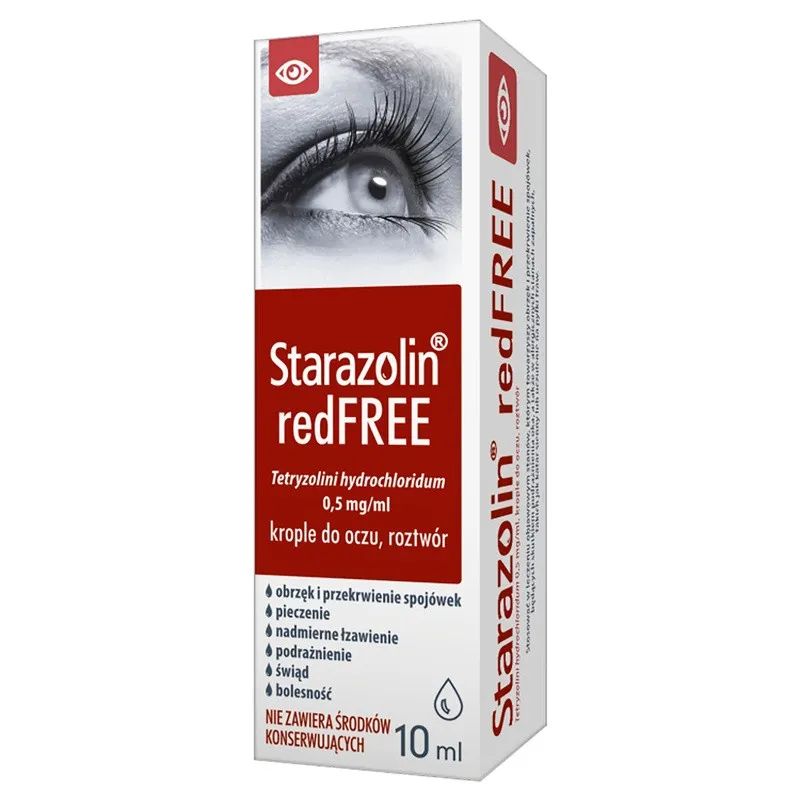
Table of Contents
Package leaflet: Information for the patient
Starazolin redFREE, 0,5 mg/ml, eye drops, solution
Tetryzolini hydrochloridum
Please read the entire leaflet carefully before using the medicine, as it contains
important information for the patient.
This medicine should always be used exactly as described in this patient leaflet or as directed by a
physician or pharmacist.
- Keep this leaflet, as you may need to read it again.
- If you need advice or further information, consult your pharmacist.
- If you experience any adverse reactions, including those not listed in this leaflet, inform your physician or pharmacist. See section 4.
- If there is no improvement or if your condition worsens after 2 days, consult your physician.
Table of contents of the leaflet
- What Starazolin redFREE is and what it is used for
- Important information before using Starazolin redFREE
- How to use Starazolin redFREE
- Possible side effects
- How to store Starazolin redFREE
- Contents of the pack and other information
1. What Starazolin redFREE is and what it is used for
Starazolin redFREE is a sterile, preservative-free solution for eye drops.
Starazolin redFREE contains tetryzoline hydrochloride as the active substance, which belongs to a group of medicines known as ocular vasoconstrictors.
Starazolin redFREE is indicated for the symptomatic treatment of conditions associated with swelling and redness of the conjunctiva caused by eye irritation, e.g. due to smoke, dust, wind, chlorinated water, or cosmetics, as well as in allergic inflammatory conditions such as hay fever or pollen allergy.
The eye drops relieve accompanying symptoms such as burning, itching, pain, excessive tearing, and irritation.
The effect of the medicine begins within minutes after instillation and lasts from 4 to 8 hours.
2. Important information before using Starazolin redFREE
When not to use Starazolin redFREE
- if the patient is allergic to tetryzoline hydrochloride or any of the other ingredients of this medicine (listed in section 6);
- if the patient has contact hypersensitivity to silver;
- if the patient has narrow-angle glaucoma;
- if the patient has severe heart or vascular disease (e.g. coronary artery disease or hypertension);
- if the patient has pheochromocytoma;
- if the patient has metabolic disorders, e.g. hyperthyroidism, porphyria, or diabetes;
- if the patient is taking monoamine oxidase inhibitors (MAOIs), tricyclic antidepressants, or other medicines that may increase blood pressure (see section "Starazolin redFREE and other medicines");
- if the patient has benign prostatic hyperplasia;
- in children under 2 years of age.
Warnings and precautions
Before starting to use Starazolin redFREE, consult your doctor or
pharmacist:
- if the patient has dry rhinitis, keratoconjunctivitis;
- if the patient has elevated intraocular pressure (glaucoma).
In case of severe eye pain, headache, loss of vision, appearance of "floating spots" in the visual field, severe, sharp or unilateral redness of the eye, pain upon exposure to light, or double vision, seek immediate medical advice.
Starazolin redFREE should be used only in cases of mild eye irritation.
If there is no improvement within 48 hours, or if eye irritation and redness persist or worsen, discontinue the drops immediately and consult a doctor.
Patients using Starazolin redFREE should be aware that eye irritation or redness is often a symptom of a serious eye condition and should therefore consult an ophthalmologist.
If eye irritation or redness is due to a serious eye condition, e.g. infection, presence of a foreign body, or chemical injury to the cornea, seek immediate medical advice.
Prolonged and inappropriate use of this medicine, especially in doses higher than recommended, may reduce its effectiveness and lead to conjunctival redness and persistent nasal mucosal hyperemia.
Care should be taken not to use a higher dose than recommended or to use it for too long, as prolonged use or overuse may reduce its effectiveness, cause worsening or recurrence of hyperemia, and lead to conjunctival redness and persistent nasal mucosal hyperemia. Avoid prolonged use, especially in children.
See also section 3 "How to use Starazolin redFREE".
Children
Starazolin redFREE is contraindicated in children under 2 years of age.
Always consult a doctor before using this medicine in children.
Starazolin redFREE and other medicines
Tell your doctor or pharmacist about all medicines you are currently taking or have recently taken, as well as any medicines you plan to take, including over-the-counter medicines.
Concomitant use of the following medicines may enhance vasoconstrictive effects and increase blood pressure (see also section "When not to use Starazolin redFREE"):
- MAO inhibitors used in the treatment of Parkinson's disease or depression, e.g. selegiline, rasagiline, moclobemide, tranylcypromine;
- tricyclic antidepressants, e.g. amitriptyline and maprotiline;
- other medicines that may increase blood pressure.
Pregnancy and breastfeeding
If the patient is pregnant or breastfeeding, suspects she may be pregnant, or is planning to have a child, she should consult her doctor or pharmacist before using this medicine.
Due to possible systemic adverse effects, the use of Starazolin redFREE in pregnant and breastfeeding women is possible only after careful consideration by the physician of the risks and benefits of treatment.
There are no data available on the passage of tetryzoline hydrochloride through the placental barrier or into breast milk.
The use of this medicine should be avoided during pregnancy and breastfeeding due to possible systemic adverse effects.
Driving and operating machinery
Administration of Starazolin redFREE may cause transient blurred vision. In such cases, do not drive or operate machinery.
3. How to use Starazolin redFREE
This medicine should always be used exactly as described in this patient leaflet or as directed by a
physician or pharmacist. If in doubt, consult a doctor or pharmacist.
Children under 6 years of age
Do not use in children under 2 years of age. Use in children aged 2 to 6 years should be under
medical supervision.
Adults and children over 6 years of age
Unless otherwise directed by a physician, instill 1 to 2 drops into the affected eye up to 3 times
daily. Contact lenses must be removed before instillation and may be reinserted approximately
15 minutes after administration of the medicine (see below – Information for contact lens wearers).
Use in children under 12 years of age should be supervised by an adult.
This medicine must not be used for longer than 2 days. Prolonged use beyond 2 days is permitted
only under medical supervision.
Method of administration
For ocular administration.
Do not swallow.
Information for contact lens wearers
Contact lenses should not be worn during eye disease. In exceptional cases where wearing contact
lenses is permitted, they must be removed before using this medicine. After instillation, wait
15 minutes before reinserting contact lenses.
Instructions for use:
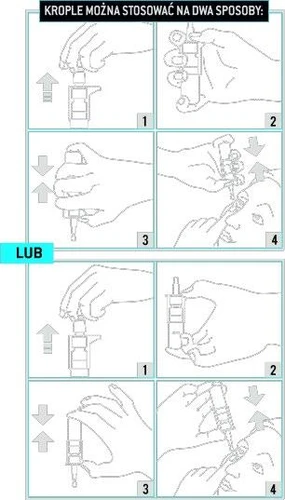
- Wash your hands.
- Remove the protective cap from the bottle (figure 1).
- Hold the bottle in your hand (figure 2).
- Turn the bottle upside down and press the pump until the first drop appears (figure 3). Then discard at least 5 first drops before first instillation into the eye. Before each subsequent drop, discard at least 2 drops. If the medicine has not been used for 15 days or longer, discard 5 drops before administering the medicine into the eye.
- Tilt your head backward and gently pull down the lower eyelid to create a pouch between it and the eye. Holding the bottle upside down, press the pump to instill one drop into the eye (figure 4). Do not let the tip of the dispenser touch any surface to avoid contamination of the solution.
- Immediately after instillation, press the inner corner of the eye near the nose with a finger or close the eyelids for 1–2 minutes. This helps prevent the medicine from spreading to other parts of the body.
- If the medicine is also to be used in the other eye, repeat steps 5 and 6.
- Immediately after use, close the bottle with the protective cap.
Use of a higher than recommended dose of Starazolin redFREE
In case of overdose or accidental swallowing, seek immediate medical advice from a doctor,
pharmacist, or nearest hospital and bring the medicine or this package leaflet with you.
Symptoms of local or systemic overdose may include: pupil dilation, cyanosis (bluish discoloration of
skin and mucous membranes), fever, convulsions, tachycardia (rapid heartbeat), cardiac rhythm
disturbances, cardiac arrest, hypertension (high blood pressure), pulmonary edema (fluid
accumulation in the lungs), respiratory disturbances, and psychiatric disorders.
The risk of overdose symptoms is particularly high in infants and young children due to systemic
absorption following ingestion. This may lead to central nervous system disorders, circulatory
failure, and respiratory failure.
Keep the medicine out of reach of children. In case of accidental ingestion, seek immediate
medical help.
Missed dose of Starazolin redFREE
Do not use a double dose to make up for a missed dose.
If you have any further questions about the use of this medicine, consult your doctor or
pharmacist.
4. Possible adverse reactions
Like all medicines, this medicine can cause adverse reactions, although not everyone will experience them.
Common (occur in less than 1 in 10 patients):
- Increased ocular mucosal oedema (reactive hyperaemia), burning or dryness of the ocular mucosa, palpitations, headache, tremor, weakness, sweating, elevated blood pressure, rapid heartbeat.
Uncommon (occur in less than 1 in 1,000 patients):
- Pupil dilation.
Rare (occur in less than 1 in 10,000 patients):
- Keratinization of the conjunctival surface, leading to closure of the lacrimal ducts and epiphora (excessive tearing) due to impaired tear drainage following prolonged use of this medicine.
Frequency not known (frequency cannot be estimated from available data):
- Burning sensation in the eyes or around the eyes, redness, irritation, swelling, pain, itching, blurred vision, conjunctival irritation.
Reporting of adverse reactions
If any adverse reactions occur, including any adverse reactions not listed in this leaflet, inform your doctor or pharmacist. Adverse reactions can be reported directly to the Department of Monitoring Adverse Drug Reactions of the Office for Registration of Medicinal Products, Medical Devices and Biocidal Products
Al. Jerozolimskie 181C
02-222 Warsaw
Tel.: +48 22 49 21 301
Fax: +48 22 49 21 309
Website: https://smz.ezdrowie.gov.pl
Adverse reactions can also be reported to the marketing authorization holder.
Reporting adverse reactions helps to provide more information on the safety of the medicine.
5. How to store Starazolin redFREE
Keep the medicine out of sight and reach of children.
Store below 30°C.
Shelf life after first opening the bottle: 6 months. After first opening, store
below 30°C.
Do not use this medicine after the expiry date stated on the packaging after "EXP".
The expiry date refers to the last day of the stated month.
Medicines must not be disposed of via wastewater or household waste. Ask your
pharmacist how to dispose of medicines no longer required. This will help
protect the environment.
6. Contents of the pack and other information
What Starazolin redFREE contains
- The active substance is tetryzoline hydrochloride. Each ml of solution contains 0.5 mg of tetryzoline hydrochloride.
- The other components are: sodium chloride, boric acid, borax, purified water.
What Starazolin redFREE looks like and contents of the pack
A clear, colourless solution. It does not contain preservatives.
10 ml HDPE bottle with a 3K metering pump (PP, HDPE, LDPE), HDPE protective cap, and PP applicator, in a cardboard box.
Marketing Authorisation Holder
Zakłady Farmaceutyczne POLPHARMA S.A.
ul. Pelplińska 19, 83-200 Starogard Gdański
tel. + 48 22 364 61 01
Manufacturer
JADRAN-GALENSKI LABORATORIJ d.d.
Svilno 20, 51000 Rijeka, Croatia