Spitaderm
Poland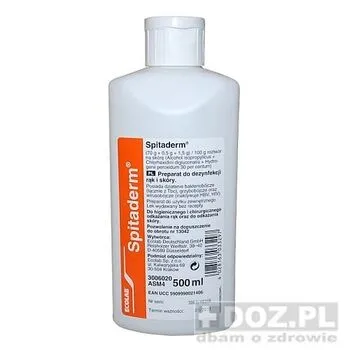
Table of Contents
Package leaflet: Information for the user
Spitaderm, (70 g + 0.5 g + 1.5 g)/100 g, solution for skin application
(Alcohol isopropylicus + Chlorhexidini digluconatis + Hydrogenii peroxidum 30 per centum)
Please read this leaflet carefully before use, as it contains information important for the patient/user.
This medicine should always be used exactly as described in this patient leaflet or as directed by a
physician, pharmacist, or nurse.
Keep this leaflet, as you may need to read it again.
- If you need advice or further information, please consult your pharmacist.
- If you experience any adverse reactions, including any possible adverse reactions not listed in this leaflet, inform your doctor, pharmacist, or nurse. See section 4.
- If there is no improvement or if you feel worse, consult your doctor.
Table of contents of the leaflet:
- What Spitaderm is and what it is used for
- Important information before using Spitaderm
- How to use Spitaderm
- Possible side effects
- How to store Spitaderm
- Contents of the pack and other information
1. What Spitaderm is and what it is used for
Medicinal product for hygienic and surgical disinfection of hands and skin
Spitaderm is a combination product containing active substances with proven clinical efficacy.
The active substances in this medicine—isopropyl alcohol, chlorhexidine digluconate, and hydrogen peroxide—complement each other’s spectrum of activity, providing broad-spectrum effectiveness.
This medicine is effective against microorganisms present on the skin, including bacteria (including Mycobacterium tuberculosis), fungi, and viruses (HBV, HIV).
Efficacy against hepatitis B virus (HBV) has been confirmed by the MADT test (morphological alteration and disintegration test).
The product is self-sterilizing (European Patent No. 0016319). Hydrogen peroxide ensures that the product is free from bacterial spores during manufacturing, transfer, and filling. The hydrogen peroxide contained in the product destroys bacterial spores that might re-enter the solution.
2. Information prior to use of Spitaderm
When not to use Spitaderm
If the patient has hypersensitivity to the active substances or to any of the excipients.
This medicinal product must not be used for disinfection of mucous membranes or wounds. Do not use in the immediate vicinity of the eyes.
Warnings and precautions
Avoid contact of Spitaderm with the eyes due to the risk of visual damage. In case of eye contact, rinse immediately and thoroughly with water. If irritation, redness or eye pain occurs, or if visual disturbances develop, seek immediate medical advice.
Severe cases of permanent corneal damage (surface damage of the eye) have been reported following accidental exposure to chlorhexidine digluconate-containing medicinal products during surgical procedures in patients under general anaesthesia (in deep, painless sleep), which may necessitate corneal transplantation.
The product is flammable; do not spray near flames. Flash point (according to DIN 51755 standard): 20°C. Observe application times and safety instructions for use. Wait until the product has dried before switching on electrical equipment. Use with caution on surfaces sensitive to alcohol. Enzymatic glucose testing may only be performed at least 1 minute after application of the product. Chemical burns have been reported following topical use of chlorhexidine gluconate in newborns and infants. Premature infants are at particular risk due to immaturity of the skin barrier. Therefore, Spitaderm should be used in newborns and infants only when no alternative medicinal products are available and when the expected therapeutic benefit outweighs the risk. It is recommended to promptly remove any excess liquid.
Concomitant use of products containing anionic surfactants may lead to inactivation of chlorhexidine.
Pregnancy, breastfeeding and fertility
Pregnancy
There are no results from controlled clinical studies on the use of this medicinal product in pregnant women. No animal studies have been conducted with this product.
Spitaderm should be used with caution during pregnancy.
Breastfeeding
There are no clinical data available.
Driving and operating machinery
The effect of Spitaderm on the ability to drive and operate machinery is unknown.
Important information about certain excipients of Spitaderm
Possible allergic skin irritation caused by chlorhexidine.
3. How to use Spitaderm
This medicine should always be used as directed by a physician or pharmacist. If in doubt,
consult a physician or pharmacist.
Instructions for use:
For topical use only.
Use the solution undiluted.
Surgical hand disinfection:
Rub at least 5 ml of the medicine into the hands and forearms for 1.5 minutes.
Repeat the procedure. Hands must remain wet during disinfection.
Hygienic hand disinfection:
Rub 3 ml of the medicine for 30 seconds.
Skin disinfection prior to injections:
Apply the medicine to the skin for 15 seconds.
Skin disinfection prior to punctures or surgery:
Apply the medicine to the skin for 1 minute.
Use of a larger than recommended dose of Spitaderm
In case of accidental ingestion: rinse the mouth,
seek medical advice.
In case of accidental contact with eyes:
immediately rinse eyes with clean water for at least 10 minutes, seek medical advice. If in doubt regarding the use of the medicine, consult a physician or pharmacist.
4. Possible adverse reactions
Like all medicines, this product may cause adverse reactions, although not everyone experiences them.
The most common reaction is transient skin redness, which is not harmful and resolves spontaneously.
Urticaria and allergic reactions, including anaphylactic shock, have occurred rarely (from >1/10,000 to <1/1,000). Skin irritation and contact dermatitis have occurred frequently (from >1/100 to <1/10). Chemical burns in newborns and infants (frequency unknown – frequency cannot be estimated from available data).
Corneal damage (surface injury of the eye) and permanent eye damage, including permanent visual impairment (following accidental eye exposure during surgical procedures on the head, face, and neck) in patients under general anaesthesia (deep, painless sleep) after administration of medicinal products containing chlorhexidine digluconate (frequency unknown).
Reporting of adverse reactions
If any adverse reactions occur, including any adverse reactions not listed in this leaflet, inform a doctor, pharmacist, or nurse. Adverse reactions can be reported directly to:
Department of Monitoring Adverse Drug Reactions, Office for Registration of Medicinal Products, Medical Devices and Biocidal Products, Al. Jerozolimskie 181C, 02-222 Warsaw, tel.: +48 22 49 21 301, fax: +48 22 49 21 309,
Website: https://smz.ezdrowie.gov.pl
Adverse reactions can also be reported to the marketing authorization holder.
Reporting adverse reactions helps to provide more information on the safety of the medicine.
5. How to store Spitaderm medicine
Store the medicine at a temperature below 25°C.
Shelf life after first opening of the immediate packaging: 6 months.
Keep out of the reach and sight of children.
Do not use after the expiry date.
For packages above 1000 ml: any re-filling of the medicine should be carried out under sterile conditions (sterile working environment).
Medicines should not be disposed of via wastewater or household waste.
Ask your pharmacist what to do with medicines no longer in use. This will help protect the environment.
6. Contents of the packaging and other information
What the medicine Spitaderm contains
100 g of solution contains the following active substances: 70 g of isopropanol, 0.5 g of chlorhexidine digluconate,
1.5 g of 30% hydrogen peroxide solution.
The other ingredients are: macrogol-6-glycerol caprylocaprate, fragrance 70/0676, purified water.
What Spitaderm looks like and contents of the pack
Spitaderm is a clear, slightly yellow, transparent solution with a characteristic smell of isopropanol.
pH value: 6.5–7.5.
Packaging: bottles with a capacity of 500 ml or canisters with a capacity of 5,000 ml.
Marketing Authorization Holder:
Ecolab Sp. z o.o.
Opolska 114
31-323 Kraków
Poland
+48 12 2616100
Manufacturer:
Ecolab Deutschland GmbH
Reisholzer Werftstrasse 38-42
D-40589 Düsseldorf
Germany