Spamilan
Poland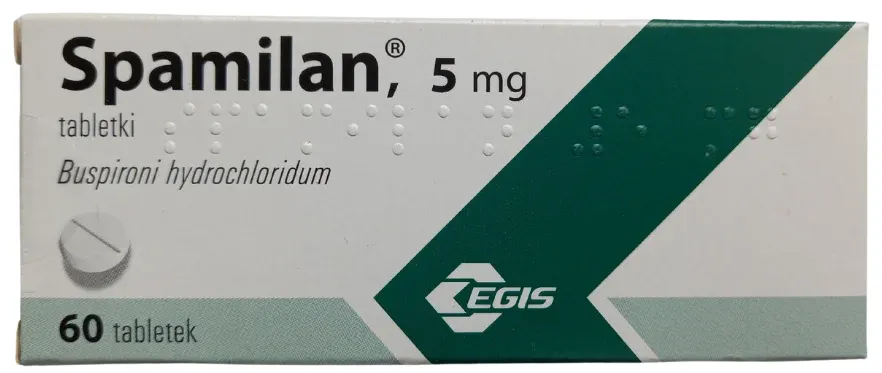
Table of Contents
Package leaflet: Information for the patient
Spamilan, 5 mg, tablets
Spamilan, 10 mg, tablets
Buspironi hydrochloridum
Please read the entire leaflet carefully before using this medicine, as it contains important information for the patient.
- Keep this leaflet for future reference.
- Consult your doctor or pharmacist if you have any further questions. This medicine has been prescribed for a specific individual. Do not give it to others. The medicine may harm another person, even if their symptoms are the same.
- If any adverse reactions occur, including those not listed in this leaflet, inform your doctor or pharmacist. See section 4.
Table of contents
- What Spamilan is and what it is used for
- What you need to know before taking Spamilan
- How to take Spamilan
- Possible side effects
- How to store Spamilan
- Contents of the pack and other information
1. What Spamilan is and what it is used for
Buspirone, the active substance in Spamilan, has anxiolytic properties.
Spamilan is indicated for the short-term treatment of anxiety disorders and for alleviating symptoms of anxiety, with or without accompanying depression.
2. Important information before using Spamilan
When not to use Spamilan
- if the patient is allergic to buspirone or any of the other ingredients of this medicine (listed in section 6);
- if the patient has epilepsy;
- if the patient has severe renal impairment (creatinine clearance < 20 mL/min/1.73 m² or plasma creatinine concentration above 200 micromoles/L);
- if the patient currently has or has ever had severe liver disease;
- if the patient is in a state of acute intoxication due to alcohol, hypnotics, analgesics or antipsychotics (medicines used in the treatment of certain psychiatric disorders).
Warnings and precautions
Before starting treatment with Spamilan, consult a doctor or pharmacist:
- if the patient has glaucoma;
- if the patient has myasthenia gravis (a disease characterized by muscle weakness, difficulty chewing or slurred speech);
- if the patient is addicted to drugs or narcotics;
- if the patient has impaired liver and/or kidney function (see also section "How to take Spamilan");
- if the patient has previously taken a benzodiazepine medicine, e.g. nitrazepam or temazepam, or another commonly used sedative or hypnotic medicine. Before starting treatment with Spamilan, these medicines should be gradually withdrawn.
- if the patient is taking certain antidepressants, mood-stabilizing normothymic medicines, analgesics, medicines used to treat infections, migraine, severe pain or opioid dependence (see "Spamilan with other medicines"). Taking certain medicines together with Spamilan may lead to serotonin syndrome, which may be a potentially life-threatening condition (see "Spamilan with other medicines").
The treating physician may recommend laboratory tests before starting treatment with Spamilan.
Inform the treating physician about any concomitant medical conditions the patient may have that the physician may not be aware of.
Children and adolescents
Spamilan is not recommended for use in children and adolescents under 18 years of age.
Spamilan with other medicines
Tell your doctor about all medicines you are currently taking or have recently taken, as well as any medicines you plan to take.
In particular, inform your doctor if you are taking any of the following medicines:
- monoamine oxidase inhibitors such as moclobemide and selegiline (used in the treatment of depression);
- Spamilan must not be used concomitantly with monoamine oxidase inhibitors due to the risk of increased blood pressure;
- erythromycin, itraconazole, linezolid and rifampicin (used in the treatment of infections);
- calcium channel blockers such as diltiazem and verapamil (used in the treatment of high blood pressure);
- selective serotonin reuptake inhibitors such as citalopram, escitalopram, fluoxetine, fluvoxamine, paroxetine and sertraline (used in the treatment of depression and anxiety disorders);
- nefazodone, trazodone, St. John's wort preparations, L-tryptophan (used in the treatment of depression);
- haloperidol and lithium (used in the treatment of psychiatric disorders);
- digoxin (used in the treatment of heart failure);
- gastric acid-reducing medicines containing cimetidine (used in the treatment of gastric ulcers and heartburn);
- tramadol (an analgesic);
- triptans, e.g. sumatriptan (used in the treatment of migraine);
- baclofen (used for increased muscle tension);
- lofexidine (used in the treatment of withdrawal syndrome);
- nabilone (used in the treatment of nausea and vomiting);
- antihistamines (used in the treatment of allergic reactions);
- diazepam (used in the treatment of anxiety);
- warfarin (used in the treatment of blood clots);
- phenobarbital, phenytoin, carbamazepine (used in the treatment of epilepsy);
- buprenorphine (used in the treatment of severe pain or opioid dependence).
Taking Spamilan with food, drink and alcohol
Do not drink alcohol while taking Spamilan.
Do not drink grapefruit juice while taking Spamilan.
Pregnancy, breastfeeding and fertility
During pregnancy, while breastfeeding, if pregnancy is suspected, or when planning a pregnancy, consult a doctor or pharmacist before using this medicine.
Do not take Spamilan during pregnancy or while breastfeeding.
Driving and using machines
Spamilan has a moderate effect on the ability to drive and operate machinery. It may cause drowsiness or dizziness. Before driving or operating machinery, ensure that such symptoms do not occur.
Due to the possibility of transient adverse effects at the beginning of treatment, do not drive or operate machinery until you are certain that the medicine does not adversely affect your ability to drive or operate machinery.
Spamilan contains lactose
Each Spamilan 5 mg tablet contains 55.7 mg of monohydrate lactose, and each Spamilan 10 mg tablet contains 111.4 mg of monohydrate lactose. If the patient has previously been diagnosed with intolerance to certain sugars, the patient should consult a doctor before taking this medicine.
The medicine contains less than 1 mmol (23 mg) of sodium per tablet, meaning the medicine is considered "sodium-free".
3. How to use Spamilan
This medicine should always be taken as directed by the physician or pharmacist. If in doubt, consult your physician or pharmacist.
Your physician will determine how many tablets to take per day and how often.
Tablets should be taken with water. The medicine should be taken daily at the same time, always with food or always without food.
Spamilan requires repeated administration: therapeutic effects do not appear earlier than within approximately 7–14 days of treatment. To achieve maximum therapeutic benefit, treatment for 4 weeks may be necessary. Your physician will decide how long you should continue taking Spamilan.
Adults (including elderly patients)
The recommended initial dose is 5 mg two or three times daily, which may be increased every 2–3 days.
The usual therapeutic dose is 15 to 30 mg per day in divided doses.
The maximum daily dose is 60 mg in divided doses.
Patients with mild or moderate hepatic and/or renal impairment
In patients with mild or moderate hepatic and/or renal impairment, the physician may recommend a lower dose.
Use in children and adolescents
The use of this medicine in children has not been established. There is a lack of data on efficacy and safety in children. Therefore, the use of Spamilan is not recommended in children and adolescents.
Taking more Spamilan than recommended
If you take more than the recommended dose, contact your physician immediately or go to the nearest hospital. Bring all remaining tablets along with this leaflet and show them to the physician.
Symptoms of overdose include: nausea or vomiting, headache, dizziness, drowsiness, ringing or buzzing in the ears, motor restlessness, constricted pupils, and gastrointestinal disturbances.
Slow heart rate and low blood pressure may also occur.
Additionally, seizures, difficulty speaking or swallowing, loss of balance, mask-like facial expression, shuffling gait, stiffness of arms and legs, and tremor of hands and fingers may occur.
If you miss a dose of Spamilan
If you miss a dose, take it as soon as possible. Do not take the missed dose if it is almost time for the next scheduled dose. In this case, skip the missed dose and continue with your regular dosing schedule. Do not take a double dose to make up for a missed tablet.
Take the tablets as often and for as long as directed by your physician.
Stopping Spamilan treatment
Do not stop treatment on your own, even if you do not notice any improvement in your health. Before discontinuing the medicine, speak with your physician and follow their instructions.
If you have any further doubts about the use of this medicine, consult your physician or pharmacist.
4. Possible adverse reactions
Like all medicines, this medicine can cause adverse reactions, although not everybody will experience them.
You should stop taking Spamilan and contact your doctor immediately if
the patient experiences symptoms of serotonin syndrome (confusion, agitation, drowsiness, restlessness,
sweating, tremors, chills, body temperature above 38°C, hallucinations (seeing or hearing
non-existent things), increased muscle tension, sudden involuntary rhythmic muscle contractions,
including muscles controlling eye movements, or rapid heartbeat).
If any of the following symptoms occur, contact your doctor or the nearest hospital emergency department immediately:
- swelling of the face, lips, tongue or throat, difficulty breathing or swallowing;
- fainting;
- itchy skin rash. These are very serious adverse reactions caused by hypersensitivity to Spamilan and may require urgent medical attention and intensive hospital treatment.
The following adverse reactions have also been reported:
Very common (may affect more than 1 in 10 people):
dizziness, feeling faint, headache, drowsiness.
Common (may affect up to 1 in 10 people):
nervousness, insomnia, difficulty concentrating, depression, confusion, sleep disturbances, irritability;
paraesthesia (numbness or tingling), blurred vision, coordination disorders, tremor,
tinnitus (ringing in the ears); rapid heartbeat, chest pain; nausea, abdominal pain, dry mouth,
diarrhoea, constipation, vomiting; cold sweats, rash; muscle, tendon, ligament and bone pain; fatigue (tiredness).
Rare (may affect up to 1 in 1,000 people):
purpura (bruising), urticaria,
Very rare (may affect up to 1 in 10,000 people):
psychiatric disorders, hallucinations, depersonalization (feeling of self-estrangement), affective lability;
seizures, tunnel vision, extrapyramidal disorders (difficulty speaking or swallowing, loss of balance, mask-like face, shuffling gait, stiffness of arms and legs, tremor of hands or fingers), muscle rigidity with cogwheel phenomenon (interrupted movements), dyskinesia (involuntary movements), dystonia (muscle spasms of the neck, shoulders and body affecting posture), fainting or loss of consciousness, memory loss, ataxia (difficulty controlling movements), parkinsonism (tremor, stiffness and shuffling gait), akathisia (inability to sit or stand still), restless legs syndrome, motor restlessness; inability to completely or partially empty the bladder; excessive milk production.
Reporting of adverse reactions
If any adverse reactions occur, including any not listed in this leaflet, inform your doctor or pharmacist. Adverse reactions can be reported directly to the Department of Monitoring of Adverse Drug Reactions of the Office for Registration of Medicinal Products, Medical Devices and Biocidal Products
Al. Jerozolimskie 181C
02-222 Warsaw
Phone: +48 22 49 21 301
Fax: +48 22 49 21 309
Website: https://smz.ezdrowie.gov.pl
Reporting adverse reactions helps to provide more information on the safety of the medicine.
5. How to store the medicine Spamilan
Store below 25°C. Keep in the original packaging to protect from light.
Keep this medicine out of the reach and sight of children.
Do not use the medicine after the expiry date (EXP) stated on the packaging. The expiry date (EXP) refers to the last day of the specified month.
Medicines must not be disposed of via wastewater or household waste. Ask your pharmacist how to dispose of medicines no longer required. This will help protect the environment.
6. Contents of the pack and other information
What Spamilan contains
The active substance is buspirone hydrochloride: each Spamilan 5 mg tablet contains 5 mg of buspirone hydrochloride, and each Spamilan 10 mg tablet contains 10 mg of buspirone hydrochloride.
The other ingredients are: lactose monohydrate, microcrystalline cellulose, sodium carboxymethyl starch (type A), magnesium stearate, and colloidal anhydrous silica.
What Spamilan looks like and contents of the pack
Appearance
Spamilan, 5 mg
White or almost white, round, flat tablets with bevelled edges, having a division line on one side and a stylized mark E 151 on the other side.
The tablet can be divided into equal doses.
Spamilan, 10 mg
White or almost white, round, flat tablets with a bevelled edge, having a division line on one side and a stylized mark E 152 on the other side.
The tablet can be divided into equal doses.
Packaging
Blisters made of OPA/Aluminium/PVC/Aluminium foil in a cardboard box.
60 tablets (6 blisters containing 10 tablets each).
Marketing Authorisation Holder
EGIS Polska Sp. z o.o.
ul. Komitetu Obrony Robotników 45D
02-146 Warsaw
Poland
Manufacturer
EGIS Pharmaceuticals PLC
H-1165 Budapest, Bökényföldi út 118-120
Hungary
For further information about this medicinal product, please contact the representative of the Marketing Authorisation Holder.
EGIS Polska Sp. z o.o.
ul. Komitetu Obrony Robotników 45D
02-146 Warsaw
Poland
Telephone: +48 22 417 92 00
6.09.2024