Somatostatin-eumedica
Poland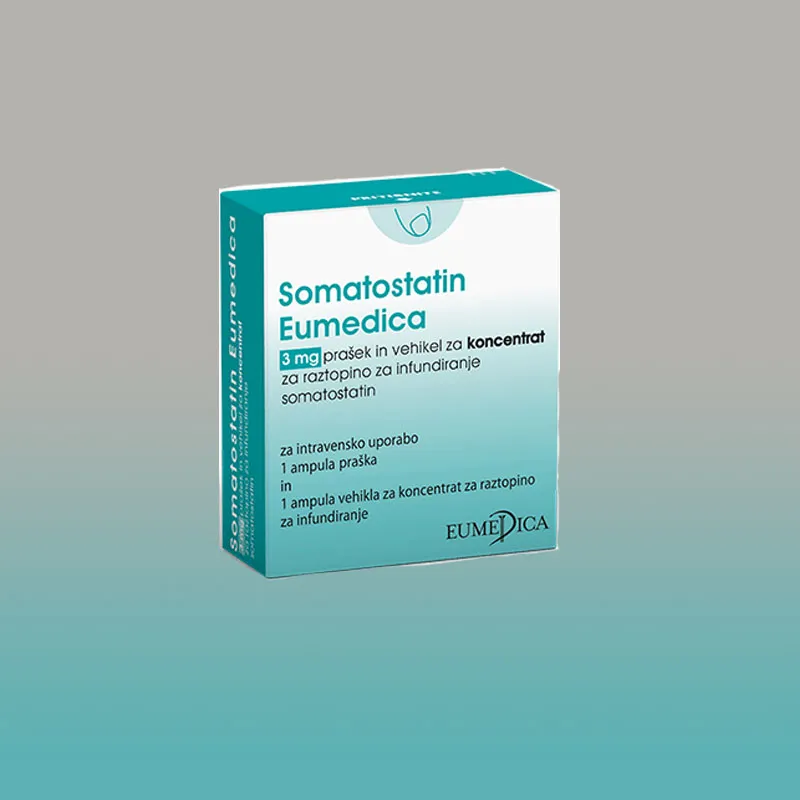
Table of Contents
- Package leaflet: Information for the patient
- 1. What Somatostatin-Eumedica is and what it is used for
- 2. Important information before using Somatostatin-Eumedica
- 3. How to use Somatostatin-Eumedica
- 4. Possible adverse reactions
- 5. How to store Somatostatin-Eumedica
- 6. Contents of the pack and other information
- Information intended exclusively for medical professionals
Package leaflet: Information for the patient
Somatostatin-Eumedica, 3 mg, powder for solution for injection / infusion
Somatostatinum
Please read carefully all of this leaflet before using this medicine because it contains important information for the patient.
- Keep this leaflet, as you may need to read it again.
- If you have any questions, please consult your doctor, pharmacist or nurse.
- If you experience any adverse reactions, including any not listed in this leaflet, inform your doctor, pharmacist or nurse. See section 4.
Table of contents of the leaflet
- What Somatostatin-Eumedica is and what it is used for
- Important information before using Somatostatin-Eumedica
- How to use Somatostatin-Eumedica
- Possible side effects
- How to store Somatostatin-Eumedica
- Contents of the pack and other information
1. What Somatostatin-Eumedica is and what it is used for
Somatostatin-Eumedica contains somatostatin. At therapeutic doses, somatostatin inhibits the function and peristalsis of the gastrointestinal tract, as well as its secretory activity, and reduces blood flow in the splanchnic circulation.
Somatostatin-Eumedica is indicated for use in adult patients:
- for the treatment of acute gastrointestinal bleeding caused by gastric or duodenal ulcer, haemorrhagic gastritis, or bleeding oesophageal varices, suspected on clinical grounds or confirmed by endoscopy;
- for the treatment of intestinal and pancreatic fistulas;
- for symptomatic treatment of excessive secretion from gastrointestinal endocrine tumours;
- for the prevention of complications following pancreatic surgery or endoscopic retrograde cholangiopancreatography (ERCP).
2. Important information before using Somatostatin-Eumedica
Somatostatin-Eumedica is intended for use in hospital settings.
When not to use Somatostatin-Eumedica
- if the patient is allergic to the active substance, its analogs, or any of the other ingredients of this medicinal product (listed in section 6).
Warnings and precautions
Before starting treatment with Somatostatin-Eumedica, discuss this with your doctor,
pharmacist, or nurse.
Somatostatin-Eumedica should be used with caution in the following situations:
- if the patient has severe renal impairment (creatinine clearance ≤ 30 ml/min), half the recommended dose should be administered;
- if the patient is at risk of cardiovascular disorders;
- if the patient has or has had cardiac arrhythmias in the past;
- when administered as direct intravenous injection, the medicinal product must be given slowly over at least 1 minute; infusions must be administered continuously;
- patients receiving Somatostatin-Eumedica must remain under close medical supervision due to the possibility of hypoglycemia (decreased blood glucose concentration) during the initial phase of infusion and increased blood glucose concentration at a later stage. The physician will decide on appropriate intervals for monitoring blood glucose levels;
- during treatment with Somatostatin-Eumedica, a decrease in glomerular filtration rate, urine flow, and serum sodium concentration may occur; therefore, the physician may recommend regular monitoring of renal function and serum electrolyte concentrations.
Somatostatin-Eumedica inhibits intestinal absorption of certain nutrients and
the secretion of various gastrointestinal hormones (e.g., cholecystokinin, gastrin, and secretin).
Sudden interruption of infusion may lead to a rebound effect (see "Discontinuation of
Somatostatin-Eumedica").
Somatostatin-Eumedica and other medicines
Inform your doctor or pharmacist about all medicines the patient is currently taking,
has recently taken, or plans to take.
Inform your doctor if the patient is taking:
- medicines affecting blood glucose regulation (antidiabetic agents), because Somatostatin-Eumedica may alter the effects of these medicines;
- medicines affecting plasma renin levels and arterial blood pressure (antihypertensive agents), because Somatostatin-Eumedica may alter the effects of these medicines;
- carbohydrates in any form (including glucose or fructose solutions, or total parenteral nutrition). Concomitant administration of carbohydrates may cause disturbances in glycemia (blood glucose concentration); therefore, close monitoring of blood glucose levels is required. Insulin administration may become necessary.
Pregnancy, breastfeeding, and fertility
If the patient is pregnant, breastfeeding, suspects she may be pregnant, or is planning to become pregnant, she should consult her doctor or pharmacist before using this medicinal product. There are insufficient data on the use of Somatostatin-Eumedica during pregnancy and breastfeeding; therefore, Somatostatin-Eumedica should not be used in pregnant or breastfeeding women.
Driving and operating machinery
Not applicable, as the medicinal product is administered in a hospital setting.
3. How to use Somatostatin-Eumedica
This medicine should always be used according to the doctor's instructions. If in doubt, consult your
doctor or pharmacist.
Somatostatin-Eumedica is intended for use in a hospital setting.
The doctor will decide on the appropriate dosage and method of administration.
The recommended dose is 3.5 μg/kg body weight/hour (or 6 mg/24 hours for a patient weighing 75 kg),
administered as a continuous infusion of 250 μg/hour. The infusion should be given for 12 to 24 hours
(depending on whether a 3 mg or 6 mg dose is administered).
After completion of treatment, the patient should remain under close observation.
Additional recommendations for the treatment of acute gastrointestinal bleeding
Infusion of Somatostatin-Eumedica should be started before endoscopy, as soon as possible
after the first signs of bleeding, and continued for five days. The minimum duration of
treatment is 48 hours. Immediately after starting the continuous infusion, the doctor will administer
Somatostatin-Eumedica as an intravenous bolus injection of 3.5 μg/kg body weight.
The doctor will decide whether to administer another intravenous bolus injection one minute before
endoscopic procedure. The intravenous bolus injection should be given slowly
(for at least one minute). After endoscopy, the doctor will decide whether similar doses of the medicine
should be administered as intravenous bolus injections if clinical signs of bleeding recur.
Additional recommendations for the treatment of fistulas or excessive secretion from endocrine tumours
Intravenous bolus injection is not required. In most patients, fistula healing occurs within
7 to 14 days. After healing, it is recommended to continue with half the dose as an intravenous infusion
for an additional 48 hours to prevent possible rebound effect.
Detailed dosage information intended for healthcare professionals is provided at the end of this leaflet.
Use of a higher than recommended dose of Somatostatin-Eumedica
In case of overdose, symptomatic treatment should be administered. There is no specific
antidote.
In reported cases of somatostatin overdose, no additional risks were observed other than adverse
reactions associated with the recommended dose of the medicine.
In case of somatostatin overdose, close monitoring of blood glucose levels, circulatory parameters,
renal function, and plasma electrolyte concentrations is recommended.
After discontinuation of intravenous somatostatin infusion administered at the recommended
therapeutic dose, the half-life of somatostatin in blood is approximately 2 minutes.
Missed dose of Somatostatin-Eumedica
Do not use a double dose to make up for a missed dose.
Stopping Somatostatin-Eumedica
If you have any further questions about the use of this medicine, consult your
doctor, pharmacist, or nurse.
Sudden interruption of the infusion may lead to a rebound effect (recurrence of symptoms), particularly
in patients with fistula. The doctor will decide on the appropriate time to discontinue treatment.
4. Possible adverse reactions
Like all medicines, this medicine can cause adverse reactions, although not everyone experiences them.
The following adverse reactions have been observed:
Cardiac disorders:
Atrioventricular block
Bradycardia (slowing of the heart rate)
Arrhythmia (disturbances in heart rhythm)
Additional ventricular contractions
Gastrointestinal disorders:
Abdominal pain
Diarrhea
Nausea
Vomiting
Metabolism and nutrition disorders:
Hyperglycaemia (increased blood glucose concentration)
Hypoglycaemia (decreased blood glucose concentration)
Vascular disorders:
Hypertension
Hypotension
Hot flushes
Sudden interruption of continuous infusion may lead to rebound effects, particularly
in patients with fistula.
Reporting of adverse reactions
If any adverse reactions occur, including any adverse reactions not listed
in this leaflet, inform a doctor or pharmacist. Adverse reactions can
be reported directly to the Department of Monitoring Adverse Drug Reactions of the Office for Registration of Medicinal Products, Medical Devices and Biocidal Products
Al. Jerozolimskie 181C
02-222 Warsaw
Tel.: + 48 22 49 21 301
Fax: + 48 22 49 21 309
Website: https://smz.ezdrowie.gov.pl
Adverse reactions can also be reported to the marketing authorization holder.
Reporting adverse reactions enables further collection of information on the safety of the medicine.
5. How to store Somatostatin-Eumedica
Keep this medicine out of sight and reach of children.
Do not use this medicine after the expiry date stated on the carton and vial under "Expiry date (EXP)". The expiry date refers to the last day of the stated month.
Store below 25°C.
After reconstitution, store for no longer than 24 hours in a refrigerator (2°C – 8°C).
From a microbiological point of view, somatostatin solutions should be used immediately after preparation. Otherwise, the duration and conditions of storage prior to use are the responsibility of the user and should not exceed 24 hours at a temperature of 2 – 8°C, unless the solution was prepared under controlled and validated aseptic conditions.
Medicines must not be disposed of via wastewater or household waste. Ask your pharmacist how to dispose of medicines no longer required. Such measures will help protect the environment.
6. Contents of the pack and other information
What Somatostatin-Eumedica contains
The active substance is somatostatin in the form of somatostatin acetate. One vial contains 3 mg of somatostatin.
Other components of the medicinal product are: sodium hydroxide or concentrated hydrochloric acid.
What Somatostatin-Eumedica looks like and contents of the pack
The vial of Somatostatin-Eumedica contains a white, lyophilized powder.
The vial is made of colourless glass (type I), closed with a grey bromobutyl rubber stopper and an aluminium cap, packed in a cardboard box.
Somatostatin-Eumedica is available in packaging containing one vial with 3 mg of somatostatin powder.
Marketing Authorisation Holder and Manufacturer
Marketing Authorisation Holder:
EUMEDICA Pharmaceuticals GmbH
Basler Straße 126
79540 Lörrach
Germany
Tel: +49 (0) 7621 424 7562
E-mail: [email protected]
Manufacturer:
EUMEDICA SA
Chemin de Nauwelette 1
7170 Manage
Belgium
EUMEDICA Pharmaceuticals GmbH
Basler Straße 126
79540 Lörrach
Germany
Information intended exclusively for medical professionals
Due to its short half-life in plasma (1–2 minutes), the medicinal product Somatostatin-Eumedica must be administered as a continuous intravenous infusion. The solution should be prepared immediately before administration by dissolving the powder in 1 ml of sodium chloride (0.9%) solution.
Adults:
The recommended dose is 3.5 μg/kg body weight/hour (or typically 6 mg/24 hours in a patient weighing 75 kg), administered as a continuous infusion of 250 μg/hour. The infusion should be given for 12 to 24 hours (accordingly, in case of administering a dose of 3 mg or 6 mg).
Elderly patients:
In elderly patients with severe renal function impairment, dose adjustment is recommended (see section: Patients with severe renal impairment).
Children and adolescents:
The product is not recommended for use in children and adolescents due to lack of adequate clinical studies establishing its safety and efficacy in this patient group.
Patients with severe renal impairment (creatinine clearance ≤ 30 ml/min):
The dose should be reduced to 1.75 μg/kg body weight/hour, both for continuous infusion and for intravenous bolus administration.
Patients with hepatic impairment:
Dose adjustment is not required in patients with impaired liver function.
After completion of treatment, the patient should remain under close observation.
Additional recommendations for the treatment of acute gastrointestinal bleeding
Infusion of Somatostatin-Eumedica should be initiated before endoscopy, as soon as possible after the first signs of bleeding, and continued for five days. The minimum duration of treatment is 48 hours. Immediately after starting the continuous infusion, a bolus intravenous injection of Somatostatin-Eumedica at a dose of 3.5 μg/kg body weight should be administered. A subsequent intravenous bolus should be given one minute before endoscopic procedure. The intravenous bolus should be administered slowly (over at least one minute). After endoscopy, similar bolus doses should be administered if the patient shows clinical signs of ongoing bleeding.
Additional recommendations for the treatment of fistulas or excessive secretion from endocrine tumors
Intravenous bolus administration is not required. In most patients, fistula healing occurs within 7 to 14 days. After healing, it is recommended to continue administration at half the dose via intravenous infusion for an additional 48 hours to prevent possible rebound effect.