Solvetusan
Poland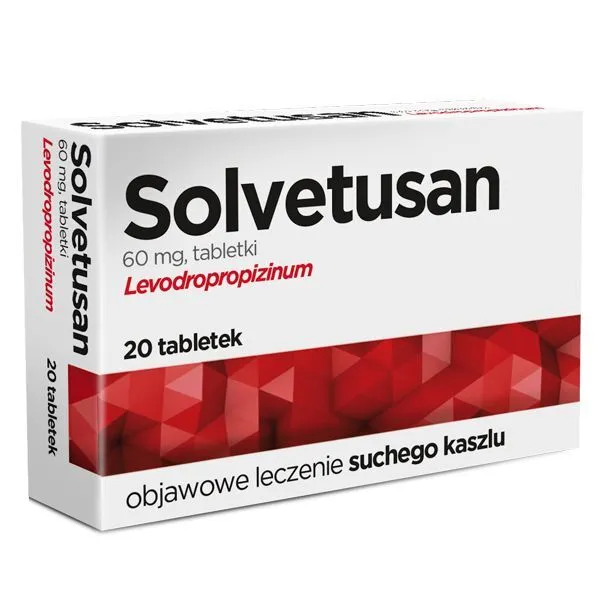
Table of Contents
Package leaflet: Information for the patient
Solvetusan
60 mg, tablets
Levodropropizine
Please read this leaflet carefully before taking the medicine, as it contains important information for the patient.
This medicine should always be taken exactly as described in this patient leaflet or as directed by the physician or pharmacist.
- Keep this leaflet, as you may need to read it again.
- If you need advice or further information, please consult your pharmacist.
- If you experience any adverse reactions, including any not listed in this leaflet, inform your doctor or pharmacist. See section 4.
- If there is no improvement after 7 days, or if you feel worse, consult your doctor.
Table of contents
- What Solvetusan is and what it is used for
- Important information before taking Solvetusan
- How to take Solvetusan
- Possible side effects
- How to store Solvetusan
- Contents of the pack and other information
1. What Solvetusan is and what it is used for
Solvetusan contains the active substance levodropropizine, which has antitussive and bronchospasmolytic properties.
Solvetusan is indicated for the symptomatic treatment of non-productive (dry) cough.
Numerous data indicate that this medicine effectively suppresses cough of various origins, such as cough associated with upper and lower respiratory tract infections, pertussis, or cough occurring in lung cancer.
Solvetusan is indicated for use in adults and children with body weight above 30 kg.
If there is no improvement after 7 days, or if you feel worse, consult your doctor.
2. Important information before taking Solvetusan
When not to take Solvetusan
- if the patient is allergic to the active substance or to any of the other ingredients of this medicine (listed in section 6);
- in patients with abundant bronchial secretion and impaired bronchial ciliary function (Kartagener syndrome, ciliary dyskinesia);
- in pregnant and breastfeeding women.
Warnings and precautions
Before starting treatment with Solvetusan, discuss it with your doctor or pharmacist.
Solvetusan is a medicine used for symptomatic treatment of non-productive (dry) cough
and may only be used while awaiting diagnosis of the underlying cause of cough and/or response to treatment
of the disease causing the cough.
Elderly patients
Particular caution should be exercised when using levodropropizine in elderly patients (over 65 years of age),
as there is evidence of altered sensitivity to many drugs in this patient group.
Patients with renal impairment
Caution is recommended when administering this medicine to patients with severe renal impairment (creatinine clearance < 35 ml/min).
Children
Do not use in children with body weight below 30 kg.
Solvetusan and other medicines
Inform your doctor or pharmacist about all medicines currently or recently taken, as well as any medicines planned for future use.
Human studies have not shown changes in EEG curve recordings during administration of
levodropropizine in combination with benzodiazepines (sedative medicines).
However, caution should be exercised in particularly sensitive individuals when taking sedative medicines concomitantly.
Solvetusan with food and drink
Due to lack of information on the effect of meals on drug absorption, it is recommended to take the medicine between meals.
Pregnancy and breastfeeding
If the patient is pregnant or breastfeeding, suspects she may be pregnant, or plans to become pregnant, she should consult her doctor or pharmacist before using this medicine.
The medicine is contraindicated in women who are pregnant or planning pregnancy, as well as during breastfeeding.
Driving and operating machinery
Studies evaluating the ability to drive vehicles and/or operate machinery have not been conducted.
However, since the medicine may rarely cause drowsiness (see also section 4. Possible side effects), caution should be exercised in patients who intend to drive vehicles or operate mechanical equipment, and they should be informed of this possibility.
Solvetusan contains monohydrate lactose and sodium
Monohydrate lactose
If the patient has previously been diagnosed with intolerance to certain sugars, he or she should consult a doctor before taking this medicine.
Sodium
The medicine contains less than 1 mmol (23 mg) of sodium per tablet, meaning the medicine is considered "sodium-free".
3. How to take Solvetusan
This medicine should always be taken exactly as described in this patient leaflet or as directed by a
physician or pharmacist. If in doubt, consult a doctor or pharmacist.
Do not take Solvetusan for longer than 7 days without consulting a doctor.
Recommended dose
Adults and children weighing over 30 kg:
1 tablet up to 3 times daily, at intervals of at least 6 hours.
Solvetusan should be taken orally.
The break line on the tablet is intended only to facilitate breaking the tablet for easier swallowing,
and does not ensure an equal division into doses.
Treatment should be continued until the cough subsides or as directed by a physician.
In any case, if the cough persists after 7 days of treatment, discontinue taking the medicine and
consult a doctor. Remember that cough is a symptom of disease and the underlying condition causing
it should be diagnosed and treated accordingly.
Taking more Solvetusan than recommended
If more than the recommended dose has been taken, inform a doctor or pharmacist immediately.
In the event of overdose with clinical symptoms, the physician will immediately initiate symptomatic
treatment and, if necessary, apply standard emergency procedures (e.g. gastric lavage, activated
carbon, parenteral fluid administration, etc.).
If you forget to take Solvetusan
Do not take a double dose to make up for a missed dose.
If a patient forgets to take Solvetusan, they should take the next dose at the usual time.
If you have any further doubts regarding the use of this medicine, consult your doctor or pharmacist.
4. Possible adverse reactions
Like any medicine, this medicine may cause adverse reactions, although not everyone experiences them.
Adverse reactions during treatment with Solvetusan occur very rarely. In most cases, they are not severe complications, and symptoms resolve after discontinuation of treatment, sometimes requiring only specific pharmacological treatment.
Treatment with Solvetusan should be discontinued and immediate contact with a doctor should be made or
the patient should go to the nearest hospital Emergency Department if any of the following adverse
reactions occur:
- allergic reaction occurring within 20 minutes of taking the medicine (rash, severe swelling of the face, lips or throat, difficulty breathing, speaking or swallowing, sudden drop in blood pressure, slow or rapid heartbeat, pallor, restlessness, sweating, dizziness, loss of consciousness, respiratory arrest or cardiac arrest) – occurs very rarely (less than 1 in 10,000 patients);
- angioedema (severe allergic reaction – sudden swelling of lips, tongue, throat, face, limbs or joints without itching or pain). Swelling in the head and neck area may cause difficulty in swallowing and breathing – occurs very rarely (less than 1 in 10,000 patients);
- severe skin reactions (urticaria, itching) or skin diseases, for example, with blister formation (epidermolysis) – frequency unknown;
- cardiac arrhythmias (irregular heartbeat, risk of atrial bigeminy) – frequency unknown;
- hypoglycemic coma (loss of consciousness due to a significant decrease in blood glucose level) – frequency unknown;
- fainting – frequency unknown;
- seizures – frequency unknown.
Immediate medical advice should be sought if any of the above adverse reactions occur, as they may lead to life-threatening consequences.
In addition, the following may occur:
Very rarely (less than 1 in 10,000 patients):
- urticaria, erythema, exanthema, itching, skin reactions;
- stomach pain, abdominal pain, nausea, vomiting, diarrhea;
- general malaise;
- dizziness, balance disturbances, tremors, tingling, numbness;
- cardiac disorders (palpitations, tachycardia), hypotension;
- irritability, drowsiness, depersonalization (feeling of self-estrangement);
- dyspnea, cough, edema of the respiratory mucosa;
- asthenia (general physical weakness) and weakness of lower limbs.
Frequency not known (frequency cannot be estimated from available data):
- glossitis and aphthous stomatitis with fever;
- cholestatic hepatitis (inflammatory condition caused by impaired bile outflow from the liver);
- cases of generalized edema, fainting and weakness;
- epileptic seizures: grand mal seizures (clonic-tonic seizures) and petit mal seizures (non-convulsive, so-called petit mal seizures);
- pupillary dilation and loss of vision. In both cases, symptoms resolved after discontinuation of the medicine;
- drowsiness, decreased muscle tone and vomiting in newborns, attributed to levodropropizine passing into the infant’s body through breast milk from a nursing mother. Symptoms appeared after breastfeeding and resolved spontaneously after skipping several feedings;
- eyelid edema.
Using Solvetusan according to the recommendations provided in the patient leaflet reduces the risk of adverse reactions.
Reporting adverse reactions
If any adverse reactions occur, including any adverse reactions not listed in this leaflet, inform your doctor or pharmacist.
Adverse reactions can be reported directly to the Department of Monitoring Adverse Drug Reactions of the Office for Registration of Medicinal Products, Medical Devices and Biocidal Products
Al. Jerozolimskie 181 C, 02-222 Warsaw
Tel.: + 48 22 49 21 301
Fax: + 48 22 49 21 309
Website: https://smz.ezdrowie.gov.pl
Adverse reactions may also be reported to the marketing authorization holder.
Reporting adverse reactions helps to gather more information on the safety of the medicine.
5. How to store Solvetusan
Keep this medicine out of the sight and reach of children.
Do not use this medicine after the expiry date stated on the blister and carton.
The expiry date refers to the last day of the stated month.
Store below 25°C.
Medicines must not be disposed of via wastewater or household waste. Ask your pharmacist
how to dispose of medicines no longer required. This will help protect the environment.
6. Contents of the pack and other information
What Solvetusan contains
- The active substance is levodropropizine. Each tablet contains 60 mg of levodropropizine.
- Other ingredients are: monohydrate lactose, microcrystalline cellulose, sodium carboxymethyl starch (type A), magnesium stearate.
What Solvetusan looks like and contents of the pack
Solvetusan is a white, round, biconvex uncoated tablet with a single-scored line, 9.0 mm in diameter.
The break line on the tablet is intended only to facilitate breaking for easier swallowing and does not ensure equal dosing.
Pack size: 20 tablets.
Marketing Authorisation Holder
Aflofarm Farmacja Polska Sp. z o.o.
ul. Partyzancka 133/151
95-200 Pabianice
tel. (42) 22-53-100
Manufacturer
Aflofarm Farmacja Polska Sp. z o.o.
ul. Szkolna 31
95-054 Ksawerów