Solian
Poland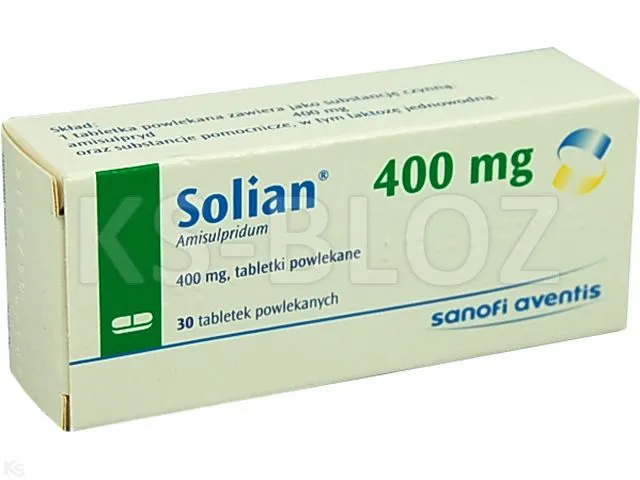
Table of Contents
Package leaflet: Information for the user
Warning! Keep this leaflet. The information on the immediate packaging is in a foreign language.
Solian (Solian)
400 mg, coated tablets
Amisulpridum
Solian and Solian are the same brand names of the same medicine, written in Polish and Bulgarian languages.
Please read this leaflet carefully before taking the medicine, as it contains important information for the patient.
- Keep this leaflet, as you may need to read it again.
- If you have any questions, please consult your doctor or pharmacist.
- This medicine has been prescribed for a specific individual. Do not share it with others. This medicine may harm other people, even if their symptoms are identical.
- If you experience any adverse effects, including any not listed in this leaflet, inform your doctor, pharmacist or nurse. See section 4.
Contents of the leaflet:
- What Solian is and what it is used for
- What you need to know before taking Solian
- How to take Solian
- Possible side effects
- How to store Solian
- Contents of the pack and other information
1. What Solian is and what it is used for
Solian is available as tablets and coated tablets and contains amisulprid as the active substance. Amisulprid is an antipsychotic, neuroleptic medicine.
Solian is indicated for the treatment of acute and chronic schizophrenia with positive symptoms (such as delusions, hallucinations, thought disorders) and/or negative symptoms (such as emotional blunting, emotional and social withdrawal), including patients with predominant negative symptoms.
2. Information before using Solian
When not to use Solian:
- if the patient is allergic to amisulpride or any of the other ingredients of this medicine (listed in section 6). An allergic reaction may manifest as rash, difficulty in swallowing or breathing, swelling of the lips, face, throat or tongue;
- if the patient has tumour diseases whose growth is dependent on prolactin levels, e.g. prolactinoma of the pituitary gland, breast cancer;
- if the patient has a chromaffin cell tumour of the adrenal gland (pheochromocytoma);
- concomitantly with levodopa;
- in children before puberty;
- concomitantly with medicines that may cause serious heart rhythm disorders leading to death, such as: medicines used to treat irregular heartbeat (e.g. quinidine, disopyramide, amiodarone, sotalol); other medicines such as: bepridil, cisapride, sultopride, thioridazine, methadone, intravenous erythromycin, intravenous vinpocetine, halofantrine, pentamidine, sparfloxacin.
This medicine should not be taken if any of the above conditions apply. If in doubt, consult a doctor or pharmacist before starting treatment with Solian.
Warnings and precautions
Before taking Solian, discuss with your doctor or pharmacist if:
- the patient has kidney disease;
- the patient has Parkinson's disease;
- the patient has seizures (epileptic fits);
- the patient has irregular heart rhythm (arrhythmia);
- the patient has heart disease or a family history of heart disease;
- the patient has been informed of having had a stroke;
- the patient or someone in their family has had blood clots, as use of medicines such as Solian may be associated with blood clot formation;
- the patient has diabetes or has been informed of an increased risk of developing diabetes;
- the patient has a slow heart rate (less than 55 beats per minute);
- the patient has been informed of low potassium levels in the blood;
- the patient is elderly: in older people, low blood pressure and excessive sedation occur more frequently. Caution is advised when using amisulpride in elderly patients with psychosis secondary to dementia, as there is an increased risk of death compared to patients not treated with antipsychotic medicines. A dose reduction may be required due to impaired kidney function;
- the patient or someone in their family has had breast cancer;
- the patient has visual field defects and headaches: these may be symptoms of a benign pituitary tumour. The doctor will order tests and, if diagnosis is confirmed, treatment with Solian will be discontinued.
Contact your doctor immediately if:
- during treatment the patient develops muscle stiffness or muscle pain associated with muscle breakdown (rhabdomyolysis), and if the patient has increased blood creatine kinase activity, and disturbances of consciousness accompanied by fever of unknown origin: treatment should be stopped immediately and urgent medical advice sought, as this may lead to death.
Severe liver function disorders have been reported with the use of Solian. Contact your doctor immediately if fatigue, loss of appetite, nausea, vomiting, abdominal pain, or yellowing of the eyes or skin (jaundice) occur.
If in doubt about any of the above conditions, contact your doctor or pharmacist before starting treatment with Solian.
Solian and other medicines
Tell your doctor or pharmacist about all medicines the patient is currently taking or has recently taken, including herbal preparations and medicines planned for future use. Solian and other medicines may interact and affect each other's actions.
In particular, do not take levodopa, a medicine used to treat Parkinson's disease, or medicines used to treat irregular heart rhythm such as quinidine, disopyramide, amiodarone, sotalol, and inform the doctor if the patient is taking any of the following medicines:
- other antipsychotic medicines used to treat mental disorders;
- medicines used to treat acute pain, such as morphine;
- medicines used to treat malaria, such as mefloquine;
- medicines used to treat high blood pressure and heart disease;
- clonidine, used to treat migraine, facial flushing or high blood pressure;
- medicines used to treat sleep disorders, such as barbiturates or benzodiazepines;
- painkillers;
- anaesthetics;
- antihistamines that cause drowsiness;
- bromocriptine, ropinirole;
- clozapine, used to treat schizophrenia;
- medicines that lower potassium levels in the blood.
If in doubt about any of the above situations, contact your doctor or pharmacist before starting treatment with Solian.
If you feel that the effect of Solian is too weak or too strong, do not change the dose yourself but consult your doctor.
Solian with food and drink
Solian should be taken with non-alcoholic drinks. Alcohol should not be consumed during treatment with Solian, as it may affect the medicine's action.
The medicine may be taken with or without food.
Pregnancy, breastfeeding and fertility
If the patient is pregnant or breastfeeding, suspects she may be pregnant, or is planning to have a baby, she should consult her doctor before using this medicine.
Pregnancy
Use of Solian is not recommended during pregnancy or in women of childbearing potential who are not using effective contraception.
In a newborn whose mother took Solian during the last trimester (last three months) of pregnancy, the following symptoms may occur: agitation, increased muscle tone, tremors, drowsiness, breathing difficulties or feeding difficulties. If such symptoms are observed in your child, contact your doctor.
Breastfeeding
Breastfeeding should not be undertaken during treatment with Solian. Discuss with your doctor the best way to feed your baby if you are taking Solian.
Fertility
Reduced fertility has been observed in animal studies related to the pharmacological action of the medicine.
Driving and using machines
Solian may cause reduced alertness, drowsiness and blurred vision, which may affect the ability to drive or operate machinery. If such symptoms occur, discontinue these activities.
Solian contains lactose monohydrate
If the patient has been previously diagnosed with an intolerance to certain sugars, they should consult their doctor before taking this medicine.
Solian contains sodium
This medicine contains less than 1 mmol (23 mg) of sodium per tablet, i.e. the medicine is considered "sodium-free".
3. How to take Solian
This medicine should always be taken exactly as prescribed by your doctor. If in doubt, consult your doctor.
Taking the medicine
- Take the medicine orally.
- Swallow the tablet with a non-alcoholic drink.
- If the patient feels that the effect of the medicine is too weak or too strong, they should consult their doctor. Do not change the dose on your own.
Dosage
The dose depends on the severity of the disease. Always follow your doctor's instructions precisely.
Adults
- The usual daily dose ranges from 50 mg to 800 mg.
- Your doctor may start treatment with a lower dose, if necessary.
- Your doctor may prescribe a dose up to 1200 mg daily, if needed.
- Doses up to 400 mg may be taken as a single dose. The medicine should be taken at the same time each day.
- Higher doses should be divided into two doses, with half taken in the morning and half in the evening.
(Available also: Solian 100 mg tablets and Solian 200 mg tablets).
Use in elderly patients
Amisulpride should be used with particular caution in elderly patients due to the risk of hypotension or excessive sedation. Dose reduction may be required due to impaired renal function.
Use in children and adolescents
The efficacy and safety of amisulpride in patients from puberty to 18 years of age have not been established. Data on the use of amisulpride in adolescents with schizophrenia are limited. Therefore, the use of amisulpride in patients from puberty to 18 years of age is not recommended. Administration of amisulpride to children before puberty is contraindicated, as the safety of the medicine has not been established in this age group.
Use in renal impairment
Amisulpride is eliminated from the body via the kidneys. In case of renal impairment, your doctor may prescribe a lower dose.
Use in hepatic impairment
There is no need to adjust the dose in case of liver function disorders.
Taking more Solian than prescribed
If you take more Solian than prescribed, contact your doctor immediately or go to the nearest hospital, as specialist medical help may be required. Take the medicine package with you so the doctor knows which medicine has been taken. Symptoms may include: restlessness or tremor, muscle stiffness, drowsiness, which may lead to loss of consciousness.
If you miss a dose of Solian
If you miss a dose, take it as soon as possible, unless it is almost time for the next dose. Do not take a double dose to make up for a missed one. If in doubt, consult your doctor.
Stopping Solian treatment
Continue taking Solian unless your doctor decides otherwise. Do not stop taking Solian just because you feel better. Stopping the medicine may cause the illness to worsen or return. Do not stop taking Solian suddenly unless your doctor tells you to. After abrupt discontinuation of Solian, withdrawal symptoms may occur, such as:
- nausea or vomiting
- sweating
- difficulty sleeping or feeling restless
- muscle stiffness or unusual body movements
- return of symptoms present before treatment.
Blood tests
Taking Solian may affect certain blood test results, particularly measurements of prolactin hormone levels and liver function tests. If you are scheduled for blood tests, inform your doctor that you are taking Solian.
If you have any further doubts about the use of this medicine, consult your doctor or pharmacist.
4. Possible adverse reactions
Like any medicine, this medicine can cause adverse reactions, although not everyone experiences them.
Amisulpride is generally a well-tolerated medicine, and sometimes it is difficult to distinguish
medicine-related adverse reactions from symptoms of the underlying disease. The following
adverse reactions may also occur with other antipsychotics.
Stop taking Solian and contact your doctor or go to the nearest hospital emergency department
if the patient experiences any of the following adverse reactions:
Uncommon (affects less than 1 in 100 patients)
- Seizure (epileptic fit);
- Liver damage (symptoms include fatigue, loss of appetite, nausea, vomiting, abdominal pain, yellowing of the eyes or skin).
Rare (affects less than 1 in 1,000 patients)
- High temperature, sweating, muscle stiffness, rapid heartbeat, fast breathing, confusion, drowsiness, and agitation. These may be symptoms of a serious but rare condition called neuroleptic malignant syndrome;
- Irregular heart rhythm, rapid heartbeat, or chest pain, which may lead to a heart attack or life-threatening heart disease;
- Blood clots in the veins, especially in the legs (symptoms include itching, pain, and redness in the limbs). These clots may travel through blood vessels to the lungs, causing chest pain and difficulty breathing. If such symptoms occur, contact your doctor immediately;
- Allergic reactions. Symptoms may include: itchy rash, difficulty swallowing or breathing, swelling of the lips, face, throat, or tongue, urticaria, angioedema.
Frequency not known (cannot be estimated from available data)
- Rhabdomyolysis (muscle breakdown and associated muscle pain);
- Increased creatine phosphokinase activity (a blood test indicating muscle damage). Contact your doctor as soon as possible if any of the following adverse reactions occur:
Very common (affects more than 1 in 10 patients)
- Tremor, muscle stiffness or spasms, slowed movement, increased salivation, restlessness, uncontrollable movements, mainly of hands and feet (these symptoms may be reduced if the doctor reduces the dose of Solian or prescribes an additional medicine).
Uncommon (affects less than 1 in 100 patients)
- Uncontrollable movements, mainly of the face and tongue;
- Disorientation (incoherent, chaotic speech, thinking, and behavior inappropriate to reality).
Frequency not known (cannot be estimated from available data)
- Withdrawal syndrome in newborns.
Other adverse reactions:
Common (affects less than 1 in 10 patients)
- Disturbed milk production in women and men, and breast pain;
- Absence of menstruation;
- Breast enlargement in men;
- Erectile dysfunction;
- Insomnia, anxiety, agitation;
- Orgasm disorders;
- Uncontrollable muscle spasms in certain muscle groups: eyes (forced upward deviation of the eyeballs), face, neck (trismus, torticollis);
- Drowsiness;
- Blurred vision;
- Low blood pressure;
- Constipation, nausea, or vomiting, dry mouth;
- Weight gain.
Uncommon (affects less than 1 in 100 patients)
- Leukopenia (reduced number of white blood cells in the blood), neutropenia (reduced number of a certain type of white blood cells – neutrophils – in the blood);
- Hypertriglyceridemia (elevated blood triglyceride levels above normal, associated with increased risk of atherosclerosis) and hypercholesterolemia (elevated blood cholesterol levels above normal);
- Allergic reactions;
- High levels of glucose, triglycerides, or cholesterol in the blood;
- Slowed heart rate;
- Increased blood pressure;
- Nasal mucosa congestion;
- Aspiration pneumonia;
- Osteopenia (reduced bone density), osteoporosis;
- Urinary retention;
- Increased liver enzyme activity, mainly transaminases.
Rare (affects less than 1 in 1,000 patients)
- Agranulocytosis (reduced number of a certain type of white blood cells – granulocytes – in the blood);
- QT interval prolongation in electrocardiogram;
- Benign pituitary gland tumor (a gland located in the brain);
- Hyponatremia (reduced sodium levels in the blood below normal), syndrome of inappropriate antidiuretic hormone secretion (SIADH – a condition caused by excessive release of antidiuretic hormone – vasopressin – from the pituitary gland).
Frequency not known
- Restless legs syndrome (uncomfortable sensation in the legs temporarily relieved by movement, symptoms worsening towards the end of the day);
- Increased skin sensitivity to sunlight and ultraviolet radiation;
- Falls due to impaired body balance, sometimes leading to fractures.
Reporting of adverse reactions
If any adverse reactions occur, including any not listed in this leaflet, inform your doctor, pharmacist, or nurse. Adverse reactions can be reported directly to the Department of Monitoring Adverse Drug Reactions, Office for Registration of Medicinal Products, Medical Devices and Biocidal Products
Al. Jerozolimskie 181 C
02-222 Warsaw
Phone: +48 22 49 21 301
Fax: +48 22 49 21 309
Website: https://smz.ezdrowie.gov.pl
Reporting adverse reactions helps to provide more information on the safety of the medicine.
5. How to store Solian
Storage – no special requirements.
Keep the medicine in a place invisible and out of reach of children.
Do not use the medicine after the expiry date stated on the packaging. The expiry date refers to the last day of the stated month.
Medicines must not be disposed of via wastewater or household waste. Ask your pharmacist how to dispose of medicines no longer in use. This will help protect the environment.
6. Contents of the packaging and other information
What Solian contains
- The active substance is amisulpride. Each coated tablet contains 400 mg of amisulpride.
- Other components: sodium carboxymethyl starch (type A), monohydrate lactose, microcrystalline cellulose, hypromellose, magnesium stearate.
Coating composition:
- hypromellose, microcrystalline cellulose, polyglycolized stearate (macrogol 40 stearate), titanium dioxide (E 171).
What Solian looks like and contents of the pack
White, coated, divisible, elongated tablets, embossed with "AMI 400" on one side.
Pack contents:
30 tablets.
For more detailed information, please contact the marketing authorization holder or the parallel importer.
Marketing Authorization Holder in Bulgaria, country of export:
Sanofi Winthrop Industrie
82 avenue Raspail
94250 Gentilly
France
Manufacturer:
Delpharm Dijon
6, Boulevard de L’Europe
21800 Quetigny
France
Parallel importer:
Delfarma Sp. z o.o.
ul. Św. Teresy od Dzieciątka Jezus 111
91-222 Łódź
Repackaged in:
Delfarma Sp. z o.o.
ul. Św. Teresy od Dzieciątka Jezus 111
91-222 Łódź
Marketing Authorization Number in Bulgaria, country of export: 20010129
Parallel Import License Number: 363/21