Softacort
Poland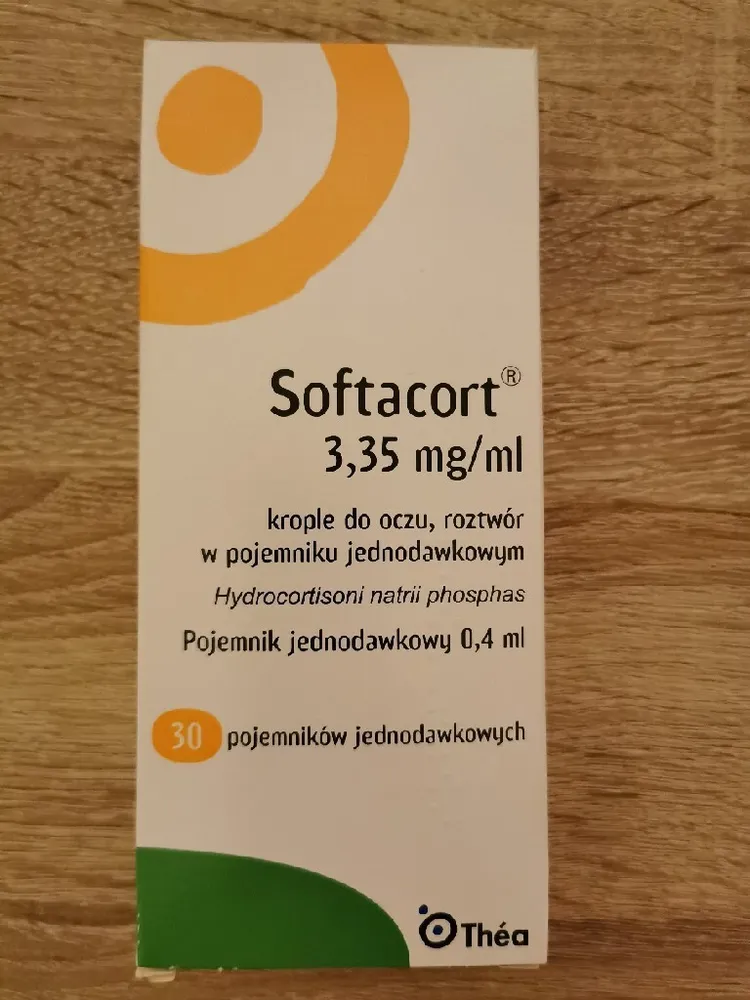
Table of Contents
Patient Information Leaflet
Softacort, 3.35 mg/ml, eye drops, solution in single-dose container
Hydrocortisoni natrii phosphas
Please read this leaflet carefully before using this medicine because it contains important information for you.
- Keep this leaflet so that you can read it again if necessary.
- If you have any questions, please consult your doctor, pharmacist, or nurse.
- This medicine has been prescribed for a specific individual. Do not share it with others. This medicine may harm others, even if their symptoms are the same.
- If you experience any adverse reactions, including any not listed in this leaflet, inform your doctor, pharmacist, or nurse. See section 4.
Table of contents
- What Softacort is and what it is used for
- Important information before using Softacort
- How to use Softacort
- Possible side effects
- How to store Softacort
- Contents of the pack and other information
1. What Softacort is and what it is used for
This medicine is an eye drop solution in single-dose containers containing a substance called hydrocortisone. This substance is a corticosteroid that reduces symptoms of inflammation.
The medicine is used in the treatment of mild allergic or inflammatory conditions of the surface of the eye(s) (conjunctiva).
The eye should not be infected (see When not to use Softacort).
2. Important information before using Softacort
When not to use Softacort:
- If the patient is allergic to the active substance (hydrocortisone) or to any of the other ingredients of this medicine (listed in section 6).
- If the patient has high intraocular pressure (intraocular hypertension) caused by glucocorticoids (a group of corticosteroids) or due to other factors.
- If the patient has acute herpes simplex virus infection or any other viral disease in the ulcerative stage (unless the infection is being treated with antiviral medications against herpes simplex virus).
- If the patient has keratoconjunctivitis with ulcerative keratitis (corneal inflammation), even at an early stage.
- If the patient has a bacterial eye infection (acute purulent infection, conjunctivitis, blepharitis, or hordeolum).
- If the patient has a fungal eye infection (fungal keratitis).
- If the patient has a bacterial infection called tuberculosis affecting the eyes (ocular tuberculosis).
Warnings and precautions
- Before starting to use this medicine, discuss it with your doctor, pharmacist, or nurse.
- Do not use this medicine if the patient has red eyes that have not been diagnosed by a doctor.
- If the patient has a viral eye infection (herpes), this medicine may be used only if antiviral treatment has been initiated; close monitoring of the eye condition is also required.
- If the patient has a disease causing thinning of the outer part of the eye (cornea and sclera), there may be an increased risk of perforation due to the use of locally applied corticosteroids administered to the eye.
- If the patient has been using or has used corticosteroid medicines for a long time and has eye wounds (corneal ulcers), fungal infection should be suspected.
- Close and regular monitoring of the eye condition is necessary during treatment. Prolonged use of corticosteroids has been shown to increase intraocular pressure and lead to glaucoma, especially in patients who already have elevated intraocular pressure or are at risk of developing it during local steroid treatment (see Possible side effects), as well as cause lens opacity (cataract), particularly in children and elderly patients.
- Corticosteroid use may lead to opportunistic eye infections. Moreover, locally administered corticosteroids to the eye may stimulate, worsen, or mask objective and subjective symptoms of opportunistic eye infections.
- Wearing contact lenses should be avoided during treatment with this medicine.
- If the patient experiences blurred vision or other visual disturbances, they should contact a doctor.
Children
There is a lack of data on the safety and efficacy of Softacort in children.
Uninterrupted, long-term corticosteroid treatment in children may suppress adrenal function.
Intraocular pressure elevation in children occurs more frequently, progresses faster, and is more severe than in adult patients.
Softacort and other medicines
Tell your doctor or pharmacist about all medicines the patient is currently taking or has recently taken, as well as any medicines they plan to take, including those available without a prescription.
Some medicines may enhance the effect of Softacort; therefore, your doctor may perform careful monitoring if the patient is taking such medicines (including certain drugs used in HIV treatment: ritonavir, cobicistat).
Pregnancy and breastfeeding
If the patient is pregnant or breastfeeding, suspects she may be pregnant, or is planning to have a child, she should consult her doctor or pharmacist before using this medicine.
- Use during pregnancy is not recommended, except when considered necessary by a physician and treatment is conducted under strict medical supervision.
- It is not known whether the medicine is excreted in breast milk. The treating physician will decide whether this medicine can be used during breastfeeding.
Driving and operating machinery
Transient blurred vision or other visual disturbances may affect the ability to drive or operate machinery. Do not drive or operate machinery until normal vision returns.
Softacort contains phosphates
The medicine contains 0.227 mg of phosphates in each drop.
3. How to use Softacort medicine
Dosage
This medicine should always be used exactly as recommended by your doctor or pharmacist. If in doubt,
you should consult your doctor or pharmacist.
The recommended dose is 2 drops into the affected eye (or both affected eyes), 2 to 4 times daily, depending
on the prescribed dosing regimen. To prevent recurrence of the disease, a gradual reduction of the dose is recommended.
The duration of treatment usually lasts from several days up to a maximum of 14 days.
The same dose is recommended for adults and elderly patients.
Use in children
The efficacy and safety of this medicine in children have not been established.
Instructions for use
This medicine is intended for ophthalmic use.
To administer the drops, follow these instructions:
- Wash your hands and stand or sit comfortably.
- Open the sachet containing 10 single-dose containers. Record the date of first opening of the sachet.
- Detach one single-dose container from the strip.
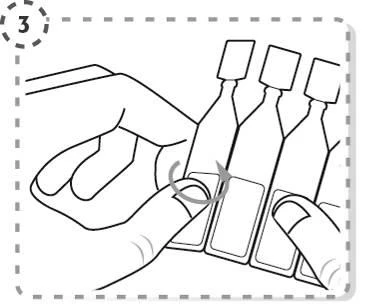
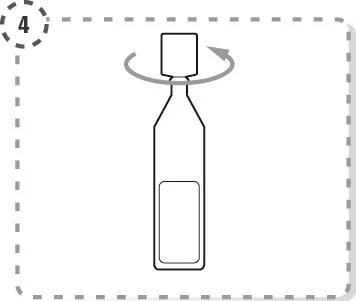
- To open the single-dose container, twist the top part of the container as shown in the illustration. Do not touch the tip of the container after opening.
- Gently pull down the lower eyelid of the affected eye with your finger.
- Hold the tip of the single-dose container close to the eye, but without touching the surface of the eye.
- Gently squeeze the single-dose container so that two drops enter the eye, then release the lower eyelid.
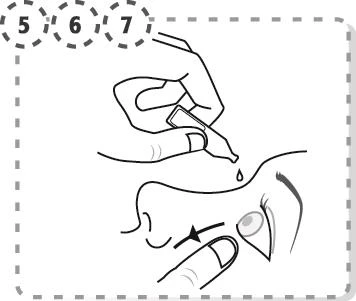
- Press with your finger against the inner corner of the affected eye at the side of the nose. Keep eyes closed and maintain pressure for 1 minute.
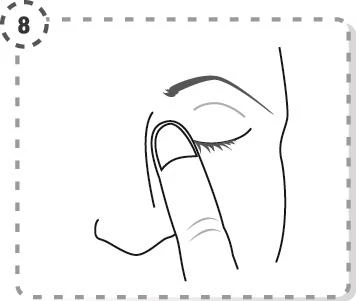
- Repeat the procedure for the second eye, if recommended by your doctor. Each single-dose container contains sufficient solution for administration into both eyes.
- Dispose of the single-dose container after use. Do not store for reuse.
- Return unused single-dose containers to the sachet and place the opened sachet back into the carton. Unused containers should be used within one month of opening the sachet.
If other eye drops are being used, they should be administered at least 5 minutes after this medicine.
Use of a higher than recommended dose of Softacort
If too much medicine has been administered into the eye and prolonged irritation occurs, rinse the eye with sterile water.
Contact your doctor or pharmacist immediately.
Missed dose of Softacort
Do not use a double dose to make up for a missed dose.
Stopping Softacort treatment
Do not stop treatment abruptly. Always consult your doctor if you are considering stopping treatment.
If you have any further questions about the use of this medicine, consult your doctor, pharmacist, or nurse.
4. Possible adverse reactions
Like all medicines, this medicine can cause adverse reactions, although not everybody will experience them.
Frequency unknown: frequency cannot be estimated from the available data
- Transient discomfort (burning, stinging) after instillation.
The following adverse reactions have been reported with medicines of the same group (corticosteroids) used in the treatment of eye disorders.
Frequency unknown: frequency cannot be estimated from the available data
- Allergic reactions,
- Delayed wound healing,
- Clouding of the lens of the eye (posterior subcapsular cataract),
- Opportunistic infections (viral, such as herpes, fungal infections),
- Increased intraocular pressure (glaucoma),
- Pupil dilation (mydriasis),
- Drooping of the eyelid,
- Inflammation in the eye (uveitis),
- Changes in the thickness of the front part of the eye (cornea),
- Corneal inflammation (crystalline keratopathy),
- Blurred vision.
In patients with severe damage to the transparent front part of the eye (cornea), phosphates may very rarely lead during treatment to corneal clouding due to calcium accumulation.
Reporting of adverse reactions
If any adverse reactions occur, including any adverse reactions not listed in this leaflet, inform your doctor, pharmacist, or nurse. Adverse reactions can be reported directly to the Department of Monitoring of Adverse Drug Reactions, Office for Registration of Medicinal Products, Medical Devices and Biocidal Products
Al. Jerozolimskie 181C, 02-222 Warsaw
Tel.: +48 22 49 21 301
Fax: +48 22 49 21 309
e-mail: [email protected]
Adverse reactions can also be reported to the responsible entity.
Reporting adverse reactions allows further information on the safety of the medicine to be collected.
5. How to store Softacort
Keep this medicine out of the sight and reach of children.
Do not use this medicine after the expiry date stated on the carton, sachet, and single-dose container after: EXP. The expiry date refers to the last day of the stated month.
Do not store above 25°C.
After first opening the sachet: shelf life of single-dose containers – 1 month.
Store single-dose containers in the sachet to protect from light.
The date of first opening should be written on the sachet.
After opening a single-dose container: use immediately and discard the single-dose container after use.
Since sterility cannot be maintained after opening a single-dose container, any remaining solution must be discarded immediately after administration.
Medicines must not be disposed of via wastewater or household waste. Ask your pharmacist how to dispose of medicines no longer required. Such measures help protect the environment.
6. Contents of the package and other information
What Softacort contains
- The active substance is hydrocortisone sodium phosphate. 1 ml of eye drops, solution contains 3.35 mg of hydrocortisone sodium phosphate.
- Other components are: disodium phosphate dodecahydrate, monosodium dihydrogen phosphate monohydrate, sodium chloride, disodium edetate, hydrochloric acid, water for injections.
What Softacort looks like and contents of the pack
Softacort is an eye drop solution in a single-dose container.
The solution is practically clear, colourless to slightly yellowish, and practically free from particles. The product is packed in sachets of 10 units. Each single-dose container holds 0.4 ml of the product.
Pack sizes: 10 (1x10), 20 (2x10), 30 (3x10) or 60 (6x10) single-dose containers.
Not all pack sizes may be marketed.
Marketing Authorisation Holder
Laboratoires THEA
12, rue Louis Blériot
63017 Clermont-Ferrand Cedex 2
France
Manufacturer
Laboratoire Unither
1 rue de l’Arquerie
50200 Coutances
France
Laboratoires THEA
12, rue Louis Blériot
63017 Clermont-Ferrand Cedex 2
France
This medicinal product is authorised in the European Economic Area countries under the following names:
Austria, Bulgaria, Croatia, Cyprus, Czech Republic, Denmark, Finland, France, Germany, Greece, Iceland, Norway, Poland, Portugal, Romania, Slovakia, Slovenia, Spain, Sweden, United Kingdom: Softacort
Belgium, Luxembourg, Netherlands ............................................................................................................... Softacor
Italy .................................................................................................................................................. Sofacor
Ireland ................................................................................................................................................... Zoftacot
Detailed information about this medicine is available on the website www.urpl.gov.pl