Septogard
Poland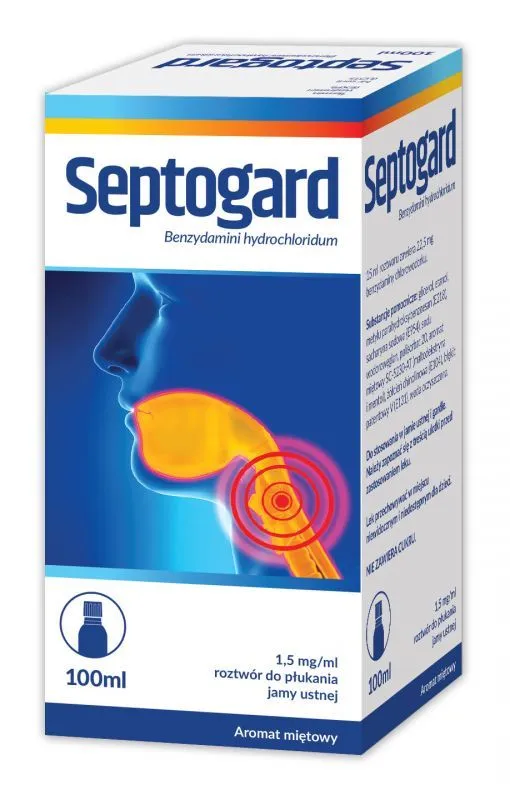
Table of Contents
Package leaflet: Information for the user
Septogard, 1.5 mg/ml, solution for mouth rinsing
Benzydamini hydrochloridum
Please read all of this leaflet carefully before using this medicine, as it contains
important information for the patient.
This medicine should always be used according to the instructions provided in this patient leaflet or as directed by a physician or pharmacist.
- Keep this leaflet, as you may need to read it again.
- If you need advice or further information, consult your pharmacist.
- If you experience any adverse reactions, including any possible side effects not listed in this leaflet, inform your doctor or pharmacist. See section 4.
- If there is no improvement after 7 days, or if symptoms worsen, consult your doctor.
Table of contents
- What Septogard is and what it is used for
- Important information before using Septogard
- How to use Septogard
- Possible side effects
- How to store Septogard
- Contents of the pack and other information
1. What Septogard is and what it is used for
Septogard is a medicine containing the active substance benzydamine hydrochloride. It belongs to a group of medicines called non-steroidal anti-inflammatory drugs (NSAIDs).
Septogard acts locally to reduce pain and inflammation (at the site of inflammation). It is used in the treatment of various painful conditions of the mouth or throat, such as:
- Mouth ulcers,
- Sore throat,
- Pain following dental procedures.
2. Important information before using Septogard
When not to use Septogard:
- if the patient is allergic to the active substance, benzidamine hydrochloride, or to any of the other ingredients of this medicine (listed in section 6).
Warnings and precautions
Before starting to use Septogard, consult a doctor or pharmacist:
- if the patient has or has ever had bronchial asthma or allergies, as this may increase the risk of bronchospasm or allergic reactions;
- if the patient is allergic to acetylsalicylic acid or other non-steroidal anti-inflammatory drugs (NSAIDs). If in doubt whether any of the above points apply, consult a doctor, dentist, or pharmacist before starting treatment with Septogard.
Care should be taken to prevent the mouthwash liquid from entering the eyes. If accidental contact occurs, immediately rinse the eyes with cold water.
Septogard with other medicines
Inform your doctor, dentist, or pharmacist about all medicines you are currently taking, have recently taken, or plan to take, including those available without a prescription.
Pregnancy, breastfeeding, and fertility
If the patient is pregnant or breastfeeding, suspects she might be pregnant, or is planning to have a child, she should consult a doctor, dentist, or pharmacist before using this medicine.
Driving and operating machinery
Septogard has no effect on the ability to drive or operate machinery.
Septogard contains:
- 1200 mg of alcohol (ethanol) in each dose (15 ml), equivalent to 80.0 mg/ml (8.0% w/v). The amount of alcohol in 15 ml of this medicine corresponds to 30 ml of beer or 12 ml of wine. The alcohol content in this medicine is unlikely to affect adults and adolescents, and its effects in children are likely to be negligible. However, it may cause some effects in younger children, such as drowsiness. The alcohol in this medicine may alter the action of other medicines. If the patient is taking other medicines, he or she should consult a doctor or pharmacist. If the patient is pregnant or breastfeeding, she should consult a doctor or pharmacist before using this medicine. If the patient is alcohol-dependent, he or she should consult a doctor or pharmacist before using this medicine.
- glycerol, which may cause headache, gastrointestinal disturbances, and diarrhoea
- methyl parahydroxybenzoate (E218), which may cause allergic reactions (including delayed-type reactions)
- less than 1 mmol of sodium (23 mg) per dose, meaning it is essentially "sodium-free".
3. How to use Septogard
This medicine should always be used exactly as recommended by your doctor, dentist, or pharmacist.
If in doubt, consult your doctor, dentist, or pharmacist.
Do not apply Septogard to the eyes or in the eye area. If the mouthwash solution gets into the eye, immediately rinse it thoroughly with cold water.
Septogard should be used for no longer than 7 days, unless otherwise advised by a doctor or dentist.
Septogard is generally used undiluted; however, if a stinging sensation occurs, it may be diluted with water.
Septogard is intended for rinsing the mouth and throat, according to the following instructions:
- Adults, elderly, and children over 12 years of age: the usual dose is 15 ml (approximately 1 tablespoon) every 1.5 to 3 hours. Rinse the mouth or throat and then spit out the solution. Do not swallow. Measure the dose using the measuring cup provided with the package;
- Children 12 years of age and younger: this medicine should not be used by children aged 12 years and younger.
Contact your doctor, dentist, or pharmacist if symptoms worsen or if the patient's condition does not improve.
Use of a higher than recommended dose of Septogard
If more than the recommended dose is taken or if a large amount of the medicine is accidentally swallowed, contact your doctor, dentist, or pharmacist immediately for advice.
Missed dose of Septogard
Do not use a double dose to make up for a missed dose.
If you have any further doubts about the use of this medicine, consult your doctor, dentist, or pharmacist.
4. Possible adverse reactions
Like all medicines, this medicine can cause adverse reactions, although not everybody will experience them.
Some adverse reactions may be serious. If any of the following adverse reactions occur,
seek medical help immediately
- severe allergic reactions, which may include symptoms such as difficulty breathing, chest pain or tightness in the chest and (or) dizziness/fainting, severe itching of the skin or raised skin rashes, swelling of the face, lips, tongue and (or) throat, which may potentially be life-threatening.
Other adverse reactions; if serious symptoms occur, tell your doctor
Uncommon (occurs in 1 in 1,000 people):
- numbness and (or) burning sensation in the mouth and (or) throat.
Very rare (occurs in less than 1 in 10,000 people):
- difficulty breathing and wheezing,
- itching,
- skin rash,
- hypersensitivity reactions which may involve itching accompanied by a red, scaly rash, sometimes with blisters.
Frequency not known (frequency cannot be estimated from the available data):
- redness or swelling of the skin,
- allergic reaction (hypersensitivity).
If you experience a burning sensation when rinsing your mouth with the solution, the next dose may be diluted with water to reduce this effect.
Reporting of adverse reactions
If you experience any adverse reactions, including any adverse reactions not listed in this leaflet, tell your doctor, pharmacist or nurse. Adverse reactions can be reported directly to the Department of Monitoring of Adverse Drug Reactions of the Office for Registration of Medicinal Products, Medical Devices and Biocidal Products
Al. Jerozolimskie 181C, 02-222 Warsaw,
tel.: +48 22 49 21 301, fax: +48 22 49 21 309,
website: https://smz.ezdrowie.gov.pl.
Adverse reactions can also be reported to the marketing authorization holder.
By reporting adverse reactions, more information on the safety of this medicine can be collected.
5. How to store Septogard
Keep this medicine out of sight and reach of children.
Store in the original packaging.
No special storage instructions apply to this medicine.
Do not use this medicine after the expiry date stated on the bottle and the cardboard
box following EXP. The expiry date refers to the last day of the stated month.
After first opening, do not use for longer than 12 months.
Medicines should not be disposed of via wastewater or household waste. Ask your
pharmacist how to dispose of medicines no longer in use. This will help protect
the environment.
6. Contents of the package and other information
What Septogard contains
The active substance is benzylamine hydrochloride (1.5 mg per 1 ml of solution).
Each 15 ml of solution contains 22.5 mg of benzylamine hydrochloride.
The other ingredients are: glycerol, ethanol 96%, methyl parahydroxybenzoate (E218), sodium saccharin (E954), sodium hydrogen carbonate, polysorbate 20, peppermint flavour SC-5230-AT (maltodextrin and menthol), quinoline yellow (E104), patent blue V (E131), purified water.
What Septogard looks like and contents of the pack
Septogard is a solution for rinsing the mouth and throat. It is a clear green-coloured solution with a characteristic peppermint aroma. It is supplied in a 100 ml bottle with a screw cap, security seal, and measuring cup, packed in a cardboard box.
Marketing Authorisation Holder Importer
Farmak International Sp. z o.o. Farmak International Sp. z o.o.
Koszykowa 65 ul. Chełmżyńska 249
00-667 Warsaw 04-458 Warsaw
tel. +48 22 822 93 06
e-mail: [email protected]