Scaldex
Poland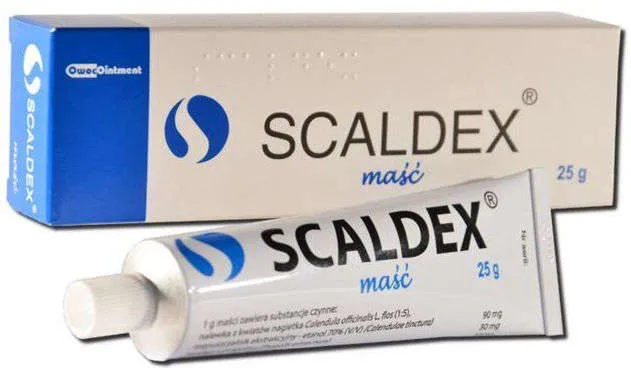
Table of Contents
Package leaflet: Information for the patient
SCALDEX, ointment
Please read carefully the entire leaflet before using the medicine, as it contains
important information for the patient.
This medicine should always be used exactly as described in the patient leaflet or as directed by
the physician.
- Keep this leaflet, as you may need to read it again.
- If you need advice or further information, consult your pharmacist.
- If you experience any adverse reactions, including any possible adverse reactions not listed in this leaflet, inform your doctor. See section 4.
- Scaldex should be used for no longer than 7 days. If there is no improvement or if your condition worsens, contact your doctor.
Table of contents
- What Scaldex is and what it is used for
- Important information before using Scaldex
- How to use Scaldex
- Possible side effects
- How to store Scaldex
- Contents of the pack and other information
1. What Scaldex is and what it is used for
Scaldex ointment is a combination of naturally derived substances, a broad-spectrum antibiotic, and vitamin A. The combined action of several active ingredients contained in propolis extract, tincture of yarrow, and bacitracin determines the antibacterial and anti-inflammatory properties of the medicine.
The medicine acts as an antiseptic, promotes faster cleansing of wounds from metabolic products and necrotic elements. Vitamin A accelerates the regeneration of damaged tissue.
Scaldex is indicated for the treatment of:
- first- and second-degree thermal burns,
- mild first- and second-degree frostbite,
- slowly healing superficial wounds,
- stage I and II pressure ulcers,
- infection of minor wounds.
Scaldex is intended for use on small skin surface areas.
Scaldex is intended for adults and adolescents aged above 12 years.
The medicine may be used in children under 12 years of age only under medical supervision.
2. Important information before using Scaldex
When not to use Scaldex
Do not use Scaldex if you are allergic to the active substances or to any of the other ingredients of this medicine (listed in section 6).
Do not use Scaldex if you are allergic to plants of the aster family ( Asteraceae, formerly Compositae ), such as tansy, hawkweed, or chamomile.
Do not use Scaldex if you have impaired kidney function.
Scaldex must not be used for third- or fourth-degree burns, or on deep and extensive wounds.
Warnings and precautions
Before starting Scaldex, consult your doctor or pharmacist and exercise caution if any of the following apply:
- If during treatment with Scaldex an allergic reaction occurs, including severe and sudden reactions (rash around the burn wound, swelling of the burn wound and surrounding area, acute contact dermatitis, contact urticaria, erythema), discontinue use immediately and consult your doctor.
- Patients allergic to neomycin or bee-derived products (honey, pollen, royal jelly) may also be allergic to Scaldex.
- Avoid using Scaldex in individuals with atopic dermatitis.
- Scaldex should only be applied to small skin or wound areas. Do not use in large amounts, as one of the active ingredients, if absorbed into the bloodstream, may cause kidney damage.
- If you are concurrently using other medicines that may damage the kidneys (e.g. aminoglycoside antibiotics), consult your doctor before using Scaldex.
- During treatment, superinfection with drug-resistant microorganisms (especially fungi) may occur; therefore, if symptoms worsen, consult your doctor.
- If you have impaired kidney function, consult your doctor before using this medicine.
- Exercise caution when applying Scaldex to the face, as contact with the eye may cause irritation of the conjunctiva, manifesting as a burning sensation. If the medicine gets into the eye, rinse thoroughly with clean water, preferably boiled and cooled.
- Scaldex is intended for use on small skin areas only; do not use for third- or fourth-degree burns or on deep and extensive wounds.
- Scaldex should be used for no longer than 7 days. If there is no improvement, contact your doctor.
Children
Use in children under 12 years of age is permitted only under medical supervision.
Scaldex with other medicines
Inform your doctor about all medicines you are currently taking or have recently taken, as well as any medicines you plan to use.
In particular, inform your doctor if you are to receive general anesthetics, are taking muscle relaxants, or medicines that may damage the kidneys, such as aminoglycoside antibiotics.
If you are unsure whether you are taking any of the above-mentioned medicines, consult your doctor or pharmacist.
Pregnancy, breastfeeding, and fertility
If you are pregnant or breastfeeding, suspect you may be pregnant, or are planning to have a child, consult your doctor or pharmacist before using this medicine.
In pregnant and breastfeeding women, consider the possibility of absorption of Scaldex medicinal product into the bloodstream.
Use Scaldex with caution during pregnancy, as there are reports that vitamin A, one of the components of Scaldex, may have harmful effects on fetal development when used in high doses.
Do not use Scaldex for inflammatory conditions of the nipple during breastfeeding.
Driving and operating machinery
Scaldex has no influence on the ability to drive or operate machinery.
Scaldex contains lanolin
1 g of ointment contains 364.5 mg of lanolin.
This medicine may cause local allergic reactions (e.g. contact dermatitis, manifested by redness, itching, and formation of blisters).
3. How to use Scaldex
This medicine should always be used exactly as directed by a doctor or pharmacist.
If in doubt, consult a doctor or pharmacist.
This medicine is intended for topical application to the skin, on a small area of skin only.
Recommended dosage for adolescents over 12 years of age and adults:
- During the first days of treatment, apply the ointment to the affected skin area every 2–3 hours.
- In the following days of treatment, apply three times daily.
- If purulent exudate is present, additionally clean the area twice daily with a 0.1% potassium permanganate (VII) solution.
Do not use under occlusive or closed dressings that prevent air access.
For burns covering more than 2% of the body surface area, apply the product to the burned skin and seek immediate medical attention.
Note: 1% of a patient's body surface area corresponds to the size of their palm without fingers.
Scaldex should be used for no longer than 7 days. If there is no improvement, consult a doctor.
If you feel that the effect of Scaldex is too strong or too weak, consult a doctor.
Use of more Scaldex than recommended
If more Scaldex has been used than recommended, consult a doctor or pharmacist immediately.
If you forget to use Scaldex
Do not apply a double dose to make up for a missed dose.
Stopping Scaldex
If you have any further doubts regarding the use of this medicine, consult a doctor or pharmacist.
4. Possible adverse reactions
Like all medicines, this medicine can cause adverse reactions, although not everyone will experience them.
Scaldex is generally well tolerated, and any adverse reactions usually resolve within a few days after discontinuation of the medicine.
The most commonly observed adverse reaction associated with Scaldex is local allergic reactions, which may manifest as itching, rash around the burn wound, swelling of the burn wound and surrounding areas.
In most cases, there are insufficient data available to estimate the frequency of adverse reactions, which may also vary depending on the indication for treatment. Adverse reactions occurring with unknown frequency (frequency cannot be estimated from available data):
- superinfection with resistant bacterial or fungal strains;
- severe allergic reaction (so-called anaphylactic reaction, which may present in various ways, from generalized itching, swelling of lips and face, excessive sweating, chest tightness to hypotension, loss of consciousness, respiratory arrest and cardiac arrest);
- allergic reactions such as rash around the burn wound, swelling of the burn wound and surrounding areas, acute contact dermatitis, contact urticaria, erythema, itching;
- harmful effects on kidneys;
- muscle weakness.
If any of these symptoms occur, the medicine should be discontinued and medical advice should be sought immediately.
Reporting of adverse reactions
If any adverse reactions occur, including any not listed in this leaflet, inform your doctor. Adverse reactions can be reported directly to the Department of Monitoring Adverse Drug Reactions of the Office for Registration of Medicinal Products, Medical Devices and Biocidal Products,
Al. Jerozolimskie 181 C, 02-222 Warsaw
Tel: +48 22 49 21 301, Fax: +48 22 49 21 309
Website: https://smz.ezdrowie.gov.pl
Adverse reactions can also be reported to the Marketing Authorisation Holder.
Reporting of adverse reactions helps to provide more information on the safety of the medicine.
5. How to store Scaldex
Keep this medicine out of sight and reach of children.
Do not use this medicine after the expiry date stated on the carton. The expiry date refers to the last day of the specified month.
Store below 25°C.
After completion of treatment, any unused medicinal product should be disposed of. Medicines must not be disposed of via wastewater or household waste. Ask your pharmacist how to dispose of medicines no longer required. This will help protect the environment.
6. Contents of the package and other information
What Scaldex contains
The active substances in the medicine are:
- tincture of marigold flowers Calendula officinalis L. flos (1:5), extraction solvent – ethanol 70% (V/V) (Calendulae tinctura)
- propolis extract (Propolis extractum)
- bacitracin (Bacitracinum)
- synthetic vitamin A, oily concentrate (Vitaminum A syntheticum densatum oleosum) (vitamin A stabilized with tocopherol; 1 g contains: vitamin A – 990 mg, α-tocopherol – 10 mg).
Each 1 g of Scaldex ointment contains: 90 mg tincture of marigold flowers; 30 mg propolis extract; 10 mg bacitracin; 0.3 mg synthetic vitamin A, oily concentrate.
Other components: first cold-pressed linseed oil, cholesterol, hard paraffin, white vaseline, lanolin.
What Scaldex looks like and contents of the pack
Scaldex is a homogeneous ointment ranging in colour from yellow-beige to dark brown, with a characteristic propolis odour.
The medicine is packed in an aluminium tube with a membrane coated internally with epoxy-phenolic lacquer, fitted with a cap made of HDPE, and placed in a cardboard box. Pack size: 25 g ointment.
Marketing Authorisation Holder and Manufacturer
Marketing Authorisation Holder:
Solinea Sp. z o.o.
Elizówka, ul. Szafranowa 6
21-003 Ciecierzyn
Poland
Manufacturer:
Medicofarma S.A.
ul. Tarnobrzeska 13
26-613 Radom
Poland
For further information on this medicine, please contact the marketing authorisation holder.