Saridon
Poland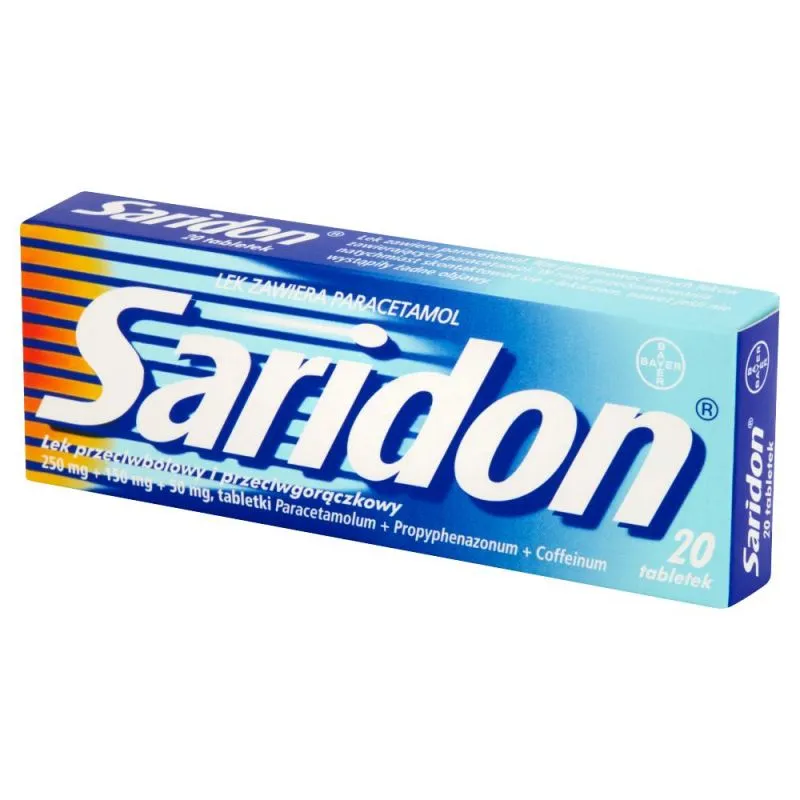
Table of Contents
Package leaflet: Information for the patient
Warning! Keep this leaflet! The information on the immediate packaging is in a foreign language.
Saridon
250 mg + 150 mg + 50 mg, tablets
Paracetamolum + Propyphenazonum + Coffeinum
Please read the entire leaflet carefully before using the medicine, as it contains
important information for the patient.
This medicine should always be used exactly as described in this patient leaflet or as directed by
a doctor or pharmacist.
- Keep this leaflet so that you can read it again if necessary.
- If you need advice or further information, please consult your pharmacist.
- If you experience any adverse reactions, including any possible side effects not listed in this leaflet, inform your doctor or pharmacist. See section 4.
- If there is no improvement after 3 days of treating fever or 5 days of treating pain, or if your condition worsens, consult a doctor.
Table of contents:
- What Saridon is and what it is used for
- Important information before taking Saridon
- How to take Saridon
- Possible side effects
- How to store Saridon
- Contents of the pack and other information
1. What Saridon is and what it is used for
Saridon is a combination medicine with synergistic action of its components. Saridon contains paracetamol and propyphenazone, which have analgesic and antipyretic effects, and a small dose of caffeine, which enhances the analgesic effect of paracetamol.
Indications:
- headache, toothache, menstrual pain, postoperative pain, rheumatic pain;
- pain and fever associated with cold and flu.
2. Important information before using Saridon
When not to use Saridon
- if the patient has a known hypersensitivity (allergy) to propyphenazone, paracetamol, caffeine, or any of the other ingredients,
- if the patient has a known hypersensitivity to pyrazolones or their derivatives (hypersensitivity to phenazone, aminophenazone, metamizole),
- if the patient has a known hypersensitivity to phenylbutazone or acetylsalicylic acid,
- if the patient has congenital glucose-6-phosphate dehydrogenase deficiency,
- if the patient has alcoholic liver disease,
- if the patient has severe hepatic insufficiency (Child-Pugh score > 9),
- if the patient has severe renal insufficiency,
- if the patient has acute hepatic porphyria,
- in children under 12 years of age,
- if the patient suffers from blood-forming system disorders,
- if the patient has Gilbert's syndrome,
- during the third trimester of pregnancy.
Warnings and precautions
- prolonged use in patients with Gilbert's syndrome (a mild jaundice caused by a deficiency of the enzyme glucuronyltransferase), or hematopoietic disorders (blood cell formation). In these patients, a reduced dose or duration of treatment may be necessary;
- hepatic insufficiency (Child-Pugh score < 9), infections affecting liver function (e.g. viral hepatitis), or other liver diseases. For these patients, during high-dose or long-term treatment, the physician may recommend regular liver function tests. Long-term use of paracetamol-containing medicines may lead to severe liver failure (e.g. liver cirrhosis). During therapeutic doses of paracetamol, an increase in serum alanine aminotransferase (ALT) levels may occur;
- in patients with kidney disease, dosage adjustment by a physician may be necessary. In patients with severe renal insufficiency (creatinine clearance <10 ml/min), the physician should assess the benefit-risk ratio of using a paracetamol-containing medicine. Long-term use of paracetamol with other analgesics may lead to permanent kidney damage and risk of renal failure;
- redness, rash, blisters, or peeling skin. The use of the medicine should be discontinued and medical advice sought immediately;
- when the patient is taking other medicines, abusing alcohol, has sepsis, or diabetes;
- when the patient has hereditary glucose-6-phosphate dehydrogenase deficiency, as there is a risk of hemolytic anemia (accelerated breakdown of red blood cells);
- if the patient is taking other analgesics containing paracetamol in addition to Saridon, as paracetamol overdose may occur. It is important to check whether other recently taken medicines contain paracetamol;
- if the medicine is taken by patients with asthma, chronic rhinitis, or chronic urticaria, especially if they have hypersensitivity to other anti-inflammatory drugs, as isolated cases of allergic reactions and anaphylactic shock after administration of propyphenazone and paracetamol have been reported;
- when the medicine is used long-term. Long-term use of analgesics for headache treatment may lead to chronic headache.
During treatment with Saridon, the patient should immediately inform the physician if they have severe diseases, including severe kidney dysfunction or sepsis (when bacteria and their toxins circulate in the blood, leading to organ damage), malnutrition, chronic alcoholism, or if they are also taking flucloxacillin (an antibiotic). Cases of a serious condition called metabolic acidosis (a disturbance in blood and body fluids) have been reported in patients who take paracetamol regularly over a long period or who take paracetamol together with flucloxacillin. Symptoms of metabolic acidosis may include: severe breathing difficulties, including rapid deep breathing, drowsiness, nausea, and vomiting.
Alcohol should not be consumed during treatment with Saridon.
Saridon and other medicines
Inform your doctor about all medicines you are currently taking, including those available without a prescription.
Your doctor should decide whether you can use Saridon if you are also taking the following medicines: rifampicin, certain sedatives, certain anticonvulsants (e.g. phenobarbital, phenytoin, carbamazepine), chloramphenicol (an antibiotic used in bacterial infections), oral anticoagulants of the coumarin group, warfarin, non-steroidal anti-inflammatory drugs, zidovudine (an antiviral medicine), sedatives (barbiturates and antihistamines), benzodiazepines (anxiolytic medicines), sympathomimetic agents – medicines acting on the nervous system, including those reducing mucosal congestion (e.g. pseudoephedrine), thyroxine (a medicine used in thyroid disorders), theophylline (a medicine used in asthma and allergic conditions), cimetidine (a medicine used in peptic ulcer disease), disulfiram (a medicine used in alcoholism), or oral contraceptives. These medicines should be used with caution together with Saridon, as they may interact with its active ingredients.
During treatment with medicines that delay gastric emptying, such as propantheline, the absorption rate of paracetamol may be slowed, resulting in delayed analgesic effect. Accelerated gastric emptying, e.g. after taking metoclopramide, leads to faster absorption of paracetamol.
Inform your doctor or pharmacist if you are taking flucloxacillin (an antibiotic), due to the serious risk of a disturbance in blood and body fluids (called metabolic acidosis), which requires urgent treatment (see section 2).
Pregnancy, breastfeeding, and fertility
If the patient is pregnant, breastfeeding, suspects she may be pregnant, or is planning to have a child, she should consult a doctor or pharmacist before using this medicine.
Pregnancy
Saridon should not be used during pregnancy, especially during the first and second trimesters and during the last six weeks. The medicine may cause kidney and heart problems in the unborn child. Use of the medicine may increase the risk of bleeding in the mother and her child and may result in prolonged or delayed labor.
From the 20th week of pregnancy, the medicine may cause kidney problems in the fetus, which may lead to reduced amniotic fluid levels surrounding the fetus (oligohydramnios) or cause constriction of the ductus arteriosus in the fetal heart. In such cases, the physician may recommend additional monitoring of the pregnancy. The medicine may be used only if the potential benefits to the mother outweigh the risks to the fetus.
Breastfeeding
Saridon should not be used during breastfeeding. The active ingredients pass into breast milk.
Fertility
Paracetamol may impair fertility. This effect reverses after discontinuation of paracetamol.
Driving and operating machinery
Saridon does not impair the ability to drive or operate machinery.
3. How to use Saridon
This medicine should always be used exactly as described in the patient information leaflet or as directed by a doctor or pharmacist. If in doubt, consult a doctor or pharmacist.
Recommended dose
The usual dose of Saridon for adults is 1-2 tablets; for adolescents aged 12-16 years: 1 tablet. If necessary, the dose may be repeated up to three times daily. If pain persists for more than 5 days, fever lasts longer than 3 days, symptoms worsen or new symptoms appear, discontinue use and consult a doctor. Do not use doses higher than those recommended.
Method of administration
Tablets should be taken with a large amount of water or another liquid.
Overdose of Saridon
Accidental or intentional overdose may cause symptoms such as nausea, vomiting, excessive sweating, drowsiness and general weakness within a few or several hours. These symptoms may subside the next day, even though liver damage may have started developing, which subsequently manifests as upper abdominal discomfort, recurrence of nausea and jaundice. In cases of acute and/or chronic overdose, hypokalaemia (reduced potassium concentration in blood) and metabolic acidosis, including lactic acidosis (reduced blood pH), may occur. In any case of ingestion of more than 20 Saridon tablets at once (5 g of paracetamol), vomiting should be induced (if less than one hour has passed since ingestion) and immediate contact with a doctor is required.
4. Possible adverse reactions
Like all medicines, this medicine can cause adverse reactions, although not everyone will experience them.
Frequency of occurrence: "frequency not known" (cannot be estimated based on available data)
A serious condition that may cause the blood to become more acidic (so-called metabolic acidosis) in patients with severe illness taking paracetamol (see section 2).
Immediately discontinue use of the medicine and consult a doctor if any of the following occur:
- very rare: allergic reactions such as skin rash, urticaria (hives), itching, erythema, angioedema (swelling of lips, tongue, throat or face), shortness of breath or asthma; in isolated reports, anaphylactic reactions (severe allergic reaction) or anaphylactic shock (acute, life-threatening allergic reaction) have been reported;
- severe skin reactions (very rare): acute generalized exanthematous pustulosis; Stevens-Johnson syndrome characterized by blisters and erosions on the skin, in the mouth, eyes and genital organs, fever and joint pain; toxic epidermal necrolysis (may be fatal), characterized by rupturing of large blisters under the epidermis, extensive erosions on the skin, shedding of large sheets of epidermis, and fever; drug eruption, erythema multiforme.
Discontinue use of the medicine and consult a doctor if any of the following occur:
- liver failure, hepatitis, as well as dose-dependent liver failure, liver necrosis (including fatal cases) manifested by nausea, vomiting, abdominal distension, jaundice (yellowing of the skin and eyes), and liver tenderness;
- blood disorders (single cases), such as decreased number of granulocytes – a type of white blood cells (agranulocytosis) leading to increased susceptibility to infections, decreased number of all blood cells (pancytopenia), decreased number of platelets (thrombocytopenia) leading to reduced blood clotting, petechiae and bruising, decreased number of white blood cells (leukopenia) associated with use of paracetamol and propyphenazone;
- kidney damage, especially in cases of overdose.
The following adverse reactions may also occur during use of Saridon:
gastrointestinal disturbances (heartburn, nausea, vomiting, stomach discomfort, diarrhea, abdominal pain),
dizziness, drowsiness.
Chronic uncontrolled use may lead to liver fibrosis, liver cirrhosis (including fatal cases).
Caffeine, when used in high doses, may adversely affect the heart causing: palpitations, sudden flushing, high blood pressure, tachycardia.
Reporting of adverse reactions
If any adverse reactions occur, including any not listed in this leaflet, inform your doctor or pharmacist. Adverse reactions can be reported directly to the Department of Monitoring Adverse Drug Reactions at the Office for Registration of Medicinal Products, Medical Devices and Biocidal Products, Al. Jerozolimskie 181C, 02-222 Warsaw, tel.: +48 22 49 21 301, fax: +48 22 49 21 309, website: https://smz.ezdrowie.gov.pl.
Reporting adverse reactions helps to provide more information on the safety of the medicine.
5. How to store Saridon
Keep the medicine out of the sight and reach of children.
Do not store above 30°C.
Store in the original packaging to protect from moisture.
Do not use this medicine after the expiry date stated on the packaging. The expiry date refers to the last day of the stated month.
Medicines must not be disposed of via wastewater or household waste. Ask your pharmacist how to dispose of medicines no longer in use. This will help protect the environment.
6. Contents of the package and other information
What Saridon contains
- The active substances in this medicine are: paracetamol, propyphenazone and caffeine. Each tablet contains 250 mg of paracetamol, 150 mg of propyphenazone and 50 mg of caffeine.
- Other components are: hypromellose, microcrystalline cellulose, formaldehyde casein (esma-spreng), maize starch, talc, magnesium stearate, colloidal anhydrous silica.
What Saridon looks like and contents of the pack
White, round, biconvex tablets with bevelled edges, embossed with the word
“Saridon” on one side and a division line on the other side.
The division line is intended to facilitate breaking the tablet for easier swallowing, not for dividing it into equal doses.
Pack sizes contain 10 or 20 tablets.
For more detailed information, please contact the responsible party or the parallel importer.
Marketing Authorisation Holder in Lithuania, the exporting country:
UAB Bayer
Sporto 18
LT-09238, Vilnius
Lithuania
Manufacturer:
Delpharm Gaillard
33, rue de l’Industrie
F-74240 Gaillard
France
Parallel Importer:
InPharm Sp. z o.o.
ul. Strumykowa 28/11
03-138 Warsaw
Poland
Repackaged in:
InPharm Sp. z o.o. Services sp. k.
ul. Chełmżyńska 249
04-458 Warsaw
Poland
Marketing Authorisation Number in Lithuania, the exporting country: LT/1/94/0863/001
Parallel Import Licence Number: 334/15