Sanosvit calcium
Poland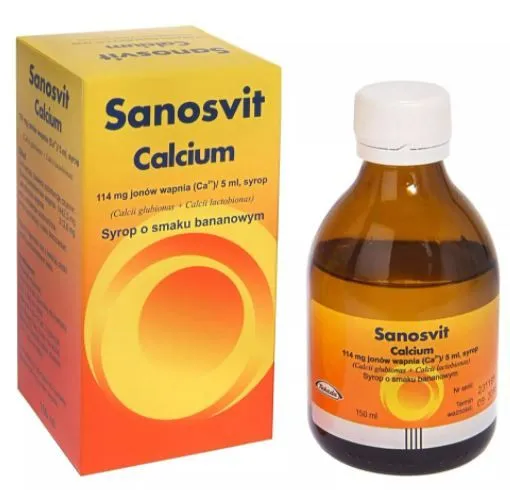
Table of Contents
Package leaflet: Information for the patient
Sanosvit Calcium
114 mg calcium ions (Ca )/5 ml, syrup
Calcii glubionas + Calcii lactobionas
Please read the entire leaflet carefully before using the medicine, as it contains
important information for the patient.
This medicine should always be used exactly as described in this patient leaflet or as directed by a
physician or pharmacist.
- Keep this leaflet for future reference.
- If advice or further information is needed, please consult a pharmacist.
- If any adverse reactions occur, including any possible adverse reactions not listed in this leaflet, inform a doctor or pharmacist. See section 4.
- If there is no improvement or if the patient feels worse, consult a doctor.
Table of contents
- What is Sanosvit Calcium and what is it used for
- Important information before using Sanosvit Calcium
- How to use Sanosvit Calcium
- Possible adverse effects
- How to store Sanosvit Calcium
- Contents of the pack and other information
1. What is Sanosvit Calcium and what is it used for
Sanosvit Calcium is a syrup with banana flavour, containing calcium glubionate and calcium lactobionate as active substances.
Calcium is a fundamental mineral component necessary for maintaining the body's water-electrolyte balance and proper functioning of numerous regulatory mechanisms.
It is an essential component of bone tissue, contributes to normal nerve conduction and muscle contraction, and is required in the blood coagulation process. By reducing the permeability of blood vessel walls, calcium exerts anti-exudative, anti-edematous, and anti-inflammatory effects.
The organic calcium compounds contained in the medicine are easily absorbed by the body. Administration of the medicine helps to supplement calcium deficiency and contributes to reduction of oedema and allergic reactions.
Sanosvit Calcium is used for the prevention and correction of calcium deficiency in the body, e.g. during pregnancy or lactation, in the treatment of osteoporosis, and as adjunctive therapy in the management of allergy symptoms.
2. Important information before using Sanosvit Calcium
When not to use Sanosvit Calcium:
- if the patient is allergic to calcium gluconolactobionate or calcium lactobionate, or to any of the other ingredients of this medicine (listed in section 6);
- if the patient has: conditions and (or) diseases leading to hypercalcaemia (increased calcium concentration in blood serum) and (or) hypercalciuria (increased excretion of calcium in urine); kidney stones; galactosaemia or diabetes.
Warnings and precautions
Before starting treatment with Sanosvit Calcium, discuss this with your doctor or pharmacist.
Consult your doctor if the patient:
- is taking digitalis glycosides, epinephrine, tetracyclines or thiazide diuretics;
- suffers from renal insufficiency, heart diseases, sarcoidosis, calcium oxalate kidney stones, or gout.
During long-term treatment with calcium-containing medicines, use of high doses of the medicine,
and especially during concomitant administration of vitamin D and (or) medicines or foods
containing calcium (e.g. milk), serum calcium levels and kidney function should be monitored regularly.
Sanosvit Calcium and other medicines
Tell your doctor or pharmacist about all medicines the patient is currently taking or has recently taken, as well as any medicines the patient plans to take.
Thiazide diuretics reduce calcium excretion in urine. Due to the risk of hypercalcaemia when thiazide diuretics are used concomitantly, serum calcium levels should be monitored regularly.
The medicine may interfere with the absorption of tetracyclines taken simultaneously. Therefore, tetracyclines should be taken at least 2 hours before or 4–6 hours after taking calcium compounds.
High doses of the medicine and vitamin D may weaken the effect of verapamil and other calcium channel blockers.
High doses of calcium salts administered simultaneously with cardiac glycosides (derivatives of digoxin and strophanthin) enhance their effect and may lead to cardiac arrhythmias.
The medicine enhances the effect of sulfonamides.
Vitamin D, glucocorticosteroids, parathormone, thiazide diuretics and citric acid increase the absorption of calcium salts, whereas calcitonin, excess lipids and phosphates reduce the absorption of calcium salts.
When bisphosphonates are used concomitantly, they should be administered at least 1 hour before taking calcium compounds, as bisphosphonate absorption may be reduced.
The medicine may reduce the effectiveness of levothyroxine by decreasing its absorption.
A minimum interval of 4 hours should be maintained between administration of calcium compounds and levothyroxine.
Absorption of quinolone antibiotics may be reduced when used concomitantly with calcium. Quinolone antibiotics should be taken 2 hours before or 6 hours after taking calcium compounds.
Calcium salts may reduce the absorption of iron, zinc and strontium ranelate. Therefore, a minimum interval of at least 2 hours between administration of these medicines and calcium salts is required.
If it is necessary to use any other medicines concomitantly, consult your doctor to determine possible changes in dosing regimen.
Taking Sanosvit Calcium with food and drink
Alkaline food pH, phytates (e.g. cereal products), oxalates (e.g. spinach, rhubarb) and phosphates (e.g. milk and dairy products) reduce calcium reabsorption.
Acidic food pH increases absorption of calcium salts.
Kidney function disorders
Patients with kidney stones should drink plenty of fluids during treatment. In patients with mild hypercalciuria, renal insufficiency or kidney stones, serum calcium concentration and urinary calcium excretion should be monitored.
Pregnancy, breastfeeding and fertility
If the patient is pregnant or breastfeeding, suspects she may be pregnant, or is planning to have a child, she should consult her doctor or pharmacist before using this medicine.
Excessive calcium intake should be avoided in pregnant women.
Driving and operating machinery
Sanosvit Calcium has no effect on the ability to drive vehicles or operate machinery.
The medicine contains sucrose, sodium benzoate (E 211), flavouring components including: propylene glycol (E 1520), sulphites and sodium
Sucrose
If the patient has previously been diagnosed with intolerance to certain sugars, the patient should consult a doctor before taking the medicine.
Propylene glycol (E 1520)
The medicine contains 10.88 mg of propylene glycol in 5 ml of syrup.
Sodium benzoate
The medicine contains 6 mg of sodium benzoate in each 5 ml of syrup.
Sulphites (from flavouring)
The medicine may rarely cause severe hypersensitivity reactions and bronchospasm.
Sodium
The medicine contains less than 1 mmol (23 mg) of sodium per 5 ml of syrup, meaning the medicine is considered "sodium-free".
3. How to use Sanosvit Calcium
This medicine should always be used exactly as described in this patient leaflet, or as directed by your doctor or pharmacist. If in doubt, consult your doctor or pharmacist.
Recommended dose
Children aged 1 to 6 years: 5 ml of syrup 2 to 3 times daily.
Children aged 6 to 12 years: 10 ml of syrup 2 to 3 times daily.
Adolescents and adults: 15 ml of syrup 2 to 3 times daily.
5 ml of syrup contains 114 mg of calcium ions.
The syrup should be taken orally in undiluted form.
After use, close the container tightly.
This medicine can be used in both children and adults; however, due to its syrup formulation and pleasant taste, it is primarily used in children.
Taking more Sanosvit Calcium than recommended
If more than the recommended dose has been taken, consult your doctor or pharmacist immediately.
Overdose may lead to hypercalcemia. Symptoms of overdose include: loss of appetite, increased thirst, nausea, vomiting, gastrointestinal disturbances, polyuria, and muscle weakness.
Missing a dose of Sanosvit Calcium
If the medicine is being taken regularly and only a short time has passed since the missed dose, take it as soon as possible.
If it is almost time for the next scheduled dose, take the next dose at the scheduled time.
Do not take a double dose to make up for a missed dose.
4. Possible adverse reactions
Like all medicines, this medicine can cause adverse reactions, although they do not occur in everyone.
Uncommon adverse reactions (occur in fewer than 1 in 100 patients):
- hypercalcemia (increased calcium concentration in blood serum) and hypercalciuria (increased excretion of calcium in urine).
Rare adverse reactions (occur in fewer than 1 in 1,000 patients):
- constipation, dyspepsia, bloating, nausea, abdominal pain, and diarrhoea.
Very rare adverse reactions (occur in fewer than 1 in 10,000 patients):
- milk-alkali syndrome (usually observed only in cases of overdose; symptoms include frequent urge to urinate, headache, loss of appetite, nausea or vomiting, unusual tiredness or weakness, increased levels of calcium in blood serum, and kidney failure);
- pruritus, rash, and urticaria.
Adverse reactions may occur when calcium intake exceeds 2000–2500 mg/day, with long-term use or in patients with renal impairment.
In patients with renal impairment, oral administration of high calcium doses may lead to hypercalcemia, the symptoms of which include: loss of appetite, gastrointestinal disturbances, muscle weakness, polyuria, and kidney damage.
Reporting of adverse reactions
If any adverse reactions occur, including any adverse reactions not listed in this leaflet, inform your doctor, pharmacist, or nurse. Adverse reactions can be reported directly to the Department of Monitoring Adverse Drug Reactions of the Office for Registration of Medicinal Products, Medical Devices and Biocidal Products:
Al. Jerozolimskie 181 C, 02-222 Warsaw, tel.: +48 22 49 21 301, fax: +48 22 49 21 309, website: https://smz.ezdrowie.gov.pl .
Adverse reactions can also be reported to the marketing authorization holder.
Reporting adverse reactions helps to provide more information on the safety of this medicine.
5. How to store Sanosvit Calcium
Store in the original, tightly closed container.
Store at a temperature below 25°C. Do not freeze.
After opening the bottle, do not store the medicine for longer than 3 months.
Keep the medicine out of sight and reach of children.
Do not use this medicine after the expiry date stated on the packaging. The expiry date refers to the last day of the stated month.
Medicines must not be disposed of via wastewater or household waste. Ask your pharmacist how to dispose of medicines no longer in use. This will help protect the environment.
6. Contents of the pack and other information
What Sanosvit Calcium contains
- The active substances are calcium glucoheptonate and calcium lactobionate. 5 ml of syrup contains 1442.5 mg of calcium glucoheptonate and 313.6 mg of calcium lactobionate.
- Other ingredients: sucrose, propionic acid, sodium benzoate (E 211), concentrated hydrochloric acid (for pH adjustment), banana flavour (containing, among others: propylene glycol - E 1520, methyl heptinocarbonate, eugenol, citral, isoeugenol, sulphites), purified water.
What Sanosvit Calcium looks like and contents of the pack
Sanosvit Calcium is a yellow syrup with a banana flavour.
The pack consists of a brown glass bottle with a white screw cap made of HDPE – with a white tamper-evident ring and a sealing insert made of LDPE or LDPE and HDPE (flow restrictor/dropper), containing 150 ml of syrup, packed in a cardboard box.
Marketing Authorisation Holder:
Orifarm Healthcare A/S
Energivej 15
5260 Odense S
Denmark
For further information about this medicinal product, please contact the local representative of the Marketing Authorisation Holder:
Orifarm Healthcare Sp. z o.o.
ul. Przyokopowa 31
01-208 Warszawa
Poland
[email protected]
Manufacturer:
Orifarm Manufacturing Poland Sp. z o.o.
ul. Księstwa Łowickiego 12
99-420 Łyszkowice
Poland