Salofalk
Poland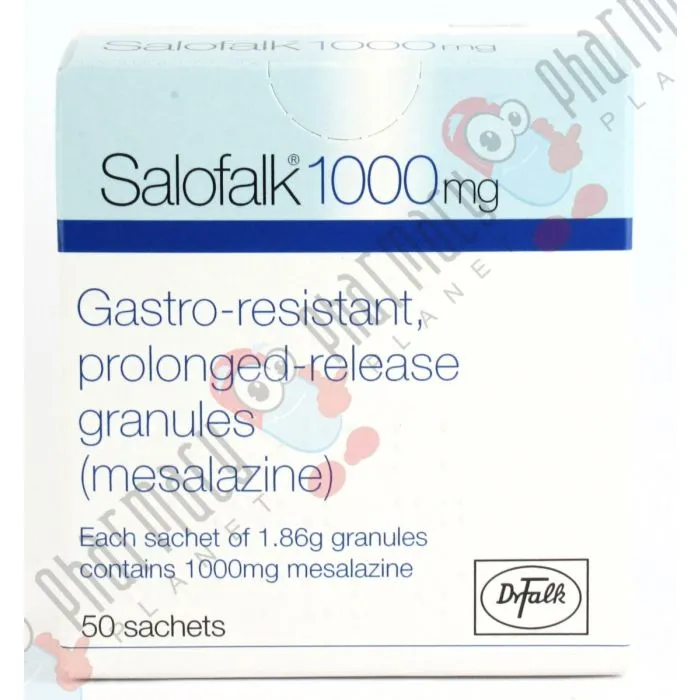
Table of Contents
Package leaflet: Information for the user
Salofalk, 1000 mg, prolonged-release granules
Mesalazinum
Please read all of this leaflet carefully before taking this medicine because it contains important information for you.
- Keep this leaflet. You may need to read it again.
- If you have any further questions, ask your doctor or pharmacist.
- This medicine has been prescribed for you personally. Do not pass it on to others. It may harm them even if their symptoms are the same as yours.
- If you get any side effects, talk to your doctor or pharmacist. This includes any possible side effects not listed in this leaflet. See section 4.
Contents of the leaflet
- What Salofalk is and what it is used for
- What you need to know before taking Salofalk
- How to take Salofalk
- Possible side effects
- How to store Salofalk
- Contents of the pack and other information
1. What Salofalk is and what it is used for
Salofalk 1000 mg granules contain the active substance mesalazine, which has anti-inflammatory action and is used in the treatment of inflammatory bowel disease.
Salofalk 1000 mg granules are used for:
- treatment of acute episodes and prevention of further episodes (relapses) of mild to moderate ulcerative colitis, an inflammatory disease of the large intestine (colon).
2. Important information before taking Salofalk
When not to take Salofalk
- if the patient is allergic to mesalazine, salicylic acid, salicylates such as acetylsalicylic acid (e.g. Aspirin), or any of the other ingredients of this medicine (listed in section 6),
- if the patient has severe liver or kidney disease.
Warnings and precautions
Before starting treatment with Salofalk, discuss the following with your doctor:
- if the patient has previously had lung problems, particularly bronchial asthma,
- if the patient has previously had an allergic reaction to sulfasalazine, a substance related to mesalazine,
- if the patient has impaired liver function,
- if the patient has impaired kidney function,
- if the patient has ever experienced severe skin rash, skin peeling, blisters, or oral ulcers after taking mesalazine.
Mesalazine may cause a reddish-brown discoloration of urine upon contact with sodium hypochlorite bleach present in toilet water. This is due to a chemical reaction between mesalazine and the bleach and is harmless.
Additional precautions
During treatment, the doctor may decide on close medical monitoring, including regular blood and urine tests.
Use of mesalazine may lead to the formation of kidney stones. Symptoms may include flank pain and blood in the urine. Adequate fluid intake is recommended during treatment with mesalazine.
Severe skin reactions have occurred with mesalazine treatment, including drug reaction with eosinophilia and systemic symptoms (DRESS), Stevens-Johnson syndrome (SJS), and toxic epidermal necrolysis (TEN). Treatment with mesalazine should be discontinued immediately and medical help sought if any symptoms of these serious skin reactions occur, as described in section 4.
If the patient experiences severe or recurring headache, vision disturbances, or ringing or buzzing in the ears, they should contact their doctor immediately.
Salofalk and other medicines
Tell your doctor about all medicines the patient is currently taking or has recently taken, as well as any medicines the patient plans to take. This is particularly important for the following medicines:
- azathioprine, 6-mercaptopurine, or thioguanine (medicines used to treat immune system disorders),
- certain anticoagulant medicines (medicines used to treat or prevent blood clots, e.g. warfarin),
- lactulose (a medicine used for constipation) or other medicines that may alter stool acidity.
Tell your doctor or pharmacist about all other medicines currently or recently taken, including those obtained without a prescription. This does not necessarily exclude the possibility of using Salofalk granules, but will allow the doctor to make an appropriate treatment decision.
Pregnancy and breastfeeding
If the patient is pregnant or breastfeeding, suspects she may be pregnant, or is planning to have a baby, she should consult her doctor or pharmacist before using this medicine.
Salofalk granules may be used during pregnancy only if prescribed by a doctor. Similarly, Salofalk granules should be used during breastfeeding only if recommended by a doctor, as the medicine may pass into human milk.
Driving and operating machinery
Salofalk has no effect or negligible effect on the ability to drive and operate machinery.
Salofalk contains aspartame, sucrose, and sodium.
The medicine contains 2 mg of aspartame per sachet of Salofalk granules. Aspartame is a source of phenylalanine. It may be harmful to patients with phenylketonuria, a rare genetic disorder in which phenylalanine accumulates in the body due to impaired excretion.
If the patient has previously been diagnosed with intolerance to certain sugars, the patient should consult a doctor before taking this medicine.
The medicine contains less than 1 mmol (23 mg) of sodium per sachet, meaning the medicine is considered "sodium-free".
3. How to take Salofalk
This medicine should always be taken exactly as directed by the physician. In case of doubt, consult your doctor or pharmacist.
Administration method
Salofalk in granule form must be administered orally only.
The granules must not be chewed. Place the granules directly on the tongue and swallow them whole, taking a large amount of liquid to help swallow, without chewing.
Dosage
| Age and body weight | Single dose | Total daily dose |
| Adults, elderly and children with body weight above 40 kg | ||
| Treatment of acute episodes | up to 3 sachets of Salofalk 1000 mg | 1 x 3 sachets or 3 x 1 sachet |
| Prevention of further episodes (in patients with increased risk of disease recurrence) | 3 sachets of Salofalk 1000 mg | 1 x 3 sachets |
| Children aged 6 years and older | ||
| Treatment of acute episodes | 30 to 50 mg mesalazine/kg body weight/day once daily or in divided doses | |
| Prevention of further episodes | 15 to 30 mg mesalazine/kg body weight/day in divided doses |
Adults and elderly patients
If the physician has not recommended a different dosage, the usual dose for the treatment of acute episodes
of ulcerative colitis is:
Depending on the individual patient's clinical needs – 3 sachets of Salofalk 1000 mg granules (equivalent to 3 g of mesalazine per day) once daily, preferably in the morning, or 1 sachet three times daily (morning, noon, evening).
Prevention of relapses of ulcerative colitis
The usual dose for preventing relapses of ulcerative colitis is:
500 mg mesalazine three times daily (equivalent to 1.5 g mesalazine per day).
If the physician determines a higher risk of relapse, the dose used to prevent further episodes of ulcerative colitis is:
3 sachets of Salofalk 1000 mg granules once daily, preferably in the morning (equivalent to
palpl-sag1000-pl11-1-nov25-clean.docx 3
3 g mesalazine per day).
Use in children
Data regarding use in children (aged 6–18 years) are limited.
Children aged 6 years and older
The exact dose of Salofalk 1000 mg granules in a child should be determined by the physician.
Acute episode:
The dose should be individually adjusted; usually starting at 30 to 50 mg mesalazine per kg body weight once daily, preferably in the morning, or in divided doses. The maximum dose is 75 mg mesalazine/kg body weight/day. The total daily dose should not exceed the maximum dose used in adults.
Prevention of relapses:
The dose should be individually adjusted; usually starting at 15 to 30 mg mesalazine per kg body weight/day in divided doses. The total daily dose should not exceed the recommended adult dose.
In children with body weight up to 40 kg, a dose equal to half the adult dose is usually recommended, whereas in children with body weight above 40 kg, the standard adult dose is typically used.
Duration of treatment
Treatment of acute episodes of ulcerative colitis usually lasts 8 weeks. The physician will decide how long treatment should continue. The duration of treatment depends on the patient's condition.
To achieve the maximum benefit from Salofalk granules, it is essential to take the medication regularly and consistently, both during acute inflammatory episodes and during long-term maintenance therapy, according to medical recommendations.
If you feel that the effect of Salofalk granules is too strong or too weak, consult your physician.
Taking more than the recommended dose of Salofalk
In case of doubt, consult your physician. The physician will decide on further management.
If a single dose of Salofalk granules exceeds the recommended amount, the next dose should be taken at the usual time. Do not reduce the dose.
Missed dose of Salofalk
Do not take a double dose to make up for a missed dose.
Stopping Salofalk treatment
Do not discontinue taking Salofalk without first consulting your physician.
If you have any further questions about the use of this medicine, consult your physician or pharmacist.
4. Possible adverse reactions
Like all medicines, this medicine can cause adverse reactions, although not everyone gets them.
If the patient experiences any of the following symptoms after taking this medicine, contact a doctor immediately
palpl-sag1000-pl11-1-nov25-clean.docx 4
and stop taking Salofalk:
- General allergic reactions, such as skin rash, fever, joint pain and (or) difficulty breathing, or general inflammation of the large intestine (causing severe diarrhoea and abdominal pain). These reactions are very rare.
- Marked deterioration in general health, especially if accompanied by fever and (or) sore throat and mouth ulcers. In very rare cases, these symptoms may be caused by a reduced number of white blood cells, leading to increased susceptibility to severe infections (agranulocytosis). It may also cause disturbances in other blood cells (e.g. platelets or red blood cells, leading to aplastic anaemia or thrombocytopenia) and may cause symptoms including unexplained bleeding, purplish spots or skin eruptions, anaemia (feeling of tiredness, weakness and paleness, especially of lips and nails). Blood tests may confirm whether the symptoms experienced by the patient are caused by this medicine's effect on blood. These reactions are very rare.
- Severe skin rashes with red, flat, disc-shaped or circular patches on the trunk, often with blisters in their center, skin peeling, ulceration in the mouth, throat, nose, genital organs and eyes, extensive rash, fever and swollen lymph nodes. These may be preceded by fever and flu-like symptoms. These reactions occur in an unknown number of patients (frequency unknown).
- Shortness of breath, chest pain or irregular heartbeat, or limb swelling, which may indicate hypersensitivity reactions affecting the heart. These reactions are rare.
- Problems with kidney function (may occur very rarely), e.g. change in colour or amount of urine produced, limb swelling or sudden lower abdominal pain (caused by kidney stones) (occur in an unknown number of patients (frequency unknown)).
- Severe or recurrent headache, visual disturbances, or ringing or buzzing in the ears. These may be symptoms of increased intracranial pressure (idiopathic intracranial hypertension) (frequency unknown [frequency cannot be estimated from available data]).
Patients taking mesalazine have also reported the following adverse reactions.
Common adverse reactions (occurring in less than 1 in 10 patients)
- headache,
- rash, itching.
Uncommon adverse reactions (occurring in less than 1 in 100 patients)
- abdominal pain, diarrhoea, indigestion, flatulence (bloating), nausea and vomiting,
- severe abdominal pain due to acute pancreatitis,
- changes in liver function parameters, changes in pancreatic enzyme activity.
Rare adverse reactions (occurring in less than 1 in 1000 patients)
- dizziness,
- jaundice or abdominal pain due to liver dysfunction and impaired bile flow,
- increased skin sensitivity to sunlight and ultraviolet radiation (photosensitivity),
- joint pain,
- feeling of weakness or fatigue.
Very rare adverse reactions (occurring in less than 1 in 10,000 patients)
- numbness and tingling of hands and feet (peripheral neuropathy),
- shortness of breath, cough, wheezing, lung shadow on X-ray due to allergic and (or) inflammatory lung reaction,
- hair loss and alopecia,
- muscle pain,
- reversible reduction in sperm count in semen.
palpl-sag1000-pl11-1-nov25-clean.docx 5
Reporting of adverse reactions
If any adverse reactions occur, including any adverse reactions not listed
in this leaflet, tell your doctor or pharmacist. Adverse reactions can be reported
directly to the Department of Monitoring Adverse Drug Reactions of the Office for Registration of Medicinal Products, Medical Devices and Biocidal Products
Al. Jerozolimskie 181C, 02-222 Warsaw
Tel.: + 48 22 49 21 301
Fax: + 48 22 49 21 309
Website: https://smz.ezdrowie.gov.pl
Adverse reactions may also be reported to the marketing authorization holder.
Reporting adverse reactions helps provide more information on the safety of this medicine.
5. How to store Salofalk
Keep this medicine out of sight and reach of children.
Do not use this medicine after the expiry date stated on the carton and sachet following EXP.
The expiry date refers to the last day of the stated month.
No special storage conditions are required for this medicine.
Medicines should not be disposed of via wastewater or household waste. Ask your pharmacist how to dispose of medicines no longer in use. This will help protect the environment.
6. Contents of the package and other information
What Salofalk contains
- The active substance in Salofalk is mesalazine: one sachet contains 1000 mg of mesalazine.
- The other ingredients are: microcrystalline cellulose, hypromellose (50 mPas), anhydrous colloidal silicon dioxide, polyacrylate dispersion 40%, magnesium stearate, simethicone, emulsion 33%. Coating: copolymer of methacrylic acid and methyl methacrylate (1:1), triethyl citrate, talc, magnesium stearate, hypromellose (50 mPas), sodium carboxymethylcellulose, aspartame (E 951), citric acid, povidone (K 25). Vanilla Custard flavour (GIV:75016-32/PHP-132872): flavourings identical to natural, maltodextrin, sucrose, propylene glycol.
What Salofalk looks like and contents of the pack
Salofalk 1000 mg prolonged-release granules are beige or brownish granules of elongated or round shape, possibly with yellowish spots on the surface.
Each sachet contains 1.83 g of granules.
Salofalk 1000 mg granules are available in packages containing 20, 50, 60, 100, and 150 sachets.
Not all pack sizes may be marketed.
Marketing Authorisation Holder and Manufacturer
DR. FALK PHARMA GmbH
Leinenweberstr. 5
79108 Freiburg
Germany
palpl-sag1000-pl11-1-nov25-clean.docx 6
Tel.: +49 (0) 761/1514-0
Fax: +49 (0) 761/1514-321
E-mail: [email protected]
This medicinal product is authorised for marketing in the European Economic Area countries under the following names:
Bulgaria, Denmark, Finland, Greece, Spain, the Netherlands, Ireland, Latvia, Germany, Norway, Poland, Portugal, the Czech Republic, Slovakia, Slovenia, Sweden, Hungary, the United Kingdom, Italy: Salofalk.
Belgium, Luxembourg: Colitofalk.
Austria: Mesagran.
France: Osperzo.
palpl-sag1000-pl11-1-nov25-clean.docx 7