Salbetan
Poland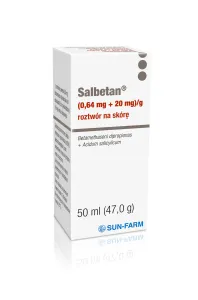
Table of Contents
Patient Information Leaflet
Salbetan, (0.64 mg + 20 mg)/g, cutaneous solution
Betamethasone dipropionate + Salicylic acid
Please read the following patient information carefully before using this medicine, as it contains important information for you.
- Keep this leaflet for future reference.
- If you have any further questions, please consult your doctor or pharmacist.
- This medicine has been prescribed for a specific individual. Do not share it with others. This medicine may harm others, even if their symptoms appear identical.
- If you experience any adverse effects, including those not listed in this leaflet, inform your doctor or pharmacist. See section 4.
Table of Contents
- What Salbetan is and what it is used for
- Important information before using Salbetan
- How to use Salbetan
- Possible side effects
- How to store Salbetan
- Contents of the pack and other information
1. What Salbetan is and what it is used for
Salbetan is a topical combination medicine containing betamethasone dipropionate (a corticosteroid) and salicylic acid (a keratolytic agent). Betamethasone dipropionate reduces inflammation and allergic reactions in the skin, as well as reactions associated with excessive skin cell proliferation. Salicylic acid loosens the outer (horny) layer of the skin and facilitates absorption of the corticosteroid.
Salbetan is used in the treatment of psoriasis (Latin: psoriasis vulgaris).
2. Important information before using Salbetan
When not to use Salbetan
- if the patient is allergic to betamethasone dipropionate, salicylic acid, or any of the other ingredients of this medicine (listed in section 6);
- if the patient has certain viral diseases (e.g. chickenpox, herpes simplex);
- if the patient has bacterial diseases (such as cutaneous tuberculosis, rosacea, syphilitic skin lesions);
- if the patient has bacterial or fungal skin infections (unless appropriately treated);
- on areas of skin affected by vaccination site reactions;
- on areas of skin affected by acne, rosacea (inflammatory skin condition with redness and flushing), or perioral dermatitis (inflammation around the mouth, especially upper lip and chin);
- in the eyes, on mucous membranes, or in the genital area, or on deep, open wounds;
- in case of repeated use: if the patient has gastric or intestinal ulcers or certain blood clotting disorders (reduced blood coagulation).
Salbetan must not be used in newborns and young children.
Salbetan must not be used under occlusive dressings (e.g. plasters, plaster casts).
Warnings and precautions
Before starting to use Salbetan, discuss it with your doctor or pharmacist.
Treatment with Salbetan should be discontinued if skin irritation or allergic reaction occurs during therapy.
Anti-inflammatory medicines (corticosteroids), such as betamethasone dipropionate – the active substance in Salbetan – are potent agents. The use of Salbetan over large skin areas or for prolonged periods is not recommended, as this increases the risk of adverse effects.
To reduce the risk of adverse effects:
- use the smallest possible amount of medicine, especially in children;
- use the medicine only as long as necessary to achieve improvement; treatment duration in adults should not exceed 3 weeks; in children, Salbetan must not be used for longer than 1 week;
- do not take Salbetan orally or apply it to the eyes, open wounds, or mucous membranes (e.g. around the anus or genital organs);
- do not use Salbetan over large body surface areas; in children, the maximum skin area treated must be less than 10% of the body surface;
- do not use Salbetan under materials impermeable to air and water, including bandages, dressings, clothing with poor air permeability, or diapers.
If the patient uses Salbetan to treat a condition other than the one for which it was prescribed, symptoms of the disease may be masked, which could delay correct diagnosis and appropriate treatment.
Salbetan should be used with caution on the face and must under no circumstances be applied to the eyes.
If the patient experiences blurred vision or other visual disturbances, consult a doctor.
To avoid symptoms of poisoning, the maximum daily dose of salicylic acid in adults must not exceed 2 g.
Children
Particular caution should be exercised when using Salbetan in children due to increased absorption of corticosteroid and salicylic acid through children's skin.
When used in children, the daily dose of salicylic acid must not exceed 0.2 g. In children, the maximum skin area treated with Salbetan must be less than 10% of the child's body surface.
Salbetan and other medicines
Inform your doctor or pharmacist about all medicines you are currently taking, have recently taken, or plan to take.
Medicated shampoos should not be used during treatment with Salbetan, as there is currently insufficient practical experience to exclude possible interactions.
The effect of this medicine on laboratory test results is currently unknown.
Pregnancy and breastfeeding
If the patient is pregnant, suspects she may be pregnant, plans to become pregnant, or is breastfeeding, she should consult her doctor or pharmacist before using this medicine.
Pregnancy:
Unless otherwise advised by a doctor, Salbetan should not be used during pregnancy to avoid exposing the unborn child to the medicine. If a doctor has prescribed Salbetan during pregnancy, the patient should use the smallest possible amount for the shortest possible time.
Breastfeeding:
If a doctor prescribes Salbetan during breastfeeding, the medicine should not be applied to the breast area. Avoid contact between the infant and any skin area treated with the medicine.
Consult your doctor or pharmacist before using any medicine.
Driving and operating machinery
No special warnings apply.
3. How to use Salbetan
This medicine should always be used as directed by a physician or pharmacist. If in doubt, consult a
physician or pharmacist. Always follow the instructions for use, as otherwise Salbetan may not work properly.
Recommended dose:
Apply Salbetan once or twice daily to the affected skin area.
In certain conditions, once-daily application may be sufficient. If improvement occurs, the frequency of
application may be reduced.
A thin layer of the solution should be applied to the affected skin area.
Duration of treatment:
The duration of treatment should not exceed 3 weeks.
Salbetan must not be used in children for longer than 1 week.
Salbetan must not be used in newborns and infants.
If the patient feels that the effect of Salbetan is too strong or too weak, they should contact a physician or
pharmacist.
Use of a higher than recommended dose of Salbetan
No significant risk is expected from a single overdose (application of too large an amount of the medicine,
over too large a skin surface, or too frequent application).
Repeated cases of overdose or improper use may cause adverse effects.
Excessive use of topical corticosteroids (repeated overdosing or improper use) may lead to so-called
hypercortisolism with severe symptoms, which will be treated appropriately by a physician. Acute symptoms
of hypercortisolism (e.g. moon face) are largely reversible. If necessary, disturbances in electrolyte balance
should be treated.
Excessive use of topical medicines containing salicylic acid may cause symptoms of salicylate poisoning
(tinnitus with hearing loss, nasal bleeding, nausea, vomiting, irritability, and dryness of mucous membranes).
The physician may initiate appropriate treatment for these symptoms.
Missed dose of Salbetan
Do not use a double dose to make up for a missed dose.
If there are any further doubts regarding the use of this medicine, consult a physician or pharmacist.
4. Possible adverse reactions
Like all medicines, this medicine can cause adverse reactions, although not everyone experiences them.
If any of the following adverse reactions occur in a patient, treatment with
Salbetan should be discontinued and medical advice should be sought immediately.
Adverse reactions have been classified according to the following frequency:
Not known (frequency cannot be estimated from available data):
skin irritation, skin thinning (atrophy), striae, blisters, steroid acne, development of light-coloured patches on the skin (depigmentation), spider veins, burning sensation of the skin, itching, dryness of the skin, folliculitis, changes in hair growth, sensitization, perioral dermatitis (around the mouth, upper lip and beard area), allergic skin reactions (contact dermatitis), maceration of the skin, delayed wound healing, scaling, secondary infections (additional infections caused by microorganisms), blurred vision.
The following adverse reactions may occur more frequently when the medicine is used under occlusive dressings (e.g. diapers, plaster casts): maceration of the skin, additional infections caused by microorganisms (secondary infections), skin thinning, striae and blisters.
Adverse reactions may occur not only at the site of application but also in completely different areas of the body (including systemic adverse reactions). This may happen if the active substance (corticosteroid) is absorbed into the body through the skin. This may lead, for example, to Cushing's syndrome, growth retardation in children, reduced weight gain, and increased intracranial pressure. This is particularly important in children, who are more susceptible to adverse reactions of the medicine.
Reporting of adverse reactions
If any adverse reactions occur, including any not listed in this leaflet, inform a doctor or pharmacist. Adverse reactions can be reported directly to the Department of Monitoring Adverse Drug Reactions of the Office for Registration of Medicinal Products, Medical Devices and Biocidal Products
Al. Jerozolimskie 181C
02-222 Warsaw
Phone: +48 22 49 21 301
Fax: +48 22 49 21 309
Website: https://smz.ezdrowie.gov.pl
Adverse reactions can also be reported to the marketing authorization holder.
Reporting adverse reactions helps to provide more information on the safety of the medicine.
5. How to store Salbetan
Keep this medicine out of the sight and reach of children.
Do not use this medicine after the expiry date stated on the bottle and carton following EXP. The expiry date refers to the last day of the stated month.
Do not store above 25°C.
Period of use after first opening the bottle: 3 months.
Medicines should not be disposed of via wastewater or household waste. Ask your pharmacist how to dispose of medicines no longer required. These measures help protect the environment.
6. Contents of the package and other information
What Salbetan contains
- The active substances are: betamethasone dipropionate and salicylic acid. 1 g of Salbetan contains 0.64 mg of betamethasone dipropionate (equivalent to 0.5 mg of betamethasone) and 20 mg of salicylic acid.
- Other components: disodium edetate, hypromellose type 2910, isopropyl alcohol, sodium hydroxide, concentrated hydrochloric acid, and purified water.
What Salbetan looks like and contents of the pack
Salbetan is a colourless, slightly viscous solution.
The medicine is available in a polyethylene bottle with a polyethylene dropper and polyethylene cap,
containing 50 ml (47.0 g) or 100 ml (94.0 g) of solution, packed in a cardboard box.
Not all pack sizes may be marketed.
Marketing Authorisation Holder and Manufacturer
Marketing Authorisation Holder
SUN-FARM Sp. z o.o.
ul. Dolna 21
05-092 Łomianki
Manufacturer
mibe GmbH Arzneimittel
Münchener Straße 15
06796 Brehna
Germany