Rytmonorm 300
Poland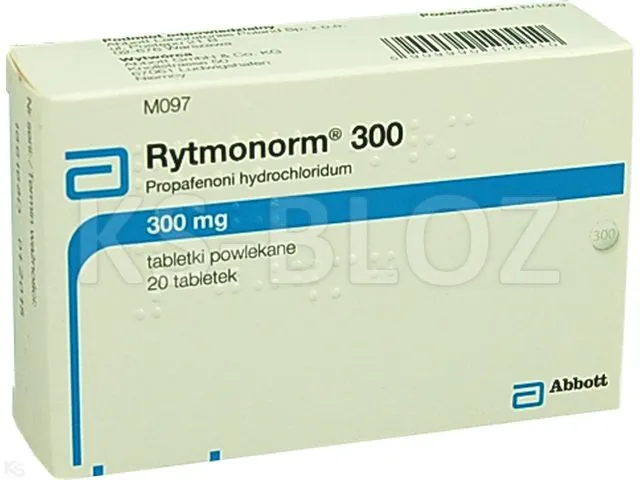
Table of Contents
PACKAGE LEAFLET: INFORMATION FOR THE PATIENT
Warning! Keep the leaflet — information on the immediate packaging is in a foreign language!
Rytmonorm 300 (Rytmonorm 300 mg)
300 mg, coated tablets
Propafenoni hydrochloridum
Rytmonorm 300 and Rytmonorm 300 mg are different trade names for the same medicinal product.
Please read the following leaflet carefully before using this medicine, as it contains
important information for the patient.
- Keep this leaflet for future reference.
- If you have any questions, consult your doctor or pharmacist.
- This medicine has been prescribed for a specific individual. Do not pass it on to others. It may harm someone else even if their symptoms are the same.
- If you experience any adverse reactions, including those not listed in this leaflet, inform your doctor or pharmacist. See section 4.
Table of contents
- What Rytmonorm 300 is and what it is used for
- What you need to know before taking Rytmonorm 300
- How to take Rytmonorm 300
- Possible side effects
- How to store Rytmonorm 300
- Contents of the pack and other information
1. What Rytmonorm 300 is and what it is used for
Propafenone hydrochloride — the active substance in Rytmonorm 300 — has antiarrhythmic properties, meaning it restores or maintains normal heart rhythm. The mechanism of action is complex and includes, among others, stabilization of the cell membrane and blockade of sodium channels. Propafenone hydrochloride also exhibits weak β-adrenolytic activity.
Rytmonorm 300 is indicated:
- for symptomatic supraventricular tachyarrhythmias requiring treatment, such as: nodal tachycardia, supraventricular tachycardia in patients with Wolff-Parkinson-White (WPW) syndrome, or paroxysmal atrial fibrillation;
- for severe symptomatic ventricular tachyarrhythmia, if the physician considers it life-threatening.
2. Important information before using Rytmonorm 300
When not to use Rytmonorm 300
- If the patient is allergic to the active substance or to any of the other ingredients of this medicine (listed in section 6).
- If the patient has:
- Brugada syndrome;
- Clinically significant structural heart disease, such as:
- Myocardial infarction within the last 3 months,
- Decompensated congestive heart failure,
- Left ventricular ejection fraction below 35%,
- Cardiogenic shock, excluding shock caused by arrhythmia,
- Symptomatic severe bradycardia (slow heart rate),
- Impaired sinus node function, atrial conduction disorders,
- Second- or higher-degree atrioventricular (AV) block, bundle branch block, or distal block in patients without a pacemaker,
- Severe hypotension;
- If the patient has symptoms of water and electrolyte imbalance (e.g. disturbances in potassium metabolism).
- In case of severe obstructive lung disease.
- In patients with myasthenia (a disease characterized by muscle weakness).
- If the patient is concurrently taking ritonavir (a medicine used in the treatment of HIV infections).
Warnings and precautions
Before starting treatment with Rytmonorm 300, discuss this with your doctor.
Propafenone, like other antiarrhythmic drugs, may cause proarrhythmic effects, i.e. it may induce new or worsen previously existing cardiac rhythm disorders (see section 4).
Before initiating treatment with Rytmonorm 300 and during treatment, your doctor will order ECG examinations and assess your clinical condition to confirm the appropriateness of treatment and to exclude Brugada syndrome (a genetically determined heart disease).
Special caution is required:
- In patients with an implanted cardiac pacemaker: the doctor will check the pacemaker's function and, if necessary, reprogram it, as the drug may affect the stimulation threshold and sensitivity of the implanted pacemaker.
- In patients with clinically significant structural heart disease, the drug is contraindicated.
- In patients with asthma.
In some patients, the drug may cause conversion of paroxysmal atrial fibrillation into atrial flutter with associated 2:1 or 1:1 conduction block.
Rytmonorm 300 and other medicines
Inform your doctor about all medicines currently used or recently taken, as well as any medicines you plan to take.
Concomitant use of Rytmonorm 300 with the following medicines may increase the risk of adverse effects:
- Local anaesthetics (e.g. during pacemaker implantation, surgical or dental procedures),
- Other drugs that reduce heart rate and/or myocardial contractility (β-blockers, tricyclic antidepressants). Increased risk of lidocaine-induced central nervous system adverse effects has been reported when lidocaine was used concomitantly with propafenone hydrochloride.
Rytmonorm 300 may enhance the effects of the following medicines:
- Drugs metabolized by the CYP2D6 isoenzyme, such as venlafaxine,
- β-blockers, such as propranolol, metoprolol,
- Antidepressants, such as desipramine,
- Immunosuppressive drugs, such as cyclosporine,
- Medicines used in the treatment of asthma, such as theophylline,
- Cardiac glycosides, such as digoxin,
- Oral anticoagulants, such as phenprocoumon, acenocoumarol, warfarin.
The following medicines may enhance the effect of Rytmonorm 300:
- Antifungal medicines (e.g. ketoconazole),
- Medicines used in the treatment of peptic ulcer disease (e.g. cimetidine),
- Antiarrhythmic drugs (e.g. quinidine),
- Antibacterial antibiotics (e.g. erythromycin),
- Selective serotonin reuptake inhibitors (SSRIs), such as paroxetine, fluoxetine.
If these medicines are used concomitantly with Rytmonorm 300, your doctor will monitor cardiovascular function and, if necessary, adjust the dose of propafenone hydrochloride.
The following medicines, when used concomitantly with Rytmonorm 300, may reduce its effectiveness:
- Phenobarbital,
- Rifampicin.
When treating concomitantly with amiodarone and Rytmonorm 300, dose adjustments of both medicines may be necessary, based on the patient's response to treatment.
Children and adolescents
Studies on the interactions between medicines have been conducted exclusively in adults. It is not known whether the range of the above interactions in children and adolescents is similar to that in adults.
Rytmonorm 300 and grapefruit juice
Grapefruit juice may increase blood levels of propafenone hydrochloride.
Pregnancy and breastfeeding
If the patient is pregnant or breastfeeding, suspects she may be pregnant, or is planning to become pregnant, she should consult a doctor or pharmacist before using this medicine.
Rytmonorm 300 may be used during pregnancy only if the benefit to the mother outweighs the potential risk to the fetus.
Excretion of propafenone into human milk has not been studied. Limited data suggest that propafenone may pass into breast milk. Caution should be exercised when administering Rytmonorm 300 to breastfeeding women.
Driving and operating machinery
Some adverse effects, such as blurred vision, dizziness, fatigue, and orthostatic hypotension (a sudden drop in blood pressure upon changing position from lying to standing), may affect reaction speed and impair the ability to drive or operate machinery.
If such symptoms occur, the patient should not drive or operate any machinery.
Rytmonorm 300 contains sodium
This medicine contains less than 1 mmol (23 mg) of sodium per tablet, meaning it is considered "sodium-free".
3. How to use Rytmonorm 300
This medicine should always be taken exactly as prescribed by your doctor. If in doubt, consult your
doctor or pharmacist.
The dosage will be individually determined by your doctor.
Due to the bitter taste of propafenone and its local anaesthetic effect, the coated tablets must be
swallowed whole (without chewing) with a drink.
Adults
During the initial dose adjustment period and for maintenance treatment in patients weighing approximately 70 kg,
the recommended daily dose of propafenone hydrochloride is 450 to 600 mg, administered in two or
three divided doses. Occasionally, it may be necessary to increase the daily dose of propafenone
hydrochloride up to 900 mg. In patients with lower body weight, the daily dose will be appropriately
reduced by the doctor. The dose may be increased only after 3 to 4 days of treatment.
If significant widening of the QRS complex or second- or third-degree atrioventricular block occurs,
the doctor will consider reducing the dose.
The individual maintenance dose should be established under cardiological supervision, including
ECG monitoring and repeated blood pressure measurements (dose-adjustment phase).
Use in children
Due to its strength, Rytmonorm 300 must not be used in children.
Elderly patients
In elderly patients, or in patients with significant left ventricular dysfunction (left ventricular ejection
fraction below 35%) or structural heart muscle disease, treatment should be initiated gradually and
with particular caution, using small, incrementally increased doses. The same applies to maintenance
therapy. If dose escalation is necessary, it may only be performed after five to eight days of treatment.
Patients with hepatic and/or renal impairment
In patients with impaired liver and/or kidney function, accumulation of the drug may occur after
administration of normally prescribed therapeutic doses. In such patients, the doctor will individually
adjust the dosage, monitoring ECG recordings and plasma drug concentrations.
Use of a higher than recommended dose of Rytmonorm 300
In case of overdose, disturbances in heart function, cardiac arrest, and hypotension may occur, and in
severe cases, cardiogenic shock.
Other symptoms may include: metabolic acidosis (a condition involving disturbance of the body's acid-base balance),
headache, dizziness, blurred vision, sensory disturbances (burning, pricking, tingling) in the hands or feet,
tremor, nausea, constipation, dry mouth, and seizures (convulsions).
Fatalities have also been reported.
In severe cases of poisoning, tonic-clonic seizures (seizures with loss of consciousness and muscle
contraction throughout the body), paresthesia (tingling sensations), somnolence, coma, and respiratory
arrest may additionally occur.
In case of overdose, seek immediate medical attention at the nearest hospital.
Missed dose of Rytmonorm 300
Do not take a double dose to make up for a missed dose.
If you have any further questions about the use of this medicine, consult your doctor or pharmacist.
4. Possible adverse effects
Like all medicines, this medicine can cause adverse effects, although not everyone will experience them.
The most commonly reported adverse effects associated with propafenone hydrochloride treatment are dizziness, conduction disturbances, and palpitations.
The adverse effects listed below have been reported in clinical trials and following the marketing of propafenone hydrochloride.
Very common (in at least 1 out of 10 patients)
- dizziness (except peripheral vertigo)
- conduction disturbances in the heart
- palpitations
Common (in 1 to 10 out of 100 patients)
- anxiety, sleep disturbances
- headache, taste disturbance
- blurred vision
- sinus bradycardia (slow heart rate), bradycardia, tachycardia (fast heart rate), atrial flutter
- shortness of breath
- abdominal pain, vomiting, nausea, diarrhoea, constipation, dry mouth
- liver function abnormalities (abnormal liver function test results, such as increased aspartate aminotransferase activity, increased alanine aminotransferase activity, increased gamma-glutamyl transferase activity, and increased alkaline phosphatase activity in blood)
- chest pain, asthenia (weakness), fatigue, fever
Uncommon (in 1 to 10 out of 1,000 patients)
- thrombocytopenia (low platelet count)
- decreased appetite, nightmares
- fainting, ataxia (lack of muscle coordination), paresthesia (tingling, numbness)
- dizziness
- ventricular tachycardia
- cardiac arrhythmia
- hypotension (low blood pressure)
- increased abdominal girth, flatulence
- urticaria, itching, rash, erythema
- erectile dysfunction
Frequency not known (frequency cannot be estimated from the available data)
- agranulocytosis (complete or almost complete lack of granulocytes in blood), leukopenia (reduced number of white blood cells), granulocytopenia (reduced number of granulocytes)
- hypersensitivity (may manifest as cholestasis, blood dyscrasias, and rash)
- confusion
- seizures, extrapyramidal symptoms, motor restlessness
- ventricular fibrillation, heart failure (existing heart failure may worsen), decreased heart rate
- orthostatic hypotension (sudden drop in blood pressure related to changing from lying to standing position)
- vomiting reflex, gastrointestinal disturbances
- hepatocellular injury, cholestasis, hepatitis, jaundice
- lupus-like syndrome
- acneiform skin eruptions
- reduced sperm count (reversible after discontinuation of propafenone)
Reporting of adverse effects
If any adverse effects occur, including any not listed in this leaflet, inform your doctor or pharmacist. Adverse effects can be reported directly to the Department of Monitoring Adverse Drug Reactions of the Office for Registration of Medicinal Products, Medical Devices and Biocidal Products, Al. Jerozolimskie 181C, 02-222 Warsaw, phone: +48 22 49 21 301, fax: +48 22 49 21 309, website: https://smz.ezdrowie.gov.pl
Reporting adverse effects helps to provide more information on the safety of the medicine.
5. How to store Rytmonorm 300
Keep this medicine out of the sight and reach of children.
There are no special storage instructions for this medicine.
Do not use this medicine after the expiry date stated on the packaging. The expiry date refers to the last day of the stated month.
Medicines must not be disposed of via the sewage system or household waste.
Ask your pharmacist how to dispose of medicines no longer required.
This will help protect the environment.
6. Contents of the pack and other information
What Rytmonorm 300 contains
- The active substance is propafenone hydrochloride. Each coated tablet contains 300 mg of the active substance.
- Other ingredients are: microcrystalline cellulose, sodium croscarmellose, corn starch, hypromellose, magnesium stearate, purified water; coating: macrogol 400, macrogol 6000, hypromellose, titanium dioxide (E 171).
What Rytmonorm 300 looks like and contents of the pack
Rytmonorm 300 is available as coated tablets. The coated tablet is white, biconvex, with the imprint "300" on one side.
Available pack sizes:
20 tablets – 2 blisters of 10 tablets
50 tablets – 5 blisters of 10 tablets
Blisters made of PVC/Al in a cardboard box.
For more detailed information, please contact the Marketing Authorisation Holder or the Parallel Importer.
Marketing Authorisation Holder in Spain, the country of export:
Teva B.V.
Swensweg 5
2031GA Haarlem
The Netherlands
Manufacturer:
ITC Farma s.r.l.
Via Pontina km 29
00071 Pomezia (RM)
Italy
Parallel Importer:
Medezin Sp. z o.o.
ul. Zbąszyńska 3
91-342 Łódź
Repackaged in:
Medezin Sp. z o.o.
ul. Zbąszyńska 3
91-342 Łódź
CEFEA Sp. z o.o. Sp. komandytowa
ul. Działkowa 56
02-234 Warszawa
SHIRAZ PRODUCTIONS Sp. z o.o.
ul. Tymiankowa 24/28
95-054 Ksawerów
CANPOLAND SPÓŁKA AKCYJNA
ul. Beskidzka 190
91-610 Łódź
Spanish Marketing Authorisation Number (country of export): 986257.2
Parallel Import Authorisation Number: 432/22