Rupafin
Poland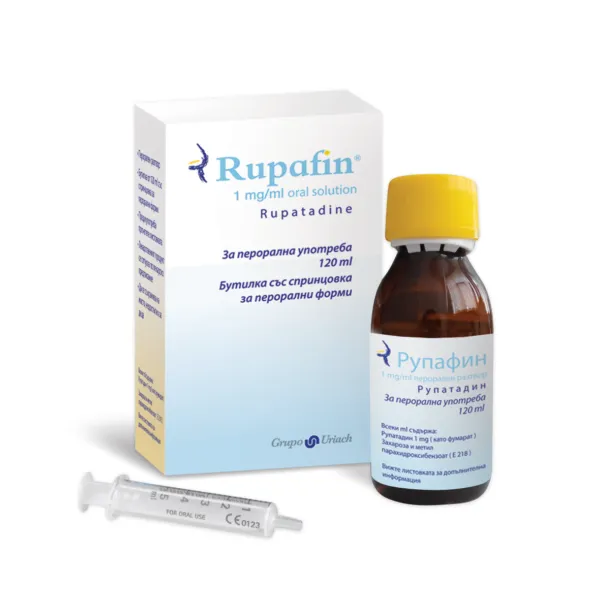
Table of Contents
Package leaflet: Information for the user
Warning! Keep this leaflet! The information on the immediate packaging is in a foreign language.
Rupafin
1 mg/ml, oral solution
Rupatadinum
Please read the entire leaflet carefully before taking this medicine, as it contains
important information for the patient.
- Keep this leaflet to be able to read it again if necessary.
- If you have any questions, please consult your doctor or pharmacist.
- This medicine has been prescribed for a specific individual. Do not pass it on to others. This medicine may harm someone else, even if their symptoms are the same.
- If the patient experiences any adverse reactions, including any adverse reactions not listed in this leaflet, inform a doctor, pharmacist or nurse. See section 4.
Table of contents of the leaflet
- What Rupafin is and what it is used for
- What you need to know before taking Rupafin
- How to take Rupafin
- Possible side effects
- How to store Rupafin
- Contents of the pack and other information
1. What Rupafin is and what it is used for
Rupafin contains the active substance rupatadine, which is an antihistamine medicine.
Rupafin oral solution relieves symptoms of allergic rhinitis, such as sneezing, runny nose, nasal congestion, itching of the eyes and nose in children aged 2 to 11 years.
Rupafin is also used to relieve symptoms associated with urticaria (allergic skin rash), such as itching and hives (localized redness and swelling of the skin) in children aged 2 to 11 years.
2. Important information before taking Rupafin
When not to take Rupafin
- If the patient is allergic to rupatadine or any of the other ingredients of this medicine (listed in section 6).
Warnings and precautions
Before starting to take Rupafin, discuss this with your doctor or pharmacist. If the patient has
kidney or liver impairment, medical advice should be sought.
Currently, the use of Rupafin is not recommended in patients with kidney or liver function disorders.
If the patient has low blood potassium levels and/or has an abnormal heart rhythm (known as QTc
prolongation on ECG), which may occur in certain heart conditions, they should consult a doctor.
Children
This medicine is not intended for use in children under 2 years of age or weighing less than 10 kg.
Rupafin and other medicines
Inform your doctor or pharmacist about all medicines currently taken or recently taken, as well as any
medicines the patient plans to take.
If the patient is taking Rupafin, they should not take medicines containing ketoconazole (a medicine
used for fungal infections) or erythromycin (a medicine used for bacterial infections).
If the patient is taking medicines that depress the central nervous system, statins (medicines used
to treat high cholesterol levels), or midazolam (a short-acting sedative and hypnotic medicine), they
should consult their doctor before using Rupafin.
Rupafin with food, drink, and alcohol
Rupafin can be taken with or without food.
Rupafin should not be taken together with grapefruit juice, as this may increase the concentration of
Rupafin in the body.
Rupafin at a dose of 10 mg does not increase alcohol-induced drowsiness.
Pregnancy and breastfeeding
If the patient is pregnant or breastfeeding, suspects she may be pregnant, or is planning to have a
child, she should consult her doctor or pharmacist before using this medicine.
Driving and operating machinery
Rupafin, when used at recommended doses, is not expected to affect the ability to drive or operate
machinery. However, if the patient is taking Rupafin for the first time, caution should be exercised
before driving or operating machinery, and the patient should observe their reaction to the medicine.
Rupafin contains sucrose, methyl parahydroxybenzoate (E 218), and propylene glycol (E 1520)
This medicine contains sucrose, which may have a harmful effect on teeth. If the patient has been
previously diagnosed with intolerance to certain sugars, they should contact their doctor before taking
this medicine.
This medicine contains methyl parahydroxybenzoate (E 218), which may cause allergic reactions
(including delayed-type reactions).
The medicine contains 200 mg of propylene glycol (E 1520) in each ml.
Before administering this medicine to a child under 5 years of age, contact a doctor or pharmacist,
particularly if the child is taking other medicines containing propylene glycol or alcohol.
Women who are pregnant or breastfeeding should not take this medicine without medical advice. The
doctor may decide to perform additional monitoring in such patients.
Patients with impaired liver or kidney function should not take this medicine without medical advice.
The doctor may decide to perform additional monitoring in such patients.
The medicine contains less than 1 mmol (23 mg) of sodium per 1 ml, meaning the medicine is considered "sodium-free".
3. How to take Rupafin
Rupafin should always be taken exactly as directed by the doctor. In case of any doubts, contact
your doctor or pharmacist.
Rupafin oral solution is intended for oral use.
Dosing in children with body weight of 25 kg or more:
5 ml (5 mg of rupatadine) of oral solution once daily, with or without food.
Dosing in children with body weight of 10 kg or more, but less than 25 kg:
2.5 ml (2.5 mg of rupatadine) of oral solution once daily, with or without food.
Your doctor will inform you how long the treatment with Rupafin should last.
Instructions for administration:
- To open the bottle, press down on the cap and turn it counterclockwise.
- Take the syringe and insert it into the perforated stopper; then turn the bottle upside down.
- Draw up the prescribed dose into the syringe.
- Administer the solution directly from the dosing syringe.
- After use, wash the syringe.
Taking more Rupafin than recommended
If you accidentally take more Rupafin than you should, contact your doctor or pharmacist immediately.
If you miss a dose of Rupafin
Do not take a double dose to make up for a missed dose.
4. Possible adverse reactions
Like any medicine, this medicine can cause adverse reactions, although they do not occur in everyone.
Common adverse reactions (may occur in up to 1 in 10 patients): headache and somnolence.
Uncommon adverse reactions (may occur in up to 1 in 100 patients): influenza, pharyngitis, upper respiratory tract infection, eosinophilia, neutropenia, dizziness, nausea, rash, night sweats, and fatigue.
Reporting of adverse reactions
If any adverse reactions occur, including any adverse reactions not listed in this leaflet, inform a doctor, pharmacist, or nurse. Adverse reactions can be reported directly to the Department of Monitoring Adverse Drug Reactions at the Office for Registration of Medicinal Products, Medical Devices and Biocidal Products, Al. Jerozolimskie 181C, 02-222 Warsaw, phone: +48 22 49 21 301, fax: +48 22 49 21 309, website: https://smz.ezdrowie.gov.pl
Adverse reactions can also be reported to the responsible party or parallel importer.
Reporting adverse reactions helps to provide more information on the safety of the medicine.
5. How to store Rupafin
Keep this medicine out of the sight and reach of children.
No special storage conditions are required.
Do not use this medicine after the expiry date stated on the packaging. The expiry date refers to the last day of the stated month. The shelf-life after first opening is the same as the expiry date indicated on the packaging.
Medicines must not be disposed of via wastewater or household waste. Ask your pharmacist how to dispose of medicines no longer required. This will help protect the environment.
6. Contents of the pack and other information
What Rupafin contains
- The active substance is rupatadine. Each ml contains 1 mg of rupatadine (as rupatadine fumarate).
- Other ingredients are: propylene glycol (E 1520), citric acid, disodium phosphate, sodium saccharin, sucrose, methyl parahydroxybenzoate (E 218), quinoline yellow (E 104), banana flavour, purified water. See section 2 "Rupafin contains sucrose, methyl parahydroxybenzo游戏副本