Rocuronium b. braun
Poland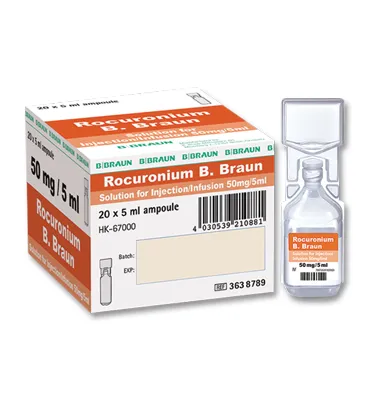
Table of Contents
- Patient Information Leaflet
- 2. Important information before administration of Rocuronium B. Braun
- 3. How to use Rocuronium B. Braun
- 4. Possible adverse reactions
- 5. How to store Rocuronium B. Braun
- 6. Contents of the pack and other information
- The following information is intended for healthcare professionals only:
Patient Information Leaflet
Rocuronium B. Braun 10 mg/ml solution for injection / infusion
Rocuronii bromidum
Please read all of this leaflet before this medicine is administered,
because it contains important information for you.
- Keep this leaflet. You may need to read it again.
- Please contact your doctor, pharmacist, or nurse if you need advice or additional information.
- This medicine has been prescribed for a specific individual. Do not pass it on to others. It may harm someone else, even if their symptoms are the same.
- If any of the side effects worsen or if any side effects not listed in this leaflet occur, inform your doctor, pharmacist, or nurse. See section 4.
Table of contents:
- What Rocuronium B. Braun is and what it is used for
- Important information before administration of Rocuronium B. Braun
- How to use Rocuronium B. Braun
- Possible side effects
- How to store Rocuronium B. Braun
- Contents of the pack and other information
1. What Rocuronium B. Braun is and what it is used for
Rocuronium B. Braun belongs to a group of medicines called muscle relaxants.
Under normal conditions, nerves transmit signals to muscles via impulses. Rocuronium B. Braun works by blocking these impulses, resulting in muscle relaxation.
During surgery, the patient's muscles should be completely relaxed. This facilitates the surgeon's work.
In adults and children under general anaesthesia, this medicine may be used to facilitate insertion of a tube into the trachea to assist breathing (mechanical ventilation) and to provide muscle relaxation during surgical procedures.
In adults, the doctor may also use this medicine for a short period as an adjunct to treatment in the intensive care unit (e.g. to facilitate intubation). Additionally, the patient may receive this medicine in an emergency situation when rapid tracheal intubation is required to prepare the patient for surgery.
2. Important information before administration of Rocuronium B. Braun
When not to use Rocuronium B. Braun:
- if the patient is allergic to rocuronium bromide, bromide ion, or any of the other ingredients of this medicine (listed in section 6).
Warnings and precautions
Before administration, consult your doctor, pharmacist, or nurse if the patient:
- has a known allergy to any muscle relaxant;
- has kidney, liver or biliary tract disease;
- has heart disease or a condition affecting blood circulation;
- has swelling of body parts due to fluid accumulation ( oedema, e.g. in the ankle joint);
- has a neuromuscular disorder (neuromuscular diseases, e.g. polio (anterior poliomyelitis), myasthenia gravis (muscle weakness), Eaton-Lambert syndrome);
- has experienced low body temperature during anaesthesia (hypothermia);
- has experienced high fever (malignant hyperthermia) during anaesthesia;
- currently has fever;
- has low calcium levels in the blood (hypocalcaemia) (e.g. due to massive blood transfusion);
- has low potassium levels in the blood (hypokalaemia) (e.g. due to severe vomiting, diarrhoea, or diuretic therapy);
- has high magnesium levels in the blood (hypermagnesaemia);
- has low protein levels in the blood (hypoproteinaemia);
- is dehydrated;
- has high acid levels in the blood (acidosis);
- has elevated carbon dioxide levels in the blood (hypercapnia);
- has experienced excessive weight loss (cachexia);
- is overweight or is of advanced age;
- has sustained burns.
Other medicines and Rocuronium B. Braun
Inform your doctor or pharmacist about all medicines currently used, recently used, or planned for use, such as:
- antibiotics;
- antidepressants – medicines used to treat depression (e.g. MAO inhibitors) containing lithium;
- medicines used to treat heart conditions and hypertension (e.g. quinidine, calcium channel blockers, adrenergic receptor blockers (e.g. beta-blockers, alpha-blockers));
- diuretics, i.e. water tablets (medicines that increase urine excretion);
- certain laxatives, e.g. magnesium salts;
- quinine (used to treat pain and infections);
- medicines used to treat epilepsy (e.g. phenytoin, carbamazepine);
- corticosteroids used long-term in intensive care;
- medicines used to treat myasthenia gravis ( muscle weakness ) (neostigmine, edrophonium, pyridostigmine, aminopyridine);
- theophylline (used to treat asthma);
- medicines used to treat or prevent viral infections (protease inhibitors).
Note:
During surgery, the patient may receive other medicines that may affect the action of rocuronium. These include certain anaesthetics (e.g. local anaesthetics, inhalational anaesthetics), other muscle relaxants, and protamine, which reverses the anticoagulant effect of heparin. The doctor will take this into account when deciding whether to adjust the dose of the medicine.
Pregnancy, breastfeeding and fertility
If you are pregnant, breastfeeding, think you may be pregnant, or are planning to become pregnant, consult your doctor or pharmacist before receiving this medicine.
Data on the use of Rocuronium B. Braun in pregnant and breastfeeding women are very limited. Rocuronium B. Braun may be administered to pregnant and breastfeeding women only if the doctor decides that the benefits outweigh the risks. Rocuronium B. Braun may be used during caesarean section.
There are no available data on the effect of this medicine on fertility.
Driving and operating machinery
Rocuronium B. Braun has a significant effect on the ability to drive and operate machinery. Therefore, driving or operating potentially dangerous machinery is not recommended during the first 24 hours after administration of the medicine, or until the full effects of the medicine have completely worn off.
The doctor should inform the patient when they can resume driving or operating machinery. After anaesthesia, a patient returning home should remain under the continuous supervision of an adult.
Rocuronium B. Braun contains sodium
This medicine contains less than 1 mmol of sodium (23 mg) per single dose, which qualifies it as "sodium-free".
3. How to use Rocuronium B. Braun
Rocuronium B. Braun will be administered to the patient by an anaesthesiologist. The medicine is given either as a single intravenous injection or by continuous intravenous infusion (over a longer period).
Adults
The usual dose is 0.6 mg per kg of body weight. The effect of the medicine lasts 30 to 40 minutes. During surgery, the effect of Rocuronium B. Braun is continuously monitored. Therefore, the doctor may administer additional doses of the medicine depending on the individual patient's condition. If necessary, further doses may be given. The dose is adjusted to the patient's needs by the anaesthesiologist. The dose size depends on several factors, such as drug interactions (cross-activity), estimated duration of surgery, as well as the patient's age and clinical condition.
The medicine is intended for single use only.
Use in children and adolescents
This medicine may be given to newborns (0–27 days), infants (28 days–2 months), young children (3–23 months), children (2–11 years), and adolescents (12 to ≤17 years). The anaesthesiologist adjusts the dose according to the child's needs.
In children, an increased infusion rate may be required.
Experience with the use of rocuronium bromide in children and adolescents undergoing a specific anaesthetic technique called rapid sequence induction is limited. Therefore, the use of rocuronium bromide for this purpose in children and adolescents is not recommended.
Elderly patients, obese/overweight patients, and patients with liver, biliary, and/or kidney disease:
Dose adjustment by the physician may be necessary according to the individual patient's condition.
There is a lack of data supporting the recommendation for the use of rocuronium bromide in newborns (0–1 month).
Administration of a higher than recommended dose of Rocuronium B. Braun
During treatment with Rocuronium B. Braun, the patient remains under close supervision of the anaesthesiologist, making it unlikely that an excessive dose will be administered. If this occurs, it may intensify the muscle-relaxing effect. In such a case, the anaesthesiologist may administer reversal agents to counteract this effect and ensure that anaesthesia and artificial ventilation are continued until the patient resumes spontaneous breathing.
Questions regarding the use of the medicine
If you have any further questions about the use of this medicine, please consult your doctor, pharmacist, or nurse.
For information intended for physicians and healthcare professionals, see the appropriate section below.
4. Possible adverse reactions
Like all medicines, this medicine can cause adverse reactions, although not everyone will experience them.
The following adverse reactions may be serious. If any of the reactions listed here occur,
tell your doctor or nurse immediately:
Very rare (may affect up to 1 in 10,000 patients):
Hypersensitivity (allergic) reactions and related symptoms occur rarely, i.e. may affect more than 1 in 1,000 patients, but may be life-threatening. Symptoms of hypersensitivity reactions may include: rash, itching, difficulty breathing, low blood pressure, rapid heartbeat, circulatory collapse, shock, or swelling of the face, lips, throat or tongue, urticaria, linear wheals after stroking, skin redness. Additionally, during anesthesia, other respiratory problems may occur (anesthesia-related airway complications).
Unknown frequency (cannot be estimated from available data):
- respiratory arrest;
- respiratory failure;
- severe allergic coronary artery spasm (Kounis syndrome) causing chest pain (angina pectoris) or heart attack (myocardial infarction).
Other adverse reactions include:
Uncommon/rare (may affect 1 to 10 in 1,000 patients):
- increased heart rate (tachycardia)*;
- delayed emergence from anesthesia;
- drop in blood pressure (hypotension);
- lack of effectiveness of the medicine;
- increased or decreased overall effect of the medicine;
- increased or decreased response of the body to the medicine;
- pain at injection site;
- prolonged muscle-relaxing effect (prolonged neuromuscular blockade).
Very rare (may affect 1 in 10,000 patients):
- increased blood histamine concentration;
- wheezing (bronchospasm);
- inability to move (flaccid paralysis);
- muscle weakness (after prolonged use of this medicine in intensive care, particularly when administered with corticosteroids).
*Clinical studies suggest that increased heart rate in children and adolescents occurs commonly and may affect up to 1 in 10 patients.
Reporting of adverse reactions
If any adverse reactions occur, including any not listed in this leaflet, tell your doctor, pharmacist or nurse. Adverse reactions can be reported directly via the Department of Monitoring Adverse Drug Reactions, Office for Registration of Medicinal Products, Medical Devices and Biocidal Products
Al. Jerozolimskie 181C, 02-222 Warsaw
Tel.: +48 22 49 21 301
Fax: +48 22 49 21 309
Website: https://smz.ezdrowie.gov.pl
Adverse reactions can also be reported to the marketing authorization holder.
Reporting adverse reactions helps provide more information on the safety of this medicine.
5. How to store Rocuronium B. Braun
Keep this medicine out of the sight and reach of children.
Do not use this medicine after the expiry date stated on the label and carton after "Expiry date". The expiry date refers to the last day of the specified month.
Do not store above 25°C.
After first opening: The medicine should be used immediately after opening the ampoule.
Diluted solution: The ready-to-use solution at a concentration of 5.0 mg/ml or 0.1 mg/ml (diluted with sodium chloride 9 mg/ml (0.9%) infusion solution or glucose 50 mg/ml (5%) infusion solution) maintains chemical and physical stability for 24 hours at room temperature under normal light exposure conditions in glass and plastic containers.
Due to the risk of microbiological contamination, the solution should be used immediately. If this is not possible, the responsibility for the storage conditions and duration of the ready-to-use solution lies with the user. Usually, storage should not exceed 24 hours at 2–8°C, unless dilution has been carried out under controlled and validated aseptic conditions.
Do not use this medicine if the solution is not clear or contains any particles.
Medicines must not be disposed of via wastewater or household waste. Ask your pharmacist how to dispose of medicines no longer required. Such measures will help protect the environment.
6. Contents of the pack and other information
What Rocuronium B. Braun contains
The active substance is rocuronium bromide.
1 ml contains 10 mg of rocuronium bromide.
Each 5 ml ampoule contains 50 mg of rocuronium bromide.
Other ingredients are gluconolactone, sodium acetate trihydrate, sodium citrate dihydrate, and water for
injections.
What Rocuronium B. Braun looks like and contents of the pack
Rocuronium B. Braun is a clear, colourless or pale brownish-yellow solution for injection or infusion.
Pack types:
Rocuronium B. Braun is available in packs of 20 plastic ampoules containing 5 ml of solution.
Marketing Authorisation Holder and Manufacturer
Marketing Authorisation Holder
B. Braun Melsungen AG
Carl-Braun-Strasse 1
34212 Melsungen
Germany
Correspondence address:
34209 Melsungen
Telephone: +49 5661/71-0
Fax: +49 5661/71-4567
This medicinal product is authorised in the Member States of the European Economic Area under the following names:
| Austria | Rocuronium bromide B. Braun 10 mg/ml |
| Belgium | Rocuronium B. Braun 10 mg/ml solution for injection/infusion |
| Czech Republic | Rocuronium B. Braun 10 mg/ml |
| Germany | Rocuronium bromide B. Braun 10 mg/ml |
| Greece | Rocuronium B. Braun 10 mg/ml |
| Spain | Rocuronium B. Braun 10 mg/ml |
| Finland | Rocuronium B. Braun 10 mg/ml |
| Ireland | Rocuronium 10 mg/ml |
| Italy | Rocuronium B. Braun 10 mg/ml |
| Luxembourg | Rocuronium bromide B. Braun 10 mg/ml |
| Netherlands | Rocuronium bromide B. Braun 10 mg/ml |
| Poland | Rocuronium B. Braun |
| Portugal | Rocuronium bromide B. Braun 10 mg/ml |
| Sweden | Rocuronium B. Braun 10 mg/ml |
| Slovak Republic | Rocuronium B. Braun 10 mg/ml |
| United Kingdom | Rocuronium 10 mg/ml |
The following information is intended for healthcare professionals only:
Preparation method:
Rocuronium B. Braun 10 mg/ml solution for injection / for infusion
Before preparing the medication for administration, the entire text of this instruction must be read.
Preparation for intravenous administration
The medicinal product is intended for single use only.
Rocuronium B. Braun is intended for intravenous ( iv .) administration as a bolus injection or by continuous infusion.
Rocuronium B. Braun is compatible with the following solutions: sodium chloride 9 mg/ml (0.9%) and glucose 50 mg/ml (5%).
Any unused solution should be discarded.
Rocuronium B. Braun must not be mixed with other medicinal products except those mentioned above.
Physical incompatibility of rocuronium bromide has been documented when added to solutions containing the following medicinal products: amphotericin, amoxicillin, azathioprine, cefazolin, cloxacillin, dexamethasone, diazepam, enoxymon, erythromycin, famotidine, furosemide, sodium succinate hydrocortisone, insulin, intralipid, methohexital, methylprednisolone, sodium succinate prednisolone, thiopental, trimethoprim, and vancomycin.
If Rocuronium B. Braun is administered using the same infusion line as other medicinal products, it is essential to adequately flush the infusion line (e.g. with 0.9% NaCl) between administration of Rocuronium B. Braun and any medicinal product with which rocuronium bromide has been shown to be incompatible or for which compatibility with rocuronium bromide has not been established.