Rocuronium aguettant
Poland
Table of Contents
- Package leaflet: Information for the user
- 1. What Rocuronium Aguettant is and what it is used for
- 2. Important information before using Rocuronium Aguettant
- 3. How to use Rocuronium Aguettant
- 4. Possible adverse reactions
- 5. How to store Rocuronium Aguettant
- 6. Contents of the Package and Other Information
Package leaflet: Information for the user
Rocuronium Aguettant, 10 mg/mL, solution for injection in ampoule-syringe
Rocuronii bromidum
Please read all of this leaflet carefully before this medicine is administered, because it contains
important information for the patient.
- Keep this leaflet, as you may need to read it again.
- If you have any further questions, please ask your doctor or pharmacist.
- If you experience any side effects, including any not listed in this leaflet, please inform your doctor or pharmacist. See section 4.
Contents of the leaflet
- What Rocuronium Aguettant is and what it is used for
- Important information before administration of Rocuronium Aguettant
- How to use Rocuronium Aguettant
- Possible side effects
- How to store Rocuronium Aguettant
- Contents of the pack and other information
1. What Rocuronium Aguettant is and what it is used for
Rocuronium Aguettant belongs to a group of medicines called muscle relaxants and is intended for use in adults and children aged 2 years and older. Muscle relaxants are used during surgery to assist general anaesthesia. This helps the surgeon to perform the surgical procedure. Normally, nerves send signals to muscles. Rocuronium Aguettant can temporarily block these signals, thereby causing muscle relaxation. Because the muscles involved in breathing are also relaxed, artificial ventilation will be provided until the patient is able to breathe independently again. During surgery, the effect of the muscle relaxant will be continuously monitored, and additional doses of Rocuronium Aguettant may be administered if necessary. After completion of surgery, the effect of Rocuronium Aguettant may wear off, allowing the patient to start breathing independently again. In some cases, another medicine will be given to speed up the return of spontaneous breathing. Rocuronium Aguettant may also be used during intensive medical care.
2. Important information before using Rocuronium Aguettant
When not to use Rocuronium Aguettant
- if the patient is allergic to rocuronium or any of the other ingredients of this medicine (listed in section 6). The doctor should be informed if this applies to the patient.
Warnings and precautions
Previous medical conditions may affect the way Rocuronium Aguettant is administered. You should
inform the doctor if the patient has or has ever had any of the following conditions:
- allergy to muscle relaxants
- impaired kidney function (kidney problems) or kidney disease
- cardiovascular diseases
- development of oedema (fluid accumulation in the body, e.g. in the ankles)
- liver, gallbladder or biliary tract diseases or impaired liver function
- diseases affecting nerve and muscle function
- a history of malignant hyperthermia (sudden fever with rapid heartbeat, rapid breathing, and muscle stiffness and/or pain).
Certain medical conditions may influence the effect of Rocuronium Aguettant, such as:
- low blood potassium levels (hypokalaemia)
- high blood magnesium levels (hypermagnesaemia), e.g. during treatment of pregnancy toxemia with magnesium salts
- low blood calcium levels (hypocalcaemia)
- low blood protein levels (hypoproteinaemia)
- insufficient fluid levels (dehydration)
- excess acid in the blood (acidosis)
- excess carbon dioxide in the blood (hypercapnia)
- general weakness
- obesity
- burns
If any of the above conditions apply to the patient, the doctor will take this into account when
determining the appropriate dose of Rocuronium Aguettant for the patient.
Children and adolescents
Rocuronium Aguettant may be used in children (aged 2–11 years) and adolescents (aged 12–17 years). However, maintenance dosing is not recommended in children under 12 years of age.
Rocuronium Aguettant should not be administered to children under 2 years of age, as the pre-filled syringe graduations do not allow accurate dose measurement for this age group.
Rocuronium Aguettant and other medicines
You should inform the doctor or pharmacist about all medicines the patient is currently taking, has recently taken, or plans to take. This will help the doctor determine the appropriate dose of Rocuronium Aguettant for the patient.
The following medicines may affect the action of Rocuronium Aguettant:
Medicines that enhance the effect of Rocuronium Aguettant:
- certain anaesthetics
- medicines used to relax muscles (succinylcholine)
- certain antibiotics used to treat bacterial infections
- certain medicines used to treat bipolar disorder (lithium)
- certain medicines used to treat heart disease or high blood pressure (quinidine, calcium channel blockers, beta-blockers)
- certain medicines used to treat malaria (quinine)
- diuretics (water tablets)
- magnesium salts
- local anaesthetics (lidocaine and bupivacaine)
- short-term use of anticonvulsants (phenytoin), e.g. during surgical procedures.
Medicines that reduce the effect of Rocuronium Aguettant:
- long-term use of corticosteroids (anti-inflammatory medicines) or medicines used to treat epilepsy (phenytoin and carbamazepine)
- medicines used in pancreatitis, coagulation disorders, and acute blood loss (protease inhibitors: gabexate, ulinastatin)
- calcium chloride, potassium chloride.
Medicines with variable effects on Rocuronium Aguettant:
- other medicines used to relax muscles.
Rocuronium Aguettant may affect the action of the following medicines:
- The effect of local anaesthetics (lidocaine) may be enhanced.
Pregnancy, breastfeeding and fertility
If the patient is pregnant or breastfeeding, suspects she may be pregnant, or is planning to have a
child, she should consult her doctor or pharmacist before using this medicine.
Data on the use of rocuronium bromide in pregnant women are very limited. There are no data on the use of rocuronium bromide during breastfeeding.
Rocuronium Aguettant may be administered to pregnant and breastfeeding women only if the doctor decides that the benefits outweigh the risks.
This medicine may be administered during caesarean section.
Driving and operating machinery
The doctor will inform the patient when it will be safe to resume driving or operating machinery after administration of Rocuronium Aguettant.
Rocuronium Aguettant contains sodium
This medicine contains less than 1 mmol (23 mg) of sodium per pre-filled syringe, meaning the medicine is considered "sodium-free".
3. How to use Rocuronium Aguettant
Dosage
The doctor will determine the dose of Rocuronium Aguettant based on the following factors:
- the type of anaesthesia used
- the expected duration of the surgical procedure
- other medications being administered to the patient
- the patient's age and overall health condition
Rocuronium Aguettant will be administered by a doctor or nurse before and/or during the surgical procedure. The usual dose is 0.6 mg/kg of body weight of rocuronium bromide, and its effect lasts between 30 and 40 minutes. During the procedure, the doctor will monitor whether the effect of Rocuronium Aguettant is maintained. If necessary, additional doses may be given.
Method of administration
Rocuronium Aguettant is not intended for self-administration. Rocuronium Aguettant will be given intravenously as a solution. It may be administered as a single injection or by infusion.
Administration of a higher than recommended dose of Rocuronium Aguettant
Since medical personnel will closely monitor the patient's condition, it is unlikely that an excessive dose of Rocuronium Aguettant will be administered. However, if this occurs, artificial ventilation will be continued until the patient is able to breathe independently. The effect of an excessive dose of Rocuronium Aguettant can be reversed and recovery of spontaneous breathing accelerated by administering a medication that counteracts the effects of Rocuronium Aguettant.
4. Possible adverse reactions
Like all medicines, this medicine can cause adverse reactions, although they do not occur in everyone.
If adverse reactions occur during anaesthesia, they will be noticed and treated by the physician.
The following adverse reactions may occur:
Uncommon/rare (may affect fewer than 1 in 100/1,000 people)
- fast heartbeat (tachycardia)
- low blood pressure (arterial hypotension)
- lack of effect, excessive effect or insufficient effect of Rocuronium Aguettant
- pain at the injection site
- redness or itching at the injection site
- prolonged muscle-relaxing effect
- delayed recovery from anaesthesia
Very rare (may affect fewer than 1 in 10,000 people)
- allergic reactions such as breathing difficulties, changes in blood pressure or heart rate, shock (sudden drop in blood pressure) due to insufficient circulating blood volume, or skin changes (e.g. fluid accumulation, redness or rash)
- excessive and prolonged bronchial muscle contraction causing breathing difficulties (bronchospasm)
- muscle weakness or paralysis
- sudden accumulation of fluid in the skin and mucous membranes (e.g. throat or tongue), breathing difficulties and (or) itching or rash, often as an allergic reaction (angioedema)
- fluid accumulation (oedema) in the face
- respiratory disorders caused by the anaesthetic drug
- rash, sometimes with intense itching and tearing (urticaria)
- skin redness
- facial flushing
Frequency unknown (frequency cannot be estimated from available data)
- severe allergic coronary artery spasm (Kounis syndrome) causing chest pain (angina pectoris) or heart attack
- pupil dilation or fixed pupil that does not change size in response to light or other stimuli
Reporting suspected adverse reactions
If any adverse reactions occur, including any adverse reactions not listed in this leaflet, inform your doctor, pharmacist or nurse. Adverse reactions can be reported directly to the Department of Monitoring Adverse Drug Reactions of the Office for Registration of Medicinal Products, Medical Devices and Biocidal Products,
Al. Jerozolimskie 181C,
PL-02-222 Warsaw
Tel.: + 48 22 49 21 301,
Fax: + 48 22 49 21 309,
Website: https://smz.ezdrowie.gov.pl .
Adverse reactions can also be reported to the marketing authorization holder.
Reporting suspected adverse reactions helps to provide more information on the safety of this medicine.
5. How to store Rocuronium Aguettant
Keep the medicine out of the sight and reach of children.
Do not use this medicine after the expiry date stated on the label, blister, and carton.
Store in a refrigerator (2°C - 8°C).
Do not freeze.
Keep the pre-filled syringe in the unopened blister until the time of use.
After opening, the medicinal product should be used immediately.
This medicine may be stored at a temperature not exceeding 30°C for a maximum period of 12 weeks. In all cases, after first removal from refrigerated storage, the medicine must be discarded after 12 weeks. The medicinal product should not be returned to the refrigerator once it has been stored outside the refrigerator. The storage period of the medicinal product must not exceed the designated expiry date.
Do not use this medicine if visible signs of deterioration are observed.
Each pre-filled syringe, even if partially used, should be disposed of according to local regulations.
Medicines must not be disposed of via wastewater or household waste. Ask your pharmacist how to dispose of medicines no longer required. This will help protect the environment.
6. Contents of the Package and Other Information
What Rocuronium Aguettant contains
- The active substance is rocuronium bromide. Each mL of solution contains 10 mg of rocuronium bromide. Each 5 mL pre-filled syringe contains 50 mg of rocuronium bromide (50 mg/5 mL).
- Other ingredients: sodium acetate trihydrate (E 262), sodium chloride, acetic acid, glacial (used to adjust pH) (E 260), water for injections.
What Rocuronium Aguettant looks like and contents of the pack
Rocuronium Aguettant is a clear, colourless or pale brownish-yellow solution for injection in a 5 mL pre-filled syringe made of polypropylene, with a self-adhesive transparent graduated label (graduations every 0.2 mL from 0 to 5 mL). Each pre-filled syringe is individually packed in a transparent blister.
Pack size: cardboard box containing 10 pre-filled syringes.
Marketing Authorisation Holder and Manufacturer:
Marketing Authorisation Holder
Laboratoire Aguettant
1 rue Alexander Fleming
69007 Lyon
France
Manufacturer
Laboratoire Aguettant
1, rue Alexander Fleming
69007 Lyon
France
Laboratoire Aguettant
Lieu Dit Chantecaille
07340 Champagne
France
For further information about this medicinal product, please contact the local representative of the Marketing Authorisation Holder:
Zakłady Farmaceutyczne POLPHARMA S.A.
ul. Pelplińska 19
83-200 Starogard Gdański
tel. + 48 22 364 61 01
This medicinal product is authorised in the European Economic Area countries under the following names:
Austria, France, Germany, Iceland, Poland, Romania: Rocuronium Aguettant
Belgium, Denmark, Finland, Luxembourg, Norway, Sweden: Rocuronium bromide Aguettant
Italy: Rocuronio bromuro Aguettant
Netherlands: Rocuroniumbromide Aguettant
Portugal: Brometo de Rocurónio Aguettant
Spain: Rocuronio Aguettant
Ireland: Rocuronium bromide
Information intended exclusively for healthcare professionals:
The pre-filled syringe is not suitable for accurate administration of the product in children under 2 years of age.
The pre-filled syringe is intended for single-patient use only. It must be discarded after use and must not be reused.
Appearance of the solution
Before administration, visually inspect the solution for particulate matter and discoloration. Only use clear, colourless to pale brownish-yellow solution free from particles or precipitates.
Pharmaceutical incompatibilities of the solution
Physical incompatibility of rocuronium bromide has been documented with the following medicinal products: amphotericin, amoxicillin, azathioprine, cefazolin, cloxacillin, dexamethasone, diazepam, enoximone, erythromycin, famotidine, furosemide, sodium hydrocortisone succinate, insulin, methohexital, methylprednisolone, sodium prednisolone succinate, thiopental, trimethoprim, and vancomycin.
Rocuronium bromide is also incompatible with Intralipid.
Use of the pre-filled syringe
The contents of an unopened and undamaged blister are sterile; therefore, do not open the blister until the syringe is ready for use.
The pre-filled syringe is intended for single-patient use only. After use, it must be discarded and must not be reused.
The pre-filled syringe is not suitable for accurate administration of the product in children under 2 years of age.
Do not use the product if the tamper-evident seal on the syringe is broken.
Do not use this medicinal product if visible signs of deterioration are observed.
Prepare the pre-filled syringe for use as follows:
The outer surface of the pre-filled syringe is sterile until the blister is opened. Do not open the blister until the syringe is ready for use.
When handling this product using antiseptic technique, after removal from the blister, the pre-filled syringe may be placed in a sterile field.
- Remove the sterile pre-filled syringe from the blister.
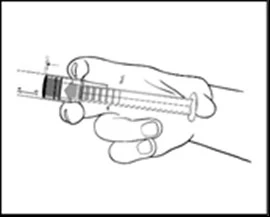
- Push the plunger to release the rubber plunger. The sterilisation process may have caused the rubber plunger to adhere to the barrel of the syringe.
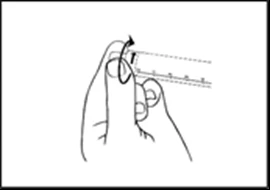
- Unscrew the end cap to break the tamper-evident seal. Do not touch the exposed luer connector to avoid contamination.
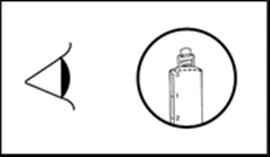
- Check whether the syringe tip protector has been completely removed. If not, reattach the cap and unscrew it again.
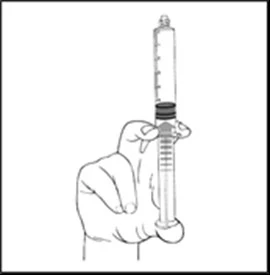
- Expel air by gently pressing the plunger.
- Connect the syringe to the intravenous access using a luer/luer lock system. Slowly push the plunger to inject the required volume. Administer the product via the appropriate route of administration.
The pre-filled syringe is not suitable for use with infusion pumps. The pre-filled syringe contains ready-to-use product and is not intended for dilution in an infusion bag.
Do not use the pre-filled syringe if it has been damaged or handled without maintaining sterility.
Any unused medicinal product or waste material should be disposed of in accordance with local regulations.