Resonium a
Poland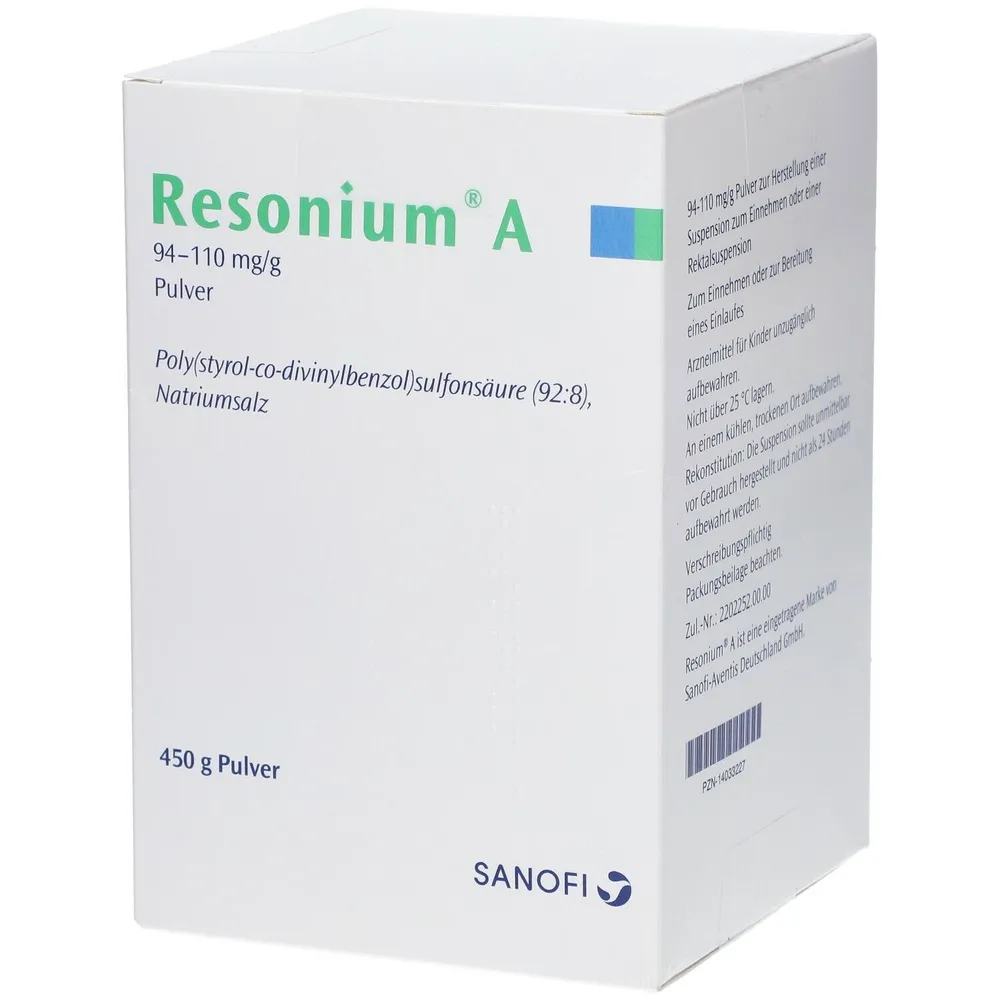
Table of Contents
Package leaflet: Information for the user
RESONIUM A
1.42 g sodium ions/15 g, oral powder or powder for preparing rectal suspension
Polystyrene sulfonate sodium
Please read all of this leaflet carefully before taking this medicine, because it contains
important information for you.
- Keep this leaflet. You may need to read it again.
- If you have any further questions, please ask your doctor or pharmacist.
- This medicine has been prescribed for a specific individual. Do not pass it on to others. It may harm them even if their symptoms are the same.
- If you experience any adverse reactions, including any not listed in this leaflet, tell your doctor, nurse or pharmacist. See section 4.
Contents of the leaflet
- What Resonium A is and what it is used for
- What you need to know before taking Resonium A
- How to take Resonium A
- Possible side effects
- How to store Resonium A
- Contents of the pack and other information
1. What Resonium A is and what it is used for
Resonium A contains as the active substance sodium polystyrene sulfonate.
The medicine belongs to a group of medicines called "ion-exchange resins".
Resonium A is used in the treatment of hyperkalaemia (excessively high potassium levels in the blood). The medicine removes excess potassium from the body, restoring normal potassium levels in the blood. It is used in patients with kidney problems and in dialysed patients.
2. Important information before using Resonium A
When not to use Resonium A:
- if the patient is allergic to sodium polystyrene sulfonate, other polystyrene sulfonate resins, or any of the other ingredients of this medicine (listed in section 6). Symptoms of an allergic reaction may include: rash, difficulty swallowing or breathing, swelling of the lips, face, throat or tongue.
- if the patient has low blood potassium levels.
- if the patient's intestines are partially or completely blocked (intestinal obstruction).
- if the patient is using a sweetener called sorbitol (a "sugar-free" sweetener used to sweeten food) or consuming products containing sorbitol. This is because administration of Resonium A, either as monotherapy or in combination with sorbitol, may cause gastrointestinal obstruction as well as serious intestinal damage, intestinal necrosis, and perforation. Sorbitol in any form must not be taken during treatment with Resonium A.
- Resonium A must not be administered orally to newborns. Its use is contraindicated in newborns with postoperative or drug-induced intestinal atony (absence of intestinal peristalsis).
Do not use Resonium A if any of the above apply to the patient. If in doubt, consult a doctor, nurse, or pharmacist before using Resonium A.
Warnings and precautions
Before starting Resonium A, discuss with your doctor, nurse, or pharmacist if:
- the patient is taking other oral medicines;
- the patient has heart problems;
- the patient has high blood pressure;
- the patient has kidney problems;
- the patient has swollen hands or feet (oedema);
- the patient has low levels of potassium, calcium, or magnesium in the blood;
- the patient suffers from constipation;
- the patient has abnormal bowel movements due to illness (including those occurring after surgery or caused by medications), as these may lead to various disorders, including bloating, severe constipation, reduced blood flow to the intestine, or intestinal perforation;
- the medicine has been prescribed for a premature child, a child with low birth weight, or a child with reduced intestinal motility.
If the patient is unsure whether any of the above apply, consult a doctor, nurse, or pharmacist before using Resonium A.
Resonium A and other medicines
Tell your doctor, nurse, or pharmacist about all medicines the patient is currently taking, has recently taken, or plans to take. This is because Resonium A may affect the action of other medicines, and other medicines may also affect the action of Resonium A.
In particular, inform the doctor if the patient is taking:
- oral medicines. Resonium A may bind to orally administered medicines, reducing their gastrointestinal absorption and effectiveness. An interval should be maintained between administration of Resonium A and other oral medicines.
- medicines containing sorbitol. Concomitant administration with Resonium A is contraindicated (see section 2 and section 4).
- medicines containing salts such as magnesium, potassium, or calcium. If in doubt, consult a doctor.
- certain laxatives containing magnesium.
- certain antacids used for indigestion (which neutralize stomach acid) containing magnesium or aluminium.
- digoxin or similar digitalis preparations – used for heart problems.
- levothyroxine or thyroxine – used for hypothyroidism.
- lithium – used for psychiatric disorders.
If the patient is unsure whether any of the above apply, consult a doctor, nurse, or pharmacist before using Resonium A.
Pregnancy and breastfeeding
If the patient is pregnant, breastfeeding, suspects she may be pregnant, or planning to become pregnant, she should consult a doctor before using this medicine.
Patients at risk due to increased sodium intake: This medicine is a source of sodium; therefore, caution is required in patients in whom increased sodium intake may be harmful (e.g. patients with severe congestive heart failure, severe hypertension, kidney damage, or significant oedema). In such cases, appropriate clinical and biochemical monitoring is necessary.
Resonium A contains sodium
This medicine contains between 1400 mg and 1700 mg of sodium (the main component of table salt) per dose. This corresponds to 70% to 85% of the maximum recommended daily dietary sodium intake for adults.
Patients using the medicinal product Resonium A for prolonged periods should seek advice from a doctor or pharmacist, especially if they have been advised to follow a low-salt (low-sodium) diet.
3. How to use Resonium A
This medicine is usually administered by a doctor or nurse. If the patient is unsure why they are receiving Resonium A or has any questions regarding the dose being used, they should speak to their doctor, nurse, or pharmacist.
- The dose of the medicine depends on blood test results.
- In children, the dose is also calculated based on the child's body weight.
Administration of the medicine
- Resonium A is administered orally or rectally (into the lower part of the gastrointestinal tract). In newborns, it is administered exclusively rectally.
- This medicine must not be mixed with fruit juice, as this may prevent the medicine from working properly.
- When administering orally, it is important that the patient sits upright while taking the medicine to avoid inhaling the powder into the lungs.
- When administering rectally, try to retain the resin in the lower part of the gastrointestinal tract for at least 9 hours. The bowel should then be flushed to remove the resin.
- The resin suspension should be prepared shortly before use; after 24 hours, the suspension is no longer suitable for use.
- Resonium A should be given 3 hours before or 3 hours after other orally administered medicines. Resonium A may bind to orally administered medicines, which could reduce their gastrointestinal absorption and effectiveness. In patients with gastroparesis (delayed gastric emptying), consider maintaining a 6-hour interval between administrations of medicines.
Recommended dose:
Adults (including elderly patients):
Orally
- The recommended dose is 15 g (one full teaspoon) three or four times daily. Each dose should be given as a suspension in a small amount of water, or for better taste, in a sweetened drink (except fruit juices, which contain potassium), at a ratio of 3 to 4 ml per gram of resin.
Rectally
- The recommended dose is 30 g (two full teaspoons) once daily in 150 ml of water or 10% glucose solution.
In certain cases, the medicine may be administered both orally and rectally at the same time. This applies when potassium levels need to be reduced quickly. If initially administered both orally and rectally, rectal administration may be discontinued once the orally administered resin reaches the rectum.
Children:
Orally
- Initial daily dose is 1 g per kilogram of body weight, given in divided doses. The medicine is administered orally, preferably with a drink (but not with fruit juices, as they contain high levels of potassium) or with a small amount of jam or honey.
- Subsequently, the daily dose may be reduced to 0.5 g per kilogram of body weight (maintenance dose).
Rectally
- If a child cannot take the medicine orally, it may be administered rectally using a dose at least equivalent to that which would have been given orally, suspended in a proportional amount of 10% glucose solution in water.
Newborns:
Resonium A is used in newborns exclusively by rectal administration.
- The smallest effective dose ranging from 0.5 g to 1 g per kilogram of body weight is used, diluted as for adults.
It is important to give children and newborns the correct dose of medicine. If too high a dose is administered, severe constipation may occur in children and newborns.
Administration of a higher than recommended dose of Resonium A
It is unlikely that a doctor or nurse would administer too high a dose of the medicine. The doctor or nurse will monitor treatment progress and verify which medicine is being administered to the patient.
If the patient has doubts about why they are receiving a particular dose, they should consult their doctor or nurse.
If the patient takes too high a dose of Resonium A, the following symptoms may occur:
- feeling irritable or disoriented
- difficulty concentrating
- muscle weakness and diminished reflexes, leading to paralysis
- breathing difficulties
- increased heart rate or palpitations
- muscle spasms
- apnea
Missing a dose of Resonium A
The doctor or nurse will instruct the patient when to take the medicine. It is unlikely that a dose will be missed. If the patient suspects they may have missed a dose, they should inform their doctor or nurse.
Stopping treatment with Resonium A
Resonium A should be used until the doctor decides to discontinue it. If the patient stops taking Resonium A, their condition may return.
Blood tests
During treatment, the doctor may recommend regular blood tests to monitor levels of electrolytes (potassium, sodium, calcium, and magnesium).
If you have any further questions about the use of this medicine, please consult your doctor, pharmacist, or nurse.
4. Possible adverse reactions
Like all medicines, this medicine can cause adverse reactions, although not everyone will experience them.
You should immediately inform your doctor or nurse if any of the following serious adverse reactions occur:
- severe abdominal pain, pain in the rectum.
- bloating, severe constipation.
- severe nausea and vomiting.
- black, bloody or tar-like stools, coughing up blood or vomiting that looks like coffee grounds.
- allergic reaction. Symptoms may include: rash, difficulty swallowing or breathing, swelling of the lips, face, throat or tongue.
- blood in vomit or black, tarry stools.
You should inform your doctor or nurse if any of the following adverse reactions occur:
- feeling of fatigue, disorientation, muscle weakness, muscle cramps or heart rhythm disturbances.
- feeling shaky, tremors or muscle spasms. This may be caused by low levels of calcium or magnesium in the body.
- increased thirst or need to urinate frequently.
- high blood pressure, kidney problems, heart problems or swelling of limbs. This may be caused by high levels of sodium in the body.
- stomach upset, intestinal pain, narrowing of the gastrointestinal tract or intestinal obstruction.
- severe abdominal pain or collapse.
- loss of appetite.
- nausea, vomiting, constipation or diarrhoea.
- shortness of breath or cough. These may be early signs of a serious chest infection. This may be caused by accidental inhalation of the medicine into the lungs.
- faecal impaction (impaction) after rectal administration of the medicine, especially in children, and concretions (bezoars) after oral administration.
Cases of gastrointestinal ischaemia, ischaemic colitis, ulceration or necrosis of the stomach and intestines have been reported, which may lead to intestinal perforation and, occasionally, death.
Reporting of adverse reactions
If any adverse symptoms occur, including any adverse symptoms not listed in this leaflet, you should inform your doctor or pharmacist. Adverse reactions can be reported directly to the Department of Monitoring Adverse Drug Reactions of the Office for Registration of Medicinal Products, Medical Devices and Biocidal Products,
Al. Jerozolimskie 181C, 02-222 Warsaw,
tel.: + 48 22 49 21 301, fax: + 48 22 49 21 309, website: https://smz.ezdrowie.gov.pl
Adverse reactions can also be reported to the marketing authorisation holder or the representative of the marketing authorisation holder in Poland.
By reporting adverse reactions, more information on the safety of this medicine can be collected.
5. How to store Resonium A
This medicine will be stored by a doctor or pharmacist in a safe place, out of sight and reach of children.
The medicine should be stored in a dry place.
Do not use this medicine after the expiry date stated on the carton. The expiry date refers to the last day of the month indicated.
Medicines must not be disposed of via wastewater or household waste. Ask your pharmacist how to dispose of medicines no longer required. Such measures help protect the environment.
6. Contents of the pack and other information
What Resonium A contains
- The active substance is sodium polystyrene sulfonate 99.934%. 15 g of powder contains 1.42 g of sodium ions in the form of sodium polystyrene sulfonate 99.934%.
- Other components are: vanillin and saccharin.
What Resonium A looks like and contents of the pack
Resonium A is a cream-coloured powder with a vanilla odour. It is supplied in packs containing 454 g of powder with a 15 g measuring spoon.
Marketing Authorisation Holder
Sanofi Winthrop Industrie
82, Avenue Raspail
94250 Gentilly
France
Manufacturer
Astrea Amilly
196 rue du Marechal Juin
45200 Amilly
France
This leaflet does not contain all the information about this medicine. If you have any questions or doubts, please consult your doctor, nurse or pharmacist.
For more detailed information, contact the local representative of the Marketing Authorisation Holder:
Sanofi Sp. z o.o.
ul. Marcina Kasprzaka 6
01-211 Warsaw
tel.: +48 22 280 00 00