Remidia
Poland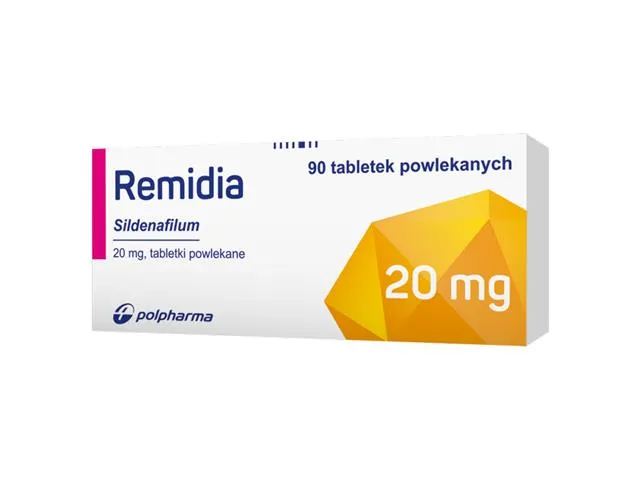
Table of Contents
Patient Information Leaflet
Remidia, 20 mg, coated tablets
Sildenafilum
Please read all of this leaflet carefully before taking this medicine, because it contains
important information for you.
- Keep this leaflet, as you may need to read it again.
- If you have any further questions, please ask your doctor or pharmacist.
- This medicine has been prescribed for a specific individual. Do not pass it on to others. It may harm them, even if their symptoms are the same.
- If you experience any adverse reactions, including any not listed in this leaflet, tell your doctor or pharmacist. See section 4.
Leaflet Contents
- What Remidia is and what it is used for
- What you need to know before taking Remidia
- How to take Remidia
- Possible side effects
- How to store Remidia
- Contents of the pack and other information
1. What Remidia is and what it is used for
Remidia contains the active substance sildenafil, which belongs to a group of medicines called phosphodiesterase type 5 (PDE5) inhibitors.
Remidia lowers blood pressure in the pulmonary arteries by relaxing the blood vessels in the lungs.
Remidia is used to treat high blood pressure in the pulmonary arteries (pulmonary arterial hypertension) in adults, children, and adolescents aged 1 to 17 years.
2. Important information before using Remidia
When not to use Remidia:
- If the patient is allergic to sildenafil or any of the other ingredients of this medicine (listed in section 6).
- If the patient is taking nitrates or medicines that release nitric oxide, such as amyl nitrite. These medicines are used to treat chest pain (angina pectoris). Remidia may enhance the effects of these medicines, so the patient should inform their doctor about their use. If in doubt, consult a doctor or pharmacist.
- If the patient is taking riociguat. This medicine is used to treat pulmonary hypertension (i.e. high blood pressure in the lungs) and chronic thromboembolic pulmonary hypertension (i.e. high blood pressure in the lungs caused by blood clots). PDE5 inhibitors such as Remidia have been shown to enhance the blood pressure-lowering effect of this medicine. If the patient is taking riociguat or is unsure, they should inform their doctor.
- If the patient has recently had a stroke or heart attack, or has severe liver disease or very low blood pressure (<90/50 mm Hg).
- If the patient is taking medicines used to treat fungal infections, such as ketoconazole, itraconazole, or ritonavir (used in the treatment of HIV).
- If the patient has ever experienced vision loss due to impaired blood flow to the optic nerve, known as non-arteritic anterior ischemic optic neuropathy (NAION).
Warnings and precautions
Before starting treatment with Remidia, discuss this with your doctor.
Inform your doctor about:
- A condition more related to blockage or narrowing of a vein in the lungs rather than blockage or narrowing of an artery;
- Severe heart disease;
- Disorders affecting blood flow through the heart chambers;
- Increased blood pressure in the pulmonary blood vessels;
- Low blood pressure at rest;
- Significant fluid loss (dehydration), which may occur due to excessive sweating or insufficient fluid intake. This may also occur during fever, vomiting, or diarrhea;
- A rare inherited eye disease (retinitis pigmentosa);
- A red blood cell disorder (sickle cell anemia), blood cancer (leukemia), bone marrow cancer (multiple myeloma), or any penile disorder or anatomical penile deformity;
- Peptic ulcer disease, bleeding disorders (such as hemophilia), or frequent nosebleeds;
- Use of medicines for erectile dysfunction.
During treatment with phosphodiesterase type 5 (PDE5) inhibitors, including sildenafil, for erectile dysfunction, the following adverse reactions related to vision disturbances have been reported with unknown frequency: partial, sudden, transient or permanent weakening or loss of vision in one or both eyes.
If sudden vision loss or weakening occurs, discontinue use of Remidia immediately and seek medical advice without delay (see also section 4).
In men using sildenafil, prolonged and sometimes painful erections have been observed. If an erection lasts longer than 4 hours, discontinue use of Remidia immediately and seek medical advice without delay (see also section 4).
Use of Remidia in patients with kidney or liver disease
Inform your doctor if you have kidney or liver disease, as dose adjustment may be necessary.
Children
Remidia must not be used in children under 1 year of age.
Remidia and other medicines
Tell your doctor or pharmacist about all medicines the patient is currently taking or has recently taken, as well as any medicines the patient plans to take.
- Medicines containing nitrates or nitric oxide-releasing agents, such as amyl nitrite (so-called "poppers"). These medicines are used to treat angina or chest pain (see section 2 "Important information before using Remidia").
- Riociguat.
- Concurrently used other treatments for pulmonary hypertension (e.g. bosentan, iloprost).
- Medicines containing St. John's wort (herbal remedy), rifampicin (used to treat bacterial infections), carbamazepine, phenytoin, or phenobarbital (used, among others, in epilepsy treatment).
- Medicines that inhibit blood clotting (e.g. warfarin), although they have not caused adverse effects.
- Medicines containing erythromycin, clarithromycin, telithromycin (antibiotics used to treat bacterial infections), saquinavir (used in HIV treatment), or nefazodone (used in depression treatment), as dose adjustment may be necessary.
- α-adrenergic blocking agents (e.g. doxazosin), used to treat high blood pressure or benign prostatic hyperplasia, because concomitant use may cause symptoms of low blood pressure (e.g. dizziness, feeling of emptiness in the head).
- Medicines containing sacubitril with valsartan, used in the treatment of heart failure.
Remidia with food and drink
Do not drink grapefruit juice during treatment with Remidia.
Pregnancy and breastfeeding
If the patient is pregnant or breastfeeding, suspects she may be pregnant, or is planning to have a child, she should consult her doctor or pharmacist before using this medicine.
Remidia may be used during pregnancy only when absolutely necessary.
Use of Remidia is not recommended in women of childbearing potential unless they use appropriate contraceptive methods.
Remidia passes into human milk in very small amounts and is not expected to have a negative effect on breastfed infants.
Driving and operating machinery
Remidia may cause dizziness and visual disturbances. The patient should assess their individual response to the medicine before driving or operating machinery.
Remidia contains lactose monohydrate and sodium
If the patient has previously been diagnosed with intolerance to certain sugars, they should consult their doctor before taking this medicine.
The medicine contains less than 1 mmol of sodium (23 mg) per tablet, meaning the medicine is considered "sodium-free".
3. How to use Remidia
This medicine should always be used exactly as prescribed by the doctor. In case of doubt, consult
your doctor or pharmacist.
The recommended dose for adults is 20 mg three times daily (every 6-8 hours),
taken with or without food.
Use in children and adolescents
For children and adolescents aged 1 to 17 years, the recommended dose is 10 mg three times daily
for those weighing ≤20 kg, or 20 mg three times daily for those weighing >20 kg, taken with or
without food. Higher doses should not be used in children. This medicine should only be used when
the 20 mg three times daily dose is required. For patients weighing ≤20 kg and other younger
patients unable to swallow tablets, an alternative medicinal product containing sildenafil in an
appropriate pharmaceutical form - oral suspension - is available.
Taking more Remidia than recommended
Do not take more medicine than recommended.
If you take more than the recommended dose, contact your doctor immediately. Taking more
Remidia than recommended may increase the risk of experiencing the adverse reactions described.
Missing a dose of Remidia
If you miss a dose of Remidia, take it as soon as possible and continue treatment according to
the prescribed schedule. Do not take a double dose to make up for a missed dose.
Stopping Remidia treatment
Stopping Remidia abruptly may lead to worsening of the clinical condition. Do not discontinue
treatment without your doctor's instruction. Your doctor may decide to gradually reduce the dose
over several days before stopping treatment.
If you have any further questions about the use of this medicine, consult your doctor or pharmacist.
4. Possible adverse reactions
Like any medicine, this medicine may cause adverse reactions, although not everyone will experience them.
If any of the following adverse reactions occur, you must stop taking Remidia and seek immediate medical advice (see also section 2):
- in case of unexpected weakness or loss of vision (frequency unknown),
- in case of an erection lasting continuously for more than 4 hours. Prolonged and sometimes painful erections have been observed in men taking sildenafil (frequency unknown).
Adults
Very common (affects more than 1 in 10 patients): headache, sudden facial flushing, indigestion, diarrhoea, and pain in hands or legs.
Common (affects less than 1 in 10 patients): subcutaneous infections, flu-like symptoms, sinusitis, reduced number of red blood cells (anaemia), fluid retention, difficulty falling asleep, anxiety, migraine, tremor, tingling sensation, feeling of warmth, reduced skin sensitivity, bleeding in the back of the eye, visual disturbances, blurred vision, light sensitivity, colour vision disturbances, eye irritation, eye redness (red eyes), dizziness, bronchitis, nosebleeds, runny nose, cough, nasal congestion, gastric mucosal inflammation, gastritis and enteritis, heartburn, haemorrhoids, flatulence, dry mouth, hair loss, skin redness, night sweats, muscle pain, back pain, and increased body temperature.
Adverse reactions reported less commonly (affects less than 1 in 100 patients): reduced visual acuity, double vision, abnormal eye sensations, penile bleeding, blood in semen and/or urine, and gynaecomastia (enlargement of the breasts in men).
Skin rash, sudden worsening or loss of hearing, and low blood pressure have also been reported, with unknown frequency (frequency cannot be estimated from available data).
Children and adolescents
The following serious adverse reactions have been reported as common (affects less than 1 in 10 patients): pneumonia, heart failure, right ventricular failure, cardiogenic shock, increased pulmonary arterial pressure, chest pain, fainting, respiratory tract infection, bronchitis, viral gastroenteritis, urinary tract infection, and dental caries.
Serious adverse reactions considered related to treatment and reported less commonly (affects less than 1 in 100 patients) include: allergic reactions (such as skin rash, facial swelling, swelling of lips and tongue, wheezing, difficulty breathing or swallowing), seizures, irregular heartbeat, hearing disturbances, shortness of breath, gastrointestinal inflammation, and wheezing due to obstructed airflow.
Very common adverse reactions (affects more than 1 in 10 patients): headache, vomiting, throat infections, fever, diarrhoea, influenza, and nosebleeds.
Common adverse reactions (affects less than 1 in 10 patients): nausea, increased frequency of erections, pneumonia, and runny nose.
Reporting of adverse reactions
If any adverse reactions occur, including any not listed in this leaflet, inform your doctor or pharmacist. Adverse reactions can be reported directly to the Department of Monitoring Adverse Reactions of Medicinal Products at the Office for Registration of Medicinal Products, Medical Devices and Biocidal Products
Al. Jerozolimskie 181C
02-222 Warsaw
Tel.: +48 22 49 21 301
Fax: +48 22 49 21 309
Website: https://smz.ezdrowie.gov.pl
Adverse reactions may also be reported to the marketing authorisation holder.
Reporting adverse reactions helps provide more information on the safety of this medicine.
5. How to store Remidia
Keep this medicine out of the sight and reach of children.
No special storage instructions are required for this medicine.
Do not use this medicine after the expiry date stated on the packaging. The expiry date refers to the last day of the stated month.
The marking on the packaging following the abbreviation EXP indicates the expiry date, and the marking following the abbreviation Lot/LOT indicates the batch number.
Medicines must not be disposed of via wastewater or household waste. Ask your pharmacist how to dispose of medicines no longer required. Such measures will help protect the environment.
6. Contents of the packaging and other information
What Remidia contains
- The active substance is sildenafil. Each tablet contains 20 mg of sildenafil (as sildenafil citrate).
- Other ingredients are:
- Tablet core: mannitol, crospovidone (type A), povidone (K30), anhydrous colloidal silicon dioxide, maize starch, magnesium stearate, sodium lauryl sulfate.
- Coating: hypromellose (type 2910), macrogol 3350, lactose monohydrate, titanium dioxide (E 171), triacetin.
What Remidia looks like and contents of the pack
Remidia is white, round, biconvex coated tablets with a diameter of 5 mm, packed in a cardboard box.
The pack contains 90 coated tablets.
Marketing Authorisation Holder and Manufacturer
Zakłady Farmaceutyczne POLPHARMA S.A.
Pelplińska 19, 83-200 Starogard Gdański, Poland
tel. +48 22 364 61 01