Relenza
Poland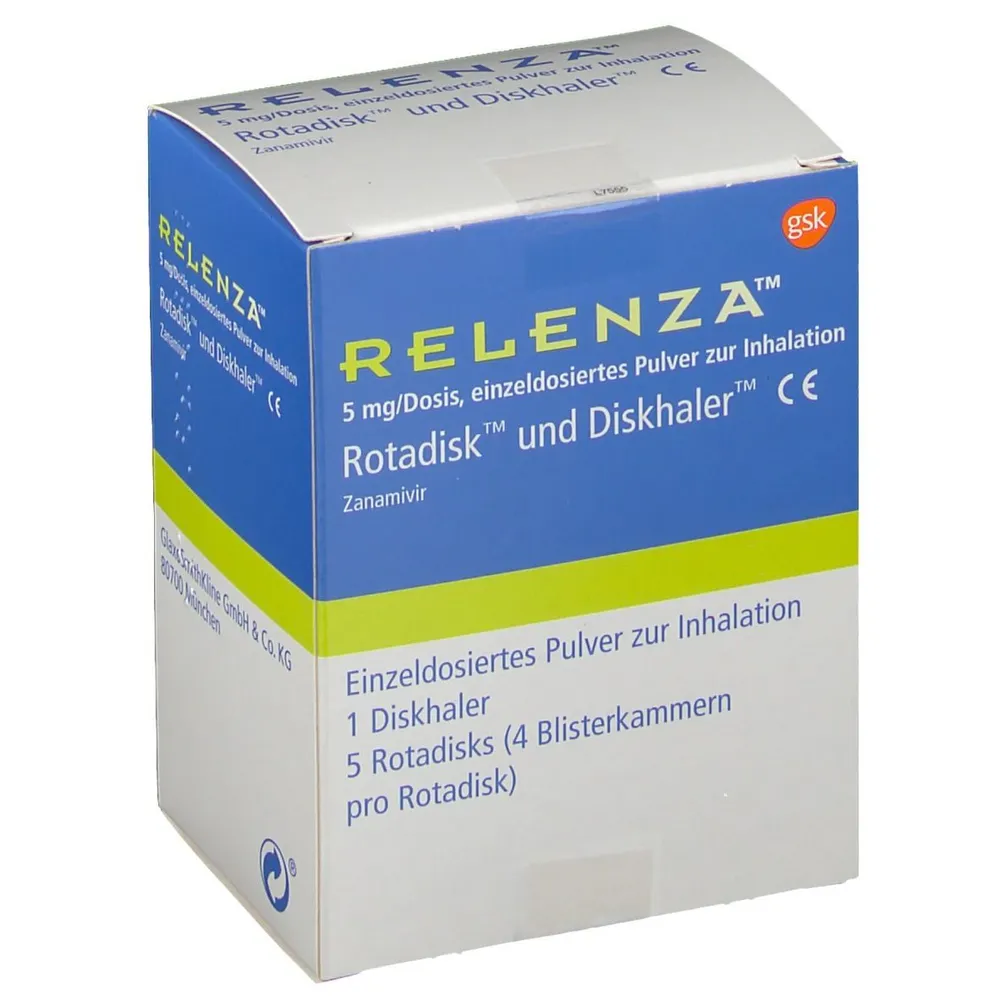
Table of Contents
Patient Information Leaflet
Relenza
5 mg per dose, inhalation powder, divided
Zanamivir
Please read this leaflet carefully before using this medicine, as it contains
important information for you.
- Keep this leaflet, as you may need to read it again.
- If you have any further questions, please consult your doctor, pharmacist, or nurse.
- This medicine has been prescribed for a specific individual. Do not pass it on to others. It may harm them, even if their symptoms are the same.
- If you experience any adverse reactions, including any not listed in this leaflet, inform your doctor, pharmacist, or nurse. See section 4.
Table of contents
- What Relenza is and what it is used for
- What you need to know before taking Relenza
- How to take Relenza
- Possible side effects
- How to store Relenza
- Contents of the pack and other information
1. What Relenza is and what it is used for
Relenza contains the active substance zanamivir, which belongs to a group of medicines called antivirals.
Relenza is used to treat influenza (flu virus infection), reducing the severity of symptoms and speeding recovery.
Relenza is also used to prevent influenza during an outbreak.
Relenza can be used in adults and children aged 5 years and older.
Relenza is administered by inhalation (breathing in) into the lungs, because absorption into the body after swallowing is poor. Influenza virus infects the lungs; when Relenza is inhaled, it acts directly on the viruses present in the lungs.
Relenza does not replace flu vaccination. You should consult your doctor to determine whether flu vaccination is required.
2. Important information before using Relenza
When not to use Relenza
- if the patient is allergic to zanamivir or any of the other ingredients of this medicine (listed in section 6),
- if the patient is allergic to milk protein (see "Relenza contains lactose and milk protein" and section 6).
Relenza must not be used in children under 5 years of age.
When to exercise special caution with Relenza
- If the patient experiences a sensation of tightness in the throat or chest while taking Relenza. Very rarely, Relenza may cause reactions including:
- a sensation of tightness in the throat and chest,
- difficulty breathing. If any of these symptoms occur while taking Relenza:
- stop using Relenza immediately and seek medical help urgently,
- contact your doctor or the nearest hospital emergency department.
- If the patient has asthma or other lung or breathing problems. If the patient suffers from:
- asthma,
- other lung diseases causing breathing difficulties – for example emphysema, chronic obstructive pulmonary disease (COPD) or chronic bronchitis. Tell your doctor before using Relenza , as this will allow closer monitoring of the patient's health.
- If the patient is using inhaled medicines for the treatment of asthma or other breathing disorders, they should carefully read the following section of this leaflet ( Using Relenza with inhaled medicines used for breathing disorders).
Using Relenza with inhaled medicines used for breathing disorders
If the patient is using inhaled medicines for the treatment of asthma or other breathing disorders, they should
continue taking them at the usual times.
If Relenza has been prescribed to be taken at the same time as other inhaled medicines, the inhaled
medicines should be taken several minutes before Relenza.
Ensure that an inhaler containing a fast-acting bronchodilator
(such as salbutamol) is readily available during treatment with Relenza.
Relenza and other medicines
Tell your doctor or pharmacist about all medicines the patient is currently taking or has recently taken,
including medicines obtained without a prescription, as well as any medicines the patient plans to use.
If the patient is using inhaled medicines for the treatment of asthma or breathing disorders, they should ensure
they have read the above warnings.
If the patient has been advised to have a flu vaccination
Vaccination can be given at any time, even if the patient is taking Relenza to help prevent influenza.
Pregnancy, breastfeeding and fertility
If the patient is pregnant or breastfeeding, suspects she may be pregnant, or is planning to have a child,
she should consult her doctor before using this medicine.
There is only limited data on the safety of Relenza in pregnant women. Although there is currently no evidence that Relenza harms the unborn baby, it should not be used during pregnancy unless recommended by a doctor.
The active substance (zanamivir) may pass into breast milk, therefore breastfeeding should not be undertaken during treatment with Relenza. Consult your doctor – he or she will decide whether to discontinue/stop treatment with the medicine or to stop breastfeeding, depending on what is best for the patient and the baby.
Driving and using machines
Relenza is unlikely to affect the ability to drive or operate machinery.
Relenza contains lactose and milk protein.
Relenza contains a sugar called lactose and milk protein. If the patient has previously been diagnosed with intolerance to certain sugars, the patient should contact their doctor before taking this medicine.
3. How to use Relenza
This medicine should always be used according to the instructions given by your doctor or pharmacist. If in
doubt, consult your doctor or pharmacist.
Relenza is a medicine in powder form that must be inhaled into the lungs through the mouth using the
inhalation device provided, the Diskhaler. Each circular blister pack Rotadisk, which fits into the
Diskhaler inhalation device, contains 4 doses of powder.
The medicine contained in the Rotadisk circular blister pack must only be used with the Diskhaler inhalation device.
Relenza should not be used in children under 5 years of age.
When to start using Relenza
Treatment of influenza (flu)
The best results are achieved when treatment is started as soon as possible after the onset of symptoms:
- in adults, within 48 hours of symptom onset;
- in children, within 36 hours of symptom onset.
Prophylaxis to help prevent influenza (flu)
If someone in the household has influenza, to help prevent infection, start using Relenza as soon as possible after contact with the infected person:
- in adults and children, within 36 hours of contact with the infected person.
If there is an influenza outbreak in your area, follow your doctor's advice regarding when to start using Relenza.
Dosage of Relenza
The dosage depends on whether Relenza is being used to treat influenza or to help prevent it.
Treatment of influenza (flu)
Adults and children (aged 5 years and older): usually 2 inhalations (2 doses) twice daily for 5 days.
Prevention of influenza (flu)
If someone in the household has influenza
Adults and children (aged 5 years and older): usually 2 inhalations (2 doses) once daily for 10 days.
If there is an influenza outbreak in your area
Adults and children (aged 5 years and older): 2 inhalations (2 doses) once daily for up to 28 days is recommended.
Accidental overdose of Relenza
Accidentally taking more Relenza than recommended is unlikely to cause problems. However, if the patient is concerned or does not feel well, especially if they have asthma or other lung problems, you should tell your doctor.
Missed dose of Relenza
If a dose of Relenza is missed, it should be taken as soon as possible, and then continue treatment as before.
Do not take a double dose to make up for a missed dose.
Stopping Relenza treatment
When treating influenza, it is important to complete the full course (usually 5 days), even if the patient feels better. Otherwise, influenza symptoms may return.
If the patient wishes to stop using Relenza earlier:
consult your doctor for advice.
Instructions for using the Diskhaler device are provided step by step on the reverse side of this leaflet.
Please read these instructions carefully before taking the first dose. If you are unsure how to use the Diskhaler device, consult your pharmacist and review the correct usage together.
4. Possible adverse reactions
Like all medicines, this medicine can cause adverse reactions, although not everyone will experience them.
Adverse reactions that require attention
Severe allergic reactions
Occur less frequently than in 1 out of 1,000 people taking Relenza. Symptoms include:
- Raised, itchy rash (urticaria);
- Swelling, sometimes affecting the face, lips or throat, causing difficulty in breathing;
- Fainting.
If any of these symptoms occur:
- Seek immediate medical advice from a doctor.
Severe skin reactions
These adverse reactions are very rare and may occur less frequently than in 1 out of 1,000 people taking Relenza:
- Skin rash, which may be blistering and resemble target-like lesions (dark spots in the center, surrounded by a paler area with a dark ring around it) – erythema multiforme.
- Widespread rash with blisters and peeling skin, particularly around the mouth, nose, eyes and genital area – Stevens-Johnson syndrome.
- Extensive peeling of the skin affecting a large body surface – toxic epidermal necrolysis. If any of these symptoms occur, seek immediate medical advice from a doctor. You must stop taking Relenza.
Other common adverse reactions
Occur less frequently than in 1 out of 10 people taking Relenza:
- Skin rash
Other less common adverse reactions
Occur less frequently than in 1 out of 100 people taking Relenza:
-
Feeling of tightness in the throat and chest, shortness of breath or sudden difficulty in breathing. In patients with lung diseases (such as asthma or COPD), close monitoring may be required during treatment with Relenza due to the possibility of these adverse reactions occurring.
-
Swelling of the face, mouth and throat.
-
Urticaria (itchy skin lumps).
-
Fainting and dizziness. If a patient does not feel well during treatment with Relenza, fainting or dizziness may occur after inhalation of Relenza. Before inhalation, the patient should sit in a comfortable position. After inhaling the dose, breath-holding should only last as long as is comfortable for the patient. If a patient does not feel well, it is recommended that the dose of Relenza be taken in the presence of another person.
If any of these symptoms occur during treatment with Relenza:
Stop using the medicine and seek immediate medical help –
contact a doctor or the emergency department of the nearest hospital.
- Sudden changes in behaviour, hallucinations and convulsions. During treatment with Relenza, changes in behaviour such as feeling disoriented or unresponsive to stimuli have been observed. Some patients may also experience hallucinations (seeing, hearing or feeling things that are not real) or convulsions, which may lead to loss of consciousness. Parents should pay particular attention to the occurrence of these symptoms when their children (young or adolescent) have influenza. These symptoms have also been observed in influenza patients who did not take Relenza. Therefore, it is not known whether Relenza influenced their occurrence.
If any of these symptoms occur
- seek immediate medical advice from your doctor.
Reporting of adverse reactions
If any adverse reactions occur, including any adverse reactions not listed in this leaflet, inform your doctor or pharmacist. Adverse reactions can be reported directly to the Department for Monitoring Adverse Drug Reactions of the Office for Registration of Medicinal Products, Medical Devices and Biocidal Products
Al. Jerozolimskie 181C, 02-222 Warsaw
Tel.: + 48 22 49 21 301
Fax: + 48 22 49 21 309
Website: https://smz.ezdrowie.gov.pl
Reporting adverse reactions helps to provide more information on the safety of the medicine.
Adverse reactions can also be reported to the marketing authorisation holder.
5. How to store Relenza
Keep this medicine out of the sight and reach of children.
Do not use this medicine after the expiry date stated on the packaging after "EXP".
The expiry date refers to the last day of the stated month. The abbreviation "Lot" indicates the product batch number.
Do not store above 30°C.
Medicines must not be disposed of via wastewater or household waste. Ask your pharmacist how to dispose of medicines no longer required. These measures will help protect the environment.
Ask your pharmacist how to dispose of the Diskhaler inhalation device no longer in use. This will help protect the environment.
6. Contents of the pack and other information
What Relenza contains
The active substance is zanamivir (5 mg per dose).
The other ingredient in the medicine is monohydrate lactose (which contains milk protein).
What Relenza looks like and contents of the pack
Four doses of Relenza powder are contained in a circular aluminium foil blister called a Rotadisk. Each dose contains 5 mg of zanamivir.
The medicine from the Rotadisk blister is inhaled through the mouth using a plastic inhaler device called a Diskhaler.
Relenza is available in two pack sizes:
- Single-day pack, containing one Relenza Rotadisk blister and one Diskhaler;
- Five-day treatment pack, containing five Relenza Rotadisk blisters and one Diskhaler.
Marketing Authorisation Holder and Manufacturer
Marketing Authorisation Holder
GlaxoSmithKline Trading Services Limited
12 Riverwalk
Citywest Business Campus
Dublin 24
D24 YK11
Ireland
Manufacturer
Glaxo Wellcome Production
Zone Industrielle No.2
23 Rue Lavoisier
27000 Evreux
France
GlaxoSmithKline Trading Services Limited
12 Riverwalk
Citywest Business Campus
Dublin 24
Ireland
Manufacturer of the Diskhaler inhalation device
GlaxoSmithKline Trading Services Limited
12 Riverwalk
Citywest Business Campus
Dublin 24
Ireland
For further information, please contact the representative of the Marketing Authorisation Holder:
GSK Services Sp. z o.o.
ul. Rzymowskiego 53
02-697 Warszawa
tel. (22) 576-90-00
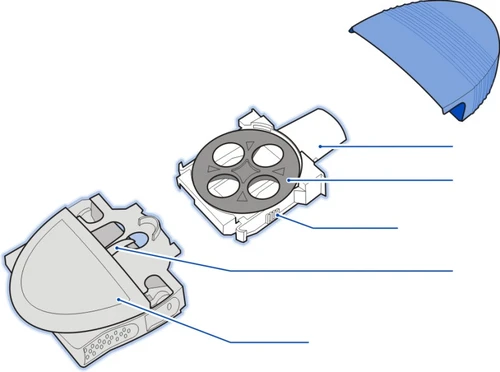
The Diskhaler device consists of three parts:
Do not disassemble the Diskhaler device before reading the instructions.
The circular Rotadisk blister is intended for use with the Diskhaler inhalation device
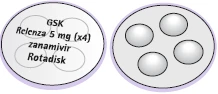
The Rotadisk is placed on the Diskhaler device carousel.
The Rotadisk contains four blisters. Each blister contains 5 mg of zanamivir. The standard dose is two blisters (10 mg).
Warning:
Do not pierce the powder blister before placing it into the Diskhaler inhalation device.
The Rotadisk may remain in the Diskhaler inhalation device at all times, but
it must be pierced immediately before administering the inhalation.
The Diskhaler device must be kept clean. After use, wipe the mouthpiece with a cloth. When the device is not in use, protect the mouthpiece with the blue cap.
Contact your doctor or pharmacist if you notice any abnormalities
regarding the Diskhaler inhalation device or the Rotadisk circular blister.
STEP-BY-STEP INSTRUCTIONS FOR USING THE DISKHALER INHALATION DEVICE
Inserting the Rotadisk into the Diskhaler inhalation device:
1 Remove the blue mouthpiece cap.
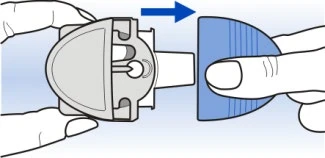
Ensure the mouthpiece is clean both inside and outside.
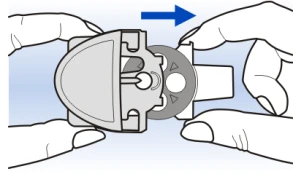
2 Holding the Diskhaler device by the edges as shown in the picture, pull out the white slide with the mouthpiece fully.
3 Gently press the side clips of the white slide to remove the carousel from the Diskhaler device housing.
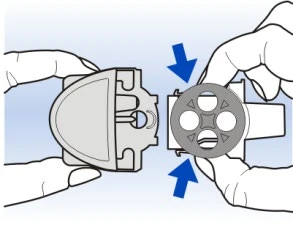
The white slide should come out easily.
4 Remove the Rotadisk from its packaging and place it onto the carousel.
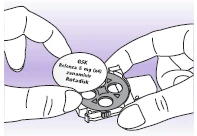
Ensure the printed side is facing upwards and the blisters are facing downwards.
The blisters fit into the carousel holes.
5 Reinsert the white slide back into the Diskhaler device housing.
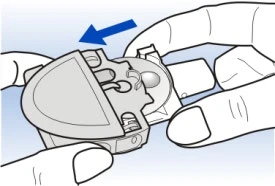
If the patient is not ready to inhale, replace the blue mouthpiece cap.
Releasing the dose of medicine:
Do not perform the following steps if the patient is not ready to inhale.
6 Hold the Diskhaler device horizontally.
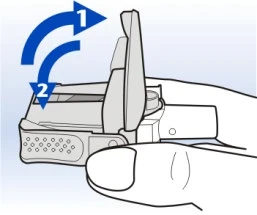
Hold the Diskhaler horizontally.
Lift the device cover fully to the upright (vertical) position.
The cover must be in the upright position to pierce the blister both from the top and bottom.
Lower the device cover back down.
The Diskhaler is now ready for use. Keep holding it horizontally until the inhalation is completed.
If the patient is using other inhaled medicines, carefully read section 2 of this leaflet Using Relenza with inhaled medicines used for respiratory disorders before using Relenza.
Inhaling the medicine:
7 Before placing the Diskhaler mouthpiece into the mouth, breathe out deeply, keeping the Diskhaler away from the mouth. Do not blow into the Diskhaler. If you do so, the powder may be blown out of the Rotadisk.
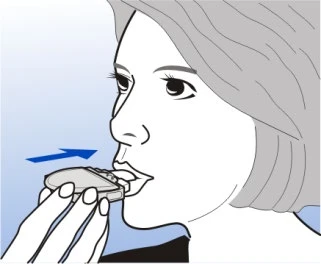
Hold the Diskhaler horizontally.
With the Diskhaler held horizontally, place the mouthpiece between your teeth and seal your lips tightly around it.
Do not bite the mouthpiece. Do not block the air intake holes on both sides of the mouthpiece.
Breathe in quickly and as deeply as possible through the mouthpiece, then hold your breath.
Remove the Diskhaler from your mouth.
Continue to hold your breath for several seconds, as long as comfortable.
Preparing the Diskhaler for reuse (second part of the dose):
8 Pull out the white slide with the mouthpiece fully (do not remove completely), then push it back in.
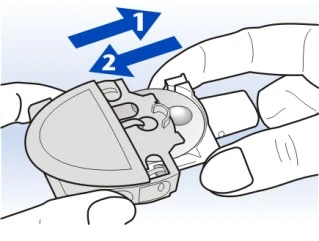
This action rotates the medication disk.
Repeat this step until a full blister of medicine aligns under the piercing spike.
To perform the next inhalation, follow steps 6–7.
9 After taking the full dose (usually two inhalations):
Wipe the mouthpiece with a tissue and replace the blue mouthpiece cap. It is important to keep the Diskhaler device clean.
Replacing the Rotadisk in the Diskhaler inhalation device:
10 If all four blisters are empty, replace the Rotadisk blister from the Diskhaler inhalation device and insert a new one by repeating steps 1–5.