Ranitidine
Poland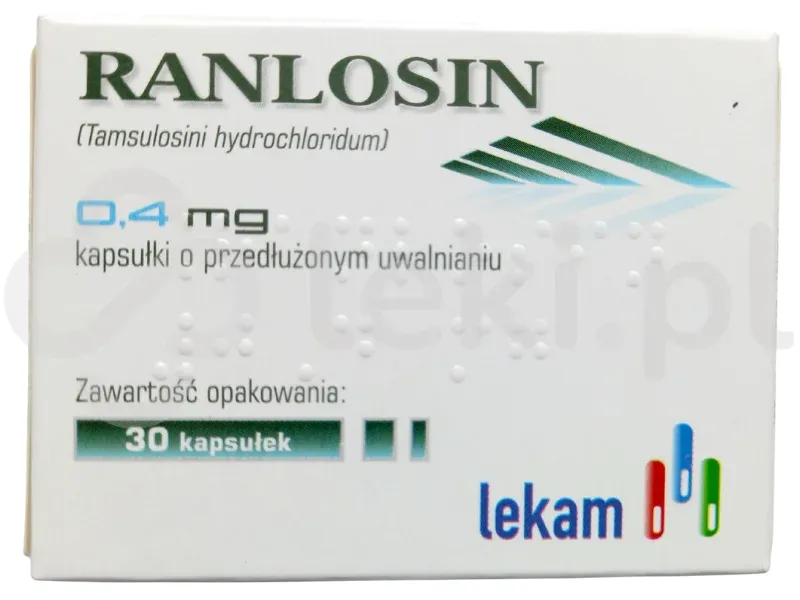
Table of Contents
PACKAGE LEAFLET: INFORMATION FOR THE PATIENT
Ranlosin, 0.4 mg prolonged-release capsules
(tamsulosini hydrochloridum)
Please read carefully the entire leaflet before taking this medicine, because
it contains important information for the patient.
- Keep this leaflet so that you can read it again if necessary.
- If you have any doubts, consult your doctor or pharmacist.
- This medicine has been prescribed for a specific individual. Do not share it with others. This medicine may harm others, even if their symptoms are identical.
- If any adverse reactions occur, including any not listed in this leaflet, inform your doctor or pharmacist. See section 4.
Table of contents:
- What Ranlosin is and what it is used for
- Important information before taking Ranlosin
- How to take Ranlosin
- Possible side effects
- How to store Ranlosin
- Contents of the package and other information
1. WHAT IS RANLOSIN AND WHAT IS IT USED FOR
The active substance in Ranlosin is tamsulosin. Tamsulosin is a selective antagonist of
α-adrenergic receptors. It reduces the tone of smooth muscles in the prostate gland
(prostate) and urethra, facilitating urine flow through the urethra and urination. Additionally,
tamsulosin reduces the sensation of urinary urgency.
Ranlosin is used in the treatment of lower urinary tract symptoms associated with
enlargement of the prostate gland (benign prostatic hyperplasia).
These symptoms may include: difficulty urinating (weak stream), urinating drop by drop, urinary urgency, and increased frequency of urination both during the night and during the day.
2. IMPORTANT INFORMATION BEFORE USING RANLOSIN
When not to use Ranlosin
- If the patient is allergic (hypersensitive) to the active substance or to any of the other ingredients of the medicine (listed in section 6). Hypersensitivity may manifest as sudden swelling of soft tissues (e.g. throat or tongue), difficulty in breathing and/or itching and rash (angioedema).
- If the patient has severe hepatic impairment.
- If the patient experiences drops in blood pressure (upon standing from sitting or lying positions) causing dizziness and fainting.
Warnings and precautions
Before starting treatment with Ranlosin, discuss this with your doctor or pharmacist.
- Periodic medical examinations are necessary to monitor the progression of the disease being treated.
- Inform your doctor about any other medical conditions before starting treatment.
- Rarely, as with other medicines in the same class, fainting may occur. If symptoms such as dizziness or weakness occur, sit or lie down until symptoms subside.
- If the patient has severe kidney or liver disease, inform the doctor.
- If the patient is scheduled for eye surgery due to cataract or increased intraocular pressure (glaucoma), inform the ophthalmologist that the patient is currently taking, has previously taken, or plans to take Ranlosin. Ranlosin may cause complications (intraoperative floppy iris syndrome, IFIS) during surgery. The specialist can then take appropriate precautions regarding treatment and surgical technique. Ask your doctor whether it is necessary to delay starting or temporarily discontinue Ranlosin prior to cataract or glaucoma surgery.
Children and adolescents
Ranlosin should not be used in children and adolescents under 18 years of age, as it is not effective in this population.
Ranlosin and other medicines
Tell your doctor or pharmacist about all medicines the patient is currently taking, has recently taken, or plans to take.
Specifically, inform your doctor or pharmacist if the patient is taking:
- Diclofenac (an anti-inflammatory and pain-relieving medicine) and/or warfarin (an anticoagulant).
- Medicines that may affect tamsulosin blood levels, such as verapamil or diltiazem (used to lower blood pressure), ritonavir and/or indinavir (used in the treatment of HIV infection), ketoconazole, itraconazole, or erythromycin (used to treat fungal or bacterial infections).
Concomitant use of Ranlosin with other medicines in the same class (α-adrenergic receptor antagonists), such as doxazosin, indoramin, prazosin, or alfuzosin, may lead to unintended lowering of blood pressure.
It is particularly important to inform the doctor if the patient is taking medicines that may reduce the elimination of Ranlosin from the body (e.g. ketoconazole, erythromycin).
Other medicines should only be taken together with Ranlosin on the advice of a doctor.
Ranlosin with food, drink, and alcohol
Ranlosin should be taken after breakfast or after the first meal of the day.
Pregnancy, breastfeeding, and fertility
Not applicable, as Ranlosin is not intended for use in women.
In men, sexual dysfunction has been observed following the use of tamsulosin.
Driving and operating machinery
The effect of Ranlosin on the ability to drive and operate machinery has not been established.
However, bear in mind that dizziness may occur. In such cases, avoid performing tasks requiring concentration.
Ranlosin contains Sunset Yellow, Azorubine, and Carmoisine
Allergic reactions caused by dyes present in this medicine may occur: Sunset Yellow (E110), Azorubine (E122), and Carmoisine (E124).
Ranlosin contains sodium
The medicine contains less than 1 mmol (23 mg) of sodium per capsule, meaning the medicine is considered "sodium-free".
3. HOW TO USE THE MEDICINAL PRODUCT RANLOSIN
This medicine should always be used as directed by the physician. If in doubt, consult your doctor or pharmacist.
The usual dose is one capsule daily, taken after breakfast or after the first meal of the day. The capsule should be taken while standing or sitting (not lying down), with a glass of water. The capsule must be swallowed whole; do not chew or crush it, as this would disrupt the slow release of the active substance.
Ranlosin is generally prescribed for long-term use. Its effect on the bladder and urination persists during prolonged treatment.
Taking more Ranlosin than prescribed
Taking an excessive dose may lead to undesirable lowering of blood pressure and increased heart rate accompanied by a feeling of weakness. If too many capsules have been taken, contact a doctor immediately.
Missing a dose of Ranlosin
If a dose is missed, the patient may take it later on the same day. If a full day has passed, continue taking the daily dose from the next day. Do not take a double dose to make up for a missed dose.
Stopping Ranlosin treatment
If treatment is stopped earlier than recommended, symptoms of the disease may recur. Therefore, continue taking Ranlosin for the entire prescribed duration, even if symptoms have improved. Any decision to discontinue treatment should always be discussed with the doctor.
If you have any further questions about the use of this medicine, consult your doctor or pharmacist.
4. POSSIBLE ADVERSE REACTIONS
Like all medicines, this medicine can cause adverse reactions, although not everybody will experience them.
Serious adverse reactions are rare or very rare. You must stop taking the medicine if any of the following symptoms occur – medical help may be required:
- Sudden local swelling of soft tissues (e.g. throat or tongue), difficulty in breathing, and/or itching and skin rash, often in the form of an allergic reaction (angioedema) (may occur in up to 1 in 1,000 patients).
- Priapism (painful, prolonged, involuntary penile erection), in which case immediate medical attention is required (may occur in up to 1 in 10,000 patients).
- Severe inflammatory condition of the skin and mucous membranes, which is an allergic reaction to medicines or other substances, known as Stevens-Johnson syndrome (may occur in up to 1 in 10,000 patients).
- Serious skin rashes (erythema multiforme, exfoliative dermatitis) (frequency cannot be estimated from the available data).
The following adverse reactions have also been reported:
Common (may affect up to 1 in 10 people):
- Dizziness, especially when sitting down or standing up.
- Ejaculation disorders.
- Retrograde ejaculation: this means that semen does not exit through the urethra but flows back into the bladder. This phenomenon is not dangerous.
- Absence of ejaculation.
Uncommon (may affect up to 1 in 100 people):
- Headache.
- Palpitations (awareness of rapid heartbeat).
- Low blood pressure felt, for example, when changing position from lying down to sitting or standing, sometimes associated with dizziness.
-
- Nasal congestion or stuffy nose (rhinitis).
- Diarrhea, nausea, and vomiting.
- Constipation, feeling of weakness, rash, itching, and urticaria.
Rare (may affect up to 1 in 1,000 people):
- Fainting.
- Weakness.
Frequency unknown (frequency cannot be estimated from the available data):
- Blurred vision, visual disturbances.
- Nosebleeds.
- Dry mouth.
- Irregular heartbeat (atrial fibrillation, arrhythmia, tachycardia), difficulty in breathing (dyspnea).
- If a patient is scheduled for eye surgery due to lens opacity (cataract) and the patient is currently taking or has previously taken Ranlosin, consider that the pupil may dilate poorly and the iris (the colored, circular part of the eyeball) may become floppy during the procedure.
During eye surgery due to lens opacity (cataract) or increased intraocular pressure (glaucoma),
if the patient is currently taking or has recently taken Ranlosin, the pupil may dilate poorly and the
iris (the colored circular part of the eye) may become floppy.
Reporting of adverse reactions
If any adverse reactions occur, including any possible adverse reactions not listed in this leaflet, inform your doctor or pharmacist.
Adverse reactions can be reported directly to the Department of Monitoring Adverse Drug Reactions of the Office for Registration of Medicinal Products, Medical Devices and Biocidal Products, Al. Jerozolimskie 181 C, PL-02-222 Warsaw, Tel.: +48 22 49 21 301, Fax: +48 22 49 21 309, Website: https://smz.ezdrowie.gov.pl .
Adverse reactions can also be reported to the marketing authorization holder.
Reporting adverse reactions helps provide more information on the safety of the medicine.
5. HOW TO STORE RANLOSIN
Keep this medicine out of the reach and sight of children.
No special precautions for storage are required.
Do not use Ranlosin after the expiry date stated on the packaging. The expiry date refers to the last day of the stated month.
Medicines must not be disposed of via wastewater or household waste. Ask your pharmacist how to dispose of medicines no longer required. Such measures help protect the environment.
6. CONTENTS OF THE PACKAGE AND OTHER INFORMATION
What Ranlosin contains
The active substance is tamsulosin hydrochloride. Ranlosin contains 400 micrograms of
tamsulosin hydrochloride.
The other ingredients are:
Capsule contents: microcrystalline cellulose (PH101), magnesium stearate, methacrylic acid-ethyl acrylate copolymer (1:1), sodium hydroxide, triacetin, titanium dioxide (E171), talc.
Capsule shell: gelatin, orange yellow (E110), cochineal red (E124), quinoline yellow (E104), titanium dioxide (E171), yellow iron oxide (E172), brilliant blue FCF (E133), azorubine (E122).
Printing ink: shellac, black iron oxide (E172), potassium hydroxide.
What Ranlosin looks like and contents of the pack
Ranlosin 0.4 mg prolonged-release capsules have a light brown cap and an orange body, size “2”. They are printed with black edible ink: “R” on the cap and “TSN400” on the body. The capsules contain white to off-white granules.
The pack contains 14, 30 or 90 prolonged-release capsules.
Not all pack sizes may be marketed.
Marketing Authorisation Holder:
Przedsiębiorstwo Farmaceutyczne LEK-AM Sp. z o.o.
ul. Ostrzykowizna 14A
05-170 Zakroczym
Poland
Tel.: (+48)(22) 785 27 60
Fax: (+48)(22) 785 27 60 ext. 106
Manufacturer:
Sun Pharmaceutical Industries Europe B.V.
Polarisavenue 87
2132JH Hoofddorp
The Netherlands
Terapia, S.A.
124, Fabricii Street
400632 Cluj Napoca
Cluj county, Romania
22.09.2022