Radirex max
Poland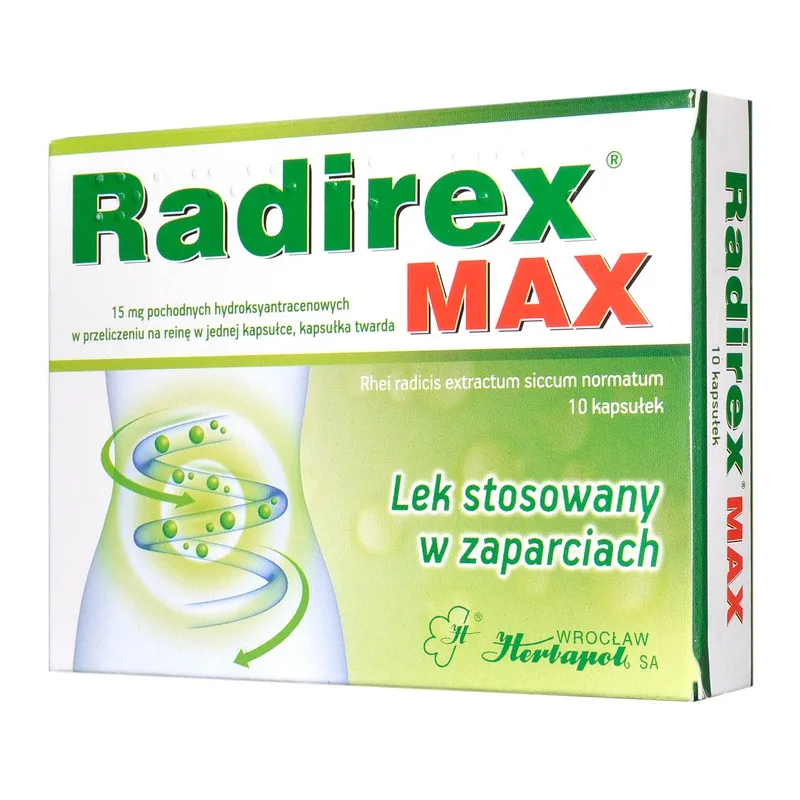
Table of Contents
Package leaflet: Information for the patient
Radirex MAX
15 mg hydroxyanthracene derivatives expressed as rhein,
hard capsules
Rhei radicis extractum siccum normatum
Please read all of this leaflet carefully before taking the medicine, as it contains
important information for the patient.
This medicine should always be taken exactly as described in this patient leaflet or as directed by the doctor or pharmacist.
- Keep this leaflet so that you can read it again if necessary.
- If you need advice or further information, please consult your pharmacist.
- If the patient experiences any adverse reactions, including any possible adverse reactions not listed in this leaflet, inform the doctor or pharmacist. See section 4.
- If there is no improvement after 7 days, or if the patient feels worse, consult a doctor.
Contents of the leaflet
- What Radirex MAX is and what it is used for
- Important information before taking Radirex MAX
- How to take Radirex MAX
- Possible side effects
- How to store Radirex MAX
- Contents of the pack and other information
1. What Radirex MAX is and what it is used for
Radirex MAX is a herbal medicinal product intended for short-term use in occasional constipation.
The medicine has a laxative effect.
If there is no improvement after 7 days, or if the patient feels worse, consult a doctor.
2. Important information before using Radirex MAX
When not to use Radirex MAX
- If the patient is allergic to the active substance or any of the other ingredients of this medicine (listed in section 6).
- If the patient has intestinal obstruction, intestinal stenosis or atony, appendicitis, inflammatory bowel diseases (e.g. Crohn's disease, ulcerative colitis), abdominal pain of unknown cause, severe dehydration with excessive loss of electrolytes and water.
- In children under 12 years of age.
- In women during pregnancy and breastfeeding.
Warnings and precautions
Before starting to use Radirex MAX, discuss this with your doctor or pharmacist.
Patients taking cardiac glycosides (digoxin), antiarrhythmic drugs (quinidine, phenytoin,
propranolol, amiodarone, verapamil), QT-prolonging drugs (hydroxyzine, escitalopram,
amitriptyline), diuretics (hydrochlorothiazide, furosemide, indapamide), corticosteroids (prednisone,
prednisolone, methylprednisolone), or liquorice root should consult their doctor before
starting treatment with this medicine.
As with other laxatives, unless recommended by a doctor, Radirex MAX should not be used by patients with faecal impaction or acute or chronic gastrointestinal disorders of unknown origin such as abdominal pain, nausea, vomiting, as these symptoms may indicate possible or existing intestinal obstruction.
If the patient uses laxatives daily, the underlying cause of constipation should be investigated.
Prolonged use of laxatives should be avoided.
Long-term use of stimulant laxatives may lead to impaired bowel function and dependence on laxatives.
Preparations containing senna extract should only be administered if therapeutic effect cannot be achieved by dietary changes or use of bulk-forming agents.
If Radirex MAX is administered to patients with faecal incontinence, diapers should be changed more frequently to prevent prolonged skin contact with faeces.
Patients with impaired kidney function should be aware of the risk of electrolyte disturbances.
Children and adolescents
Use of this medicine in children under 12 years of age is contraindicated.
Radirex MAX and other medicines
Inform your doctor or pharmacist about all medicines you are currently taking or have recently taken, as well as any medicines you plan to take.
Low serum potassium levels (hypokalemia) caused by chronic overuse of laxatives may enhance the effects of cardiac glycosides (digoxin) and may lead to interactions with antiarrhythmic drugs (quinidine, phenytoin, propranolol, amiodarone, verapamil). Concomitant use with other drugs that cause hypokalemia, such as diuretics (hydrochlorothiazide, furosemide, indapamide), corticosteroids (prednisone, prednisolone, methylprednisolone), or liquorice root, may exacerbate electrolyte disturbances.
Taking Radirex MAX with food and drink
Take the medicine after meals, swallowing the capsule with water.
Pregnancy and breastfeeding
Use of this medicine during pregnancy and breastfeeding is contraindicated.
If the patient suspects she might be pregnant or is planning a pregnancy, she should consult her doctor or pharmacist before using this medicine.
Driving and operating machinery
Radirex MAX has no significant influence on the ability to drive vehicles or operate machinery.
Radirex MAX contains between 3.8 mg and 178.1 mg of monohydrate lactose per 1 capsule.
If the patient has previously been diagnosed with intolerance to certain sugars, the patient should consult a doctor before taking this medicine.
3. How to use Radirex MAX
This medicine should always be used exactly as described in this patient information leaflet or as directed by a
physician or pharmacist. If in doubt, consult your doctor or pharmacist.
The maximum daily dose is 30 mg of hydroxyanthracene glycosides, equivalent to two
capsules of Radirex MAX per day.
The most appropriate single dose is the lowest dose required to achieve soft stools.
The laxative effect occurs 8–12 hours after administration.
The medicine should be taken orally.
Recommended dose:
Adults, elderly patients, and adolescents over 12 years of age:
1–2 capsules of Radirex MAX per day, taken orally in the evening.
Usually, administering the medicine two to three times per week is sufficient.
Do not use for longer than 7 days. See Warnings and precautions.
If symptoms persist during treatment, consult your doctor or pharmacist.
Use in children
Radirex MAX must not be used in children under 12 years of age.
Taking more Radirex MAX than recommended
The main symptoms of overdose or abuse are cramping abdominal pain and severe diarrhoea with
concomitant loss of fluids and electrolytes, which should be replenished. In such cases, consult a doctor
immediately for symptomatic treatment. The patient should be aware that diarrhoea with associated loss of
potassium ions may be dangerous, especially in elderly individuals. Chronic abuse of medicines containing
anthranoids may lead to toxic liver inflammation.
Missing a dose of Radirex MAX
Do not take a double dose to make up for a missed dose.
Stopping treatment with Radirex MAX
If you have any further questions about the use of this medicine, consult your doctor or pharmacist.
4. Possible adverse reactions
Like all medicines, Radirex MAX may cause adverse reactions, although not everyone experiences them.
The adverse reactions of the medicinal product are presented according to organ system classifications as per MedDRA and frequency of occurrence: frequency unknown (cannot be estimated from the available data).
The following may occur during the use of Radirex MAX:
Immune system disorders
Hypersensitivity reactions (itching, urticaria, localised or generalised rash) – frequency unknown.
Gastrointestinal disorders
Abdominal pain, intestinal cramps, diarrhoea (especially in patients with irritable bowel) – frequency unknown.
These symptoms may also occur as a consequence of individual overdose.
In such cases, dose reduction is necessary.
Long-term use of the product may lead to pigmentation of the intestinal mucosa (pseudomelanosis coli), which usually resolves after discontinuation of the product – frequency unknown.
Urinary system disorders
During treatment, yellow or red-brown (depending on urine pH) discoloration of urine may occur due to the presence of metabolites of active substances; this is not clinically significant – frequency unknown.
Prolonged use of the product may lead to disturbances in water-electrolyte balance, proteinuria, and haematuria – frequency unknown.
If any other adverse reactions not described above occur, consult a physician or pharmacist.
Reporting of adverse reactions
If any adverse effects occur, including any adverse effects not listed in this leaflet, inform your doctor or pharmacist. Adverse reactions can be reported directly to the Department of Monitoring Adverse Drug Reactions, Office for Registration of Medicinal Products, Medical Devices and Biocidal Products,
Al. Jerozolimskie 181C
02-222 Warsaw
Phone: +48 22 49 21 301
Fax: +48 22 49 21 309
Website: https://smz.ezdrowie.gov.pl
Adverse reactions can also be reported to the marketing authorisation holder.
Reporting adverse reactions helps to provide more information on the safety of the medicine.
5. How to store Radirex MAX
Store this medicine at a temperature below 25°C.
Keep the medicine in a place out of sight and reach of children.
Do not use this medicine after the expiry date stated on the pack after: EXP.
The expiry date refers to the last day of the stated month.
Medicines should not be disposed of via wastewater or household waste. Ask your pharmacist how to dispose of medicines no longer in use. This will help protect the environment.
6. Contents of the package and other information
What Radirex MAX contains
The active substance in Radirex MAX is standardized dry extract of rhubarb root (Rhei radicis extractum siccum normatum).
One capsule contains 196.9 mg – 371.2 mg of dry extract from Rheum palmatum L. and/or Rheum officinale Baillon, radix (rhubarb root), equivalent to 15 mg of hydroxyanthracene derivatives calculated as rhein, extracted with 70% ethanol (V/V).
Excipient with known effect: monohydrate lactose from 3.8 mg to 178.1 mg per capsule.
Other ingredients: colloidal anhydrous silica, calcium carbonate, crospovidone type A, magnesium stearate, hard gelatin capsule with printing (capsule shell: black iron oxide, titanium dioxide, yellow iron oxide, gelatin; ink: shellac, propylene glycol, concentrated ammonia solution, potassium hydroxide, black iron oxide).
What Radirex MAX looks like and contents of the pack
Hard cylindrical capsules, olive in colour, printed with "RADIREX MAX".
The package contains 1 or 2 PVC/ACLAR/PVC/Aluminium foil blisters with 10 capsules each.
Marketing Authorisation Holder and Manufacturer
Wrocławskie Zakłady Zielarskie „Herbapol” SA
ul. św. Mikołaja 65/68
50-951 Wrocław
Tel: +48 71 33 57 225
Fax: +48 71 37 24 740
e-mail: [email protected]
For further information about this medicinal product, please contact the Marketing Authorisation Holder: tel. 71 321 86 04 ext. 123.