Pylera
Poland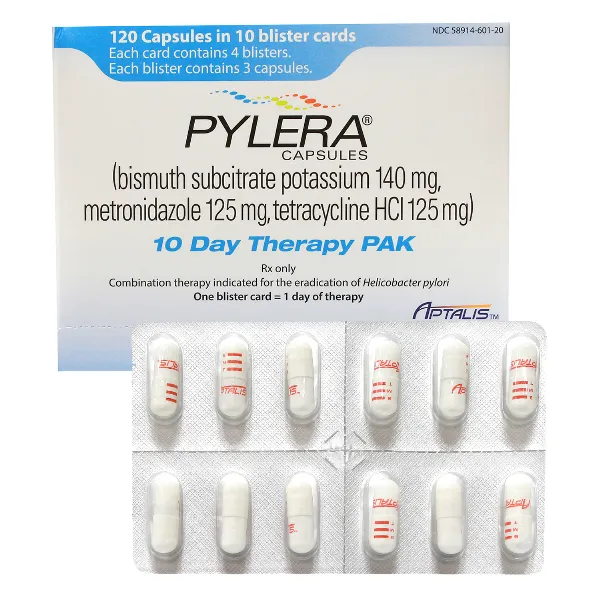
Table of Contents
Warning! Keep the leaflet. Information on the immediate packaging in a foreign language.
Pylera, 140 mg + 125 mg + 125 mg, hard capsules
Bismuthi kalii subcitras + Metronidazolum + Tetracyclini hydrochloridum
Please read the entire leaflet before using the medicine, as it contains important information
for the patient.
- Keep this leaflet for future reference.
- Consult your doctor or pharmacist if you have any further questions.
- This medicine has been prescribed for a specific individual. Do not pass it on to others. It may harm someone else, even if their symptoms are the same.
- If the patient experiences any adverse reactions, including those not listed in this leaflet, inform your doctor, pharmacist, or nurse. See section 4.
Table of contents of the leaflet
- What Pylera is and what it is used for
- What you need to know before taking Pylera
- How to take Pylera
- Possible side effects
- How to store Pylera
- Contents of the pack and other information
1. WHAT PYLERA IS AND WHAT IT IS USED FOR
Pylera contains three different active substances: bismuth potassium citrate, metronidazole, and tetracycline hydrochloride. Tetracycline and metronidazole belong to a group of medicines called antibiotics. Bismuth potassium citrate enhances the effect of antibiotics in treating infection.
Pylera contains a combination of substances used to treat adult patients infected with Helicobacter pylori (H. pylori) who have or have had gastric ulcers. H. pylori is a bacterium present in the gastric mucosa.
Pylera must be taken together with a medicine called omeprazole. Omeprazole is a medicine that reduces the amount of acid produced by the stomach. When taken together with a proton pump inhibitor (e.g., omeprazole), Pylera acts synergistically to eradicate the infection and reduce gastric mucosal inflammation.
2. IMPORTANT INFORMATION BEFORE USING PYLERA
When not to use Pylera
- if the patient is pregnant or breastfeeding;
- in patients under 12 years of age;
- if the patient has kidney disorders;
- if the patient has liver disorders;
- if the patient has a known allergy (hypersensitivity) to bismuth subcitrate potassium, metronidazole or other nitroimidazole derivatives, tetracycline, or any other component of Pylera (listed in section 6);
- if the patient has Cockayne syndrome (see "Warnings and precautions").
Warnings and precautions
Before starting treatment with Pylera, discuss this with your doctor or pharmacist.
Severe, irreversible liver damage/acute liver failure, including fatal cases occurring very rapidly after initiation of systemic metronidazole therapy, have been reported in patients with Cockayne syndrome.
Immediately contact your doctor and discontinue metronidazole if any of the following symptoms occur:
- Abdominal pain, loss of appetite, nausea, vomiting, fever, malaise, fatigue, jaundice, dark urine, pale stools, or itching.
Metronidazole, one of the components of this medicine, may exacerbate changes in the ECG, specifically QT interval prolongation, leading to delayed electrical signal conduction and heart rhythm disturbances (arrhythmias), when administered together with substances that may cause similar ECG changes. This should be discussed with your doctor before starting Pylera, especially if you have previously experienced such ECG changes or heart rhythm disorders (see "Pylera with other medicines").
When to exercise special caution when using Pylera
- if the patient is scheduled for X-ray imaging, as Pylera may affect imaging results;
- if the patient is scheduled for blood tests, as Pylera may affect the results of certain blood tests;
- if the patient has previously been diagnosed with intolerance to certain sugars.
Avoid exposure to sunlight and use of sunbeds during treatment with Pylera, as it may increase sensitivity to sunlight. In case of sunburn, consult your doctor.
Children and adolescents
Pylera capsules must not be given to children under 12 years of age and are not recommended for children aged 12 to 18 years.
Pylera with other medicines
Inform your doctor or pharmacist about all medicines currently taken or recently used, as well as any medicines you plan to take, including those available without a prescription.
In particular, inform your doctor if you are taking or have recently taken any of the following medicines:
- lithium, used in the treatment of certain psychiatric disorders;
- medicines used to thin the blood or prevent blood clots (e.g. warfarin);
- phenytoin and phenobarbital, used in epilepsy;
- methoxyflurane (an anaesthetic);
- other antibiotics, particularly penicillins;
- dietary supplements containing iron, zinc, or sodium hydroxide;
- long-term use of Pylera with other medicines containing bismuth may affect the nervous system;
- busulfan and fluorouracil, used in chemotherapy;
- cyclosporine, used to suppress the body's immune response after organ transplantation;
- disulfiram, used in the treatment of alcohol dependence;
- ranitidine, used for indigestion and heartburn;
- retinoids, used in the treatment of skin diseases;
- atovaquone, used to treat lung infections;
- medicines known to cause ECG changes (QT interval prolongation) and whose blood concentration may be increased by metronidazole. Such substances include, among others:
- Amiodarone (used to treat heart rhythm disorders);
- Ondansetron (used to treat nausea and vomiting);
- Methadone (used as replacement therapy in opioid dependence);
- Domperidone (used to treat nausea and vomiting).
Do not take antacids containing aluminium, calcium, or magnesium at the same time as Pylera.
Pylera with food, drink, or alcohol
Take Pylera with a full glass of water (250 ml), after meals and at bedtime (preferably after a light snack).
Do not eat or drink dairy products (e.g. milk or yoghurt) or beverages containing calcium at the same time as taking Pylera or during treatment with Pylera, as this may affect the medicine's effectiveness.
Do not drink alcohol during treatment with Pylera and for 24 hours after completing treatment.
Drinking alcohol during treatment may cause unpleasant adverse reactions such as nausea, vomiting, abdominal pain (cramps), hot flushes, and headache.
Inform your doctor or pharmacist about all medicines currently taken or recently used, including those available without a prescription.
Pregnancy and breastfeeding
Do not use Pylera if you are, may be, or suspect you may be pregnant.
If you become pregnant during treatment, contact your doctor immediately.
Do not breastfeed while taking Pylera, as small amounts of the active ingredients of Pylera may pass into breast milk.
Driving and operating machinery
Do not drive or operate machinery if you experience dizziness, drowsiness, seizures, or transient blurred or double vision.
Pylera contains lactose monohydrate and potassium
Pylera contains lactose monohydrate, a type of sugar. If you have previously been diagnosed with intolerance to certain sugars, consult your doctor before taking this medicine.
Pylera contains 96 mg of potassium per dose (3 capsules, each containing 32 mg of potassium), which should be taken into account in patients with impaired kidney function and in patients who are monitoring potassium intake in their diet.
3. HOW TO USE PYLERA
This medicine should always be taken as directed by your doctor. Pylera must be taken together with a proton pump inhibitor (e.g. omeprazole). If in doubt, consult your doctor or pharmacist again.
Adults and elderly patients
Do not open the capsules; swallow them whole.
Take 3 capsules of Pylera after breakfast, 3 capsules after lunch, 3 capsules after dinner, and 3 capsules at bedtime (preferably after a snack), for a total of 12 capsules per day.
Swallow the capsules whole, while sitting upright, with a full glass of water (250 ml) to avoid throat irritation. Do not lie down immediately after taking Pylera. It is important to complete the full course of treatment (10 days) and take all 120 capsules.
Take one tablet (capsule) of omeprazole 20 mg together with the doses of Pylera taken after breakfast and after dinner (a total of 2 tablets (capsules) of omeprazole per day).
Daily dosing schedule for Pylera
| Time of dose administration | Number of Pylera capsules | Number of omeprazole capsules/tablets |
|---|---|---|
| After breakfast | 3 | 1 |
| After lunch | 3 | 0 |
| After dinner | 3 | 1 |
| At bedtime (preferably after a snack) | 3 | 0 |
Overdose of Pylera
If more Pylera has been taken than recommended, contact your doctor or go to the nearest hospital emergency department immediately. Take the medicine container and any remaining capsules with you so the doctor knows which medicine has been taken.
Missed dose of Pylera
If you forget to take a dose of Pylera, take it as soon as you remember. However, if it is almost time for the next dose, skip the missed dose. Do not take a double dose to make up for a missed one. If more than 4 consecutive doses of Pylera (1 day) are missed, contact your doctor.
Stopping Pylera treatment
It is important to complete the full course of treatment, even if you start feeling better after a few days. If treatment is stopped too early, the infection may not be completely cured, and symptoms may return or worsen. Resistance to tetracycline and/or metronidazole (antibiotics) may also develop.
If you have any further questions about the use of this medicine, consult your doctor or pharmacist.
4. POSSIBLE ADVERSE REACTIONS
Like all medicines, this medicine can cause adverse reactions, although not everyone will experience them.
If any of the following conditions occur, stop taking
the medicine Pylera and contact your doctor or go to the emergency department
of the nearest hospital:
- swelling of the face, lips, tongue or throat, which may cause difficulty in swallowing or breathing;
- itchy, raised rash or hives.
These may be symptoms of an allergic reaction.
- Severe skin reactions (Stevens-Johnson syndrome, toxic epidermal necrolysis (Lyell's syndrome), drug reaction with eosinophilia and systemic symptoms (DRESS syndrome)) (See below under "Not known" adverse reactions).
A serious, but very rare adverse reaction is brain disease
(encephalopathy). Symptoms vary, but the patient may have fever, neck stiffness, headache,
see or hear things that do not exist. The patient may also have difficulty moving
arms and legs, speaking, or may feel confused. If such symptoms occur, inform your doctor immediately.
Other possible adverse reactions
Very common (may affect more than 1 in 10 people):
- changes in stool consistency and color, including black stools;
- diarrhoea;
- nausea;
- unusual or metallic taste in the mouth.
Common (may affect up to 1 in 10 people):
- abdominal pain;
- constipation;
- dry mouth;
- vomiting;
- flatulence / bloating;
- headache;
- feeling weak;
- feeling of lack of energy and fatigue;
- general malaise;
- vaginal infections – symptoms include itching and irritation in the genital area, burning or yellowish/white vaginal discharge;
- blood tests may show increased liver enzyme activity (aminotransferases);
- darkening of urine;
- loss or decrease of appetite;
- dizziness;
- feeling sleepy;
- skin problems such as redness (rash).
Uncommon (may affect up to 1 in 100 people):
- allergic reaction to the medicine (symptoms include swelling of the face, mouth, tongue or oesophagus, which may make swallowing or breathing difficult; itchy raised rash or hives);
- feeling of abdominal bloating;
- hiccups or belching;
- mouth ulcers / oral ulceration;
- changes in tongue coloration (black tongue);
- swelling of the tongue;
- chest pain, discomfort in the chest;
- fungal infection (candidiasis), which may affect the mouth (symptoms: white patches inside the mouth) or genitals (symptoms: intense itching, burning, irritation);
- numbness;
- tingling;
- tremor;
- feeling anxious, depressed or having difficulty sleeping;
- memory disturbances;
- skin disorders such as itching or burning (urticaria);
- blurred vision;
- dizziness.
Not known (frequency cannot be estimated from available data)
- serious illness with blistering of the skin, mouth, eyes and genital areas (Stevens-Johnson syndrome);
- serious illness with blistering of the skin (Lyell's syndrome, toxic epidermal necrolysis);
- flu-like symptoms, facial rash spreading over the whole body with high fever, elevated liver enzymes in blood tests, increased levels of certain white blood cells (eosinophilia), and enlarged lymph nodes (DRESS);
- blisters (skin blisters) and skin peeling;
- aseptic meningitis: a syndrome of symptoms including fever, nausea, vomiting, headache, neck stiffness, and extreme sensitivity to light. This may be caused by inflammation of the membranes covering the brain and spinal cord (meningitis);
- nerve damage, which may cause numbness, tingling, pain or weakness in hands or feet (peripheral neuropathy);
- inflammation of the large intestine (pseudomembranous colitis);
- a neurological disorder called cerebellar syndrome, whose symptoms may include: difficulty with coordination of movements, speech and (or) walking, involuntary eye movements and tremor. This may resolve after discontinuation of treatment.
Reporting of adverse reactions
If any adverse reactions occur, including any adverse reactions not listed
in this leaflet, inform your doctor, pharmacist or nurse.
Adverse reactions can be reported directly to the Department of Monitoring Adverse Drug Reactions of the Office for Registration of Medicinal Products, Medical Devices and Biocidal Products
Al. Jerozolimskie 181 C
02-222 Warsaw
Tel.: + 48 22 49 21 301
Fax: + 48 22 49 21 309
Website: https://smz.ezdrowie.gov.pl
By reporting adverse reactions, additional information on the safety of the medicine can be collected.
5. HOW TO STORE PYLERA
Keep this medicine out of the sight and reach of children.
Do not use this medicine after the expiry date stated on the packaging. The expiry date refers to the last day of the stated month.
There are no special requirements regarding storage temperature. Store in the original packaging to protect from light and moisture.
Medicines must not be disposed of via wastewater or household waste. Ask your pharmacist how to dispose of medicines no longer required. Such measures will help protect the environment.
6. CONTENTS OF THE PACKAGE AND OTHER INFORMATION
What Pylera contains
The active substances in Pylera are bismuth potassium citrate, metronidazole, and tetracycline hydrochloride.
Each capsule contains 140 mg of bismuth potassium citrate (equivalent to 40 mg of bismuth oxide), 125 mg of metronidazole, and 125 mg of tetracycline hydrochloride.
Other ingredients: magnesium stearate (E 572), monohydrate lactose, talc (E 553b); capsule shell: titanium dioxide (E 171), gelatin, and printing ink containing shellac, propylene glycol, and red iron oxide (E 172).
The medicine contains monohydrate lactose and potassium. See section 2.
What Pylera looks like and contents of the pack
Pylera is a long, white, opaque hard capsule with the red imprint "BMT" on the cap. The capsule contains white powder and additionally a small opaque capsule containing yellow powder.
Pylera capsules are supplied in HDPE bottles with a child-resistant closure, containing a desiccant (silica gel) and a silk-wrapped desiccant strip, all packed in a cardboard box. Each bottle contains 120 capsules.
To protect against moisture, a desiccant (silica gel packet) and a silk-wrapped desiccant strip are included in the bottle. The desiccant or the silk-wrapped strip must not be ingested.
For more detailed information, please contact the marketing authorization holder or the parallel importer.
Marketing Authorization Holder in the Czech Republic, country of export:
Laboratoires Juvisé Pharmaceuticals
149 Boulevard Bataille de Stalingrad
69100 Villeurbanne
France
Manufacturer:
Skyepharma Production SAS
Zone Industrielle Chesnes Ouest
55 rue du Montmurier
38070 Saint Quentin Fallavier
France
Parallel Importer:
Delfarma Sp. z o.o.
ul. Św. Teresy od Dzieciątka Jezus 111
91-222 Łódź
Poland
Repackaged by:
Delfarma Sp. z o.o.
ul. Św. Teresy od Dzieciątka Jezus 111
91-222 Łódź
Poland
Marketing Authorization Number in the Czech Republic, country of export: 09/248/14-C
Parallel Import Authorization Number: 319/25
This medicinal product is authorized in the European Economic Area countries under the following names:
Belgium: Tryplera
Austria, Czech Republic, France, Spain, Germany, Poland, Portugal, Slovakia, Italy: Pylera