Purethal
Poland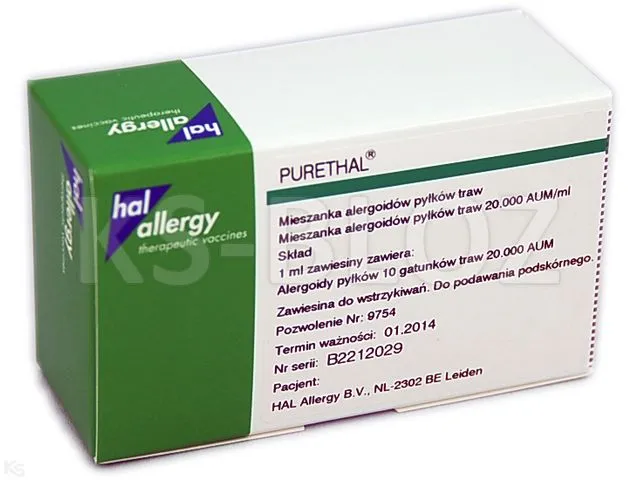
Table of Contents
Package leaflet: information for the patient
PURETHAL pollen allergoid mixtures,
20,000 AUM
suspension for injection
Please read carefully all the information in this leaflet before using the medicine, as it contains
important information for the patient.
- Keep this leaflet, as you may need to read it again.
- If you have any questions, please consult your doctor or pharmacist.
- This medicine has been prescribed for a specific individual. Do not pass it on to others. The medicine may harm someone else, even if their symptoms are the same.
- If the patient experiences any adverse reactions, including any not listed in this leaflet, inform a doctor or pharmacist immediately. See section 4.
Table of contents:
- What PURETHAL is and what it is used for
- Important information before using PURETHAL
- How to use PURETHAL
- Possible side effects
- How to store PURETHAL
- Contents of the pack and other information
1. What PURETHAL is and what it is used for
PURETHAL is used for specific immunotherapy (desensitization) of IgE-dependent respiratory allergies, with symptoms of allergic rhinitis, allergic conjunctivitis, and allergic asthma.
The mechanism of action includes:
- modulation of T-lymphocyte function
- induction of IgG antibodies
- reduction of inflammatory cell reactivity.
Diagnosis should be based on a detailed medical history confirming hypersensitivity reactions to pollen in the patient.
2. Important information before using the medicine PURETHAL
When not to use PURETHAL
- if the patient has hypersensitivity (allergy) to any of the other components of this medicine (listed in section 6),
- if the patient has reduced immunity (e.g. due to taking immunosuppressive drugs),
- if the patient has an autoimmune disease (e.g. rheumatic disease),
- if the patient has severe asthma, particularly with FEV (one-second forced expiratory volume) persistently maintained below 70% of predicted value, or glucocorticosteroid-dependent asthma,
- if the patient has cardiovascular insufficiency and is being treated with beta-blockers or ACE inhibitors (angiotensin-converting enzyme inhibitors),
- if the patient has contraindications to the use of adrenaline (e.g. hyperthyroidism),
- if the patient has active tuberculosis,
- if the patient has a malignant tumor,
- if the patient has been diagnosed with serious psychiatric disorders,
- in children under 5 years of age,
- during pregnancy. If treatment was initiated before conception, it may be continued in consultation with the attending physician.
Warnings and precautions
This medicine should be prescribed and administered only by specialist allergists experienced in allergy treatment.
Consult your doctor, even if the warnings below refer to conditions that occurred in the past.
In rare cases, after injection of this medicine, a severe systemic reaction may occur (wheezing, shortness of breath, Quincke's edema, generalized urticaria), and in extreme cases, anaphylactic shock may develop.
Typical warning symptoms include: burning pain, itching, sensation of warmth in or under the tongue, in the throat, on the palms and soles.
If any of these symptoms occur, contact your doctor immediately.
During pollen season, PURETHAL may be administered only to patients who are not experiencing allergic symptoms; if allergic symptoms occur during treatment in pollen season, the next injection should be postponed until symptoms subside or treatment discontinued. During this time, the interval between injections should be extended, which must be taken into account when continuing treatment. The decision on administering the next dose is made by the physician.
Do not initiate desensitization during pollen season!
Avoid physical exertion (sports, heavy physical work) before and after each injection of the medicine.
PURETHAL and other medicines
Inform your doctor about all medicines currently or recently taken, as well as any medicines planned for future use.
Immunosuppressive drugs should not be used during desensitization. Concurrent use of blood pressure-lowering drugs (beta-blockers and angiotensin-converting enzyme inhibitors - ACE inhibitors) may cause a very strong reaction, even after small doses of the medicine.
Additional exposure to external allergens or other harmful substances may lower the tolerance threshold (see: Warnings and precautions regarding use during pollen season).
If symptomatic anti-allergic treatment is being used simultaneously (with antihistamines, mast cell degranulation inhibitors, or corticosteroids), the patient's response and sensitivity to previously well-tolerated doses of the medicine may change. Furthermore, skin sensitivity may be altered, and skin tests performed during this period may yield false, unreliable results.
Bacterial and viral vaccinations may be administered no sooner than 7 days after the last injection of PURETHAL (except in life-saving situations). The next injection of the medicine may be administered only after complete resolution of the reaction to vaccination, but never earlier than 14 days after vaccination.
Pregnancy and breastfeeding
Pregnancy
Currently, there are no adequately documented data on the use of allergoids for desensitization in pregnant women. The potential risk to the mother and fetus is unknown.
Treatment with PURETHAL should not be initiated during pregnancy. If such treatment was started before conception, it may be continued in consultation with the attending physician.
Breastfeeding
Treatment with PURETHAL should not be initiated during breastfeeding. If such treatment was started before conception, it may be continued in consultation with the attending physician.
Driving and operating machinery
In very rare cases, mild fatigue may occur. This possibility should be taken into account before driving or operating machinery.
3. How to use Purethal
This medicine should always be used as directed by the physician. In case of doubt, consult your doctor.
Use of Purethal in children
In children and adolescents aged between 5 and 18 years, the same dose as in adults is recommended.
Treatment with Purethal may be administered either pre-season or throughout the year.
Treatment usually starts with a dose of 0.05 ml (first injection), followed by gradual weekly increases in dose up to the maximum dose of 0.5 ml (or a lower dose individually established for the patient). Initial treatment is completed once the highest dose has been administered.
Further management depends on the chosen treatment regimen, i.e., whether it will be rapid immunotherapy, pre-seasonal or year-round therapy.
Rapid immunotherapy may be completed after 6 weekly injections.
In adult patients, initial treatment with Purethal may be conducted according to an accelerated schedule (rapid treatment), i.e., 3 weekly injections to reach the maximum dose. After completion of this initial treatment, maintenance therapy may be continued.
Pre-seasonal or year-round maintenance immunotherapy
After completion of initial treatment, injections every 14 days are recommended. If the patient tolerates them well, after the third injection in the 14-day cycle, the interval between subsequent injections may be extended to 4 weeks.
When starting a new vial, there is no need to reduce the dose.
The above recommendations for use should be regarded solely as guidance and examples of treatment with Purethal. The treating physician may recommend a different dosage based on assessment of the patient's degree of sensitization.
Any decision to increase the dose must be based on evaluation of the response to the last administered dose. Treatment with an increased dose may be continued if no adverse reactions have occurred and if there has been no worsening of allergic reaction after administration of the last dose.
For information on the use of allergen extracts from plant pollens during the pollen season, see section 2. Important information before using Purethal.
Duration of immunotherapy
Full and lasting treatment effect is achieved after 3–5 years of Purethal treatment.
4. Possible adverse reactions
Like all medicines, this medicinal product may cause adverse reactions, although not everyone experiences them.
Local or systemic (affecting the whole body) allergic reactions may occur following the use of PURETHAL.
Local allergic reactions may be mild or moderate, such as swelling, urticaria, or redness, and systemic reactions such as rhinitis, itching and eye inflammation, sneezing, throat irritation, or cough.
Severe adverse symptoms and actions to take if they occur:
In rare cases, anaphylactic shock may occur. Typical warning signs include:
- sensation of warmth or itching on (or) under the tongue and in the throat, particularly on the palms and soles
- wheezing, noisy breathing, or difficulty breathing
- urticaria
- pale or greyish skin color
- rapid heartbeat
- fainting or collapse
If any of these warning symptoms occur, you must contact a doctor immediately.
The doctor will decide whether treatment with PURETHAL should be continued.
Other adverse reactions reported, for which frequency cannot be determined from available data, include asthma, skin rash, transient subcutaneous induration, rapid breathing, skin itching, nausea, abdominal pain, fever, and fatigue.
Adverse reactions usually occur shortly after injection; therefore, the patient should be observed for 30 minutes after administration of the medicine. However, delayed allergic reactions may occur several hours after administration.
When using the accelerated treatment schedule in adults, more intense adverse reactions may occur. In clinical studies, patients reported adverse reactions ranging from mild to moderate.
Children
No differences in the occurrence of adverse reactions between children and adults have been observed.
The adverse reactions observed during the use of PURETHAL are listed in the table below:
| Very common – may affect more than 1 in 10 people |
|
| Common – may affect less than 1 in 10 people but more than 1 in 100 people |
|
| Uncommon – may affect less than 1 in 100 people but more than 1 in 1000 people |
|
|
Reporting of adverse reactions
If any adverse reactions occur, including any adverse reactions not listed in the package leaflet,
inform a doctor, pharmacist, or nurse. Adverse reactions can be reported directly to the Department of Monitoring Adverse Drug Reactions of the Office for Registration of Medicinal Products, Medical Devices and Biocidal Products, Al. Jerozolimskie 181 C, PL-02 222 Warsaw, Tel.: + 48 22 49 21 301, Fax: + 48 22 49 21 309,
Website: https://smz.ezdrowie.gov.pl
Adverse reactions can also be reported to the responsible entity.
Reporting adverse reactions helps to gather further information on the safety of using the medicinal product.
5. How to store the medicine PURETHAL
Store in a refrigerator (2°C - 8°C).
Do not freeze.
The suspension must not be used if it has been frozen!
Keep the medicine out of sight and reach of children!
Do not use this medicine after the expiry date stated on the packaging. The expiry date refers to the last day of the stated month.
Medicines must not be disposed of via wastewater or household waste. Ask your pharmacist how to dispose of medicines no longer required. These measures will help protect the environment.
6. Contents of the packaging and other information
What Purethal contains
The active substances in this medicine are:
Grasses
Agrostis stolonifera
Anthoxanthum odoratum
Dactylis glomerata
Lolium perenne
Arrhenatherum elatius
Festuca rubra
Poa pratensis
Secale cereale
Holcus lanatus
Phleum pratense
Trees
Betula verrucosa
Alnus glutinosa
Corylus avellana
Grasses + Birch
Agrostis stolonifera
Anthoxanthum odoratum
Dactylis glomerata
Lolium perenne
Arrhenatherum elatius
Festuca rubra
Poa pratensis
Secale cereale
Holcus lanatus
Phleum pratense
Betula verrucosa
Grasses + Trees
Agrostis stolonifera
Anthoxanthum odoratum
Dactylis glomerata
Lolium perenne
Arrhenatherum elatius
Festuca rubra
Poa pratensis
Secale cereale
Holcus lanatus
Phleum pratense
Betula verrucosa
Alnus glutinosa
Corylus avellana
Other ingredients are: aluminium hydroxide, sodium chloride, phenol, water for injections.
What Purethal looks like and contents of the pack
A type I glass vial with a bromobutyl rubber stopper and a 1 ml polypropylene syringe with a 26G1/2 needle, in a cardboard box.
1 vial containing 3 ml of suspension and 8 syringes with needles.
Marketing Authorisation Holder and Manufacturer
Hal Allergy B.V.
J.H. Oortweg 15, 2333 CH Leiden
P.O. Box 1204, 2302 BE Leiden, The Netherlands
For further information, please contact the Marketing Authorisation Holder's representative.
Centrofarm Sp. z o.o.
Leszczynowa 1
05-092 Kiełpin, Łomianki
Tel: +48 691 810 590