Pterocyn
Poland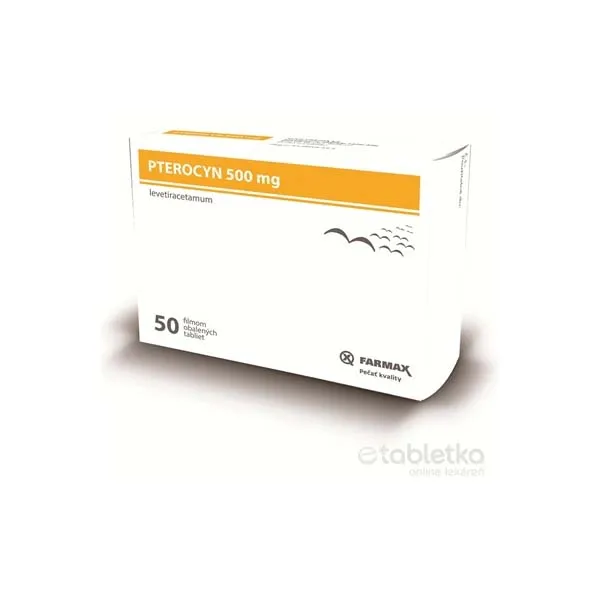
Table of Contents
Pterocyn, 250 mg, film-coated tablets
Pterocyn, 500 mg, film-coated tablets
Pterocyn, 750 mg, film-coated tablets
Pterocyn, 1000 mg, film-coated tablets
Levetiracetam
Please read the entire leaflet before using the medicine.
- Keep this leaflet for future reference.
- Consult your doctor or pharmacist if you have any further questions.
- This medicine has been prescribed for a specific individual. Do not share it with others. This medicine may harm other people, even if their symptoms are identical.
- If any of the side effects worsen or if any side effects not listed in this leaflet occur, inform your doctor or pharmacist immediately.
Table of contents of the leaflet:
- What Pterocyn is and what it is used for
- Important information before taking Pterocyn
- How to take Pterocyn
- Possible side effects
- How to store Pterocyn
- Further information
1. WHAT PTEROCYN IS AND WHAT IT IS USED FOR
Pterocyn is an antiepileptic medicine (a medicine used to treat epileptic seizures).
Pterocyn is used:
- as monotherapy in patients aged 16 years and older with newly diagnosed epilepsy, for the treatment of partial-onset seizures with or without secondary generalization;
- in patients already taking another antiepileptic medicine for the treatment of:
- partial-onset seizures with or without secondary generalization in patients aged 1 month and older;
- myoclonic seizures in patients aged 12 years and older with juvenile myoclonic epilepsy;
- primary generalized tonic-clonic seizures in patients aged 12 years and older with idiopathic generalized epilepsy.
2. IMPORTANT INFORMATION BEFORE USING THE MEDICINAL PRODUCT PTEROCYN
When not to use Pterocyn
- If the patient is allergic (hypersensitive) to levetiracetam or any of the other ingredients of the medicine
When to exercise special caution when using Pterocyn
- If the patient has a kidney disease, strictly follow the doctor's instructions, as the doctor may decide to adjust the dose specially.
- If any growth retardation or unexpected premature maturation in a child is observed, contact the doctor.
- If seizures worsen (e.g. increased frequency of seizures), contact the doctor.
- In a small number of patients treated with antiepileptic medicines such as Pterocyn, thoughts of self-harm or suicidal thoughts have occurred. In case of symptoms of depression and (or) suicidal thoughts, contact the doctor.
Use of other medicines
Inform your doctor or pharmacist about all medicines you are currently taking or have recently taken, including those obtained without a prescription.
Use of Pterocyn with food and drink
Pterocyn may be taken with or without food. For safety reasons, alcohol should not be consumed with Pterocyn.
Pregnancy and breastfeeding
Before using any medicine, consult your doctor or pharmacist.
During pregnancy or if pregnancy is suspected, consult your doctor before using the medicine. Pterocyn should not be used during pregnancy unless absolutely necessary. The risk to the fetus is unknown. In animal studies, levetiracetam administered in doses higher than those used to control seizures showed adverse effects on fertility.
Breastfeeding is not recommended during treatment.
Driving and operating machinery
Pterocyn may impair the ability to drive and operate any tools or machinery, as the medicine may cause drowsiness. This is more likely at the beginning of treatment or after an increase in dose. Driving and operating machinery are not recommended until the effect of the medicine on the patient's ability to perform these activities has been established.
Important information about some ingredients of Pterocyn
Pterocyn 750 mg, film-coated tablets contain the colouring agent Sunset Yellow FCF (E110), which may cause allergic reactions.
3. HOW TO USE THE MEDICINAL PRODUCT PTEROCYN
Pterocyn should always be taken as directed by the physician. In case of any doubts, consult your
doctor or pharmacist.
The medicine should be taken twice daily, in the morning and evening, approximately at the same
time each day.
Take the number of tablets as prescribed by your doctor.
Monotherapy
Dosage in adults and adolescents (from 16 years of age):
The usual dosage range is 1000 mg to 3000 mg per day.
If the patient is taking Pterocyn for the first time, the doctor will usually start with a lower dose for
two weeks, before increasing to the lowest commonly used dose.
Example: if the daily dose is 2000 mg, take one 1000 mg tablet in the morning and one 1000 mg
tablet in the evening.
Adjunctive therapy
Dosage in adults and adolescents (from 12 to 17 years of age) with body weight of 50 kg or more:
The usual dosage range is 1000 mg to 3000 mg per day.
Example: if the daily dose is 2000 mg, take one 1000 mg tablet in the morning and one 1000 mg
tablet in the evening.
Dosage in infants (from 6 to 23 months), children (from 2 to 11 years) and adolescents (from 12 to 17 years)
with body weight below 50 kg:
The doctor will determine the most appropriate formulation of Pterocyn based on age, body weight, and
required dose.
For infants and children under 6 years of age, the most appropriate formulation is the oral solution.
The usual dosage range is 20 mg/kg body weight to 60 mg/kg body weight/day.
For example, if the dose is 20 mg/kg body weight per day, in a child weighing 25 kg, administer
one 250 mg tablet in the morning and one 250 mg tablet in the evening.
Dosage in infants (from 1 month to below 6 months):
For infants, the most appropriate formulation is the oral solution.
Administration method:
Tablets should be swallowed whole with sufficient liquid (e.g. a glass of water).
Duration of treatment:
- Pterocyn is used for long-term treatment. Continue treatment for as long as directed by your doctor.
- Do not discontinue treatment without consulting your doctor, as this may lead to an increased frequency of seizures. If your doctor decides to discontinue treatment, they will provide instructions on how to taper the dose gradually.
Overdose of Pterocyn
Possible adverse effects after overdose of Pterocyn include drowsiness, agitation, aggression, reduced alertness, respiratory depression, and coma.
In case of ingestion of a dose higher than recommended, seek medical advice immediately.
The doctor will initiate the most appropriate treatment for overdose.
Missed dose of Pterocyn
Contact your doctor if one or more doses have been missed.
Do not take a double dose to make up for a missed dose.
Discontinuation of Pterocyn
If treatment with Pterocyn is to be discontinued, the medicine should be tapered gradually, as with other antiepileptic drugs, to avoid increased seizure frequency.
If you have any further questions concerning the use of this medicinal product, consult your doctor or pharmacist.
4. POSSIBLE ADVERSE REACTIONS
Like all medicines, Pterocyn may cause adverse reactions, although not everyone will experience them.
If any of the adverse symptoms worsen or if any adverse symptoms not listed in this leaflet occur, please inform your doctor or pharmacist.
Some of these adverse reactions, such as drowsiness, fatigue or dizziness, are more common at the beginning of treatment or during dose escalation. These effects should gradually diminish over time.
Adverse reactions can be classified according to the following frequency categories:
Very common (affects more than 1 in 10 patients)
Common (affects 1 to 10 in 100 patients)
Uncommon (affects 1 to 10 in 1,000 patients)
Rare (affects 1 to 10 in 10,000 patients)
Very rare (affects less than 1 in 10,000 patients)
Frequency not known (cannot be estimated from available data)
Very common
- Nasopharyngitis (inflammation of the nasal and throat mucosa)
- Drowsiness, headache
Common
- Loss of appetite
- Depression, hostility or aggression, anxiety, insomnia, nervousness or irritability
- Seizures, balance disorders (feeling of unsteadiness), dizziness, somnolence, involuntary tremor
- Vertigo (sensation of spinning)
- Cough
- Abdominal pain, diarrhoea, dyspepsia, vomiting, nausea
- Rash
- Asthenia (weakness, fatigue)
Uncommon
- Decreased platelet count, decreased white blood cell count
- Weight decrease, weight increase
- Suicide attempts and suicidal thoughts, mental disorders, abnormal behaviour, hallucinations, confusion, emotional instability/mood changes, agitation
- Amnesia (memory loss), memory disorders (forgetfulness), ataxia (impaired coordination), paresthesia (tingling), concentration difficulties (inability to concentrate)
- Diplopia (double vision), visual disturbances
- Abnormal liver function test results
- Hair loss, rash, pruritus (itching)
- Muscle weakness, myalgia (muscle pain)
- Injuries
Rare
- Infection
- Decreased red and/or white blood cell count
- Suicide, personality disorders (behavioural disturbances), thought disorders (slow thinking, inability to concentrate attention)
- Involuntary muscle contractions of the head, trunk and limbs, difficulty controlling movements, hyperkinesia (excessive activity)
- Pancreatitis
- Liver failure, hepatitis
- Skin, mouth, eyelid and genital area blistering, skin eruptions
If any adverse reactions occur, including any possible adverse reactions not listed in this leaflet, consult your doctor or pharmacist.
5. HOW TO STORE PTEROCYN MEDICINAL PRODUCT
Keep out of the reach and sight of children.
Do not use Pterocyn after the expiry date stated on the
carton/bottle/blister after: EXP. The expiry date refers to the last day of the specified month.
This medicinal product does not require any special storage conditions.
Medicines must not be disposed of via wastewater or household waste. Ask your
pharmacist what to do with medicines no longer required. Such measures will help
protect the environment.
6. OTHER INFORMATION
What Pterocyn contains
The active substance is levetiracetam 250, 500, 750, 1000 mg.
Other ingredients are:
Tablet core:
Crospovidone (type B), povidone K 30, anhydrous colloidal silicon dioxide, magnesium stearate.
Pterocyn 250 mg coated tablets, coating:
Hypromellose, polyethylene glycol 400, titanium dioxide (E 171), talc, indigo carmine, lake (E 132)
Pterocyn 500 mg coated tablets, coating:
Hypromellose, polyethylene glycol 400, titanium dioxide (E 171), talc, yellow iron oxide (E 172)
Pterocyn 750 mg coated tablets, coating:
Hypromellose, polyethylene glycol 400, titanium dioxide (E 171), talc, orange yellow, lake (E 110), red iron oxide (E 172)
Pterocyn 1000 mg coated tablets, coating:
Hypromellose, polyethylene glycol 400, titanium dioxide (E 171), talc
What Pterocyn looks like and contents of the pack
Pterocyn 250 mg coated tablets are blue, elongated, with a score line on one side, measuring 12.9 x 6.1 mm, packed in PVC/PE/PVDC/Aluminium blisters and cartons.
Pack sizes: 10, 20, 30, 50, 60, 80, 120 and 200 coated tablets.
Pterocyn 500 mg coated tablets are yellow, elongated, with a score line on one side, measuring 16.5 x 7.7 mm, packed in PVC/PE/PVDC/Aluminium blisters and cartons.
Pack sizes: 10, 20, 30, 50, 60, 80, 120 and 200 coated tablets.
Pterocyn 750 mg coated tablets are orange, elongated, with a score line on one side, measuring 18.8 x 8.9 mm, packed in PVC/PE/PVDC/Aluminium blisters and cartons.
Pack sizes: 10, 20, 30, 50, 60, 80, 120 and 200 coated tablets.
Pterocyn 1000 mg coated tablets are white, elongated, with a score line on one side, measuring 19.2 x 10.2 mm, packed in PVC/PE/PVDC/Aluminium blisters and cartons.
Pack sizes: 10, 20, 30, 50, 60, 80, 120 and 200 coated tablets.
Not all pack sizes may be marketed.
Marketing Authorisation Holder, Manufacturer
SVUS Pharma a.s., Smetanovo nábřeží 1238/20a, 500 02 Hradec Králové, Czech Republic
This medicinal product is authorised in the Member States of the European Economic Area under the following names:
Portugal: PTEROCYN 250, 500, 750, 1000 mg
Poland: PTEROCYN
Czech Republic: PTEROCYN 250, 500, 750, 1000 mg potahované tablety
Slovak Republic: PTEROCYN 250, 500, 750, 1000 mg filmom obalené tablety