Pso triol
Poland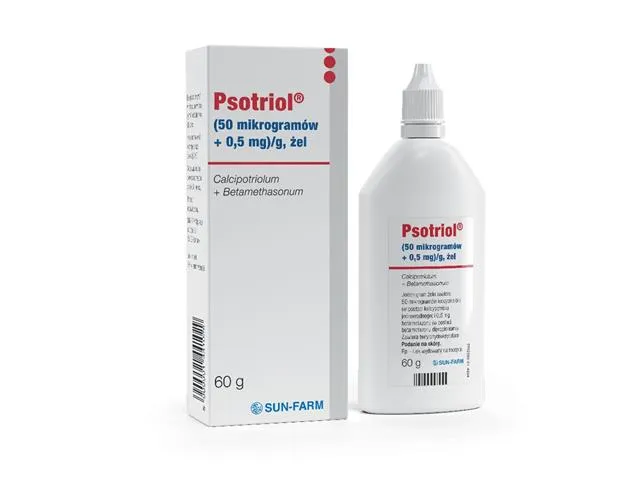
Table of Contents
Package leaflet: Information for the user
Psotriol, (50 micrograms + 0.5 mg)/g, gel
Calcipotriolum + Betamethasonum
Please read this leaflet carefully before using the medicine, as it contains
important information for the patient.
- Keep this leaflet, so that you can read it again if necessary.
- If you have any questions, please consult your doctor or pharmacist.
- This medicine has been prescribed for a specific individual. Do not pass it on to others. The medicine may harm another person, even if their symptoms are the same.
- If you experience any adverse reactions, including any adverse reactions not listed in this leaflet, inform your doctor or pharmacist. See section 4.
Contents of the leaflet
- What Psotriol is and what it is used for
- Important information before using Psotriol
- How to use Psotriol
- Possible side effects
- How to store Psotriol
- Contents of the pack and other information
1. What Psotriol is and what it is used for
Psotriol is used for the topical treatment of scalp psoriasis in adults and mild to moderate plaque psoriasis (psoriasis vulgaris) in adults affecting skin other than the scalp.
Psoriasis is caused by excessive skin cell production. This leads to redness, scaling, and thickening of the skin.
Psotriol contains calcipotriol and betamethasone. Calcipotriol helps slow down the rate of skin cell growth to normal levels, while betamethasone reduces inflammation.
2. Important information before using Psotriol
When not to use Psotriol
- if the patient is allergic (hypersensitive) to calcipotriol, betamethasone, or any of the other ingredients of Psotriol (listed in section 6),
- if the patient has disorders of calcium levels in the body (should consult a doctor),
- if the patient has been diagnosed with certain types of psoriasis: erythrodermic psoriasis, pustular psoriasis, or exfoliative psoriasis (should consult a doctor).
Due to the fact that Psotriol contains a potent steroid, this medicine should NOT be used in skin conditions such as:
- viral skin infections (e.g. herpes simplex or chickenpox),
- fungal skin infections (e.g. athlete's foot or dermatophytosis),
- bacterial skin infections,
- parasitic skin infections (e.g. scabies),
- tuberculosis,
- perioral dermatitis (red rash around the mouth),
- thin skin with easy bruising, fragile blood vessels, or stretch marks,
- ichthyosis (dry, scaly skin resembling fish scales),
- acne,
- rosacea (severe or sudden facial redness or flushing),
- skin ulcers or disruption of skin integrity.
Warnings and precautions
Before starting treatment with Psotriol, consult your doctor or pharmacist if:
- the patient is using other medicines containing corticosteroids that may cause adverse effects,
- the patient has been using this medicine for a long time and plans to discontinue treatment (because there is a risk of worsening or rebound of psoriasis following sudden steroid withdrawal),
- the patient has diabetes, as steroids may affect blood glucose levels,
- the patient has a skin infection that may require discontinuation of treatment,
- the patient has a specific type of psoriasis called guttate psoriasis,
- the patient experiences blurred vision or other visual disturbances.
Special precautions
Avoid using the medicine on more than 30% of body surface area or using more than 15 g of the medicine per day.
Avoid using the medicine under occlusive swim caps, bandages, or dressings, as this increases steroid absorption.
Avoid applying the medicine to large areas of damaged skin, mucous membranes, or skin folds (groin, armpits, under the breasts), as this increases steroid absorption.
Avoid applying the medicine to the face or genital organs (genitalia), as these areas are highly sensitive to steroid effects.
Avoid excessive sun exposure, excessive use of solariums, and other forms of phototherapy.
Children and adolescents
Psotriol is not recommended for use in children and adolescents under 18 years of age.
Psotriol with other medicines
Inform your doctor or pharmacist about all medicines the patient is currently taking, has recently taken, or plans to take.
Pregnancy, breastfeeding, and fertility
If the patient is pregnant, breastfeeding, suspects she may be pregnant, or is planning to become pregnant, she should consult a doctor before using this medicine.
If the doctor has approved breastfeeding during treatment, exercise caution and do not apply Psotriol to the breast area.
Driving and operating machinery
This medicine is not expected to have any effect on the ability to drive or operate machinery.
Psotriol contains butylated hydroxytoluene (E 321)
Butylated hydroxytoluene (E 321) may cause local skin reactions (e.g. contact dermatitis) or irritation of the eyes and mucous membranes.
3. How to use Psotriol
This medicine should always be used as directed by your doctor. If in doubt, consult your
doctor or pharmacist.
Method of administration of Psotriol: topical application to the skin.
Instructions for correct use:
- Apply only to skin affected by psoriasis; do not apply to unaffected skin.
- Shake the bottle before use and remove the cap.
- Squeeze the gel onto a clean finger or directly onto the psoriatic lesion.
- Apply Psotriol to affected areas using fingertips and gently rub in until a thin layer of gel is achieved.
- Do not apply bandages, occlusive dressings, or wraps to the treated area.
- After using Psotriol, wash hands thoroughly. This helps prevent accidental transfer of the gel to other parts of the body (especially face, mouth, or eyes).
- There is no need to worry if a small amount of gel accidentally spreads to healthy skin near the psoriatic lesion. If the gel spreads too far, wipe it off.
- To achieve optimal effect, avoid showering or bathing immediately after applying Psotriol.
- After applying the gel, avoid contact with textiles that are easily stained by oily substances (e.g. silk).
When using Psotriol for psoriasis on the scalp:
Before applying Psotriol to the hairy scalp, comb the hair to remove any loose skin scales.
Tilt the head to prevent Psotriol from running onto the face. Parting the hair before application may be helpful.
- Shake the bottle before use.
- Apply a drop of Psotriol onto the fingertip.
- Apply the medicine directly to the skin where plaques are palpable and rub Psotriol into the skin. Depending on the size of the affected area, 1–4 g of gel (up to one teaspoon) is usually sufficient.
To achieve optimal effect, washing the hair immediately after application of Psotriol is not recommended.
Leave the medicine on the skin overnight or during the day. When washing the hair after application,
the following instructions may be helpful:
- Apply a gentle shampoo to dry hair, especially to areas where the gel was applied.
- Leave the shampoo on the scalp for several minutes before rinsing.
- Wash hair as usual.
If necessary, steps 4–6 may be repeated once or twice.
Duration of treatment
- Apply the gel once daily. Evening application may be more convenient.
- The initial treatment period is usually 4 weeks for the scalp and 8 weeks for other body areas.
- Your doctor may decide on a different treatment duration.
- Your doctor may decide to repeat the treatment.
- Do not use more than 15 grams of medicine per day.
When using other medicines containing calcipotriol, the total amount of calcipotriol-containing products must not exceed 15 grams per day, and the treated skin area should not exceed 30% of the total body surface area.
What to expect when using Psotriol
Most patients notice clear improvement within 2 weeks, even if psoriasis symptoms have not yet completely resolved at the treated site.
Using more than the recommended dose of Psotriol
A patient who has used more than 15 grams of the medicine in one day should contact their doctor.
Excessive use of Psotriol may cause disturbances in blood calcium levels, which usually return to normal after stopping treatment. Your doctor may recommend a blood test to check whether excessive use of the gel has caused abnormal calcium levels. Prolonged, excessive use may also suppress normal adrenal gland function (glands located near the kidneys that produce hormones).
Missing a dose of Psotriol
Do not use a double dose to make up for a missed dose.
Stopping Psotriol treatment
Psotriol treatment should be discontinued according to your doctor's instructions. Gradual discontinuation may be necessary, especially if the medicine has been used for a long time.
If you have any further questions about the use of this medicine, consult your doctor or pharmacist.
4. Possible adverse reactions
Like all medicines, this medicine can cause adverse reactions, although not everyone will
experience them.
Severe adverse reactions
If any of the following symptoms occur, inform your doctor or nurse immediately or as
quickly as possible. It may be necessary to discontinue treatment.
Not very common (may affect up to 1 in 100 people)
- Worsening of psoriasis. If psoriasis worsens, inform your doctor as soon as possible.
It is known that some severe adverse reactions are caused by betamethasone (a potent
steroid), one of the components of Psotriol. If any of the following severe adverse
reactions occur, inform your doctor as soon as possible. These are likely to occur after
prolonged use, use in skin folds (e.g. groin, underarms or under the breasts), under occlusive
(airtight) dressings, or on large areas of skin.
These adverse reactions include:
- Suppression of normal adrenal gland function. Signs include fatigue, depression and anxiety.
- Cataract (symptoms include blurred and hazy vision, difficulty seeing at night, and sensitivity to light) or increased intraocular pressure (symptoms include eye pain, redness of the eyes, reduced or blurred vision).
- Infections (due to suppression or weakening of the immune system's ability to fight infections).
- Pustular psoriasis (a red area with yellowish pustules, usually on the hands or feet). If such symptoms are observed, discontinue use of Psotriol and inform your doctor immediately.
- Effect of the medicine on metabolic control in diabetes (if the patient has diabetes, fluctuations in blood glucose levels may occur).
Severe adverse reactions caused by calcipotriol
- Allergic reactions with deep swelling of the face or other parts of the body, such as hands or feet. Swelling of the mouth or throat and difficulty breathing may occur. If an allergic reaction is observed, discontinue use of Psotriol and inform your doctor immediately or go to the nearest hospital emergency department.
- Use of this gel may lead to increased calcium levels in the blood or urine (usually due to excessive use of the gel). Signs of elevated calcium levels in the blood include excessive urination, constipation, muscle weakness, confusion and coma. These may be severe, so contact your doctor immediately. However, after discontinuation of treatment, calcium levels return to normal.
Less severe adverse reactions
Common adverse reactions (may affect up to 1 in 10 people)
- Itching
Uncommon (may affect up to 1 in 100 people)
- Eye irritation
- Burning sensation of the skin
- Skin pain or irritation
- Inflammation or swelling of the hair root (folliculitis)
- Skin rash with inflammation (dermatitis)
- Skin redness due to dilation of small blood vessels (erythema)
- Acne (pimples)
- Dry skin
- Rash
- Pustular rash
- Skin infections
Rare (may affect up to 1 in 1,000 people)
- Allergic reactions
- Stretch marks
- Skin peeling
- Rebound effect: worsening of psoriasis symptoms after stopping treatment.
Frequency not known (frequency cannot be estimated from available data)
- White or grey hair may temporarily turn yellowish at the site of application when the medicine is applied to hairy scalp skin.
- Blurred vision
Less severe adverse reactions caused by betamethasone, especially when used for a prolonged period, are listed below. If any of these occur, inform your doctor or nurse as soon as possible.
- Thinning of the skin
- Appearance of superficial blood vessels and stretch marks
- Changes in hair growth
- Red rash around the mouth (perioral dermatitis)
- Rash with inflammation or swelling (allergic contact dermatitis)
- Golden-colored gel-filled bumps (colloid milia)
- Lightening of skin color (depigmentation)
- Inflammation or swelling of hair follicles (folliculitis)
Less severe adverse reactions caused by calcipotriol include:
- Dry skin
- Skin sensitivity to light, causing a rash
- Eruption
- Itching
- Skin irritation
- Burning or stinging sensation
- Skin redness associated with dilation of small blood vessels (erythema)
- Rash
- Rash with skin inflammation
- Worsening of psoriasis
Reporting of adverse reactions
If any adverse reactions occur, including any not listed in this leaflet, inform your doctor or pharmacist. Adverse reactions can be reported directly to the Department of Monitoring Adverse Drug Reactions of the Office for Registration of Medicinal Products, Medical Devices and Biocidal Products:
Al. Jerozolimskie 181C
02-222 Warsaw
Tel.: +48 22 49 21 301
Fax: +48 22 49 21 309
Website: https://smz.ezdrowie.gov.pl
Adverse reactions can also be reported to the marketing authorization holder.
Reporting adverse reactions helps provide more information on the safety of the medicine.
5. How to store Psotriol
This medicine should be stored out of sight and reach of children.
Do not use this medicine after the expiry date stated on the packaging after EXP.
The expiry date refers to the last day of the stated month.
Do not store above 30°C.
Period of use after first opening the bottle: 6 months.
Medicines must not be disposed of via wastewater or household waste. Ask your pharmacist how to dispose of medicines no longer in use. This will help protect the environment.
6. Contents of the package and other information
What Psotriol contains
The active substances in this medicine are calcipotriol and betamethasone.
One gram of gel contains 50 micrograms of calcipotriol (as calcipotriol monohydrate) and
0.5 mg of betamethasone (as betamethasone dipropionate).
The other ingredients are:
liquid paraffin, stearyl alcohol polyoxyethylene ether [containing butylhydroxytoluene (E 321)], hydrogenated castor oil.
What Psotriol looks like and contents of the pack
Psotriol is a nearly transparent, colourless or almost white gel, supplied in a bottle with a polyethylene cap, packed in a cardboard box.
Pack size: 60 g.
Marketing Authorisation Holder and Manufacturer
Marketing Authorisation Holder
SUN-FARM Sp. z o.o.
ul. Dolna 21
05-092 Łomianki
Manufacturer
mibe GmbH Arzneimittel
Münchener Straße 15
06796 Brehna
Germany
SUN-FARM Sp. z o.o.
ul. Dolna 21
05-092 Łomianki
Poland