Protevasc sr
Poland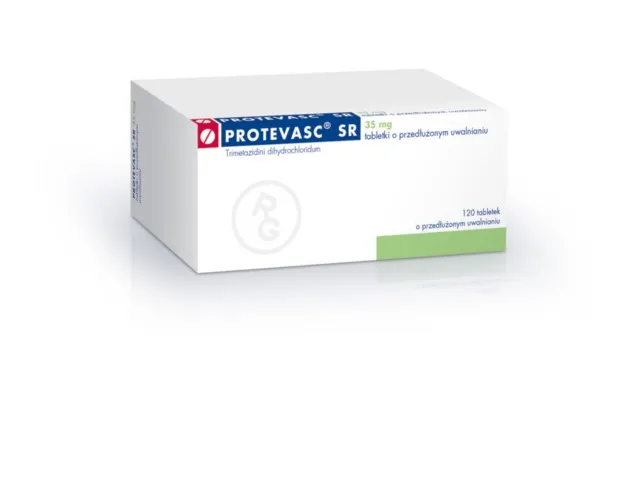
Table of Contents
Package leaflet: Information for the user
Protevasc SR, 35 mg, prolonged-release tablets
trimetazidini dihydrochloridum
Read this leaflet carefully before taking this medicine because it contains important information for you
- Keep this leaflet. You may need to read it again.
- If you have any further questions, ask your doctor or pharmacist.
- This medicine has been prescribed for you only. Do not pass it on to others. It may harm them, even if their symptoms are the same as yours.
- If you experience any side effects, including any not listed in this leaflet, tell your doctor or pharmacist. See section 4.
Contents of the leaflet
- What Protevasc SR is and what it is used for
- What you need to know before taking Protevasc SR
- How to take Protevasc SR
- Possible side effects
- How to store Protevasc SR
- Contents of the pack and other information
1. What Protevasc SR is and what it is used for
This medicine is intended for use in adults, in combination with other medications, for the treatment of angina pectoris (chest pain caused by coronary artery disease).
2. What you need to know before taking Protevasc SR
Do not take Protevasc SR
- if you are allergic to trimetazidine or to any of the other ingredients of this medicine (listed in section 6),
- if you are allergic to soya or peanuts,
- if you have Parkinson's disease: a brain disorder affecting movement (tremor, stiffness, slow movements and shuffling gait, unbalanced walking),
- if you have severe kidney disease.
Warnings and precautions
Before starting treatment with Protevasc SR, discuss with your doctor or pharmacist if:
- you have severe liver disease,
- you have kidney problems,
- you are over 75 years of age.
Severe skin reactions have been reported during treatment with Protevasc SR, including drug reaction with eosinophilia and systemic symptoms (DRESS) and acute generalized exanthematous pustulosis (AGEP). If you notice any symptoms related to this serious skin reaction, described in section 4, stop taking Protevasc SR immediately and seek medical help.
This medicine may cause or worsen symptoms such as tremor, stiffness, slow movements, shuffling gait and unbalanced walking, especially in elderly patients. These symptoms should be monitored and reported to your doctor, who will reassess the treatment.
Protevasc SR is not suitable for treating acute attacks of angina pectoris.
Children and adolescents
Protevasc SR is not recommended for use in children and adolescents under 18 years of age.
Other medicines and Protevasc SR
Tell your doctor or pharmacist if you are taking, have recently taken or might take any other medicines.
Protevasc SR with food and drink
Food and beverages do not significantly affect the absorption and effectiveness of this medicine.
Pregnancy and breastfeeding
If you are pregnant or breastfeeding, think you may be pregnant or are planning to have a baby, talk to your doctor or pharmacist before taking this medicine.
Pregnancy:
You should avoid using this medicine during pregnancy. If pregnancy is diagnosed during treatment, consult your doctor for advice. Only your doctor should decide whether to continue treatment with Protevasc SR.
Breastfeeding:
It is unknown whether trimetazidine is excreted in human breast milk. Therefore, use of Protevasc SR should be avoided during breastfeeding.
Driving and using machines
This medicine may cause dizziness and drowsiness, which may affect your ability to drive or operate machinery.
Protevasc SR contains soya lecithin.
If you are allergic to soya or peanuts, you should not take this medicine.
3. How to take Protevasc SR
Always take this medicine exactly as your doctor has told you. If in doubt, consult your doctor or pharmacist.
Adults
The recommended dose of Protevasc SR is one 35 mg tablet taken twice daily, during meals, in the morning and evening.
Take the tablets in the morning and evening, during meals, with a glass of water if needed.
If you have kidney problems or are over 75 years of age, your doctor will adjust the recommended dose.
Use in children
Protevasc SR is not recommended for use in children.
If you take more Protevasc SR than you should
If you take too many tablets, contact your doctor immediately or go to the nearest hospital emergency department for appropriate treatment.
If you forget to take Protevasc SR
It is important to take the medicine every day. However, if you miss one or more doses, take them as soon as you remember and then return to your regular dosing schedule. Do not take a double dose to make up for a missed dose.
Stopping Protevasc SR
Follow your doctor's instructions regarding dose and duration of treatment. If you decide to stop taking Protevasc SR earlier, inform your doctor immediately.
If you have any further questions about the use of this medicine, ask your doctor or pharmacist.
4. Possible adverse reactions
Like all medicines, this medicine may cause adverse reactions, although not in everyone.
The following adverse reactions have been reported with the use of Protevasc SR:
You should stop taking Protevasc SR and immediately contact your doctor if you notice any of the following adverse reactions:
Frequency unknown: (frequency cannot be estimated from available data):
- Widespread rash, high body temperature, increased liver enzyme activity, blood abnormalities (eosinophilia), enlarged lymph nodes and involvement of other organs (drug reaction with eosinophilia and systemic symptoms, also known as DRESS). See also section 2.
- Severe generalized rash with redness of the skin and blisters.
Other possible adverse reactions:
Common adverse reactions (may occur in more than 1 in 10 patients):
Dizziness, headache, abdominal pain, diarrhoea, indigestion, nausea, vomiting, rash, itching,
urticaria and feeling of weakness.
Uncommon adverse reactions (may occur in more than 1 in 100 patients):
Unusual skin sensations such as tingling or crawling sensations on the skin (paresthesia).
Rare adverse reactions (may occur in more than 1 in 1000 patients):
Rapid or irregular heartbeat (also called palpitations), extra heartbeats, faster heartbeat, drop in blood pressure when standing, causing dizziness, feeling of emptiness in the head or fainting, malaise (general feeling of being unwell), dizziness, falls, facial flushing.
Frequency unknown (frequency cannot be estimated from available data):
Extrapyramidal symptoms (unusual movements, including tremors and shaking of hands and fingers, twisting movements of the body, dragging of legs while walking, and stiffness of arms and legs), usually resolving after discontinuation of treatment.
Sleep disturbances (difficulty falling asleep, somnolence), balance disorders (vertigo-related dizziness), constipation, swelling of the face, lips, mouth, tongue or throat, which may cause difficulty in swallowing or breathing.
Marked decrease in white blood cell count, increasing the likelihood of infections, decrease in platelet count, increasing the risk of bleeding or bruising. Liver disease (nausea, vomiting, loss of appetite, general malaise, fever, itching, yellowing of the skin and eyes, pale stools, dark urine).
In such cases, treatment must be discontinued as quickly as possible following consultation with a doctor.
Reporting of adverse reactions
If any adverse reactions occur, including any adverse reactions not listed in this leaflet, inform your doctor or pharmacist. Adverse reactions can be reported directly to the Department of Monitoring Adverse Drug Reactions at the Office for Registration of Medicinal Products, Medical Devices and Biocidal Products
Al. Jerozolimskie 181C
02-222 Warsaw
Tel.: +48 22 49 21 301
Fax: +48 22 49 21 309
Website: https://smz.ezdrowie.gov.pl
Adverse reactions may also be reported to the marketing authorization holder.
By reporting adverse reactions, more information can be gathered about the safety of the medicine.
5. How to store Protevasc SR
The medicine should be stored at a temperature below 25°C.
The medicine should be stored in its original packaging to protect it from moisture.
The medicine should be stored in a place that is out of sight and out of reach of children.
Do not use this medicine after the expiry date stated on the packaging. The expiry date refers to the last day of the stated month.
Medicines must not be disposed of via wastewater or household waste. Ask your pharmacist how to dispose of medicines you no longer use. This will help protect the environment.
6. Contents of the pack and other information
What Protevasc SR contains
The active substance is trimetazidine dihydrochloride. Each prolonged-release tablet contains 35 mg of trimetazidine dihydrochloride.
Other ingredients are:
Tablet core:
- Microcrystalline cellulose type 102
- Maize starch
- Hypromellose
- Colloidal anhydrous silica
- Magnesium stearate
Coating:
- Polyvinyl alcohol
- Talc
- Titanium dioxide (E171)
- Macrogol 3350
- Soybean lecithin
- Iron oxide red (E172)
- Iron oxide yellow (E172)
- Iron oxide black (E172)
What Protevasc SR looks like and contents of the pack
Protevasc SR is a pink, round, biconvex tablet, approximately 8 mm in diameter, without any markings.
Pack sizes: Blister packs (Aluminium/PVC) containing 60 or 120 prolonged-release tablets, packed in a cardboard box.
Not all pack sizes may be marketed.
Marketing Authorisation Holder
GEDEON RICHTER POLSKA Sp. z o.o.
ul. Ks. J. Poniatowskiego 5
05-825 Grodzisk Mazowiecki
Poland
Manufacturer
Gedeon Richter Plc.
1103 Budapest
Gyömrői út 19-21
Hungary
GEDEON RICHTER POLSKA Sp. z o.o.
ul. Ks. J. Poniatowskiego 5
05-825 Grodzisk Mazowiecki
Poland
Gedeon Richter România S.A.
Str. Cuza-Vodă Nr. 99-105
540306 Târgu-Mureș
Romania
For further information about this medicinal product and its names in other European Economic Area countries, please contact the local representative of the marketing authorisation holder:
GEDEON RICHTER POLSKA Sp. z o.o.
Medical Department
ul. Ks. J. Poniatowskiego 5
05-825 Grodzisk Mazowiecki
Tel. +48 (22)755 96 48
[email protected]
((marketing authorisation holder's logo))
((pharmacode))