Protamine sulfate leo pharma
Poland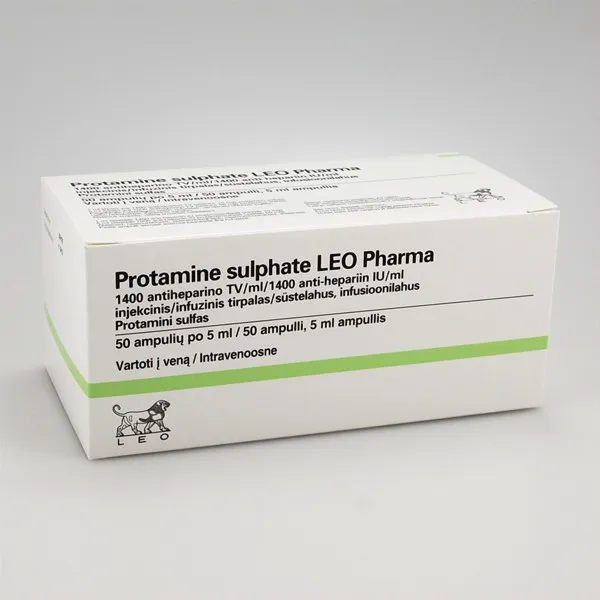
Table of Contents
- Patient Information Leaflet
- 1. What Protamine sulfate LEO Pharma is and what it is used for
- 2. Important information before using Protamine sulfate LEO Pharma
- 3. How to use Protamine sulfate LEO Pharma
- 4. Possible adverse reactions
- 5. How to store Protamine sulfate LEO Pharma
- 6. Contents of the pack and other information
Patient Information Leaflet
Protamine sulfate LEO Pharma, 1400 antiheparinic IU/mL
(equivalent to 10 mg/mL), solution for injection/infusion
Protamini sulfas
Please read all of this leaflet carefully before use, as it contains important information for the patient.
- Keep this leaflet for future reference.
- This product is usually administered by a doctor or nurse. If you have any questions, please consult your doctor, nurse, or pharmacist.
- If the patient experiences any adverse reactions, including any not listed in this leaflet, inform the doctor, pharmacist, or nurse immediately. See section 4.
Table of Contents
- What Protamine sulfate LEO Pharma is and what it is used for
- Important information before receiving Protamine sulfate LEO Pharma
- How to use Protamine sulfate LEO Pharma
- Possible side effects
- How to store Protamine sulfate LEO Pharma
- Contents of the pack and other information
1. What Protamine sulfate LEO Pharma is and what it is used for
The active substance is protamine sulfate, which acts as an antiheparin agent used to
neutralize the effects of heparin and low molecular weight heparins and reduce their impact on the body.
Heparins are used to prevent blood clotting and may cause bleeding.
The patient may receive this medicine:
- To help stop bleeding caused by heparin/low molecular weight heparin
- To prevent excessive bleeding if the patient has been treated with heparin/low molecular weight heparin and is about to undergo surgery
- To reverse the effect of heparin used during certain types of heart surgery
2. Important information before using Protamine sulfate LEO Pharma
When not to use Protamine sulfate LEO Pharma
- if the patient is allergic to protamine sulfate or to any of the other ingredients of this medicine (listed in section 6).
Warnings and precautions
Before starting treatment with Protamine sulfate LEO Pharma, discuss this with your doctor,
pharmacist, or nurse if the patient:
- has diabetes and is using insulin (especially protamine insulin)
- is allergic to fish
- is an infertile man (unable to have children) or has had a vasectomy (a surgical procedure causing male infertility)
- has previously been treated with protamine sulfate, protamine insulin, or protamine chloride.
Children and adolescents
Protamine sulfate LEO Pharma is not indicated for use in children and adolescents.
Protamine sulfate LEO Pharma and other medicines
Tell your doctor or pharmacist about all medicines the patient is currently using or has recently used, as well as any medicines the patient plans to use.
Pregnancy and breastfeeding
Pregnancy
If the patient is pregnant, suspects she may be pregnant, or is planning to have a baby, she should
consult her doctor, nurse, or pharmacist before using this medicine.
There is no available information on the use of this product in pregnant women.
Do not use Protamine sulfate LEO Pharma unless absolutely necessary.
Breastfeeding
If the patient is breastfeeding, she should consult her doctor, nurse, or pharmacist before
using this medicine.
There is no available information on the use of this medicine in breastfeeding women.
If treatment with Protamine sulfate LEO Pharma is necessary, breastfeeding should be discontinued.
Driving and operating machinery
Protamine sulfate LEO Pharma has no effect or has a negligible effect on the ability to drive and
operate machinery.
Protamine sulfate LEO Pharma contains sodium
The medicine contains less than 1 mmol (23 mg) of sodium per 5 mL, meaning the medicine is considered "sodium-free".
3. How to use Protamine sulfate LEO Pharma
The doctor will decide the appropriate dose of Protamine sulfate LEO Pharma for the patient.
This depends on blood test results to determine how much heparin needs to be neutralized.
Protamine sulfate LEO Pharma is intended for intravenous administration and may be given as a
slow injection (over approximately 10 minutes) into a vein or may be added to an intravenous infusion solution.
The patient may require additional doses, especially if reversal of low molecular weight heparin is needed or if the surgery is prolonged.
No more than 5 mL of this medicine will be administered in any 10-minute period.
Use of a higher than recommended dose of Protamine sulfate LEO Pharma
This may interfere with the blood clotting process by prolonging the time required for blood to clot.
If there are any further doubts regarding the use of this medicine, consult the doctor, pharmacist, or nurse.
4. Possible adverse reactions
Like all medicines, this medicine can cause adverse reactions, although not everyone will experience them.
Serious adverse reactions
If any of the following symptoms occur, contact a doctor, nurse or local hospital immediately for emergency assistance:
- Severe allergic reaction. Symptoms include serious breathing difficulties, wheezing, swelling of the face and lips, heart problems, collapse (fainting due to low blood pressure)
- High blood pressure in the lungs. Symptoms include serious breathing difficulties
- Severe and prolonged low blood pressure. Symptoms include slow heart rate, blue skin, feeling faint or collapse (especially if Protamine sulfate LEO Pharma was administered too rapidly)
The following less serious adverse reactions have been observed during administration of Protamine sulfate LEO Pharma:
- Low blood pressure. Symptoms include dizziness
- Vomiting
- Back pain
- Bleeding
- Allergic reaction resembling hives or other skin rashes. Symptoms include feeling of warmth, skin redness, shortness of breath, and swelling of deeper skin layers (sometimes with swelling of the tongue and airways).
Reporting of adverse reactions
If any adverse symptoms occur, including any adverse reactions not listed in this leaflet, inform a doctor, pharmacist or nurse. Adverse reactions can be reported directly to the Department of Monitoring Adverse Drug Reactions of the Office for Registration of Medicinal Products, Medical Devices and Biocidal Products
Al. Jerozolimskie 181C, 02-222 Warsaw
Tel.: + 48 22 49 21 301
Fax: + 48 22 49 21 309
Website: https://smz.ezdrowie.gov.pl.
Adverse reactions can also be reported to the responsible entity.
Reporting adverse reactions helps to provide more information on the safety of this medicine.
5. How to store Protamine sulfate LEO Pharma
- Keep this medicine out of the sight and reach of children.
- Do not use this medicine after the expiry date stated on the carton and label after: EXP. The expiry date refers to the last day of the specified month.
- This medicine does not require any special storage conditions.
- Use immediately after opening the ampoule.
- Any unused solution must be discarded.
- Only use if the solution is clear and the ampoule is intact.
- After dilution for slow intravenous infusion, the mixture must be used immediately.
Medicines must not be disposed of via wastewater or household waste. Ask your pharmacist how to dispose of medicines no longer required. These measures will help protect the environment.
6. Contents of the pack and other information
What Protamine sulfate LEO Pharma contains
- The active substance is protamine sulfate. 1 mL contains 1400 antiheparin IU of protamine sulfate (corresponding to 10 mg), 5 mL contains 7000 antiheparin IU of protamine sulfate (corresponding to 50 mg).
- The other components are: sodium chloride, hydrochloric acid concentrated (for pH adjustment), sodium hydroxide (for pH adjustment), and water for injections.
What Protamine sulfate LEO Pharma looks like and contents of the pack
This product is supplied as a solution for injection/infusion, which is a clear,
colourless liquid.
5 mL vials. Pack of 5 vials.
Not all pack sizes may be marketed.
Marketing Authorisation Holder and Manufacturer
Marketing Authorisation Holder
LEO Pharma A/S
Industriparken 55
2750 Ballerup
Denmark
Manufacturer
CENEXI
52, rue Marcel et Jacques Gaucher
94120 Fontenay-sous-Bois
France
For further information about this medicine, please contact the local representative of the Marketing Authorisation Holder:
LEO Pharma Sp. z o.o.
ul. Marynarska 15
02-674 Warszawa
Tel: 22 244 18 40
This medicine is authorised for marketing in the European Economic Area under the following names:
Protaminsulfat LEO Pharma: Austria, Denmark, Finland, Germany, Iceland, Norway, Sweden, Czech Republic, Slovakia
Protamine sulfaat LEO Pharma: Belgium, Netherlands
Protamine sulfate LEO Pharma: Estonia, Greece, Ireland, Lithuania, Luxembourg, Malta
Sulfato de protamina LEO Pharma: Portugal
Protaminijev sulfat LEO Pharma: Slovenia
Protamina sulfato LEO Pharma: Spain
Protamina solfato LEO Pharma: Italy
<------------------------------------------------------------------------------------------------------------------------>
Information intended for healthcare professionals only:
Protamine sulfate LEO Pharma
1400 antiheparin IU/mL
(equivalent to 10 mg/mL)
solution for injection/infusion
1 mL contains 1400 antiheparin IU of protamine sulfate (10 mg)
5 mL contains 7000 antiheparin IU of protamine sulfate (50 mg)
Further information is available in the Summary of Product Characteristics (SmPC).
Therapeutic indications: Protamine sulfate may be used to counteract the anticoagulant effect of heparin or LMWH (see SmPC).
Dosage and method of administration
Protamine sulfate is administered by slow intravenous injection over approximately 10 minutes or as a continuous, slow intravenous infusion. The maximum single injection (bolus dose) should not exceed 5 mL (7000 IU antiheparin/50 mg protamine sulfate). It is preferable that the dose be based on coagulation tests. Suitable tests for this purpose include activated partial thromboplastin time (APTT), activated clotting time (ACT), anti-Xa assay, and bedside protamine neutralization test. Coagulation tests are usually performed 5 to 15 minutes after administration of protamine sulfate. Further doses may be required, as protamine sulfate is cleared from the blood more rapidly than heparin, and especially more rapidly than LMWH. Prolonged absorption after subcutaneous administration of heparin or LMWH may also necessitate multiple dosing.
Neutralisation of heparin
1 mL of Protamine sulfate LEO Pharma (10 mg protamine sulfate) will neutralise approximately 1400 IU of heparin. Since heparin has a relatively short half-life after intravenous administration (30 minutes to 2 hours), the dose of protamine sulfate should be adjusted according to the time elapsed since cessation of intravenous heparin infusion. The dose of protamine sulfate relative to the amount of heparin administered should be reduced if more than 15 minutes have passed since the end of intravenous heparin injection.
Neutralisation of low molecular weight heparin (LMWH)
A dose of 1 mL of Protamine sulfate LEO Pharma (10 mg protamine sulfate) per 1000 anti-Xa IU of LMWH is generally recommended. Protamine sulfate neutralises different LMWHs to varying degrees; therefore, for each LMWH, reference should be made to the manufacturer's specific overdose guidelines. Protamine sulfate only partially neutralises the anti-Xa activity induced by LMWH, and increasing the dose of protamine sulfate beyond the recommended amount does not result in greater neutralisation. There is a risk of incomplete neutralisation with a single dose of protamine sulfate when neutralising subcutaneously administered LMWH. The absorption phase from the injection site leads to subsequent release of additional LMWH into the circulation (so-called "depot effect"). In such cases, repeated administration of protamine sulfate or a continuous, slow intravenous infusion may be necessary. When estimating the required dose of protamine sulfate, the half-life of LMWH relative to the time elapsed since the last LMWH dose should also be taken into account.
Cardiopulmonary bypass procedures
It is recommended that doses of protamine sulfate be based on coagulation tests. Activated partial thromboplastin time (APTT), activated clotting time (ACT), anti-Xa assay, and bedside protamine neutralization test are appropriate for this purpose. Coagulation tests are usually performed 5 to 15 minutes after administration of protamine sulfate. Generally, a dose of 0.1 mL to 0.2 mL (1–2 mg) of Protamine sulfate LEO Pharma is administered intravenously for every 100 units of administered heparin.
Special precautions for disposal
Use immediately after opening the vial.
Any unused solution must be discarded.
The medicine may only be used if the solution is clear, free from visible particles, and the vial is undamaged. Any unused product or waste material must be disposed of in accordance with local regulations.
Protamine sulfate LEO Pharma may be administered as a slow intravenous infusion, in which case sodium chloride 9 mg/mL should be used. Such mixtures must not be stored.