Prostin vr
Poland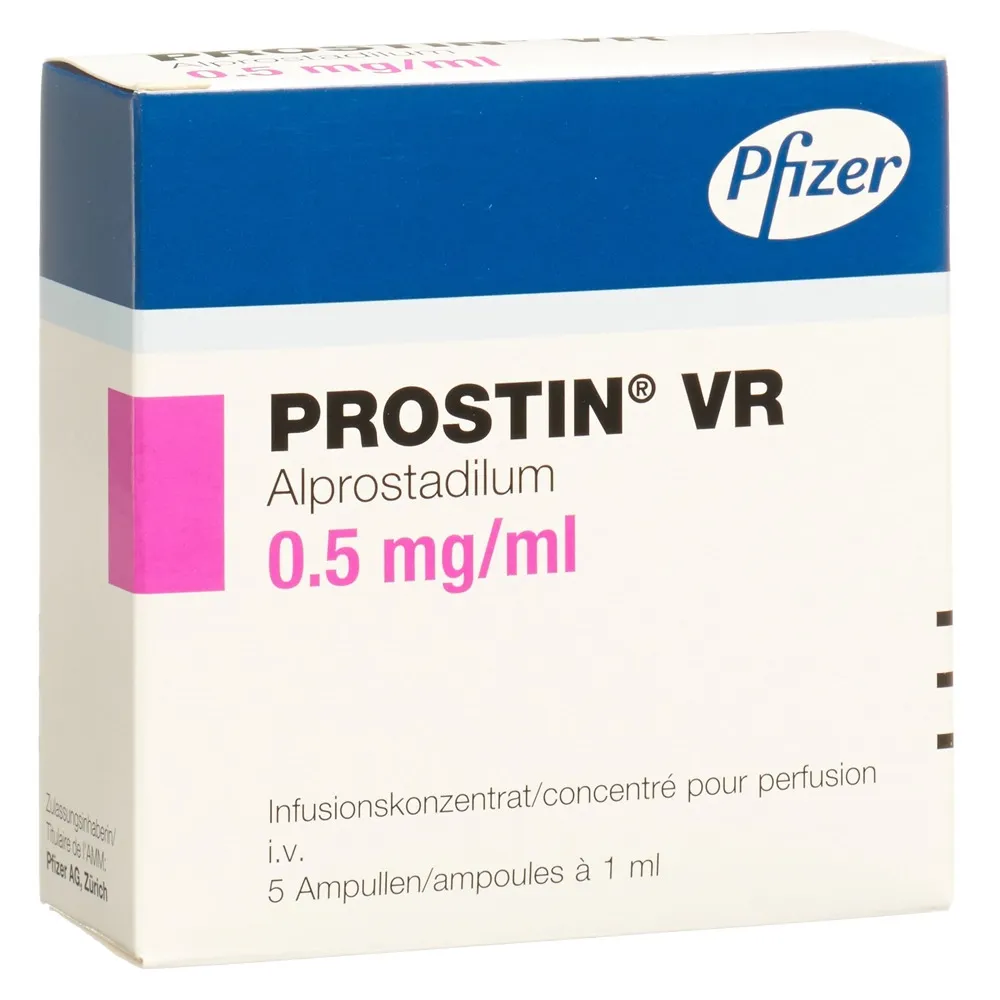
Table of Contents
PROSTIN VR
500 µg/ml, solution for injection
(Alprostadil)
Read the following information in the leaflet before using this medicine.
- Keep this leaflet for future reference.
- Consult your doctor or pharmacist if you have any further questions.
- This medicine has been prescribed for a specific individual. Do not pass it on to others. It may harm someone else, even if their symptoms are the same.
- If any of the side effects worsen, or if any side effects not listed in this leaflet occur, inform your doctor or pharmacist immediately.
Table of contents:
- What PROSTIN VR is and what it is used for
- Important information before using PROSTIN VR
- How to use PROSTIN VR
- Possible side effects
- How to store PROSTIN VR
- Contents of the pack and other information
1. WHAT PROSTIN VR IS AND WHAT IT IS USED FOR
The active substance in PROSTIN VR is alprostadil (prostaglandin E_), a naturally occurring fatty acid that induces reopening of the closing ductus arteriosus.
PROSTIN VR is used as a supportive treatment to temporarily maintain patency of the ductus arteriosus in newborns with congenital heart defects, whose survival until corrective or palliative cardiac surgery depends on maintaining ductus arteriosus patency. Such congenital heart defects include: pulmonary valve atresia, pulmonary valve stenosis, tricuspid valve atresia, tetralogy of Fallot (a complex, cyanotic congenital heart defect), interrupted aortic arch, aortic coarctation (narrowing of the aorta in the arch region), mitral valve atresia, transposition of the great arteries, with or without associated defects.
2. IMPORTANT INFORMATION BEFORE USING PROSTIN VR
When not to use PROSTIN VR:
- if the patient is allergic (hypersensitive) to alprostadil or any of the other ingredients of the medicine.
When to exercise special caution with PROSTIN VR:
- if apnea occurs, administration of PROSTIN VR must be discontinued immediately. Apnea may occur in approximately 10–12% of neonates with congenital heart defects treated with alprostadil (PGE1). In neonates with birth weight below 2 kg, apnea is the most common adverse reaction, usually occurring during the first hour of intravenous infusion. Therefore, immediate access to equipment for assisted ventilation must always be ensured when administering PROSTIN VR;
- in critically ill children, carefully consider the risks associated with prolonged infusion of PROSTIN VR against the expected benefits of initiating this therapy;
- histological changes in the ductus arteriosus and pulmonary arteries have been observed in neonates treated with prostaglandin E; therefore, caution should be exercised when using PROSTIN VR;
- prolonged infusion of the drug has been associated with cortical hyperostosis of long bones. This effect resolves after discontinuation of treatment;
- caution is required in infants (and neonates) with a tendency to bleeding, as prostaglandin E strongly inhibits platelet aggregation;
- PROSTIN VR should not be used in neonates (and infants) with respiratory distress syndrome (hyaline membrane disease);
- if a significant drop in blood pressure occurs, the infusion rate should be reduced immediately;
- weakening of the walls of the ductus arteriosus and pulmonary arteries has been observed with prolonged use of the drug; therefore, PROSTIN VR should be used with caution;
- prolonged administration of the drug, depending on the total dose, has been associated with hypertrophy of the pyloric portion of the stomach, leading secondarily to delayed gastric emptying manifested by vomiting after feeding; therefore, caution should be exercised during administration of PROSTIN VR;
- in neonates (or infants) with limited pulmonary blood flow, the efficacy of PROSTIN VR is assessed by measuring the increase in blood oxygen saturation; therefore, caution is required;
- in neonates (or infants) with limited systemic blood flow, efficacy is determined by monitoring increased arterial blood pressure in peripheral arteries and blood pH.
Children
This medicine contains alcohol (ethanol) and may affect children (see section "PROSTIN VR contains alcohol (ethanol)").
Use with other medicines
No interactions have been reported between alprostadil and other drugs commonly used in the treatment of neonates with congenital heart defects.
These drugs include: antibiotics (such as penicillin, gentamicin), vasoactive agents (dopamine or isoprenaline), cardiac glycosides, and diuretics (e.g., furosemide).
Use of PROSTIN VR with food and drink
Not applicable.
Pregnancy and breastfeeding
Not applicable.
Driving and operating machinery
Not applicable.
PROSTIN VR contains alcohol (ethanol)
This medicine contains 790 mg of alcohol (ethanol) per 1 ml vial, equivalent to 790 mg/ml (79% w/v).
The amount of alcohol in each 1 ml vial is equivalent to less than 20 ml of beer or 8 ml of wine.
The alcohol content in this medicine may affect children. Symptoms may include drowsiness and behavioral changes.
Since this medicine is usually administered slowly over more than 24 hours, the effect of ethanol may be reduced.
Concomitant administration with medicines containing, for example, propylene glycol or ethanol may lead to accumulation of ethanol and cause adverse effects, especially in small children with low or immature metabolic capacity.
If the patient has epilepsy or liver problems, the patient should consult a doctor or pharmacist before using this medicine.
The amount of alcohol in this medicine may alter the effect of other medicines. If the patient is taking other medicines, the patient should consult a doctor or pharmacist.
3. HOW TO USE PROSTIN VR
Prostin VR is administered intravenously or intra-arterially.
Alprostadil infusion is usually initiated at a dose of 0.05 to 0.1 µg/kg body weight/min. Effective therapeutic response has also been achieved with lower initial doses, although clinical experience with such doses is limited. The most commonly used dose is 0.1 µg/kg body weight/min. After achieving the desired therapeutic effect (in children with abnormal pulmonary blood flow, this is an increase in pO2; in children with peripheral circulatory disorders, it is an increase in arterial blood pressure or blood pH), the infusion rate should be reduced to maintain the lowest effective dose that sustains the desired therapeutic effect. If the dose of 0.1 µg/kg body weight/min is insufficient, it may be increased up to 0.4 µg/kg body weight/min; however, increasing the infusion rate does not always improve the therapeutic effect.
The preferred route of administration of Prostin VR is continuous intravenous infusion into a large vessel. The drug may also be administered near the opening of the ductus arteriosus via a catheter placed in the umbilical artery. Compared to intravenous administration, intra-arterial administration is associated with a higher frequency of adverse symptoms such as flushing, apnea, and bradycardia (slowing of heart rate).
Overdose of Prostin VR
Symptoms of overdose include: apnea, bradycardia (slowing of heart rate), fever, decreased arterial blood pressure, and skin flushing. In case of apnea or bradycardia, the physician will discontinue the drug and initiate appropriate treatment. After resuming the infusion, the physician will closely monitor the newborn's condition. If fever or decreased arterial blood pressure occurs, the physician will reduce the infusion rate until these symptoms resolve. Skin flushing is usually caused by improper placement of the arterial catheter and typically resolves after repositioning the catheter tip.
Discontinuation of Prostin VR treatment
The decision to discontinue treatment is made by the physician.
4. POSSIBLE ADVERSE REACTIONS
Adverse reactions have been categorized according to their frequency of occurrence.
Very common adverse reactions, which may occur in 1 or more out of 10 patients:
- apnoea
- transient fever
Common adverse reactions, which may occur in 1 or more out of 100 patients, but less than 1 out of 10 patients:
- low blood potassium levels (hypokalaemia)
- seizures
- bradycardia (slowing of heart rate)
- hypotension
- tachycardia (increased heart rate)
- diarrhoea
- cutaneous vasodilation (flushing)
Uncommon adverse reactions, which may occur in 1 or more out of 1,000 patients, but less than 1 out of 100 patients:
- gastric outlet obstruction
- gastric mucosal hyperplasia
- exostoses (bone overgrowths)
- vascular fragility
Rare adverse reactions, which may occur in 1 or more out of 10,000 patients, but less than 1 out of 1,000 patients:
- hypoglycaemia (reduced plasma glucose concentration)
Reporting of adverse reactions
If any adverse reactions occur, including any adverse reactions not listed in this leaflet, inform your doctor, pharmacist, or nurse. Adverse reactions can be reported directly to the Department of Monitoring of Adverse Drug Reactions, Office for Registration of Medicinal Products, Medical Devices and Biocidal Products
Al. Jerozolimskie 181C
02-222 Warsaw
Phone: +48 22 49-21-301
Fax: +48 22 49-21-309
Website: https://smz.ezdrowie.gov.pl
Adverse reactions can also be reported to the representative of the responsible entity.
Reporting adverse reactions helps provide more information on the safety of the medicine.
5. HOW TO STORE PROSTIN VR
Keep the medicine out of the reach and sight of children.
Store Prostin VR at a temperature of 2 °C to 8 °C.
Do not use Prostin VR after the expiry date stated on the container
(EXP).
Any unused medicine or waste material should be disposed of in accordance with local
regulations. Medicines should not be disposed of via wastewater or household waste.
Ask your pharmacist how to dispose of medicines no longer required. Such measures will help
protect the environment.
6. CONTENTS OF THE PACKAGE AND OTHER INFORMATION
What PROSTIN VR contains
- The active substance is alprostadil. 1 ml of injection solution contains 500 micrograms of alprostadil.
- The other component is anhydrous ethanol [see section 2 ("PROSTIN VR contains alcohol (ethanol)")]
What PROSTIN VR looks like and contents of the pack
Ampoules made of colourless glass in a cardboard box. The pack contains:
- 5 ampoules of 0.2 ml injection solution or
- 5 ampoules of 0.5 ml injection solution or
- 5 ampoules of 1 ml injection solution
Marketing Authorisation Holder
Pfizer Europe MA EEIG
Boulevard de la Plaine 17
1050 Bruxelles
Belgium
Manufacturer
Pfizer Manufacturing Belgium NV
Rijksweg 12
2870 Puurs-Sint-Amands
Belgium
For further information on this medicinal product, please contact the
local representative of the Marketing Authorisation Holder:
Pfizer Polska Sp. z o.o.
tel. 22 335 61 00
INFORMATION FOR QUALIFIED MEDICAL PERSONNEL
Please refer to the Product Characteristics of PROSTIN VR, 500 µg/ml, injection solution.
INSTRUCTIONS FOR SOLUTION PREPARATION:
It is recommended to prepare a fresh solution every 24 hours and to store the prepared solution in a refrigerator. Do not use the solution if more than 24 hours have passed since preparation.
To prepare the injection solution, the required amount of PROSTIN VR should be diluted with sterile glucose solution (the preferred diluent) or sterile 0.9% NaCl solution. If undiluted PROSTIN VR comes into contact with a plastic container, the solution may become cloudy. The container itself may also show changes in appearance. In such cases, both the solution and the container must be replaced. The occurrence of the phenomenon described above depends on the concentration of the solution. It is recommended to add PROSTIN VR directly into the diluent and to avoid contact between the product and plastic surfaces.
The choice of diluent depends on the type of infusion pump used.
By diluting a solution containing 500 micrograms of alprostadil in the volumes listed below, solutions of the following concentrations (in μg/ml) are obtained:
| Total volume | Micrograms of alprostadil per 500 µg (1 ml ampoule) | |--------------|------------------------------------------------------| | 250 ml | 2.0 µg/ml | | 100 ml | 5.0 µg/ml | | 50 ml | 10.0 µg/ml | | 25 ml | 20.0 µg/ml |
EXAMPLE:
Required dose of product: 0.1 μg/kg body weight/min
Newborn body weight: 2.8 kg
Prepared injection solution: 5 µg/ml
The infusion of the 5 µg/ml injection solution should be administered at the following rate:
0.1 µg/kg body weight/min
= 0.02 ml/kg body weight/min
5 µg/ml
When administering the product to a newborn weighing 2.8 kg, the infusion rate should be maintained at:
0.02 ml/kg body weight/min × 2.8 = 0.056 ml/min or 3.36 ml/h