Prostavasin 60
Poland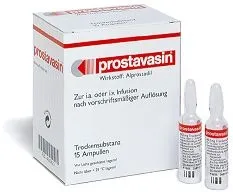
Table of Contents
- Package leaflet: Information for the patient
- 1. What Prostavasin 60 is and what it is used for
- 2. Important information before using Prostavasin 60
- 3. How to use Prostavasin 60
- 4. Possible adverse effects
- 5. How to store Prostavasin 60
- 6. Contents of the packaging and other information
- Information intended exclusively for medical personnel
Package leaflet: Information for the patient
Prostavasin 60, 60 μg, powder for solution for infusion
Alprostadil
Please read this leaflet carefully before using this medicine, as it contains
important information for you.
- Keep this leaflet, as you may need to read it again.
- If you have any further questions, please ask your doctor, pharmacist, or nurse.
- This medicine has been prescribed for a specific individual. Do not pass it on to others. It may harm other people, even if their symptoms are the same.
- If you experience any adverse reactions, including any not listed in this leaflet, please inform your doctor or nurse. See section 4.
Contents of the leaflet
- What Prostavasin 60 is and what it is used for
- Important information before using Prostavasin 60
- How to use Prostavasin 60
- Possible side effects
- How to store Prostavasin 60
- Contents of the package and other information
1. What Prostavasin 60 is and what it is used for
One vial of Prostavasin 60 contains 60 micrograms of alprostadil, a compound identical to a substance naturally produced in the body called prostaglandin E (PGE). Alprostadil dilates arteries and precapillary sphincters (circular smooth muscle cells closing capillaries), thereby increasing blood flow. Alprostadil inhibits platelet activation (blood cells involved in clotting).
Alprostadil improves cellular metabolism by enhancing the delivery and utilization of oxygen and glucose in ischemic tissues.
The drug inhibits the activation of neutrophil granulocytes (a type of white blood cell involved in inflammatory processes), thereby reducing the release of toxic metabolites. Thus, it reduces tissue damage in inflammatory processes and possibly in ischemia.
Indications for use of the medicine:
- Stage III of chronic peripheral arterial occlusive disease (according to Fontaine's classification) in patients who are not eligible for revascularization, or in whom revascularization has failed.
2. Important information before using Prostavasin 60
When not to use Prostavasin 60:
- if the patient is allergic to the active substance or to any of the other ingredients of this medicine (listed in section 6);
- if the patient has heart failure (NYHA class III and IV);
- if the patient has arrhythmia affecting hemodynamics (mechanical function of the heart);
- if the patient has unstable ischemic heart disease;
- if the patient has mitral and/or aortic valve stenosis and/or insufficiency;
- within 6 months following a myocardial infarction;
- if the patient has acute pulmonary edema (or has had it in the past in individuals with heart failure);
- if the patient has severe chronic obstructive lung disease or veno-occlusive lung disease;
- if the patient has disseminated pulmonary infiltrates;
- if the patient has a blood coagulation disorder;
- if the patient has active bleeding or risk of bleeding, e.g. in conditions such as erosive gastritis, active gastric or duodenal ulcer;
- if the patient has suspected intracranial bleeding (e.g. hemorrhagic stroke);
- during pregnancy and breastfeeding;
- if the patient has suffered a stroke within the last 6 months;
- if the patient has severe hypotension;
- if the patient has severe renal failure (oliguria, anuria);
- if the patient has symptoms of acute liver dysfunction (elevated aminotransferase or GGTP activities) or severe liver dysfunction (currently or in the past);
- if the patient has general contraindications to infusion therapy (such as: congestive heart failure, pulmonary or cerebral edema, and excessive fluid accumulation in the body).
Warnings and precautions
Before starting treatment with Prostavasin 60, discuss this with your doctor or nurse.
Prostavasin 60 should be administered only by physicians experienced in the treatment of patients with peripheral arterial occlusive disease, in medical centers equipped with appropriate methods for continuous monitoring of cardiovascular function and adequate facilities.
During each infusion, patients receiving Prostavasin 60 must remain under strict supervision. Cardiovascular performance (including: arterial blood pressure and heart rate, fluid balance) must be monitored.
After completion of treatment and before hospital discharge, the physician will confirm cardiovascular stability.
In patients with impaired renal function, the physician will recommend close monitoring of renal and cardiovascular function (e.g. fluid balance, renal function tests).
Prostavasin 60 must not be administered as a rapid intravenous bolus injection.
This medicine must not be used in women planning to become pregnant, and women of childbearing potential should use effective contraception.
Talk to your doctor before using Prostavasin 60:
- If the patient has a history of gastrointestinal bleeding and/or ulcers, peptic ulcer, or gastritis.
- If the patient has previously experienced intracranial bleeding, such as hemorrhagic stroke.
- If the patient has previously experienced other bleeding episodes.
- If the patient is taking anticoagulant or antiplatelet drugs, as these may increase the risk of bleeding.
If unusual bleeding symptoms occur, consult a doctor immediately.
Children and adolescents
Prostavasin 60 is not recommended for use in children and adolescents, as safety and efficacy have not been established in this age group.
Prostavasin 60 and other medicines
Inform your doctor about all medicines currently or recently taken, as well as any medicines the patient plans to take.
Prostavasin 60 may enhance the effect of drugs that lower blood pressure, including those used in the treatment of ischemic heart disease. The medicine may be administered concurrently with antihypertensive drugs only under blood pressure monitoring.
If Prostavasin 60 is used concomitantly with drugs that delay blood coagulation (anticoagulants, antiplatelet drugs), an increased tendency to bleeding may occur. In such cases, the physician will exercise special caution.
Pregnancy, breastfeeding, and effects on fertility
Prostavasin 60 must absolutely not be used when planning pregnancy, during pregnancy, or while breastfeeding.
Women of childbearing potential should use effective contraception during treatment with Prostavasin 60.
Based on non-clinical study results, alprostadil at recommended doses is not expected to affect fertility.
Driving and operating machinery
Prostavasin 60 may moderately impair the ability to drive and operate machinery. Caution should be exercised when driving or operating machinery.
3. How to use Prostavasin 60
Dosage in adults:
Prostavasin 60 is administered by medical personnel as an intravenous infusion once daily over a period of 2 hours. Immediately before administration, the medication is prepared by dissolving the contents of 1 vial of Prostavasin 60 in 50–250 ml of 0.9% sodium chloride solution.
Duration of treatment:
Your doctor will determine how long you should receive Prostavasin 60. After 3 weeks of treatment with Prostavasin 60, your doctor will assess the therapeutic efficacy. If a beneficial effect has not been achieved by this time, your doctor will decide to discontinue further administration of the drug. The total duration of treatment should not exceed 4 weeks.
Use of Prostavasin 60 in patients with renal function impairment and/or cardiovascular insufficiency:
In patients with impaired renal function (creatinine concentration > 1.5 mg/dl), the doctor will decide on an appropriate dose reduction at the beginning of treatment, and subsequently, depending on the course of treatment, may increase the dose over 2–3 days to the recommended doses used in patients with normal renal function.
In patients with renal insufficiency, as well as in patients with cardiovascular insufficiency, the doctor will decide to reduce the volume of the solution to be administered by limiting the total fluid volume given together with the drug to 50–100 ml per day, and to administer the drug solution intravenously using an infusion pump.
Use of a higher than recommended dose of Prostavasin 60:
If a higher than recommended dose is administered, seek immediate medical advice.
In case of alprostadil overdose, a drop in arterial blood pressure with increased heart rate, fainting with pallor, excessive sweating, nausea, and vomiting may occur.
Locally, pain, swelling, and redness along the course of the vein used for infusion may occur.
If symptoms indicating alprostadil overdose occur, the doctor will immediately reduce the rate of drug infusion or discontinue the infusion and initiate appropriate treatment.
If you have any further questions regarding the use of this medicine, consult your doctor or nurse.
4. Possible adverse effects
Like all medicines, this medicine can cause adverse effects, although not everyone will experience them.
The following adverse effects may occur during treatment with alprostadil:
Common (occurs in 1 to 10 out of 100 patients):
- headache
- redness
- swelling
- sudden facial flushing with hot flashes
- pain
- after intra-arterial administration: sensation of warmth, feeling of swelling, local swelling, paresthesia (tingling)
Uncommon (occurs in 1 to 10 out of 1,000 patients):
- low systolic blood pressure
- tachycardia (fast heartbeat)
- angina pectoris (tightness, pressure, heaviness, discomfort or pain in the chest caused by reduced blood flow to the heart)
- gastrointestinal reactions (nausea, vomiting)
- increased gastrointestinal peristalsis (diarrhea, nausea, vomiting)
- allergic reactions (skin hypersensitivity e.g.: rash, joint pain, feverish reactions, excessive sweating, chills)
- after intravenous administration: sensation of warmth, feeling of swelling, local swelling, paresthesia (tingling)
Rare (occurs in 1 to 10 out of 10,000 patients):
- thrombocytopenia (reduced number of blood platelets)
- leukopenia or leukocytosis (decreased or increased number of white blood cells in blood)
- confusion
- cerebral seizures
- arrhythmia (irregular heartbeat)
- heart's inability to pump sufficient blood to the body (biventricular heart failure)
- fluid accumulation in lung tissue (pulmonary edema)
- disturbances in liver enzyme activity
Very rare (occurs in fewer than 1 out of 10,000 patients):
- anaphylactic or anaphylactoid reactions (severe hypersensitivity reactions)
Unknown (frequency cannot be estimated from available data):
- cerebrovascular stroke (stroke)
- myocardial infarction
- dyspnea (shortness of breath)
- phlebitis (vein inflammation) at the site of administration
- thrombosis (blood clots) at the site of intravenous catheter placement
- local bleeding
- gastrointestinal bleeding (bleeding from stomach and/or intestines)
- hemorrhage (bleeding)
Reporting of adverse effects
If any adverse effects occur, including those not listed in this leaflet, inform your doctor, pharmacist, or nurse. Adverse effects can be reported directly to the Department of Monitoring of Adverse Drug Reactions, Office for Registration of Medicinal Products, Medical Devices and Biocidal Products, Al. Jerozolimskie 181C, 02-222 Warsaw, phone: +48 22 49 21 301, fax: +48 22 49 21 309. Website: https://smz.ezdrowie.gov.pl
Adverse effects can also be reported to the marketing authorization holder.
Reporting adverse effects helps to provide more information on the safety of the medicine.
5. How to store Prostavasin 60
Keep the medicine out of the sight and reach of children.
Do not use this medicine after the expiry date stated on the carton. The expiry date refers to the last day of the stated month.
Store at a temperature not exceeding 25°C.
Medicines must not be disposed of via wastewater or household waste. Ask your pharmacist how to dispose of medicines no longer in use. This will help protect the environment.
Do not use this medicine if you notice that the ampoule is damaged. If the ampoule is damaged, the contents become moist, forming a damp, compacted mass and decreasing in volume. In such a case, the medicine is not suitable for use!
6. Contents of the packaging and other information
What Prostavasin 60 contains
- The active substance is alprostadil. 1 vial (49.5 mg powder) contains 60 micrograms (µg) of alprostadil.
- The other ingredients are: Alfadeks (α-cyclodextrin), anhydrous lactose.
What Prostavasin 60 looks like and contents of the pack
The pack contains 10 vials made of colourless glass, packed in a cardboard box.
Each vial contains a white powder forming a compacted layer approximately 3 mm thick. This layer may be crumbled and/or cracked, which does not affect the quality of the medicinal product.
Marketing Authorisation Holder:
Amdipharm Limited
Unit 17
Northwood House
Northwood Crescent
Northwood
Dublin 9
D09 V504
Ireland
Manufacturer:
Aesica Pharmaceuticals GmbH
Alfred-Nobel-Str. 10
40789 Monheim
Germany
Information intended exclusively for medical personnel
Practical information for medical personnel regarding preparation and handling
of the medication
The solution should be prepared immediately before administration.
Ampoules are pre-scored at the factory (below the blue dot) and do not require additional scoring. Ampoules should be opened in the usual manner.
Preparation of the solution and method of administration
The contents of 1 ampoule of Prostavasin 60 (60 µg alprostadil) should be dissolved in 50–250 ml of 0.9% sodium chloride solution and administered as an intravenous infusion once daily over a period of 2 hours.
In patients with impaired renal function (creatinine concentration > 1.5 mg/dl), treatment should be initiated with 20 µg alprostadil administered as a two-hour intravenous infusion twice daily. Depending on the clinical condition, the dose may be increased over 2–3 days to the recommended doses used in patients with normal renal function.
In patients with renal insufficiency, as well as in patients with cardiovascular insufficiency, the infusion volume should be reduced by limiting the total volume of fluids administered together with Prostavasin 60 to 50–100 ml/day, and the product solution should be administered intravenously using an infusion pump.
Any unused portions of the product or waste material should be disposed of in accordance with local regulations.