Propycil 50 mg
Poland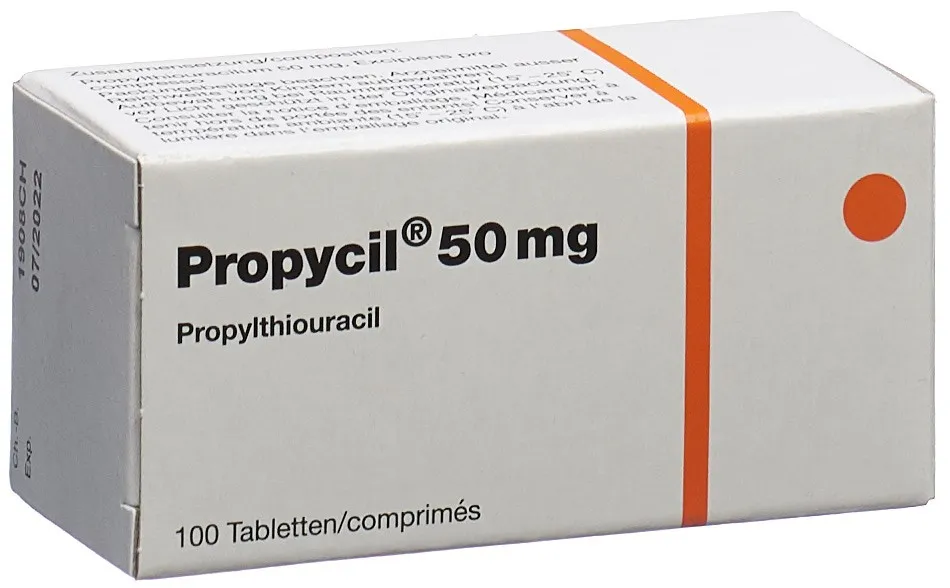
Table of Contents
Package leaflet: Information for the user
Propycil 50 mg, 50 mg, tablets
Propylthiouracilum
Please read all of this leaflet carefully before taking this medicine because it contains important information for you.
- Keep this leaflet. You may need to read it again.
- If you have any further questions, ask your doctor or pharmacist.
- This medicine has been prescribed for a specific individual. Do not pass it on to others. It may harm them even if their symptoms are the same as yours.
- If you experience any adverse reactions, including any not listed in this leaflet, inform your doctor or pharmacist. See section 4.
Contents of the leaflet
- What Propycil 50 mg is and what it is used for
- Important information before taking Propycil 50 mg
- How to take Propycil 50 mg
- Possible side effects
- How to store Propycil 50 mg
- Contents of the pack and other information
1. What Propycil 50 mg is and what it is used for
The active substance in Propycil 50 mg is propylthiouracil.
Indications:
- Hyperthyroidism (overactive thyroid), including Graves-Basedow disease and benign hyperfunctioning thyroid nodules (autonomous thyroid nodules).
- Preparation for thyroidectomy or radioactive iodine therapy, aimed at achieving normal thyroid function.
2. Important information before using Propycil 50 mg
When not to use Propycil 50 mg
- if the patient is allergic to propylthiouracil or any of the other ingredients of this medicine (listed in section 6)
- if the patient is allergic to other antithyroid drugs
- if the patient has previously experienced serious adverse reactions to treatment with propylthiouracil (especially agranulocytosis - a severe deficiency of white blood cells called neutrophils - and liver failure).
Warnings and precautions
Before starting treatment with Propycil 50 mg, discuss this with your doctor.
If during treatment fever, malaise, sore throat or inflammation of the mucous membranes of the mouth occur, the patient should immediately contact a doctor, as treatment must be discontinued. A complete blood count should be performed immediately, because these symptoms may indicate agranulocytosis—a life-threatening severe deficiency of white blood cells.
The patient should immediately contact a doctor if symptoms of liver damage occur, such as: nausea, vomiting, jaundice (yellowing of the skin or eyes), dark urine, pale stools, bleeding, itching, or chills. Severe liver injury and acute liver failure, sometimes resulting in death, have been observed in both adults and children after administration of Propycil 50 mg.
Propycil 50 mg may be used in children only if the doctor determines that other treatments for hyperthyroidism have failed.
If symptoms of vasculitis (inflammation of blood vessels) occur, the doctor will perform immunological tests and consider discontinuing Propycil 50 mg. These symptoms usually resolve after stopping treatment. Isolated fatal cases, possibly contributed to by additional complications, have been reported (see section 4).
Hypothyroidism may occur in patients treated with Propycil 50 mg. During treatment with Propycil 50 mg, thyroid function must be monitored regularly.
Before starting treatment with Propycil 50 mg, a blood test (complete blood count with blood smear) should be performed.
During treatment with Propycil 50 mg, regular blood tests should be carried out, including complete blood count with blood smear, liver enzyme activity (aminotransferases), and tests indicating cholestasis.
The possibility of further enlargement of goiter (risk of increased volume in retrosternal goiter) should also be considered.
Propycil 50 mg and other medicines
Inform your doctor about all medicines currently used, recently taken, or planned for use.
Effect of other medicines on Propycil 50 mg
Concomitant administration of thyroxine reduces the uptake of propylthiouracil by the thyroid gland and weakens its effect.
Administration of iodine or prior use of iodine-containing agents (e.g. contrast media used in radiographic diagnostics) may reduce the effectiveness of propylthiouracil and delay the achievement of normal thyroid function.
Medicines that suppress bone marrow function (affecting the immune system), hepatotoxic drugs, or those containing lithium may enhance the adverse effects of Propycil 50 mg.
Effect of Propycil 50 mg on other medicines
The use of Propycil 50 mg may alter the effects of propranolol, coumarin derivatives (anticoagulant drugs, e.g. warfarin), and theophylline (used in asthma).
Pregnancy, breastfeeding, and fertility
If the patient is pregnant, breastfeeding, suspects she may be pregnant, or plans to become pregnant, she should consult a doctor or pharmacist before using this medicine.
Pregnancy
The potential harm of Propycil 50 mg to the unborn child is unknown.
If the patient is pregnant, suspects she may be pregnant, or plans to become pregnant, she should immediately consult a doctor. Treatment with Propycil 50 mg may be necessary during pregnancy if the expected benefits outweigh the potential risks to the patient and her unborn child.
Propycil 50 mg must not be used during pregnancy unless absolutely necessary, as determined by the physician. If the doctor decides that Propycil 50 mg is necessary, the treatment should be limited and the lowest effective dose should be prescribed. Use of propylthiouracil during pregnancy does not lead to severe congenital malformations; however, the risk of certain congenital abnormalities in the child cannot be excluded.
Breastfeeding
If the doctor considers it necessary to use Propycil 50 mg during breastfeeding, the newborn must be monitored due to the risk of hypothyroidism.
Driving and operating machinery
Caution should be exercised when driving or operating machinery, as adverse effects of the medicine may affect concentration.
Propycil 50 mg contains monohydrate lactose
If the patient has previously been diagnosed with intolerance to certain sugars, the patient should contact the doctor before taking this medicine.
3. How to use Propycil 50 mg
This medicine should always be used according to the instructions given by the doctor. If in doubt, consult
your doctor or pharmacist.
Propycil 50 mg is usually taken every 6 to 8 hours, as described below.
Adults, adolescents and children over 10 years of age:
The usual initial daily dose for moderate hyperthyroidism is 100 mg to 300 mg of propylthiouracil, administered in 2–3 divided doses, each of 50 mg–100 mg (1 to 2 tablets). The maintenance dose is 50 mg to 150 mg of propylthiouracil (1 to 3 tablets) per day. In more severe cases and following iodine exposure, higher initial doses are recommended, i.e. 300 mg to 600 mg of propylthiouracil (6 to 12 tablets) per day, in 4–6 divided doses.
Use in children over 6 to 10 years of age
The usual initial dose is 50 mg to 150 mg of propylthiouracil (1 to 3 tablets) per day, in 1–3 divided doses, while the maintenance dose is approximately 25 mg to 50 mg of propylthiouracil (1/2 to 1 tablet) per day, in 1–2 divided doses.
Propycil 50 mg may be used in children only if other treatments for hyperthyroidism have failed.
Elderly patients:
The doctor will usually recommend a lower dose for elderly patients.
Patients with impaired kidney function:
The dose of Propycil 50 mg should be reduced by 25% in mild to moderate kidney impairment, and by 50% in severe kidney impairment.
Patients with impaired liver function:
The doctor will consider reducing the dose of Propycil 50 mg in patients with impaired liver function. Kidney and liver function should be assessed before starting therapy with Propycil 50 mg.
Use of a higher than recommended dose of Propycil 50 mg
If symptoms of overdose occur, seek medical advice immediately.
Symptoms of overdose may include, among others: muscle pain, nausea or vomiting, fatigue or weakness, menstrual cycle disturbances, increased sensitivity to cold, constipation, dry swollen skin, headache, apathy, drowsiness, and increased weight gain.
With prolonged use or incorrect dosing, symptoms of overdose may develop, leading to goitre (enlargement of the thyroid gland) or hypothyroidism, which requires discontinuation of Propycil 50 mg.
Missing a dose of Propycil 50 mg
Do not take a double dose to make up for a missed dose.
Stopping treatment with Propycil 50 mg
Only a doctor may decide to stop treatment with Propycil 50 mg.
If you have any further doubts regarding the use of this medicine, consult your doctor or pharmacist.
4. Possible adverse reactions
Like all medicines, this medicine can cause adverse reactions, although not everyone will experience them.
When being treated with Propycil 50 mg, the following may occur:
Very common (affecting more than 1 in 10 people):
transient increase in liver enzyme activity.
Common (affecting less than 1 in 10 and more than 1 in 100 people):
marked deficiency of white blood cells – neutrophils (neutropenia), allergic skin rashes (itching, rash, urticaria), gastrointestinal disturbances, nausea, vomiting.
Uncommon (affecting less than 1 in 100 and more than 1 in 1,000 people):
severe, life-threatening drastic reduction in the number of white blood cells – neutrophils (agranulocytosis), disturbances in taste and smell which resolve after discontinuation of treatment.
Rare (affecting less than 1 in 1,000 and more than 1 in 10,000 people):
liver damage, drug-induced fever, dizziness, neuromuscular disorders.
Very rare (affecting less than 1 in 10,000 people):
generalized blood morphology disorders, e.g. impaired production of red blood cells, thrombocytopenia, reduction in the number of all cellular blood components, positive Coombs test (detecting antibodies in pregnant women which may cross the placenta and attack the baby's red blood cells), lymph node enlargement, joint pain, vasculitis including vasculitis manifesting as kidney function disorders, glomerulonephritis, and in isolated cases, acute kidney failure, nodular vasculitis, clinical syndrome resembling systemic lupus erythematosus (e.g. fever, muscle and joint pain, skin lesions), hair loss, peripheral edema, lung inflammation, severe cases of liver disease, goiter in newborns, hearing loss, hemoptysis, diffuse or generalized alveolar hemorrhage, asthma, purpura, leukocytoclastic vasculitis (inflammation of blood vessels in the skin). In patients with Graves' disease treated with propylthiouracil, antibodies may develop that react with blood-borne immune cells called neutrophils (so-called antineutrophil cytoplasmic antibodies – ANCA). In some patients, the presence of these antibodies is associated with vasculitis, which, in addition to joint pain, muscle pain, and flu-like symptoms, may also cause adverse effects involving the following organs: skin (e.g. rash, purpura, leukocytoclastic vasculitis), kidneys (e.g. glomerulonephritis, in isolated cases acute kidney failure), lungs (e.g. interstitial lung disease, diffuse or generalized alveolar hemorrhage), and other organs.
If any of the above-mentioned symptoms of vasculitis occur, the patient should immediately consult a doctor. The physician will then order immunological tests and may decide on the necessity to discontinue Propycil 50 mg treatment. Usually, these symptoms resolve after stopping the treatment. Isolated cases resulting in death, possibly contributed by additional complications, have been reported.
During treatment with Propycil 50 mg, transient weight gain may also occur.
Pre-existing goiter may enlarge as a result of treatment with Propycil 50 mg.
Despite proper maternal treatment, goiter in the newborn has occasionally been reported.
Reporting of adverse reactions
If any adverse reactions occur, including any not listed in this leaflet, inform your doctor or pharmacist. Adverse reactions can be reported directly to the Department of Monitoring Adverse Drug Reactions at the Office for Registration of Medicinal Products, Medical Devices and Biocidal Products:
Al. Jerozolimskie 181C
PL-02-222 Warsaw
Tel.: +48 22 49 21 301
Fax: +48 22 49 21 309
Website: https://smz.ezdrowie.gov.pl
Adverse reactions can also be reported to the marketing authorization holder.
Reporting adverse reactions helps to provide more information on the safety of the medicine.
5. How to store Propycil 50 mg
Keep this medicine out of sight and reach of children.
No special storage instructions are required for this medicine.
Do not use this medicine after the expiry date stated on the packaging. The expiry date refers to the last day of the specified month.
Medicines must not be disposed of via wastewater or household waste. Ask your pharmacist how to dispose of medicines no longer required. Doing so helps protect the environment.
6. Contents of the pack and other information
What Propycil 50 mg contains
- The active substance is propylthiouracil.
- The other ingredients are: lactose monohydrate, maize starch, magnesium stearate (E 572), colloidal anhydrous silica, povidone K 30, pregelatinized starch.
What Propycil 50 mg looks like and contents of the pack
Propycil is a white, round, biconvex tablet with a score line.
The packaging consists of a glass bottle sealed with a low-density polyethylene (LDPE) cap,
with a high-density polyethylene (HDPE) liner, placed in a cardboard box.
The pack contains 20 or 100 tablets.
Marketing Authorisation Holder and Manufacturer
Marketing Authorisation Holder:
Admeda Arzneimittel GmbH
Tönsfeldtstraße 16, 22763 Hamburg
Germany
Manufacturer:
Haupt Pharma Berlin GmbH
Moosrosenstrasse 7
12347 Berlin, Germany