Propofol baxter
Poland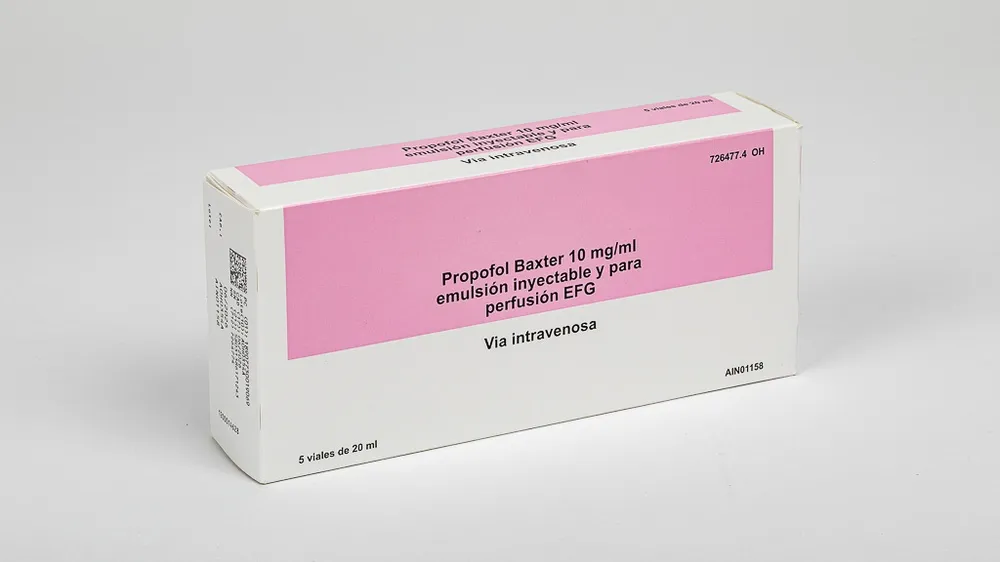
Table of Contents
- Package leaflet: Information for the user
- 1. What Propofol Baxter is and what it is used for
- 2. Important information before receiving Propofol Baxter
- 3. How to receive Propofol Baxter
- 4. Possible adverse effects
- 5. How to store Propofol Baxter
- 6. Contents of the pack and other information
- Patient information leaflet
- Information intended exclusively for healthcare professionals
Package leaflet: Information for the user
Propofol Baxter, 20 mg/ml, emulsion for injection / for infusion
Propofolum
Please read all of this leaflet carefully before receiving the medicine because it contains
important information for the patient.
- Keep this leaflet, as you may need to read it again.
- If you have any questions, please consult your doctor, pharmacist or nurse.
- If you experience any side effects, including any not listed in this leaflet, tell your doctor, pharmacist or nurse. See section 4.
Contents of the leaflet:
- What Propofol Baxter is and what it is used for
- What you need to know before receiving Propofol Baxter
- How to receive Propofol Baxter
- Possible side effects
- How to store Propofol Baxter
- Contents of the pack and other information
1. What Propofol Baxter is and what it is used for
Propofol Baxter contains the active substance called propofol. Propofol Baxter belongs to a group of medicines used for general anaesthesia. These medicines are used to induce loss of consciousness (deep sleep) so that a surgical or other procedure can be performed.
They may also be used to achieve sedation (a state in which the patient is sleepy but not completely unconscious).
Propofol Baxter is used for:
- induction and maintenance of general anaesthesia in adults and children over 3 years of age,
- sedation (calming) in mechanically ventilated patients over 16 years of age in intensive care settings,
- sedation in adults and children over 3 years of age during surgical and diagnostic procedures, either alone or in combination with local or regional anaesthesia (locally-acting anaesthetic medicines).
2. Important information before receiving Propofol Baxter
When not to use Propofol Baxter
- if the patient is allergic to propofol, soybeans, peanuts, or any of the other ingredients of this medicine (listed in section 6),
- for sedation of patients aged 16 years or younger in intensive care settings,
- for general anaesthesia in children under 3 years of age.
Warnings and precautions
Before starting treatment with Propofol Baxter, discuss with the doctor, anaesthesiologist, or
nurse:
- if the patient has ever had seizures or convulsions;
- if the patient has ever had very high levels of fat in the blood;
- if the patient has ever been diagnosed with a fat metabolism disorder;
- if the patient's body has lost a significant amount of fluid (hypovolemia);
- if the patient has any other health problems, such as heart, breathing, kidney, or liver problems;
- if the patient has generally been feeling unwell for some time;
- if the patient suffers from a mitochondrial disease.
After receiving Propofol Baxter, the patient may still experience its effects.
The patient must leave the hospital only in the company of another person.
Children and adolescents
Use of Propofol Baxter is not recommended in children under 3 years of age, as the required incremental dosing of Propofol Baxter in young children is difficult due to the exceptionally small volumes required.
Propofol Baxter must not be used for sedation in children and adolescents under 16 years of age in intensive care units, as the safety and efficacy of propofol for this indication have not been established in this age group.
Elderly patients
In elderly patients, lower doses of Propofol Baxter are required for induction of anaesthesia. The patient's overall health condition and age should be taken into account. The reduced dose should be administered slowly and titrated according to the patient's response.
Propofol Baxter and other medicines
Inform the doctor about all medicines the patient is currently taking or has recently taken, as well as any medicines the patient plans to take.
In particular, inform the treating doctor, anaesthesiologist, or nurse if the patient is taking any of the following medicines:
- Rifampicin, as it may reduce blood pressure when used in combination with general anaesthesia.
- Certain sedatives and analgesics, such as benzodiazepines and opioids, as they may enhance the effects of propofol.
- Valproate, as concomitant use with propofol may require a reduction in the dose of propofol.
Taking Propofol Baxter with food, drink, and alcohol
Alcohol in any form must not be consumed after administration of Propofol Baxter.
Pregnancy and breastfeeding
If the patient is pregnant or breastfeeding, suspects she may be pregnant, or plans to have a child, she should consult a doctor or pharmacist before using this medicine.
Pregnancy
Propofol Baxter should not be used during pregnancy unless absolutely necessary.
Breastfeeding
Studies in breastfeeding women have shown that small amounts of propofol pass into human milk. Therefore, breastfeeding should be avoided for 24 hours after administration of propofol. Breast milk expressed during this time should be discarded.
Driving and operating machinery
After receiving propofol, the patient may still feel drowsy for some time. Driving vehicles or operating tools or machinery must not be undertaken until the effects of the medicine have worn off.
- If the patient is discharged soon after receiving Propofol Baxter, he or she should not drive a car or use tools or operate machinery.
- The patient should ask the doctor when it is safe to resume these activities and when he or she can return to work.
Propofol Baxter contains soybean oil
Propofol Baxter contains soybean oil. Do not use if the patient has a known hypersensitivity to peanuts or soy.
Propofol Baxter contains sodium
The medicine contains less than 1 mmol of sodium (23 mg) per vial, meaning the medicine is considered "sodium-free".
3. How to receive Propofol Baxter
Propofol Baxter will be administered to the patient as an injection or infusion into a vein, usually in the
back of the hand or forearm.
Propofol Baxter must only be administered by doctors previously trained in anaesthesia or intensive
medical care. Sedation or anaesthesia with Propofol Baxter must not be performed by the same person
who carries out the surgical or diagnostic procedure.
To maintain sleep or drowsiness, relieve pain, maintain healthy breathing, and stable blood pressure,
the patient may require several different medicines. The physician will decide when and which
medicines are needed.
Dosage
The dose of Propofol Baxter used depends on the patient's age, body weight, general health, and
premedication. The physician will administer the appropriate dose to induce and maintain general
anaesthesia or to achieve the required depth of sedation, carefully monitoring the patient's responses
and vital signs (pulse, blood pressure, breathing, etc.).
If there are any further doubts regarding the use of this medicine, consult the physician.
4. Possible adverse effects
Like all medicines, this medicine can cause adverse effects, although not everyone will experience them.
Possible adverse effects:
Induction and maintenance of anaesthesia and sedation with propofol are usually well tolerated, with minimal signs of excitation. The most commonly reported adverse effects include, for example,
arterial hypotension and respiratory depression. The type, severity and frequency of these effects observed in patients during administration of propofol depend on the patient's health status,
the type of procedure and the surgical or therapeutic interventions performed.
The following adverse effects have been observed in particular:
Very common (may affect more than 1 in 10 people)
- Pain at the injection site upon initial administration during induction of anaesthesia
Common (may affect up to 1 in 10 people)
- Spontaneous movements and muscle twitching during induction of anaesthesia, headache during emergence
- Slow heart rate
- Low blood pressure
- Rapid breathing (hyperventilation) and coughing during induction of anaesthesia, transient ineffective breathing (apnoea) during induction of anaesthesia
- Hiccups during induction of anaesthesia, nausea and vomiting during emergence
- Flushing (hot flushes) during induction of ana游戏副本
5. How to store Propofol Baxter
Keep this medicine out of the sight and reach of children.
Do not use this medicine after the expiry date stated on the cardboard box and on the label
of the vial after EXP. The expiry date refers to the last day of the stated month.
Store below 25°C.
Do not freeze.
After first opening the container, the medicine should be used immediately.
Shake well before use.
Do not use this medicine if, after shaking, two layers are observed.
Only use homogeneous solutions and undamaged vials.
The solution is for single use only. Any unused emulsion must be discarded.
The anaesthesiologist and pharmacist are responsible for the proper storage, use, and disposal of
Propofol Baxter.
6. Contents of the pack and other information
What Propofol Baxter contains
The active substance is propofol.
1 ml of injection/infusion emulsion contains 20 mg of propofol.
A 50 ml vial contains 1000 mg of propofol.
The other components are: purified soybean oil, medium-chain triglycerides, glycerol, egg yolk lecithin, sodium oleate, sodium hydroxide (for pH adjustment), and water for injections.
What Propofol Baxter looks like and contents of the pack
A white oil-in-water emulsion for injection/infusion.
The medicine is available as:
An emulsion for injection/infusion in a vial made of colourless glass (Type II) with a grey bromobutyl rubber stopper.
Pack sizes:
50 ml vial made of colourless glass (Type II) with a grey bromobutyl rubber stopper, pack containing 1 and 10 vials.
Not all pack sizes may be marketed.
Marketing Authorisation Holder
For Austria, Czech Republic, Estonia, Hungary, Ireland, Italy, Lithuania, Portugal, Slovenia, France, Denmark, Finland, Germany, Norway, Sweden, Poland, Romania, Latvia:
Baxter Holding B.V.
Kobaltweg 49,
3542CE Utrecht, Netherlands
For the Netherlands:
Baxter Holding B.V.
Kobaltweg 49,
3542CE Utrecht, Netherlands
For the United Kingdom:
Baxter Healthcare Limited
Caxton Way
Thetford, Norfolk IP24 3SE, United Kingdom
Manufacturer
Baxter
Boulevard René Branquart 80,
7860 Lessines
Belgium
Bieffe Medital S.p.A.,
Via Nuova Provinciale
23034 Grosotto (SO), Italy
This medicinal product is authorised for marketing in the European Economic Area countries under the following names:
| CMS Country | Brand Names |
| Germany (RMS) | Propofol Baxter 20 mg/ml MCT Emulsion zur Injektion/Infusion |
| Austria | Propofol Baxter 2 % (20 mg/ml) MCT Emulsion zur Injektion/Infusion |
| Czech Republic | Propofol Baxter |
| Denmark | Profast 20mg/ml, injektions- og infusionsvæske, emulsion |
| Estonia | Anesia |
| Finland | Profast 20 mg/ml injektio-/infuusioneste, emulsio |
| France | PROPOFOL BAXTER 20 mg/ml, emulsion injectable/pour perfusion |
| Hungary | Anesia 20 mg/ml emulziós injekció vagy infúzió |
| Ireland | Propofol 20mg/ml Emulsion for Injection/infusion |
| Italy | Rapiva 20 mg/ml emulsione iniettabile e per infusion |
| Latvia | Anesia 20 mg/ml emulsija injekcijām/infūzijām |
| Lithuania | Anesia 20 mg/ml injekcinė/infuzinė emulsija |
| Netherlands | Propofol Spiva 20 mg/ml, emulsie voor injectie of infusie |
| Norway | Profast 20 mg/ml injeksjons-/infusjonsvæske, emulsjon |
| Poland | Propofol Baxter, 20mg/ml, emulsja do wstrzykiwań/ do infuzji |
| Portugal | Propofol Baxter 20 mg/ml emulsão injectável ou para perfusão |
| Romania | Profast 20 mg/ml emulsie injectabila/perfuzabila |
| Sweden | Profast 20 mg/ml injektionsvätska/infusionsvätska, emulsion |
| Slovenia | Propofol Baxter 20 mg/ml emulzija za injiciranje ali infundiranje |
| United Kingdom | Propofol 20 mg/ml Emulsion for injection/infusion |
Patient information leaflet
Information intended exclusively for healthcare professionals
This patient information leaflet is a shortened version of the Summary of Product Characteristics (SmPC).
More information can be found in the full SmPC.
Instructions for handling the medicinal product
The medicinal product Propofol Baxter may be administered only by specialist anaesthesiologists or intensive care physicians. Sedation or anaesthesia with Propofol Baxter must not be performed by the same person who is carrying out the surgical or diagnostic procedure.
Continuous monitoring of cardiovascular and respiratory functions (e.g. ECG, pulse oximetry) is required.
Immediate access to standard resuscitation equipment used in general anaesthesia or sedation emergencies must be ensured.
Storage period after opening or preparation
Chemical and physical stability has been demonstrated for 12 hours at 25°C.
The product should be used immediately after first opening.
For single use only. Any unused medicinal product must be discarded.
Instructions for use
Before administration, the rubber stopper of the vial should be disinfected with alcohol in aerosol form or with an alcohol-impregnated swab.
Vials should be shaken before use.
Propofol Baxter is administered intravenously in undiluted form from glass vials or plastic syringes.
Propofol Baxter does not contain any preservatives and may therefore support microbial growth.
The emulsion should be aseptically withdrawn into a sterile syringe or infusion set after piercing the vial stopper. The medicinal product should be administered immediately after opening.
Aseptic techniques must be maintained throughout the duration of infusion with respect to Propofol Baxter and infusion equipment. Medicinal products or fluids added to the infusion line through which Propofol Baxter is administered should be introduced only near the site of the cannula insertion.
Do not administer Propofol Baxter through infusion systems equipped with microbiological filters.
In case of concomitant parenteral nutrition, the lipid content administered with Propofol Baxter should be taken into account. 1.0 ml of Propofol Baxter contains 0.1 g of fat.
The duration of infusion of Propofol Baxter using one infusion system must not exceed 12 hours, as with parenteral administration of all types of fat emulsions. At the end of the infusion, but no later than 12 hours after initiation, the remaining volume of Propofol Baxter and the infusion system must no longer be used. If necessary, the infusion system should be replaced.
Propofol Baxter must not be mixed with other injectable or infusion solutions. Concomitant administration of Propofol Baxter with 5% glucose solution (50 mg/ml) for injection, 0.9% sodium chloride solution (9 mg/ml) for injection, or a combination of 0.18% sodium chloride (1.8 mg/ml) and 4% glucose (40 mg/ml) solutions for injection, as well as 1% lidocaine solution (10 mg/ml) without preservatives, is possible via a Y-connector close to the injection site.
An infusion pump or volumetric pump should be used for infusion.
To reduce pain at the injection site, Propofol Baxter should be administered into a larger vein or a lidocaine solution may be administered prior to induction of anaesthesia with Propofol Baxter.
If muscle relaxants (such as atracurium and mivacurium) are administered through the same infusion system as Propofol Baxter, the system should be flushed before their administration.
The contents of the vial and the entire infusion set used for administration are intended for single use in one patient. Unused emulsion must be discarded.
Dosage
General anaesthesia in adults
Induction of anaesthesia
For induction of anaesthesia, Propofol Baxter should be administered gradually (at a rate of 20–40 mg propofol every 10 seconds) until loss of consciousness occurs. In most adults under 55 years of age, the total required dose is usually 1.5–2.5 mg propofol per kg of body weight (kg bw).
In patients classified as ASA (American Society of Anesthesiologists) risk groups III and IV, particularly those with a history of heart disease, and in elderly patients, the total dose of Propofol Baxter may need to be reduced to 1 mg propofol/kg bw. In such cases, the infusion rate of Propofol Baxter should be slowed (to approximately 20 mg propofol every 10 seconds).
Maintenance of anaesthesia
To maintain anaesthesia via continuous infusion, the dose and infusion rate should be individually adjusted. The dose usually required to achieve satisfactory anaesthesia is 4–12 mg propofol/kg bw per hour.
In elderly patients, patients in poor health, patients with hypovolemia, or patients classified as ASA risk groups III and IV, the dose may be reduced to 4 mg propofol/kg bw per hour.
General anaesthesia in children over 3 years of age
Induction of anaesthesia
To induce anaesthesia, Propofol Baxter should be administered gradually and slowly until clinical signs indicating the onset of anaesthesia appear.
The dose should be adjusted according to age and/or body weight. In most children over 8 years of age, the dose required for induction of anaesthesia is approximately 2.5 mg propofol/kg bw. In younger children, a higher dose may be required (2.5–4 mg propofol/kg bw). Lower doses are recommended for patients classified as ASA risk groups III and IV.
Maintenance of anaesthesia
Maintenance of the required depth of anaesthesia can be achieved by administering Propofol Baxter as an infusion. Required doses vary significantly between patients, but satisfactory anaesthesia is usually achieved with doses in the range of 9–15 mg propofol/kg bw per hour.
Higher doses may be required in younger children. Lower doses are recommended for patients classified as ASA risk groups III and IV. There is insufficient information on use in children under 3 years of age.
Sedation of patients over 16 years of age during intensive care
To induce sedation in mechanically ventilated patients during intensive care, Propofol Baxter should be administered as a continuous infusion. Dosing should be adjusted according to the required level of sedation. The desired level of sedation is usually achieved with a dose range of 0.3–4.0 mg propofol/kg bw per hour.
Propofol Baxter must not be used to induce sedation in patients aged 16 years or younger during intensive care.
Administration of Propofol Baxter using a TCI (Target Controlled Infusion) system is not recommended for sedation in intensive care.
Sedation of adults during surgical and diagnostic procedures
During administration of Propofol Baxter, patients must be continuously monitored for signs of hypotension, airway obstruction, and hypoxia, and standard resuscitation equipment must be immediately available.
For induction of anaesthesia, a dose of 0.5–1.0 mg propofol/kg bw over 1–5 minutes is generally required. To maintain anaesthesia, dosing is based on the desired level of sedation and generally requires administration of doses in the range of 1.5–4.5 mg propofol/kg bw per hour.
Dose reduction and slower administration may be necessary in patients classified as ASA risk groups III and IV.
A lower dose may also be required in patients over 55 years of age.
Sedation of children over 3 years of age during surgical and diagnostic procedures
Dosing and intervals between doses should be determined based on the desired depth of sedation and clinical response. In most paediatric and adolescent patients, a dose of 1–2 mg propofol/kg body weight is required to induce sedation. Maintenance of sedation is achieved by gradually increasing the dose of Propofol Baxter as an infusion until the desired depth of sedation is achieved. In most patients, the required dose is 1.5–9 mg propofol/kg body weight per hour.
Lower doses may be required in patients classified as ASA risk groups III and IV.
Propofol Baxter must not be used to induce sedation in children under 16 years of age during intensive care.
Overdose
Overdose may lead to cardiovascular and respiratory depression. Apnoea requires artificial ventilation. In case of circulatory depression, standard measures should be taken, including lowering the head position and/or plasma substitution and vasoconstrictors.
Duration of use
Propofol Baxter may be used for up to a maximum of 7 days.