Propofol baxter
Poland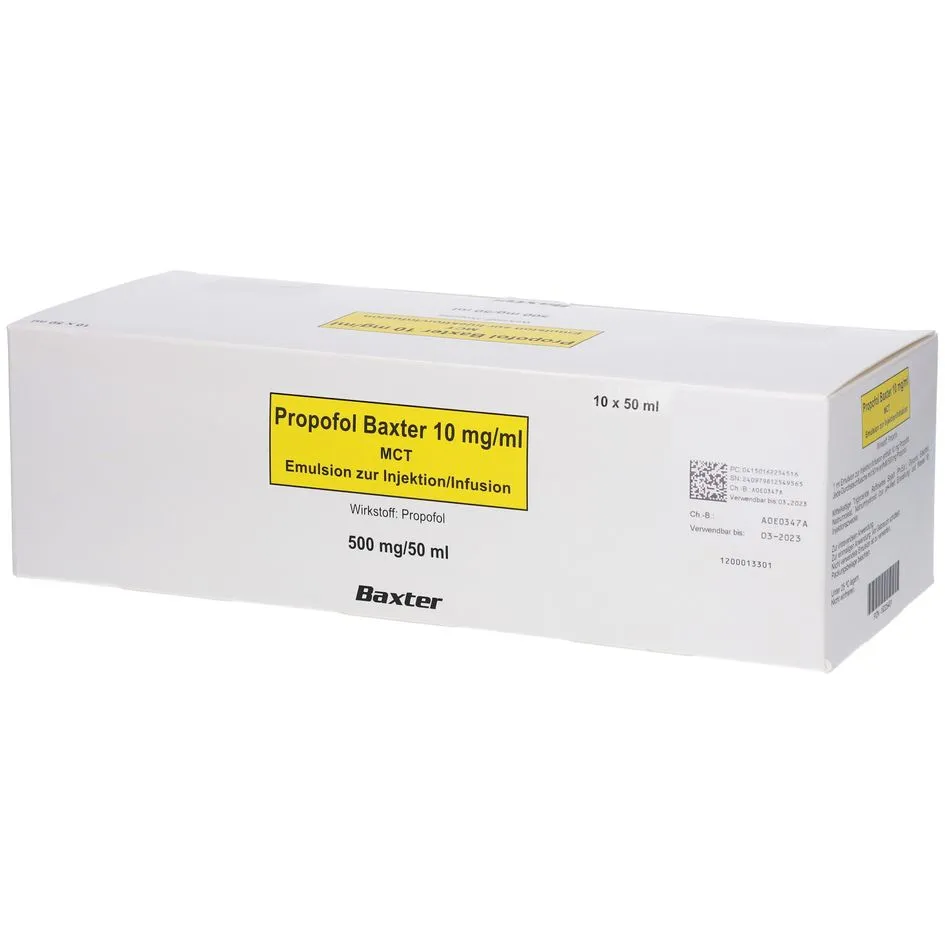
Table of Contents
- Package leaflet: Information for the user
- 1. What Propofol Baxter is and what it is used for
- 2. Important information before receiving Propofol Baxter
- 3. How to receive the medicine Propofol Baxter
- 4. Possible adverse effects
- 5. How to store Propofol Baxter
- 6. Contents of the pack and other information
- Package leaflet: Information for the user
- Information intended exclusively for medical professionals
Package leaflet: Information for the user
Propofol Baxter, 10 mg/ml, emulsion for injection / for infusion
Propofolum
Please read all of this leaflet carefully before being given this medicine, because it contains
important information for the patient.
- Keep this leaflet so that you can read it again if necessary.
- If you have any questions, please consult your doctor, pharmacist, or nurse.
- If you experience any adverse reactions, including any adverse reactions not listed in this leaflet, inform your doctor, pharmacist, or nurse. See section 4.
Contents of the leaflet:
- What Propofol Baxter is and what it is used for
- Important information before receiving Propofol Baxter
- How to receive Propofol Baxter
- Possible side effects
- How to store Propofol Baxter
- Contents of the pack and other information
1. What Propofol Baxter is and what it is used for
Propofol Baxter contains an active substance called propofol. Propofol Baxter belongs to a group of
medicines used for general anaesthesia. They are used to induce loss of consciousness (deep sleep)
in order to perform a surgical or other procedure. They may also be used to achieve sedation (a state in which the patient is drowsy but not fully asleep).
Propofol Baxter is used for:
- induction and maintenance of general anaesthesia in adults and children over
1 month of age, - sedation of mechanically ventilated patients over 16 years of age in intensive care settings,
- sedation of adults and children over 1 month of age during surgical and diagnostic procedures, either alone or in combination with local or regional anaesthesia (locally acting anaesthetic medicines).
2. Important information before receiving Propofol Baxter
When not to use Propofol Baxter
- if the patient is allergic to propofol, soy, peanuts, or any of the other ingredients of this medicine (listed in section 6),
- for sedation of patients aged 16 years or younger in intensive care settings.
Warnings and precautions
Before administration of Propofol Baxter, discuss with the doctor, anaesthesiologist, or nurse:
- if the patient has ever had a seizure or convulsions;
- if the patient has ever had very high levels of fat in the blood;
- if the patient has ever been diagnosed with a condition affecting fat metabolism;
- if the patient’s body has lost a significant amount of fluid (hypovolemia);
- if the patient has any other health problems, such as heart, breathing, kidney, or liver issues;
- if the patient has generally been unwell for some time;
- if the patient suffers from a mitochondrial disease.
After receiving Propofol Baxter, the patient may still experience its effects. The patient must not leave the hospital without being accompanied by another person.
Children and adolescents
Use of Propofol Baxter is not recommended in neonates, as this patient group has not been sufficiently studied.
Propofol Baxter must not be used for sedation in children and adolescents under 16 years of age in intensive care units, as the safety and efficacy of propofol in this indication have not been established in this age group.
Elderly patients
In elderly patients, lower doses of Propofol Baxter are required for induction of anaesthesia. The patient’s age and general health status should be taken into account. The reduced dose should be administered more slowly and titrated according to response.
Propofol Baxter with other medicines
Inform the doctor about all medicines currently taken or recently taken by the patient, as well as any medicines the patient plans to take.
In particular, inform the attending physician, anaesthesiologist, or nurse if the patient is taking:
- Rifampicin, as it may reduce blood pressure when combined with general anaesthesia.
- Certain sedatives and analgesics, such as benzodiazepines and opioids, as they may enhance the effects of propofol.
- Valproic acid, as concomitant use with propofol may require a reduction in the propofol dose.
Use of Propofol Baxter with food, drink, and alcohol
Alcohol in any form must not be consumed after administration of Propofol Baxter.
Pregnancy and breastfeeding
If the patient is pregnant or breastfeeding, suspects she may be pregnant, or plans to become pregnant, she should consult a doctor or pharmacist before receiving this medicine.
Pregnancy
Propofol Baxter should not be used during pregnancy unless absolutely necessary.
Breastfeeding
Studies in breastfeeding women have shown that small amounts of propofol pass into human milk. Therefore, breastfeeding should be avoided for 24 hours after administration of propofol. Breast milk expressed during this time should be discarded.
Driving and operating machinery
After receiving propofol, the patient may continue to feel drowsy for some time. Driving or operating tools or machinery must not be undertaken until the effects of the medicine have worn off.
- If the patient is discharged soon after receiving Propofol Baxter, they must not drive a car or use any tools or machinery.
- The patient should ask their doctor when they can resume these activities, as well as when they can return to work. Propofol Baxter contains soybean oil Propofol Baxter contains soybean oil. Do not use if hypersensitivity to peanuts or soy has been diagnosed.
Propofol Baxter contains sodium
This medicine contains less than 1 mmol of sodium (23 mg) per vial; therefore, this medicine is considered "sodium-free".
3. How to receive the medicine Propofol Baxter
Propofol Baxter will be administered to the patient as an injection or infusion into a vein, usually in the
back of the hand or forearm.
Propofol Baxter must only be given by doctors who have been specifically trained in anaesthesia or
intensive care medicine. Sedation or anaesthesia with Propofol Baxter must not be performed by the
same person who carries out the surgical or diagnostic procedure.
To maintain sleep or drowsiness, relieve pain, maintain normal breathing, and stable blood pressure,
the patient may require several different medicines. The doctor will decide when and which medicines
are needed.
Dosage
The dose of Propofol Baxter used depends on the patient's age, body weight, general health, and
premedication. The doctor will administer the appropriate dose to induce and maintain general
anaesthesia or to achieve the required depth of sedation, carefully monitoring the patient's responses
and vital signs (pulse, blood pressure, breathing, etc.).
If there are any further doubts regarding the use of this medicine, consult the doctor.
4. Possible adverse effects
Like all medicines, this medicine can cause adverse effects, although not everyone will experience them.
Possible adverse effects
Induction and maintenance of anaesthesia and sedation with propofol are usually well tolerated, with minimal signs of excitation. The most commonly reported adverse effects include, for example, arterial hypotension and respiratory depression. The type, severity and frequency of these effects observed in patients during administration of propofol depend on the patient's health status, the type of procedure and the surgical or therapeutic interventions used.
In particular, the following adverse effects have been observed:
Very common (may affect more than 1 in 10 people)
- Pain at the injection site upon initial administration during induction of anaesthesia
Common (may affect up to 1 in 10 people)
- Spontaneous movements and muscle twitching during induction of anaesthesia, headache during emergence
- Slow heart rate (bradycardia)
- Low blood pressure (arterial hypotension)
- Condition in which the patient begins to breathe very rapidly (hyperventilation) and coughing during induction of anaesthesia, transient ineffective breathing (apnoea) during induction of anaesthesia
- Hiccups during induction of anaesthesia, nausea and vomiting during emergence
- Hot flushes during induction of anaesthesia
Uncommon (may affect up to 1 in 100 people)
- Blood clotting in part of the circulatory system (thrombosis) and inflammation of veins
- Coughing during maintenance of anaesthesia Rare (may affect up to 1 in 1,000 people)
- Dizziness, chills and feeling cold during emergence
- Epilepsy-like episodes with seizures and muscle contractions causing backward arching of the head, neck and spine (opisthotonus) during induction, maintenance of anaesthesia and emergence (very rarely delayed by several hours to several days)
- Coughing during emergence
Very rare (may affect up to 1 in 10,000 people)
- Severe allergic reactions (anaphylaxis), which may include angioedema, respiratory failure due to bronchospasm, skin redness and low blood pressure
- Loss of consciousness after surgery
- Fluid accumulation in the lungs, which may cause breathing difficulties (may also occur after awakening)
- Pancreatitis
- Change in urine colour after prolonged administration of Propofol Baxter
- Absence of sexual inhibition
- Tissue damage
- Postoperative fever
Frequency not known (frequency cannot be estimated from available data)
- Excess acid in the blood caused by metabolic disturbances (metabolic acidosis)
- Increased potassium levels in the blood
- Increased lipid levels in the blood
- Euphoric mood during emergence
- Misuse and drug dependence
- Involuntary movements
- Heart arrhythmia
- Heart failure
- Ineffective breathing (dose-dependent respiratory depression)
- Enlargement of the liver
- Breakdown of striated muscle fibres (rhabdomyolysis)
- Kidney failure
- Local pain, swelling after accidental extravascular administration
- Prolonged, often painful erection (priapism)
- Changes in ECG readings
- Hepatitis, acute liver failure [symptoms may include yellowing of the skin and eyes, itching, dark urine, abdominal pain and liver tenderness on palpation (indicated as pain under the front part of the chest on the right side of the body), sometimes with loss of appetite]. When administered concomitantly with lidocaine, the following adverse effects may rarely occur:
- dizziness
- vomiting
- drowsiness
- seizures
- bradycardia
- arrhythmia
- shock
Reporting of adverse effects
If any adverse effects occur, including any not listed in this leaflet, inform your doctor, pharmacist or nurse. Adverse effects can be reported directly to the Department of Monitoring of Adverse Drug Reactions of the Office for Registration of Medicinal Products, Medical Devices and Biocidal Products:
Al. Jerozolimskie 181C
02-222 Warsaw
Tel.: + 48 22 49 21 301
Fax: + 48 22 49 21 309
Website: https://smz.ezdrowie.gov.pl
Adverse effects can also be reported to the marketing authorisation holder.
Reporting adverse effects helps to provide more information on the safety of the medicine.
5. How to store Propofol Baxter
Keep the medicine out of the sight and reach of children.
Do not use this medicine after the expiry date stated on the cardboard box and on the label
of the vial: EXP. The expiry date refers to the last day of the specified month.
Store below 25°C.
Do not freeze.
After first opening the container, the medicine must be used immediately.
Dilutions should only be performed with glucose 50 mg/ml (5%) solution for injection, sodium chloride 9 mg/ml (0.9%) solution for injection, sodium chloride 1.8 mg/ml (0.18%) and glucose 40 mg/ml (4%) solution for injection, or lidocaine solution without preservatives 10 mg/ml (1%) for injection. The mixture must be prepared under aseptic conditions (maintaining controlled and approved conditions) immediately before administration and must be administered within 12 hours of preparation.
Shake well before use.
Do not use this medicine if, after shaking, two layers are observed.
Use only homogeneous solutions and undamaged vials.
The solution is for single use only. Any unused emulsion must be discarded.
The anaesthesiologist and pharmacist are responsible for the proper storage, use, and disposal of Propofol Baxter.
6. Contents of the pack and other information
What Propofol Baxter contains
The active substance is propofol.
1 ml of injection/infusion emulsion contains 10 mg of propofol.
A 20 ml vial contains 200 mg of propofol.
A 50 ml vial contains 500 mg of propofol.
A 100 ml vial contains 1000 mg of propofol.
The other ingredients are: purified soybean oil, medium-chain triglycerides, glycerol, egg yolk lecithin, sodium oleate, sodium hydroxide (for pH adjustment), and water for injections.
What Propofol Baxter looks like and contents of the pack
A white oil-in-water emulsion for injection/infusion.
The medicine is available as:
An emulsion for injection/infusion in a vial made of colourless glass (type II) with a grey bromobutyl rubber stopper.
Pack sizes:
- A 20 ml vial made of colourless glass (type II) with a grey bromobutyl rubber stopper, containing 1, 5 or 10 vials per pack.
- A 50 ml vial made of colourless glass (type II) with a grey bromobutyl rubber stopper, containing 1 or 10 vials per pack.
- A 100 ml vial made of colourless glass (type II) with a grey bromobutyl rubber stopper, containing 1 or 10 vials per pack.
Not all pack sizes may be marketed.
Marketing Authorisation Holder
For Austria, Czech Republic, Estonia, Hungary, Ireland, Italy, Lithuania, Portugal, France, Denmark, Finland, Germany, Norway, Sweden, Latvia, Poland, Slovenia, Romania, Greece
Baxter Holding B.V.
Kobaltweg 49,
3542CE Utrecht, The Netherlands
For the Netherlands
Baxter Holding B.V.
Kobaltweg 49,
3542CE Utrecht, The Netherlands
For the United Kingdom
Baxter Healthcare Limited
Caxton Way
Thetford, Norfolk IP24 3SE, United Kingdom
Manufacturer
Baxter
Boulevard René Branquart 80,
7860 Lessines, Belgium
Bieffe Medital S.p.A.,
Via Nuova Provinciale
23034 Grossotto (SO), Italy
SIA “UNIFARMA” Vangažu iela 23,
Riga, Latvia
This medicinal product is authorised in the member states of the European Economic Area under the following names:
| CMS Country | Brand Names |
| Germany (RMS) | Propofol Baxter 10 mg/ml MCT Emulsion zur Injektion/Infusion |
| Austria | Propofol Baxter 1 % (10 mg/ml) MCT Emulsion zur Injektion/Infusion |
| Czech Republic | Propofol Baxter |
| Denmark | Profast 10mg/ml, injektions- og infusionsvæske, emulsion |
| Estonia | Anesia |
| Greece | Propofol/Baxter 10 mg/ml Γαλάκτωμα για ένεση/έγχυση |
| Finland | Profast 10 mg/ml injektio-/infuusioneste, emulsio |
| France | PROPOFOL BAXTER 10 mg/ml, emulsion injectable/pour perfusion |
| Hungary | Anesia 10 mg/ml emulziós injekció vagy infúzió |
| Ireland | Propofol 10mg/ml Emulsion for Injection/Infusion |
| Italy | Rapiva 10 mg/ml emulsione iniettabile e per infusion |
| Latvia | Anesia 10 mg/ml emulsija injekcijām/infūzijām |
| Lithuania | Anesia 10 mg/ml injekcinė/infuzinė emulsija |
| Netherlands | Propofol Spiva 10 mg/ml, emulsie voor injectie of infusie |
| Norway | Profast 10 mg/ml injeksjons-/infusjonsvæske, emulsjon |
| Poland | Propofol Baxter, 10 mg/ml, emulsja do wstrzykiwań/do infuzji |
| Portugal | Propofol Baxter 10 mg/ml emulsão injectável ou para perfusão |
| Romania | Profast 10 mg/ml emulsie injectabila/perfuzabila |
| Sweden | Profast 10 mg/ml injektionsvätska/infusionsvätska, emulsion |
| Slovenia | Propofol Baxter 10 mg/ml emulzija za injiciranje ali infundiranje |
| United Kingdom | Propofol 10 mg/ml Emulsion for injection/infusion |
Package leaflet: Information for the user
Information intended exclusively for medical professionals
This patient information leaflet is a shortened version of the Summary of Product Characteristics (SmPC).
More information can be found in the SmPC.
Instructions for handling the medicinal product
The medicinal product Propofol Baxter may be administered only by specialist anaesthesiologists or intensive care physicians. Sedation or anaesthesia with Propofol Baxter must not be performed by the same person who is carrying out the surgical or diagnostic procedure.
Continuous monitoring of cardiovascular and respiratory functions (e.g. ECG, pulse oximetry) is required.
Immediate and direct access to standard resuscitation equipment used in general anaesthesia or sedation must be ensured.
Storage instructions after opening or preparation
Chemical and physical stability has been demonstrated for 12 hours at 25°C.
Shelf life after dilution: The mixture must be prepared under aseptic conditions (maintaining controlled and validated conditions) immediately before administration and used within 12 hours of preparation.
The product should be used immediately after first opening.
For single use only. Any unused medicinal product must be discarded.
Instructions for use
Before administration, the rubber stopper of the vial should be disinfected with alcohol in aerosol form or with an alcohol-impregnated swab.
Vials should be shaken before use.
Propofol Baxter is administered intravenously either undiluted from plastic syringes or glass vials, or as a mixture with 5% glucose solution in PVC bags or glass vials.
Propofol Baxter does not contain any preservatives and may support microbial growth.
The emulsion should be withdrawn aseptically into a sterile syringe or infusion set immediately after piercing the vial stopper. Administration must begin immediately after opening.
Aseptic techniques must be maintained throughout the infusion period with regard to Propofol Baxter and infusion equipment. Medicinal products or fluids added to the infusion line through which Propofol Baxter is administered must be introduced only near the site of the cannula insertion.
Do not administer Propofol Baxter through infusion systems equipped with microbiological filters.
In cases of concomitant parenteral nutrition, consider the lipid content provided by Propofol Baxter. 1.0 ml of Propofol Baxter contains 0.1 g of fat.
Infusion of undiluted Propofol Baxter
An infusion pump or volumetric pump should be used for the infusion of undiluted Propofol Baxter.
The duration of infusion using a single infusion system must not exceed 12 hours, consistent with parenteral administration of all types of fat emulsions. At the end of the infusion, but no later than 12 hours after initiation, any remaining volume of Propofol Baxter and the infusion system must no longer be used. If necessary, the infusion system should be replaced.
Infusion of diluted Propofol Baxter:
Diluted Propofol Baxter should be administered using a controlled infusion system (burette or volumetric pump) to prevent accidental administration of excessive volumes.
Propofol Baxter may only be diluted with: 50 mg/ml (5%) glucose solution for injection, 9 mg/ml (0.9%) sodium chloride solution for injection, or a combination of 1.8 mg/ml (0.18%) sodium chloride and 40 mg/ml (4%) glucose solutions for injection, or 1% lidocaine solution (10 mg/ml) for injection without preservatives. The final concentration of propofol must not be less than 2 mg/ml.
Concomitant administration of Propofol Baxter with 5% glucose solution (50 mg/ml) for injection, 0.9% sodium chloride solution (9 mg/ml) for injection, or a combination of 0.18% sodium chloride (1.8 mg/ml) and 4% glucose (40 mg/ml) for injection is possible using a Y-connector close to the injection site.
Maximum dilution must not exceed 1 part Propofol Baxter and 4 parts of 50 mg/ml (5%) glucose solution for injection, 9 mg/ml (0.9%) sodium chloride solution for injection, or a combination of 1.8 mg/ml (0.18%) sodium chloride and 40 mg/ml (4%) glucose solution for injection (minimum concentration 2 mg propofol/ml). The mixture must be prepared under aseptic conditions (maintaining controlled and validated conditions) immediately before administration and used within 12 hours of preparation.
To reduce injection site pain, lidocaine may be injected directly before Propofol Baxter, or the product may be mixed immediately before administration with lidocaine solution without preservatives (a solution containing 20 parts propofol and up to 1 part 1% lidocaine solution for injection) under controlled and validated aseptic conditions. The mixture must be administered within 12 hours of preparation.
If muscle relaxants (such as atracurium and mivacurium) are administered through the same infusion system as Propofol Baxter, the system must be flushed before their administration.
The contents of the vial and the entire infusion set used for administration are intended for single use in one patient. Unused emulsion must be discarded.
Dosage
General anaesthesia in adults
Induction of anaesthesia
For induction of anaesthesia, Propofol Baxter should be administered gradually (at a rate of 20–40 mg propofol every 10 seconds) until loss of consciousness occurs. In most adults under 55 years of age, the total dose usually required is 1.5–2.5 mg propofol per kg body weight (kg bw).
In patients classified as ASA III and IV (American Society of Anesthesiologists classification), especially those with a history of heart disease or elderly patients, the total dose of Propofol Baxter may need to be reduced to 1 mg propofol/kg bw. Therefore, the infusion rate of Propofol Baxter should be slowed (to approximately 20 mg propofol every 10 seconds).
Maintenance of anaesthesia
Anaesthesia may be maintained by continuous infusion or repeated bolus injections of Propofol Baxter.
Continuous infusion
To maintain anaesthesia via continuous infusion, the dose and infusion rate should be individually adjusted. Typically, a dose of 4–12 mg propofol/kg bw per hour is required to achieve an adequate level of anaesthesia.
In elderly patients, patients in generally poor health, hypovolemic patients, or those classified as ASA III and IV, the dose may be reduced to 4 mg propofol/kg bw per hour.
Repeated bolus injections
For maintenance of anaesthesia using repeated bolus injections, subsequent doses of 25–50 mg propofol (equivalent to 2.5–5 ml of Propofol Baxter) are generally used.
General anaesthesia in children from 1 month of age
Induction of anaesthesia
For induction of anaesthesia, Propofol Baxter should be administered gradually and slowly until clinical signs of anaesthesia onset occur. The dose should be adjusted based on age and/or body weight. In most children over 8 years of age, the dose required for induction is approximately 2.5 mg propofol/kg bw. In younger children, especially those from 1 month to 3 years of age, a higher dose may be required (2.5–4 mg propofol/kg bw). Lower doses are recommended for patients classified as ASA III and IV.
Maintenance of anaesthesia
The required depth of anaesthesia can be maintained by infusion or repeated bolus administration of Propofol Baxter. Required doses vary significantly between patients, but satisfactory anaesthesia is usually achieved with doses of 9–15 mg propofol/kg bw per hour. Higher doses may be required in younger children, especially those from 1 month to 3 years of age.
Lower doses are recommended for patients classified as ASA III and IV.
Sedation of patients over 16 years of age during intensive care
To induce sedation in mechanically ventilated patients during intensive care, Propofol Baxter should be administered as a continuous infusion. The dosage should be adjusted according to the required level of sedation. The desired sedation level is usually achieved with a dose range of 0.3–4.0 mg propofol/kg bw per hour.
Propofol Baxter must not be used to induce sedation in patients aged 16 years or younger during intensive care.
Administration of Propofol Baxter using a TCI (Target Controlled Infusion) system is not recommended for sedation during intensive care.
Sedation of adults during surgical and diagnostic procedures
While administering Propofol Baxter, patients must be continuously monitored for signs of hypotension, airway obstruction, and hypoxia, and standard resuscitation equipment must be immediately available.
For induction of sedation, a dose of 0.5–1.0 mg propofol/kg bw over 1–5 minutes is generally required. For maintenance of sedation, dosing is based on the desired level of sedation and generally requires doses of 1.5–4.5 mg propofol/kg bw per hour. In addition to continuous infusion, if a rapid increase in sedation level is needed, a single bolus injection of 10–20 mg may be administered.
In patients classified as ASA III and IV, dose reduction and slower administration may be necessary.
A lower dose may also be required in patients over 55 years of age.
Sedation of children over 1 month of age during surgical and diagnostic procedures
Dosing and intervals between doses should be determined based on the desired depth of sedation and clinical response. In most paediatric and adolescent patients, a dose of 1–2 mg propofol/kg bw is required to induce sedation. Maintenance of sedation is achieved by gradually increasing the dose of Propofol Baxter via infusion until the desired depth of sedation is reached. In most patients, the required dose is 1.5–9 mg propofol/kg bw per hour. If a rapid increase to a deeper level of sedation is required, the infusion may be supplemented with bolus injections of up to 1.0 mg/kg bw.
Lower doses may be necessary in patients classified as ASA III and IV.
Propofol Baxter must not be used to induce sedation in children under 16 years of age during intensive care.
Overdose
Overdose may lead to cardiovascular and respiratory depression. Apnoea requires artificial ventilation. In case of circulatory depression, standard measures should be taken, including lowering the patient’s head position and/or plasma substitution and administration of vasoconstrictors.
Duration of use
Propofol Baxter may be administered for up to a maximum of 7 days.