Promonta 10 mg
Poland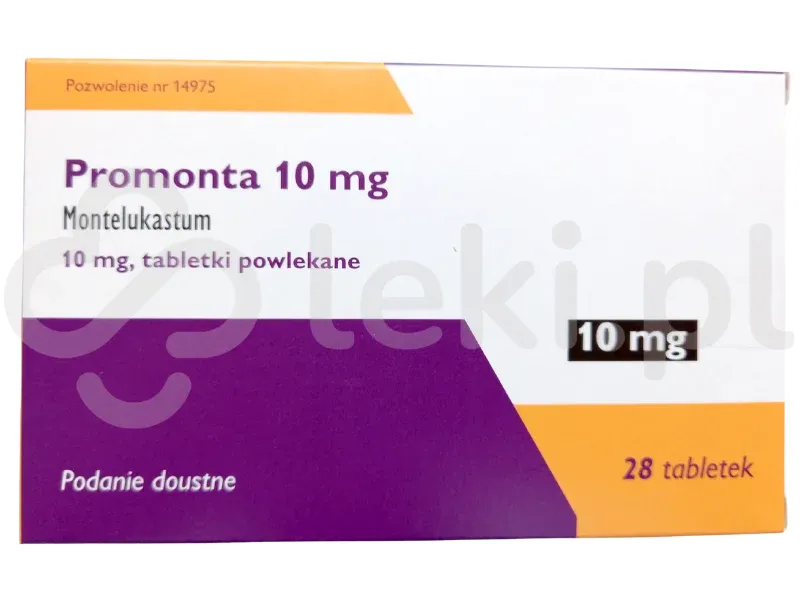
Table of Contents
Patient Information Leaflet
Promonta 10 mg
10 mg, film-coated tablets
Montelukast
For adults and adolescents aged 15 years and older
Please read this leaflet carefully before taking this medicine, as it contains
important information for you.
- Keep this leaflet, as you may need to read it again.
- If you have any further questions, please consult your doctor or pharmacist.
- This medicine has been prescribed for a specific individual. Do not pass it on to others. It may harm other people, even if their symptoms are the same.
- If you experience any adverse reactions, including any not listed in this leaflet, inform your doctor or pharmacist. See section 4.
Table of contents:
- What Promonta 10 mg is and what it is used for
- Important information before taking Promonta 10 mg
- How to take Promonta 10 mg
- Possible side effects
- How to store Promonta 10 mg
- Contents of the pack and other information
1. What Promonta 10 mg is and what it is used for
Promonta 10 mg is a leukotriene receptor antagonist that blocks the action of substances called leukotrienes. Leukotrienes cause narrowing and swelling of the airways and trigger allergy symptoms. By blocking the action of leukotrienes, Promonta 10 mg relieves asthma symptoms and helps control asthma, as well as alleviating symptoms of seasonal allergic rhinitis (also known as hay fever).
Your doctor has prescribed Promonta 10 mg for the treatment of asthma to prevent asthma symptoms during the day and at night.
- Promonta 10 mg is used in patients whose asthma is not adequately controlled with previously used medications and who require additional therapy.
- Promonta 10 mg also helps prevent exercise-induced narrowing of the airways.
- In patients with asthma, Promonta 10 mg may also relieve symptoms of seasonal allergic rhinitis.
Your doctor will determine how to use Promonta 10 mg based on your symptoms and the severity of your asthma.
What is asthma?
Asthma is a chronic disease.
In asthma, the following occur:
- Breathing difficulties caused by narrowing of the airways. This narrowing varies in severity in response to various triggers.
1/7
- Increased sensitivity of the airways, which react to many factors such as cigarette smoke, pollen, cold air, or physical exertion.
- Swelling (inflammation) of the mucous membrane lining the airways.
Asthma symptoms include coughing, wheezing, and a feeling of tightness in the chest.
What are seasonal allergies?
Seasonal allergies (also known as hay fever or seasonal allergic rhinitis) are allergic reactions commonly triggered by airborne pollen from trees, grasses, and weeds. Typical symptoms of seasonal allergies may include nasal congestion, runny nose, itchy nose, sneezing, watery eyes, eye swelling, redness, and itchy eyes.
2. Information before using Promonta 10 mg
Inform your doctor about any current or past medical conditions and allergies.
When not to use Promonta 10 mg
- if the patient is allergic to the active substance or to any of the other ingredients of this medicine (listed in section 6).
Warnings and precautions
Before starting treatment with Promonta 10 mg, discuss it with your doctor or pharmacist.
- If asthma symptoms worsen or breathing difficulties occur, contact your doctor immediately.
- Promonta 10 mg tablets for oral use are not intended for the treatment of acute asthma attacks. If an attack occurs, follow your doctor's instructions. Always keep a rescue inhaler available for immediate use in case of an asthma attack.
- It is important that the patient takes all asthma medications prescribed by the doctor. Promonta 10 mg should not be used as a substitute for other asthma medications prescribed by the doctor.
- Remember that if a patient taking asthma medications develops additional symptoms such as flu-like symptoms, tingling or numbness in the hands or feet, worsening respiratory symptoms and/or rash, medical advice should be sought.
- The patient should not take acetylsalicylic acid (aspirin) or non-steroidal anti-inflammatory drugs (NSAIDs) if these medications worsen asthma symptoms.
Neuropsychiatric events (e.g. changes in behaviour and mood, depression, suicidal thoughts) have been reported in patients of all ages treated with montelukast (see section 4). If such symptoms occur during treatment with montelukast, contact your doctor immediately.
Children and adolescents
Promonta 10 mg tablets must not be used in children under 15 years of age.
For children aged 2 to 5 years, Promonta 4 mg chewable tablets are available.
2/7
For children aged 6 to 14 years, Promonta 5 mg chewable tablets are available.
Promonta 10 mg and other medicines
Some medicines may affect the action of Promonta 10 mg or Promonta 10 mg may affect the action of other medicines the patient is taking.
Tell your doctor or pharmacist about all medicines currently or recently taken, as well as any medicines the patient plans to take.
Before starting Promonta 10 mg, inform your doctor if the patient is taking any of the following medicines:
- phenobarbital (a medicine used to treat epilepsy),
- phenytoin (a medicine used to treat epilepsy),
- rifampicin (a medicine used to treat tuberculosis and certain other infections),
- gemfibrozil (used to treat high levels of lipids in plasma).
Taking Promonta 10 mg with food and drink
Promonta 10 mg coated tablets can be taken with or without food.
Pregnancy and breastfeeding
Use during pregnancy
Women who are pregnant or planning to become pregnant should consult their doctor before taking Promonta 10 mg. The doctor will assess whether it is safe to take Promonta 10 mg during this period.
Use during breastfeeding
It is not known whether Promonta 10 mg passes into breast milk. If a woman is breastfeeding or planning to breastfeed, she should consult her doctor before taking Promonta 10 mg.
Driving and operating machinery
Promonta 10 mg is not expected to affect the ability to drive or operate machinery. However, individual responses to the medicine may vary. Some adverse reactions (such as dizziness and drowsiness), which have been reported very rarely during treatment with Promonta 10 mg, may affect the ability to drive or operate machinery.
Promonta 10 mg contains lactose
If the patient has been previously diagnosed with intolerance to certain sugars, consult a doctor before taking this medicine.
Promonta 10 mg contains sodium
The medicine contains less than 1 mmol (23 mg) of sodium per tablet, meaning the medicine is considered "sodium-free".
3. How to use Promonta 10 mg
Take only one Promonta 10 mg tablet once daily, as directed by the doctor.
The medicine should be taken even when the patient does not have asthma symptoms, as well as during an acute asthma attack.
This medicine must always be taken according to the doctor's instructions. In case of doubt, consult the doctor or pharmacist.
The medicine should be taken orally.
3/7
Adults and adolescents aged 15 years and older:
The recommended dose is one coated tablet of Promonta 10 mg once daily in the evening.
The medicine may be taken with or without food.
If the patient is taking Promonta 10 mg, ensure that they are not taking any other medicine containing the same active substance, montelukast.
Taking more than the recommended dose of Promonta 10 mg
Contact the doctor immediately.
In most cases, no adverse effects have been reported following overdose. The most commonly reported symptoms of overdose in adults and children include: abdominal pain, drowsiness, increased thirst, headache, vomiting, and hyperactivity.
Missed dose of Promonta 10 mg
Take Promonta 10 mg as directed by the doctor. However, if a dose is missed, resume the regular dosing schedule—one tablet once daily.
Do not take a double dose to make up for the missed dose.
Stopping treatment with Promonta 10 mg
Promonta 10 mg is effective in treating asthma only when taken regularly.
It is important to continue taking Promonta 10 mg for as long as directed by the doctor. This will help keep the patient's asthma under control.
If there are any further doubts regarding the use of this medicine, consult the doctor or pharmacist.
4. Possible adverse reactions
Like all medicines, this medicine can cause adverse reactions, although not everyone will experience them.
In clinical trials using montelukast 10 mg film-coated tablets, the most commonly reported adverse reactions considered to be related to montelukast use were:
abdominal pain,
headache.
These symptoms were usually mild and occurred more frequently in patients taking montelukast than in patients receiving placebo (a tablet containing no active ingredient).
Additionally, the following adverse reactions have been reported after the medicine has been placed on the market:
Very common (may affect more than 1 in 10 people):
upper respiratory tract infection
Common (may affect up to 1 in 10 people):
diarrhea, nausea, vomiting
fever
rash
increased liver enzyme activity
Uncommon (may affect up to 1 in 100 people):
allergic reactions, including swelling of the face, lips, tongue, and (or) throat, which may cause difficulty breathing or swallowing
- changes in behaviour and mood, unusual dreams including nightmares, difficulty sleeping, sleepwalking, irritability, feeling anxious, restlessness, agitation, including aggressive behaviour or hostility, depression
- dizziness, drowsiness, tingling and (or) numbness, seizures
- nosebleeds
- dry mouth, dyspepsia
- bruising, itching, urticaria
- weakness / fatigue, malaise, swelling
- joint and muscle pain, muscle tremors
Rare (may affect up to 1 in 1,000 people):
increased tendency to bleed
- tremor, attention disorders, memory disorders, palpitations
Very rare (may affect up to 1 in 10,000 people):
- hallucinations, disorientation
- suicidal thoughts and suicide attempts
- lung inflammation (pulmonary infiltrates with eosinophilia)
- hepatitis
- tender, red subcutaneous nodules, most commonly appearing on the shins (erythema nodosum)
- severe skin reactions (erythema multiforme), which may occur without prior symptoms
- stuttering
In patients with asthma treated with montelukast, very rare cases of Churg-Strauss syndrome (eosinophilic granulomatosis with polyangiitis) have been reported, characterized by a constellation of symptoms such as flu-like symptoms, tingling or numbness in the hands or feet, worsening of respiratory symptoms and (or) rash. If any of these symptoms occur, contact your doctor immediately.
For more detailed information about adverse reactions, consult your doctor or pharmacist.
Reporting of adverse reactions
If any adverse reactions occur, including any not listed in this leaflet, inform your doctor or pharmacist. Adverse reactions can be reported directly to the Department of Monitoring of Adverse Drug Reactions at the Office for Registration of Medicinal Products, Medical Devices and Biocidal Products:
Al. Jerozolimskie 181 C
02-222 Warsaw
Phone: +48 22 49 21 301
Fax: +48 22 49 21 309
Website: https://smz.ezdrowie.gov.pl
Adverse reactions can also be reported to the responsible entity.
Reporting adverse reactions helps to provide more information on the safety of the medicine.
5. How to store Promonta 10 mg
Keep this medicine out of the sight and reach of children.
No special precautions for storage are required.
5/7
Do not use this medicine after the expiry date stated on the blister pack and outer packaging.
Medicines should not be disposed of via wastewater or household waste. Ask your pharmacist how to dispose of medicines no longer required. These measures will help protect the environment.
6. Contents of the pack and other information
What Promonta 10 mg contains
The active substance is montelukast (in the form of montelukast sodium).
Each film-coated tablet contains 10 mg of montelukast in the form of montelukast sodium.
The other components are:
Tablet core:
Microcrystalline cellulose, lactose monohydrate, sodium croscarmellose, disodium edetate,
magnesium stearate.
Tablet coating:
Hypromellose 6cP, hydroxypropylcellulose, titanium dioxide, yellow iron oxide (E172), red iron oxide (E172).
What Promonta 10 mg looks like and contents of the pack
Promonta 10 mg film-coated tablets are beige, round, coated tablets.
Promonta 10 mg is available in OPA/Aluminium/PVC/Aluminium blisters containing 28 or 56 tablets.
Not all pack sizes may be marketed.
Marketing Authorisation Holder
Bausch Health Ireland Limited
3013 Lake Drive
Citywest Business Campus
Dublin 24, D24PPT3
Ireland
Tel: +48 17 865 51 00
Manufacturer
HBM Pharma s.r.o.
Sklabinská 30
036 80 Martin
Slovakia
Saneca Pharmaceutical a.s.
Nitrianska 100
920 27 Hlohovec
Slovakia
This medicinal product is authorised in the European Economic Area member states under the following names:
Poland: Promonta 10 mg
6/7
7/7