Prokit
Poland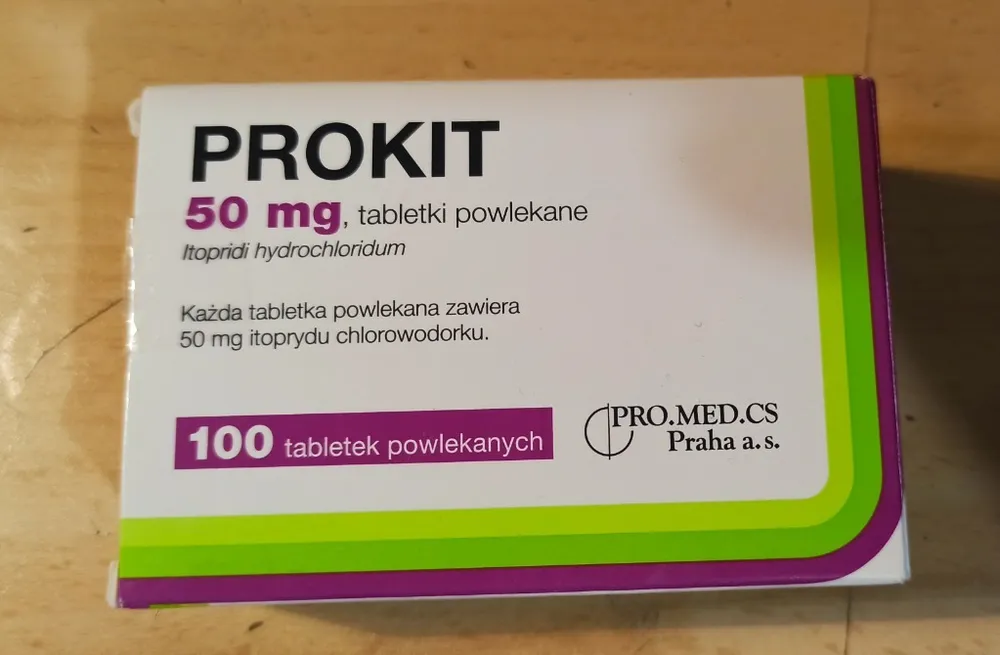
Table of Contents
Package leaflet: Information for the user
Prokit, 50 mg, coated tablets
Itopridi hydrochloridum
Please read all of this leaflet carefully before taking this medicine, because it contains
important information for you.
- Keep this leaflet, as you may need to read it again.
- If you have any further questions, please ask your doctor or pharmacist.
- This medicine has been prescribed for a specific individual. Do not pass it on to others. This medicine may harm other people, even if their symptoms are the same.
- If you experience any adverse reactions, including any not listed in this leaflet, inform your doctor or pharmacist immediately. See section 4.
Contents of the leaflet:
- What Prokit is and what it is used for
- Important information before taking Prokit
- How to take Prokit
- Possible side effects
- How to store Prokit
- Contents of the pack and other information
1. What Prokit is and what it is used for
Prokit contains itopride, which belongs to a group of medicines called prokinetic agents. Prokinetic agents improve or stimulate and enhance gastrointestinal motility by acting as antagonists at dopamine D receptors and by inhibiting acetylcholinesterase activity. Administration of these medicines accelerates gastric emptying and intestinal transit, and increases the tone of the lower esophageal sphincter. Additionally, Prokit has antiemetic properties.
Prokit is indicated for the treatment of symptoms associated with delayed gastric emptying, such as epigastric fullness or upper abdominal pain, loss of appetite, heartburn, nausea, and vomiting in gastrointestinal disorders not caused by peptic ulcer disease or organic disease affecting gastrointestinal transit.
Prokit is also indicated for symptomatic treatment of gastroesophageal reflux disease (GERD), either as monotherapy or as an add-on therapy to proton pump inhibitors (medicines that reduce gastric hydrochloric acid secretion).
Prokit is indicated for use in adults.
2. Important information before taking Prokit
When not to take Prokit:
- if the patient is allergic to itopride or any of the other ingredients of this medicine (listed in section 6).
- if accelerated gastric emptying may be harmful, e.g. in patients with gastrointestinal bleeding, obstruction, or perforation.
Warnings and precautions
Before starting Prokit, discuss this with your doctor or pharmacist.
Prokit enhances the effects of acetylcholine and should be used with particular caution.
Although clinical studies indicate that the incidence of adverse reactions in patients aged
65 years and older is not higher than in younger patients, adverse effects may occur in elderly patients due to general deterioration of liver and kidney function.
Children and adolescents
Prokit must not be used in children and adolescents under 16 years of age.
Prokit and other medicines
You must tell your doctor or pharmacist about all medicines you are currently taking
or have recently taken, as well as any medicines you plan to take.
Prokit and other concomitantly used medicines may affect each other's actions.
- No interactions between Prokit and warfarin, diazepam, diclofenac, ticlopidine, nifedipine, or nicardipine are known.
- Anticholinergic medicines (used in the treatment of asthma, chronic obstructive pulmonary disease, diarrhoea, Parkinson's disease, or to reduce smooth muscle contractions, e.g. of the urinary bladder) may reduce the effect of itopride.
- Due to itopride's effect on the gastrointestinal tract, it may influence the absorption of other orally administered medicines, especially those with a narrow therapeutic index, extended-release formulations, or those released in the small intestine.
- Anti-ulcer medicines (medicines used in the prevention and treatment of gastrointestinal ulcers), such as cimetidine, ranitidine, teprenone, and cetexcrate, do not affect the prokinetic action of Prokit on the gastrointestinal tract.
Prokit with food and drink
Prokit should be taken before meals.
Pregnancy and breastfeeding
If the patient is pregnant or breastfeeding, suspects she may be pregnant, or is planning to have a child, she should consult her doctor or pharmacist before using this medicine.
Prokit may be used during pregnancy or in women in whom pregnancy cannot be excluded only when prescribed by a doctor, when the benefits of treatment outweigh the potential risks.
If the patient is breastfeeding, the doctor should decide whether to discontinue Prokit or to stop breastfeeding, taking into account the risk of adverse reactions in the breastfed infant.
Driving and operating machinery
Although no effect of the product on the ability to drive or operate machinery has been observed, a reduction in attention cannot be ruled out. Dizziness may very rarely occur. If such symptoms occur, driving or operating machinery should be avoided until these symptoms resolve.
3. How to take Prokit
This medicine should always be taken exactly as directed by the doctor. If in doubt, consult
your doctor or pharmacist.
For gastrointestinal functional disorders and dyspepsia not associated with peptic ulcer disease, the recommended daily dose for adults is 1 tablet three times a day before meals for up to 8 weeks.
In the case of gastroesophageal reflux disease, the recommended daily dose for adults is 1 tablet three times a day before meals for up to 6 weeks when Prokit is used as monotherapy, and up to 12 weeks when Prokit is used as add-on therapy to proton pump inhibitors (PPIs).
The doctor may reduce these doses depending on the patient's age and symptoms. The doctor will determine the exact dose of Prokit and the duration of treatment.
Patients with liver or kidney function impairment
If the patient has impaired liver or kidney function, the doctor will carefully monitor the patient's health status. If adverse reactions occur, the doctor will decide on appropriate actions, such as dose reduction or discontinuation of treatment.
Use in children and adolescents
Prokit should not be used in children and adolescents under 16 years of age.
Taking more than the recommended dose of Prokit
If more than the recommended dose of Prokit is taken, or if the medicine is accidentally ingested by a child, contact a doctor or pharmacist immediately. There are no known cases of itopride overdose.
Missing a dose of Prokit
If a dose of Prokit is missed, take it as soon as remembered. However, if it is almost time for the next dose, skip the missed dose. Do not take a double dose to make up for a missed dose.
Stopping Prokit treatment
If the patient stops taking Prokit too early, symptoms may worsen. Before stopping treatment, consult with the doctor.
If you have any further questions about the use of this medicine, consult your doctor or pharmacist.
4. Possible adverse reactions
Like all medicines, this medicine can cause adverse reactions, although not everyone will experience them.
You should stop taking Prokit and inform your doctor:
- If swelling of the hands, feet, face, lips or throat occurs, causing difficulty in swallowing or breathing. Skin rash and itching may also occur. These may be symptoms of an allergic reaction.
The following adverse reactions may occur during treatment with Prokit:
Uncommon (may occur in up to 1 in 100 people):
- diarrhoea
- constipation
- abdominal pain
- excessive salivation
- headache
- irritability
- sleep disturbances
- dizziness
- chest pain or back pain
- fatigue
- increased prolactin hormone levels
- changes in blood laboratory test results (reduced white blood cell count, increased urea and creatinine levels)
Rare (may occur in up to 1 in 1000 people):
- skin rash, redness and itching
Unknown (frequency cannot be estimated from available data):
- severe allergic reactions, which may cause difficulty in breathing
- increased blood test values (AspAT, AlAT, GGTP, alkaline phosphatase, bilirubin)
- decreased platelet count (which may manifest as bruising and increased bleeding)
- tremor
- nausea
- jaundice
- gynaecomastia (enlargement of breasts in males)
If galactorrhoea (production and secretion of milk unrelated to breastfeeding) or
gynaecomastia (enlargement of breasts in males) occurs, treatment with this medicine should be discontinued or stopped.
Reporting of adverse reactions
If any adverse reactions occur, including any adverse reactions not listed in this
leaflet, inform your doctor or pharmacist. Adverse reactions can be reported
directly to the Department of Monitoring of Adverse Drug Reactions at the Office for Registration of Medicinal Products, Medical Devices and Biocidal Products,
Al. Jerozolimskie 181C, 02-222 Warsaw, Tel.: +48 22 49 21 301,
Fax: +48 22 49 21 309, website: https://smz.ezdrowie.gov.pl
Adverse reactions can also be reported to the marketing authorisation holder.
Reporting adverse reactions helps provide more information on the safety of the medicine.
5. How to store Prokit
Keep this medicine out of sight and reach of children.
No special storage conditions are required.
Do not use this medicine after the expiry date stated on the carton and blister pack after "Expiry date (EXP)". The expiry date refers to the last day of the stated month.
Medicines must not be disposed of via the sewage system or household waste. Ask your pharmacist how to dispose of medicines no longer required. These measures will help protect the environment.
6. Contents of the pack and other information
What Prokit contains
The active substance in Prokit is itopride hydrochloride. Each coated tablet contains 50 mg of itopride hydrochloride.
The other ingredients are: mannitol, povidone 25, crospovidone, colloidal anhydrous silica, magnesium stearate, and Opadry TF White 269F280005 coating (partially hydrolysed polyvinyl alcohol, calcium carbonate, macrogol 3350, talc).
What Prokit looks like and contents of the pack
Prokit is a white or almost white, round, biconvex tablet with a scored line, 7 mm in diameter. The score line is intended only to facilitate breaking the tablet for easier swallowing and does not ensure equal dosing.
Prokit is supplied in blister packs (transparent PVC/PVDC/Aluminium blisters) containing 20, 30, 40, 90, or 100 coated tablets.
Marketing Authorisation Holder and Manufacturer
PRO.MED.CS Praha a.s., Telčská 377/1, Michle, 140 00 Praha 4, Czech Republic
For further information about this medicinal product, please contact the local representative of the Marketing Authorisation Holder:
[email protected]
This medicinal product is authorised in the European Economic Area under the following names:
Poland: Prokit