Prohance
Poland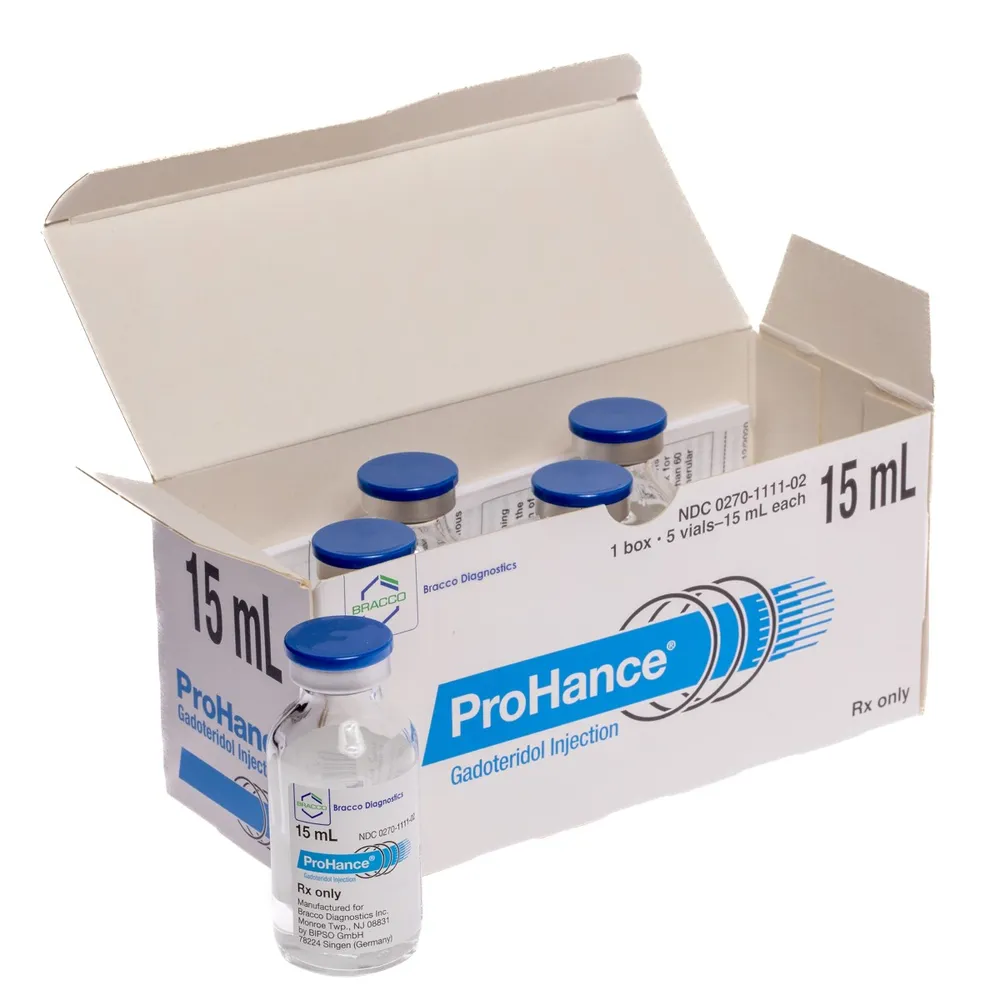
Table of Contents
ProHance, 279.3 mg/ml (0.5 mmol/ml), solution for injection
Gadoteridolum
Please read this leaflet carefully before use, as it contains information important for the patient.
- Keep this leaflet, so that you can read it again if necessary.
- If you have any further questions, please consult your doctor or nurse.
- This medicine has been prescribed for a specific individual. Do not pass it on to others. This medicine may harm others, even if their symptoms are the same.
- If you experience any adverse reactions, including any not listed in this leaflet, inform your doctor or nurse. See section 4.
Leaflet contents:
- What ProHance is and what it is used for
- Important information before using ProHance
- How to use ProHance
- Possible side effects
- How to store ProHance
- Contents of the pack and other information
1. What ProHance is and what it is used for
This product is intended for diagnostic use only.
The active substance in ProHance is gadoteridol—a non-ionic paramagnetic contrast agent used in magnetic resonance imaging (MRI).
Gadoteridol does not cross the intact blood-brain barrier and therefore does not accumulate in normal brain structures or in lesions where the blood-brain barrier is not damaged, such as cysts or mature post-surgical scars. However, disruption of the blood-brain barrier or the presence of blood vessels allows gadoteridol to reach lesions such as tumors, abscesses, or subacute infarcts.
ProHance is used in MRI examinations of the central nervous system (brain and spinal cord) and surrounding tissues. The use of ProHance improves the visibility (compared to non-contrast MRI) of pathological lesions with abnormal vascularity or suspected blood-brain barrier disruption.
ProHance is also indicated for whole-body MRI, including head, neck, liver, breast, musculoskeletal system, and soft tissues, to enhance the visualization of pathological lesions in soft tissues and parenchymal organs.
2. Important information before using ProHance
ProHance should only be administered in hospitals or medical facilities where appropriate equipment and trained personnel are available to manage allergic reactions.
When not to use ProHance
Do not use ProHance:
- if the patient is allergic to gadoteridol or any of the other ingredients of this medicine (listed in section 6).
Warnings and precautions
Inform the physician that:
- the patient has or has had allergies;
- the patient's kidneys are not functioning properly;
- the patient has recently undergone or is scheduled to undergo liver transplantation;
- the patient has a history of epilepsy or brain abnormalities.
Severe, life-threatening or fatal anaphylactic reactions or idiosyncratic reactions (individual-specific reactions) must always be considered possible. The risk of such reactions should be particularly anticipated in patients with clinically confirmed hypersensitivity to the components of the drug, bronchial asthma, or other allergic respiratory disorders in their medical history.
Appropriate medications and equipment for cardiopulmonary resuscitation must be available when administering contrast agents. Patients with a history of allergy, drug reactions, or other pseudo-allergic disorders should be closely monitored during and after administration of the contrast agent, throughout the examination and for a period considered necessary by the physician for the individual patient.
In vitro studies have shown that under the influence of gadolinium chelates, deoxygenated sickle red blood cells align linearly and perpendicularly to the magnetic field, which in vivo may lead to complications due to vascular lumen occlusion. Studies have not been conducted in patients with sickle cell anemia, other hemoglobinopathies, or hemolytic anemias to exclude the possibility of exacerbated hemolysis. Therefore, caution is recommended during administration of the contrast agent.
Repeated administration: Studies on repeated administration have not been conducted. Only cases involving two consecutive administrations during the same session for imaging of the central nervous system structures have been evaluated.
When using ProHance, standard safety precautions applicable to magnetic resonance imaging (MRI) should be observed, particularly in patients with cardiac pacemakers, aneurysm clips, or other ferromagnetic materials. In such cases, MRI (with or without contrast agent) should only be performed if the safety of the metallic implant during MRI has been previously established.
Extreme caution must be exercised during administration of the contrast agent to prevent extravasation.
The physician may decide to perform blood tests to assess kidney function before deciding to administer ProHance, especially in patients over 65 years of age.
Special patient groups
Elderly patients
Caution is recommended during and after administration of ProHance in elderly patients.
Patients with renal impairment
Gadoteridol is eliminated from the body via the kidneys; therefore, caution is required during and after administration in patients with impaired renal function.
Newborns and infants
Due to immature kidney function in children up to 4 weeks of age and infants up to 1 year of age, ProHance should be used in these patients only after careful consideration of the necessity by the physician.
Pregnancy, breastfeeding and fertility
Before using any medication, consult a physician.
Pregnancy
Gadoteridol may cross the placenta. It is unknown whether this affects the fetus. Women who are pregnant or suspect they may be pregnant should inform their physician, as ProHance should not be used during pregnancy unless absolutely necessary.
Breastfeeding
Women who are breastfeeding or intend to breastfeed should inform their physician. The physician will discuss with the patient whether she should continue breastfeeding or discontinue breastfeeding for 24 hours after administration of ProHance.
Driving and operating machinery
There is no information available on the effect of ProHance on the ability to drive, use tools, or operate machinery.
Patients should consult their physician to determine whether they can drive and whether it is safe to use tools or operate machinery.
ProHance with other medicines
There are no reported interactions between ProHance and other medications.
Inform the physician about all medications currently or recently taken, including those obtained without a prescription.
ProHance contains sodium
This medicine contains less than 1 mmol (23 mg) of sodium per dose and is therefore considered "sodium-free".
3. How to use ProHance
The lowest effective dose should be used for examinations.
Adults:
MRI examinations of the musculoskeletal system: the recommended dose of ProHance is 0.2 ml/kg body weight (0.1 mmol/kg body weight).
MRI examinations of the brain, spinal cord, liver, breast, and pelvis: from 0.2 ml/kg body weight to 0.6 ml/kg body weight (0.1 mmol/kg body weight to 0.3 mmol/kg body weight).
In most applications, the standard dose of 0.2 ml/kg body weight (0.1 mmol/kg body weight) is sufficient.
The dose of 0.6 ml/kg body weight (0.3 mmol/kg body weight) is intended for patients in whom brain metastases or other poorly enhancing pathological lesions are suspected.
In patients in whom poor enhancement of pathological lesions is likely, if initial imaging results are inconclusive or negative, a second dose of 0.4 ml/kg body weight (0.2 mmol/kg body weight) may be administered 30 minutes after the first dose.
ProHance should be administered as a rapid intravenous injection or bolus.
To minimize the potential risk of extravasation of ProHance, it is important to verify correct placement of the intravenous needle or catheter into the vein.
After injection of the contrast agent, the intravenous line, catheter, or needle should be flushed with 5 ml of saline solution to ensure complete delivery of the contrast agent. The examination should be completed within one hour after administration of ProHance.
Additional dose
The use of an additional dose during the same examination has been evaluated only in diagnostic procedures of the central nervous system in adults. If the physician determines that a repeat dose is required, the second dose may be administered 30 minutes after the first dose.
Repeat examination
Repeat contrast-enhanced MRI examinations should not be performed earlier than 6 hours after the first examination to allow for elimination of the contrast agent from the body.
Dosage in special patient groups
ProHance is not recommended in patients with severe renal impairment, as well as in patients who have recently undergone or are scheduled to undergo liver transplantation.
However, if administration of the contrast agent is necessary, the patient should receive only one dose of ProHance per examination and should not receive a second injection within at least 7 days.
Neonates, infants, and children
Children
MRI examinations of the brain and spine: the recommended dose of ProHance is 0.2 ml/kg body weight (0.1 mmol/kg body weight).
The safety and efficacy of doses higher than 0.2 ml/kg body weight and repeated doses have not been established in children. Therefore, doses higher than 0.2 ml/kg body weight should not be used and repeat examinations should not be performed in children.
Due to immature renal function in neonates up to 4 weeks of age and infants up to 1 year of age, ProHance should be used in these patients only after careful physician evaluation of the necessity of such treatment. Neonates and infants should receive only one dose of ProHance per examination and should not receive a second injection within at least 7 days.
ProHance is not recommended for whole-body MRI examinations in children under 18 years of age.
Elderly patients
Dosage adjustment is not required in patients over 65 years of age; however, renal function should be assessed by blood tests prior to administration.
Instructions for use of ProHance
ProHance must not be diluted. It should be drawn into a syringe immediately before use.
Prior to administration, inspect the solution and ensure that the container and closure are intact, and that there is no change in color or precipitation.
Do not mix or administer other drugs or parenteral nutrition products through the same intravenous line as the contrast agent due to the potential for chemical incompatibility.
Any unused portion of the medicinal product or waste material remaining after a single examination should be disposed of in accordance with local regulations.
Overdosage of ProHance
There have been no reported cases of ProHance overdose. In the event of overdose, supportive measures should be initiated and symptomatic treatment administered.
ProHance may be removed by dialysis.
4. Possible adverse reactions
Like all medicines, this medicine can cause adverse reactions, although they do not occur in everyone.
Common (occurs more frequently than in 1 in 100 and less frequently than in 1 in 10 patients)
- Nausea
Uncommon (occurs more frequently than in 1 in 1,000 and less frequently than in 1 in 100 patients)
- Headache, sensory disturbances, dizziness, taste disturbances
- Lacrimation (tearing)
- Hot flushes, low blood pressure
- Dry mouth, vomiting
- Persistent itching, skin rash, pruritus (itching)
- Pain at injection site
- Increased heart rate
- Fatigue
- Injection site reactions
Rare (occurs more frequently than in 1 in 10,000 and less frequently than in 1 in 1,000 patients)
- Hypersensitivity reactions (most commonly reported symptoms include: sensation of tightness in the throat, throat irritation, breathing difficulties, chest discomfort, feeling of warmth, difficulty swallowing, burning sensation, throat swelling, and low blood pressure)
- Anxiety
- Disorientation, lack of coordination, seizures
- Tinnitus (ringing in the ears)
- Changes in heart rhythm
- Throat spasm, shallow breathing, watery nasal discharge, cough, transient cessation of breathing, wheezing
- Abdominal pain, tongue swelling, oral itching, gingivitis, diarrhoea
- Facial swelling
- Muscle stiffness
- Chest pain, fever
Frequency not known (cannot be estimated from the available data)
- Loss of consciousness
- Coma
- Cardiac arrest
- Respiratory arrest, pulmonary oedema (fluid in the lungs)
- Kidney function disorders
- Vasovagal reaction – most commonly reported symptoms include drowsiness, dizziness and excessive sweating. In the most severe cases, pallor, profuse sweating, bradycardia (slow heart rate), and potentially loss of consciousness may occur. Additional symptoms may include anxiety, restlessness, feeling faint, and excessive salivation.
As with other gadolinium-based chelates, cases of anaphylactic, anaphylactoid-like and hypersensitivity reactions have been reported. These reactions varied in severity, including anaphylactic shock and death. They involved one or more systems, primarily the respiratory, cardiovascular and/or skin and mucous membranes.
Cases of nephrogenic systemic fibrosis (NSF) (a disease characterised by skin hardening, which may also affect soft tissues and internal organs) have been reported, most of which occurred in patients who received ProHance in combination with other gadolinium-containing medicinal products.
Children
The safety profile of ProHance in children is similar to that in adults.
If any of the adverse reactions worsen or if any adverse reactions not listed in this leaflet occur, inform your doctor or pharmacist.
Reporting of adverse reactions
If any adverse reactions occur, including any adverse reactions not listed in this leaflet, inform your doctor or pharmacist.
Adverse reactions can be reported directly to the Department of Monitoring Adverse Drug Reactions, Office for Registration of Medicinal Products, Medical Devices and Biocidal Products, Al. Jerozolimskie 181C, 02-222 Warsaw, Tel: (22) 49 21 301, Fax: (22) 49 21 309, Website: https://smz.ezdrowie.gov.pl
Adverse reactions can also be reported to the marketing authorisation holder.
Reporting adverse reactions helps to provide more information on the safety of the medicine.
5. How to store ProHance
Store at a temperature not exceeding 25°C. Protect from light. Do not freeze.
Vials or pre-filled syringes that have been frozen must be discarded.
Keep out of the reach and sight of children.
Do not use the medicine after the expiry date stated on the carton or vial. The expiry date refers to the last day of the stated month.
6. Contents of the pack and other information
What ProHance contains
The active substance is gadoteridol.
ProHance also contains: calcium calteridol salt, tromethamine, hydrochloric acid or sodium
hydroxide for pH adjustment, and water for injections.
What ProHance looks like and contents of the pack
ProHance is a clear or slightly yellow aqueous solution.
ProHance is supplied in vials and prefilled syringes:
1 or 5 vials of 5, 10, 15 or 20 ml; 1 vial of 50 ml; 10 vials of 50 ml.
1 or 5 prefilled syringes of 10, 15 or 17 ml.
Not all pack sizes may be marketed.
Marketing Authorisation Holder and Manufacturer
Marketing Authorisation Holder:
Bracco Imaging Deutschland GmbH
Max-Stromeyer-Strasse 116
D-78467 Konstanz, Germany
Manufacturer:
Vial:
BIPSO GmbH - Robert-Gerwig-Str. 4, 78224 Singen, Germany
Bracco Imaging S.p.A. - Bioindustry Park - Via Ribes 5, 10010 Colleretto Giacosa, Italy
Prefilled syringe:
Bracco Imaging S.p.A. - Bioindustry Park - Via Ribes 5, 10010 Colleretto Giacosa, Italy
For further information, contact the Marketing Authorisation Holder:
Bracco Imaging Polska Sp. z o.o.
ul. Domaniewska 39 A
02-672 Warsaw
tel: +48 22 208 24 20
Information intended exclusively for medical personnel:
Before administering the medicinal product ProHance, it is recommended that all patients be evaluated for renal function impairment, including laboratory tests.
Cases of nephrogenic systemic fibrosis (NSF) associated with the use of certain gadolinium-containing medicinal products have been reported in patients with acute or chronic severe renal impairment (GFR < 30 mL/min/1.73 m²). Patients undergoing liver transplantation are at particularly high risk due to the increased likelihood of acute renal failure in this patient group. Because of the potential for NSF to occur with the use of ProHance, administration in patients with severe renal impairment or in patients during the perioperative period of liver transplantation should only be considered after careful assessment of the benefit-risk ratio and only if the diagnostic information is essential and cannot be obtained with non-contrast MRI. If use of ProHance is necessary, the dose should not exceed 0.1 mmol/kg body weight. More than one dose should not be administered during a single imaging session. Due to lack of data on repeated administration of ProHance, repeat dosing should not be performed unless the interval between doses is at least 7 days.
Because renal function is not fully developed in neonates up to 4 weeks of age and infants up to 1 year of age, ProHance should be used in these patients only after careful benefit-risk assessment, at a dose not exceeding 0.1 mmol/kg body weight. More than one dose should not be administered during a single imaging session. Due to lack of data on repeated administration, repeat injections of ProHance should not be given unless the interval between doses is at least 7 days.
Since renal clearance of gadoteridol may be reduced in elderly patients, particularly those aged 65 years and older, monitoring for renal function impairment is especially important in this population.
Hemodialysis immediately after administration of ProHance may facilitate elimination of the medicinal product from the body. However, there is no evidence to support initiating hemodialysis in patients not already undergoing dialysis for the prevention or treatment of NSF.
ProHance should not be used during pregnancy unless the clinical condition of the woman warrants the use of gadoteridol.
The physician and the breastfeeding mother should decide whether to continue breastfeeding or discontinue it for a period of 24 hours after administration of ProHance.
The label detached from the vial or pre-filled syringe should be affixed to the patient's medical record to ensure proper documentation of the administered gadolinium-containing medicinal product. The administered dose should also be recorded.
The name of the medicinal product, batch number, and dose should be entered into the patient's electronic medical record.
The osmolality of ProHance is 2.2 times higher than plasma osmolality (285 mOsmol/kg water). Under conditions of use, ProHance is a hypertonic solution.
Osmolality at 37°C: 630 mOsm/kg water
Viscosity at 20°C: 2.0 cP
Viscosity at 37°C: 1.3 cP
Specific gravity at 25°C: 1.140
Density at 25°C: 1.137 g/cm³
Octanol:water partition coefficient: -3.68 ± 0.02