Progesterone besins
Poland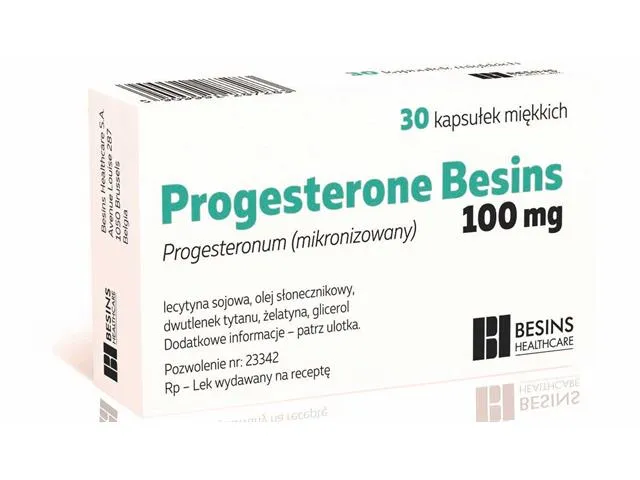
Table of Contents
Patient Information Leaflet
Warning! Keep this leaflet. The information on the immediate packaging is in a foreign language.
Progesterone Besins (Progestan), 100 mg, soft capsules
Progesteronum
Progesterone Besins and Progestan are different brand names of the same medicine.
Please read the entire leaflet carefully before using the medicine, as it contains
important information for the patient.
- Keep this leaflet for future reference.
- If you have any questions, consult your doctor, pharmacist, or nurse.
- This medicine has been prescribed for a specific individual. Do not share it with others. The medicine may harm another person, even if their symptoms are identical.
- If you experience any adverse reactions, including those not listed in this leaflet, inform your doctor, pharmacist, or nurse. See section 4.
Table of Contents
- What Progesterone Besins is and what it is used for
- Important information before taking Progesterone Besins
- How to take Progesterone Besins
- Possible side effects
- How to store Progesterone Besins
- Contents of the pack and other information
1. What Progesterone Besins is and what it is used for
What Progesterone Besins is
This medicine contains progesterone, a natural female sex hormone produced by the body. Its action is to regulate hormonal balance. This medicine provides progestagenic hormone therapy.
What it is used for
This medicine is used when the patient has disorders caused by a lack of progesterone in the body. Your doctor may recommend this medicine in the following situations:
a) Progesterone deficiency
Low levels of progesterone produced by the ovaries (in the luteal phase). In this case, this medicine may be used to treat irregular menstruation.
b) Complete cessation of menstruation (menopause)
As an add-on treatment in hormone replacement therapy (HRT) in postmenopausal women who still have their uterus.
2. Important information before using Progesterone Besins
When not to use Progesterone Besins:
-
if the patient is allergic to progesterone or any of the other ingredients of this medicine (listed in section 6),
-
if the patient has vaginal bleeding of unknown cause,
-
if the patient has severe liver function disorders,
-
if the patient has a liver tumour,
-
if the patient has or is suspected of having a tumour of the breast or genital organs,
-
if the patient has active venous thrombosis (blood clot in a vein), e.g. in the legs (deep vein thrombosis) or lungs (pulmonary embolism), or if the patient has had such blood clots in the past,
-
if the patient has bleeding into the brain,
-
if the patient has a rare inherited blood disorder called "porphyria".
-
When using Progesterone Besins during the menopausal period in combination with another hormonal treatment, the so-called "oestrogen", you should also check the patient information leaflet of that oestrogen medicine for conditions when it should not be used.
Warnings and precautions
Before starting to take Progesterone Besins, discuss this with your doctor.
- This medicine, when used as directed, has no contraceptive effect.
- Before starting hormone therapy during menopause (and subsequently at regular yearly intervals), consult your doctor, who will perform an examination of the breasts and pelvic organs.
- If treatment with Progesterone Besins is started too early in the cycle, especially before day 15, the cycle may be shortened or breakthrough bleeding may occur.
Tell your doctor if:
- the patient has had venous blood clots (venous thrombosis) in the past,
- the patient has uterine bleeding.
The patient should stop taking this medicine if:
- any visual disturbances occur (e.g. visual field defects, double vision, retinal vascular lesions),
- venous thrombosis (venous thromboembolic disease or thrombosis) occurs,
- severe headaches develop.
If the patient does not have a menstrual period during treatment, pregnancy should be ruled out.
During treatment, the endometrium (uterine lining) may become excessively thickened (endometrial hyperplasia), or existing hyperplasia may worsen.
If unexpected bleeding or spotting occurs during long-term treatment, at the end of treatment, or after treatment has ended and persists, consult your doctor.
Children
The safety and efficacy of Progesterone Besins in children have not been established.
Progesterone Besins and other medicines
Tell your doctor or pharmacist about all medicines the patient is currently taking or has recently taken, as well as any medicines she plans to take.
Some medicines may affect the action of Progesterone Besins:
- medicines called barbiturates, previously used for sleep disorders or anxiety,
- medicines used for epilepsy (phenytoin, carbamazepine),
- certain antibiotics (ampicillin, tetracyclines, rifampicin),
- phenylbutazone (an anti-inflammatory medicine),
- spironolactone (a diuretic),
- certain antifungal medicines (ketoconazole, griseofulvin).
Likewise, Progesterone Besins may affect the action of certain medicines used to treat diabetes.
Herbal products containing St. John's wort (Hypericum perforatum) may reduce the effectiveness of Progesterone Besins.
Taking Progesterone Besins with food and drink
This medicine should be taken independently of meals, preferably in the evening before bedtime.
Pregnancy, breastfeeding and fertility
If the patient is pregnant or breastfeeding, suspects she may be pregnant, or is planning to have a baby, she should consult her doctor or pharmacist before using this medicine.
Pregnancy
If the patient is pregnant, suspects she may be pregnant, or is planning to become pregnant, she should consult her doctor before using this medicine or any other medicine.
Breastfeeding
Women who are breastfeeding should not use this medicine.
Before starting to take this medicine, discuss this with your doctor or pharmacist.
Fertility
This medicine may be taken by women who have difficulty becoming pregnant. Therefore, this medicine has no harmful effect on fertility.
Before starting to take this medicine, discuss this with your doctor or pharmacist.
Driving and using machines
Do not drive or operate machinery if drowsiness or dizziness occurs.
Progesterone Besins contains soya lecithin
This medicine contains soya lecithin (soya oil). Do not use if hypersensitivity to peanuts or soya has been diagnosed.
3. How to use Progesterone Besins
This medicine should always be used exactly as directed by your doctor. If in doubt, consult your doctor or pharmacist.
Progesterone Besins is available in 100 mg and 200 mg doses.
Recommended dose for irregular menstrual bleeding
- This medicine should be taken for 10 days per cycle, usually from day 17 to day 26 inclusive.
- The usual dose is 200 to 300 mg of progesterone per day, administered in 1 or 2 divided doses, i.e. 200 mg in the evening before bedtime and 100 mg the next morning, if necessary.
Recommended dose for menopausal treatment
- In menopausal women who still have their uterus, estrogen therapy should not be used alone without additional treatment.
- Treatment should be supplemented with progesterone, administered as a single 200 mg dose before bedtime for at least 12 to 14 days per month (during the last 2 weeks of each treatment cycle).
- This should be followed by a break of approximately one week without hormone replacement therapy, during which withdrawal bleeding may occur.
How to take the capsules
Swallow the capsules with a small amount of water.
Do not take the capsules with food.
It is best to take this medicine in the evening before bedtime. The second dose should be taken the next morning.
If you take more Progesterone Besins than you should
Seek immediate advice from your doctor or pharmacist.
Symptoms of overdose may include dizziness, fatigue, intense feeling of well-being, or painful menstruation. In such cases, the dose may be reduced. Always consult your doctor beforehand.
If you forget to take Progesterone Besins
Take the missed dose as soon as you remember. However, if it is almost time for the next dose, skip the missed dose.
Do not take a double dose to make up for a forgotten dose.
Stopping Progesterone Besins
Your doctor will inform you how long you should continue taking this medicine. Do not stop treatment prematurely.
If you have any further questions about the use of this medicine, consult your doctor or pharmacist.
4. Possible adverse reactions
Like all medicines, this medicine may cause adverse reactions, although not everyone experiences them.
You must stop taking this medicine immediately if the patient experiences:
- stroke, blood clots or internal bleeding in the brain
- blood clots in the veins of the legs or pelvis
- sudden severe headache
- vision disturbances
- yellowing of the skin or whites of the eyes (jaundice)
The following adverse reactions are common (occur in no more than 1 in 10 women):
- headaches
- changes in the menstrual cycle or bleeding at times other than withdrawal bleeding. In such cases, the doctor may change the way the medicine is taken.
The following adverse reactions are uncommon (occur in no more than 1 in 100 women):
- breast changes, breasts may become tender
- feeling tired or dizziness
- nausea (vomiting), diarrhoea, constipation
- yellowing of the skin or whites of the eyes (jaundice)
- skin itching, acne
The following adverse reactions are rare (occur in no more than 1 in 1,000 women):
- allergic reactions
- nausea (feeling sick)
The following adverse reactions are very rare (occur in no more than 1 in 10,000 women):
- depression
- rash (which may be itchy)
- darkening or discolouration of the skin (so-called chloasma, pregnancy mask)
Additional adverse reactions reported with hormone replacement therapy containing estrogen and progestagen:
- benign or malignant estrogen-dependent tumors, e.g. endometrial cancer,
- venous thromboembolic events (venous thromboembolism) due to blood clots (thrombosis) in the deep veins of the legs or pelvis, as well as pulmonary embolism occur more frequently in women using hormone replacement therapy than in women who do not use it,
- heart attack (myocardial infarction) and stroke,
- gallbladder disorders,
- brownish skin discoloration (chloasma), various skin disorders with formation of blisters and nodules (erythema multiforme, nodular erythema, vasculitic purpura),
- possibly dementia.
If the treatment sequence is started too early in the cycle (especially before day 15 of the cycle)
The cycle may be shortened and bleeding may occur at times other than withdrawal bleeding.
Reporting of adverse reactions
If any adverse reactions occur, including any adverse reactions not listed in this leaflet, inform a doctor, pharmacist, or nurse. Adverse reactions can be reported directly to the Department of Monitoring Adverse Drug Reactions of the Office for Registration of Medicinal Products, Medical Devices and Biocidal Products, Al. Jerozolimskie 181C, 02-222 Warsaw, tel. +48 22 49 21 301, fax +48 22 49 21 309, website: https://smz.ezdrowie.gov.pl
Reporting adverse reactions helps to provide more information on the safety of the medicine.
5. How to store Progesterone Besins
Keep this medicine out of sight and reach of children.
Do not use this medicine after the expiry date stated on the packaging. The expiry date refers to the last day of the stated month.
Do not store above 30°C. Do not freeze. Store in the original packaging to protect from moisture.
Do not use this medicine if visible signs of deterioration are observed. Return the medicine to a pharmacist.
Medicines must not be disposed of via wastewater or household waste. Ask your pharmacist how to dispose of medicines no longer required. This will help protect the environment.
6. Contents of the pack and other information
What Progesterone Besins contains
- The active substance is progesterone. One capsule contains 100 mg of progesterone in a soft capsule.
- The other ingredients are: soya lecithin, sunflower oil, capsule shell: titanium dioxide (E 171), gelatin, glycerol, purified water.
What Progesterone Besins looks like and contents of the pack
- Progesterone Besins is available in packs containing 30 or 90 soft capsules for oral use, packed in blisters and cardboard boxes.
- Progesterone Besins is a round, slightly yellow soft capsule containing a white-tinged oily suspension.
For more detailed information, please contact the marketing authorisation holder or parallel importer.
Marketing authorisation holder in France, the country of export:
Besins Healthcare France
3, Rue du Bourg l’Abbé 75003 Paris, France
Manufacturer:
Besins Manufacturing Belgium
128 Groot-Bijgaardenstraat
1620 Drogenbos
Belgium
| Cyndea Pharma SL | |
| Emiliano Revilla Sanz Industrial Estate | |
| Avenida De Agredia 31 | |
| Olvega 42110 (Soria) | |
| Spain | |
| Needs Manufacturing España | |
| El Pitarco Parcel 4 Industrial Estate | |
| 50450 Muel (Zaragoza) | |
| Spain | |
Parallel importer:
Delfarma Sp. z o.o.
ul. Św. Teresy od Dzieciątka Jezus 111
91-222 Łódź
Repackaged in:
Delfarma Sp. z o.o.
ul. Św. Teresy od Dzieciątka Jezus 111
91-222 Łódź
Authorization numbers in France, country of export: 34009 362 088 4 1
34009 358 113 8 7
Parallel import authorization number: 217/25
This medicinal product is authorized for marketing in the European Economic Area countries under the following names:
| Belgium | Progestérone BESINS 100 mg, soft capsules |
| Estonia | Utrogestan 100 mg |
| Iceland | Utrogestan 100 mg, soft capsule |
| Lithuania | Utrogestan 100 mg |
| Latvia | Utrogestan 100 mg soft capsules |
| Luxembourg | Progestérone BESINS 100 mg, soft capsules |
| Netherlands | Progesteron Besins 100 mg soft capsules |
| Norway | Utrogestan 100 mg, soft capsule |
| Poland | Progesterone Besins, 100 mg, soft capsules |
| Germany | Utrogest 100 mg Weichkapseln |
| Sweden | Utrogestan 100 mg, soft capsule |