Priorix-tetra
Poland
Table of Contents
- Package leaflet: Information for the user
- 1. What Priorix-Tetra is and what it is used for
- 2. Important information before using Priorix-Tetra vaccine
- 3. How to administer Priorix-Tetra vaccine
- 4. Possible side effects
- 5. How to store Priorix-Tetra vaccine
- 6. Contents of the pack and other information
- Information intended exclusively for healthcare professionals:
Package leaflet: Information for the user
Priorix-Tetra, powder and solvent for solution for injection in a prefilled syringe
Vaccine against measles, mumps, rubella and varicella, live
Please read all of this leaflet carefully before the vaccine is administered, because it contains important information for you.
- Keep this leaflet. You may need to read it again.
- If you have any further questions, please ask your doctor or pharmacist.
- This medicine has been prescribed for a specific individual. Do not pass it on to others.
- If you experience any side effects, including any not listed in this leaflet, please tell your doctor or pharmacist. See section 4.
The text of this leaflet has been prepared with the assumption that it will be read by the person receiving the vaccine. However, since this vaccine may be administered to both adults and children, it is possible that a parent or guardian may be reading the information on behalf of a child.
Leaflet contents
- What Priorix-Tetra vaccine is and what it is used for
- What you need to know before receiving Priorix-Tetra
- How to use Priorix-Tetra
- Possible side effects
- How to store Priorix-Tetra
- Contents of the pack and other information
1. What Priorix-Tetra is and what it is used for
Priorix-Tetra is a vaccine given to individuals aged 11 months and older to help protect against diseases caused by the measles, mumps, rubella, and varicella (chickenpox) viruses. In certain circumstances, Priorix-Tetra may also be given to children after they have completed 9 months of life.
How Priorix-Tetra works
After administration of Priorix-Tetra, the immune system (the body’s defence system) of the vaccinated person will start producing antibodies that are intended to protect against infection with measles, mumps, rubella, and varicella viruses.
Although Priorix-Tetra contains live viruses, they have been weakened to such an extent that they cannot cause measles, mumps, rubella, or varicella in healthy individuals.
As with all vaccines, Priorix-Tetra may not fully protect all vaccinated individuals.
2. Important information before using Priorix-Tetra vaccine
When not to use Priorix-Tetra vaccine
- if the patient has a known allergy to any of the components of this vaccine (listed in section 6). Symptoms of an allergic reaction include itchy rash, difficulty breathing, swelling of the face or tongue,
- if the patient has previously experienced an allergic reaction after receiving any measles, mumps, rubella, and/or varicella vaccine,
- if the patient is allergic to neomycin (an antibiotic). Documented contact dermatitis caused by neomycin (skin rash occurring following direct skin contact with an allergen such as neomycin) should not be a problem, but you should first consult a doctor,
- if the patient has a severe infection with fever. In such a case, vaccination should be postponed until recovery. A mild infection, such as a cold, should not prevent vaccination, but you should inform the doctor first,
- if the patient has any illness (e.g. human immunodeficiency virus (HIV) infection or acquired immunodeficiency syndrome (AIDS)) or if the patient has recently taken or is still taking medications that may weaken the immune system (except for low-dose corticosteroids used to treat asthma or in replacement therapy). Whether the patient should receive the vaccine will depend on the level of immunity,
- if pregnancy has been confirmed. In addition, pregnancy should be avoided for 1 month after vaccination.
Warnings and precautions
Talk to your doctor or pharmacist before receiving Priorix-Tetra vaccine if:
- there is a personal or family history of seizures, including febrile seizures. In such cases, the patient should be closely observed after vaccination, as fever related to vaccination may occur, particularly between 5 and 12 days after vaccination (see section 4),
- the patient has ever had a severe allergic reaction to egg protein,
- the patient has experienced adverse effects after measles, mumps, or rubella vaccination involving easy bruising or prolonged bleeding (see section 4),
- if the patient has a weakened immune system (e.g. due to HIV infection) or is about to start taking a medication that weakens the immune system. Close monitoring is required, as the immune response to the vaccine may be insufficient to provide protection against disease (see section 2 "When not to use Priorix-Tetra vaccine").
If the patient is vaccinated within 72 hours of exposure to someone with measles or varicella, Priorix-Tetra may provide some protection against developing the disease.
After vaccination, the patient should avoid close contact for at least 6 weeks after vaccination with:
- individuals with reduced immunity to infections,
- pregnant women who have never had varicella or have not been vaccinated against varicella,
- newborn infants of mothers who have never had varicella or have not been vaccinated against varicella.
Fainting may occur after or even before any injectable vaccine (particularly in adolescents). Therefore, inform the doctor or nurse if the patient has ever fainted during an injection.
As with other vaccines, Priorix-Tetra may not fully protect all vaccinated individuals. However, in vaccinated individuals, the disease course is usually much milder than in unvaccinated individuals.
Priorix-Tetra and other medicines
Tell your doctor about all medicines currently taken or recently taken, medicines the patient plans to take, and any vaccines recently received.
Vaccination may be postponed by the doctor for at least 3 months if the patient recently received a blood transfusion or human antibodies (immunoglobulin).
If a tuberculin test (skin test for tuberculosis) is required, it should be performed before or simultaneously with vaccination, or at least 6 weeks after vaccination.
Avoid taking salicylates (substances contained in many antipyretic and analgesic medicines) for 6 weeks after vaccination.
Priorix-Tetra may be administered at the same time as other vaccines. Each vaccine should be administered at a different injection site.
Pregnancy and breastfeeding
Priorix-Tetra vaccine should not be given to pregnant women.
During pregnancy, breastfeeding, if there is suspicion of pregnancy, or if planning to become pregnant, consult a doctor or pharmacist before using this vaccine. It is also important that the patient does not become pregnant for 1 month after vaccination. During this time, an effective method of contraception should be used to prevent pregnancy.
Driving and using machines
There are no data suggesting that Priorix-Tetra vaccine affects the ability to drive or operate machinery.
Priorix-Tetra contains sorbitol, para-aminobenzoic acid, phenylalanine, sodium, and potassium
This vaccine contains 14 mg of sorbitol per dose.
Priorix-Tetra contains para-aminobenzoic acid. It may cause allergic reactions (including delayed-type reactions) and, very rarely, bronchospasm.
The vaccine contains 583 micrograms of phenylalanine per dose. Phenylalanine may be harmful to patients with phenylketonuria (PKU), a rare genetic disorder in which phenylalanine accumulates in the body because the body does not eliminate it properly.
This vaccine contains less than 1 mmol (23 mg) of sodium per dose, meaning the vaccine is considered "sodium-free".
This vaccine contains potassium, less than 1 mmol (39 mg) of potassium per dose, meaning the vaccine is considered "potassium-free".
3. How to administer Priorix-Tetra vaccine
Priorix-Tetra is administered subcutaneously or intramuscularly into the upper arm or the outer thigh.
Priorix-Tetra is intended for individuals aged 11 months and older.
The timing of vaccination and the number of doses the patient will receive will be determined by the physician based on officially applicable recommendations.
Under no circumstances should the vaccine be administered intravenously.
4. Possible side effects
As with any medicinal product, side effects may occur after administration of this
vaccine, although they do not occur in everyone.
The following side effects may occur after vaccination:
♦ Very common (may occur in more than 1 in 10 doses of the vaccine):
-
pain and redness at the injection site
-
fever of 38°C or higher*
-
swelling at the injection site when the vaccine is administered to adolescents
and adults
♦ Common (may occur in no more than 1 in 10 doses of the vaccine): -
swelling at the injection site when the vaccine is administered to children
-
fever higher than 39.5°C*
-
irritability
-
rash (spots and/or blisters)
♦ Uncommon (may occur in no more than 1 in 100 doses of the vaccine):
- unusual crying, restlessness, insomnia
- general malaise, lethargy, fatigue
- swelling of the salivary glands (parotid glands in the cheek area)
- diarrhoea, vomiting
- loss of appetite
- upper respiratory tract infection
- runny nose
- swelling of lymph nodes
♦ Rare (may occur in no more than 1 in 1,000 doses of the vaccine):
- middle ear infection
- febrile convulsions
- cough
- bronchitis
* Fever has been observed more frequently after administration of the first dose of Priorix-
Tetra vaccine compared to separate administration of measles, mumps, rubella and varicella
vaccines during the same visit.
Following routine administration of GlaxoSmithKline Biologicals measles, mumps, rubella or
varicella vaccines, several cases of the following adverse reactions have been reported:
- following vaccination with live attenuated measles, mumps, rubella and varicella vaccines, cases of infection or encephalitis (inflammation of the brain) have been observed. In several cases, this condition led to death, particularly in individuals with weakened immune systems (as stated in section 2, Priorix-Tetra vaccine must never be used in patients with immunodeficiency). If a vaccinated individual experiences loss or decreased level of consciousness, seizures, or loss of motor control accompanied by fever and headache, seek immediate medical attention, as these may be symptoms of infection or encephalitis. Inform the doctor or pharmacist that the patient has received Priorix-Tetra vaccine.
- infection or inflammation of the spinal cord and peripheral nerves causing transient difficulty walking (instability) or transient loss of motor control
- stroke
- inflammation of certain nerves, possibly presenting with tingling sensations, loss of sensation, or impaired mobility (Guillain-Barré syndrome)
- joint and muscle pain
- allergic reactions. These may manifest as itchy or blistering rash, eyelid and facial swelling, breathing or swallowing difficulties, sudden drop in blood pressure, and loss of consciousness. These reactions may occur even before leaving the doctor's office. If any of these symptoms occur, immediate medical attention is required
- narrowing or blockage of blood vessels
- small local bleeding or easier bruising than usual due to reduced platelet count
- erythema multiforme (symptoms include red, often itchy spots resembling varicella rash, appearing on limbs and sometimes on the face and other body parts)
- varicella-like rash
- herpes zoster (shingles)
- symptoms resembling measles and mumps (including transient, painful swelling of the testicles and swollen lymph nodes in the neck)
Reporting of side effects
If any adverse effects occur, including any not listed in this leaflet, inform a doctor or pharmacist. Adverse effects can be reported directly to the Department of Monitoring of Adverse Drug Reactions at the Office for Registration of Medicinal Products, Medical Devices and Biocidal Products:
Al. Jerozolimskie 181C
02-222 Warsaw
Phone: 22 49 21 301
Fax: 22 49 21 309
Website: https://smz.ezdrowie.gov.pl
Adverse effects can also be reported to the marketing authorisation holder.
Reporting of adverse effects helps to provide more information on the safety of the vaccine.
5. How to store Priorix-Tetra vaccine
Keep the vaccine out of the sight and reach of children.
Do not use this vaccine after the expiry date stated on the label after "EXP".
The expiry date refers to the last day of the stated month.
The abbreviation "Lot" indicates the vaccine batch number.
Store and transport in a refrigerated state (2°C - 8°C).
Do not freeze.
Store in the original packaging to protect from light.
After reconstitution, the vaccine should be administered immediately or stored
in a refrigerator (2°C - 8°C). If not used within 24 hours, it must be discarded.
Medicines must not be disposed of via the sewage system or household waste.
Ask a pharmacist how to dispose of medicines no longer required.
This helps protect the environment.
6. Contents of the pack and other information
What Priorix-Tetra vaccine contains
The active substances in the vaccine are: live, attenuated measles, mumps, rubella, and varicella viruses.
Other components of the vaccine are:
Powder: amino acids (including phenylalanine), anhydrous lactose, mannitol (E 421), sorbitol (E 420),
Medium 199 (including phenylalanine, para-aminobenzoic acid, sodium and potassium).
Solvent: water for injections.
What Priorix-Tetra vaccine looks like and contents of the pack
The vaccine is supplied as a powder and solvent for the preparation of an injectable solution (the powder is contained in a single-dose vial, the solvent in a pre-filled syringe with needle holder containing 0.5 ml), with separate needles or without needles, in the following pack sizes:
- with 2 separate needles: packs of 1 or 10,
- without needles: packs of 1 or 10.
Priorix-Tetra vaccine appears as a white to slightly pinkish powder, part of which may be yellowish, and a clear, colourless solvent (water for injections) used to reconstitute the powder.
Not all pack sizes may be marketed.
Marketing Authorisation Holder and Manufacturer
GlaxoSmithKline Biologicals S.A.
Rue de l’Institut 89
B-1330 Rixensart
Belgium
Other sources of information
Detailed information on this vaccine is available on the website of the Office for Registration of Medicinal Products, Medical Devices and Biocidal Products.
Information intended exclusively for healthcare professionals:
As with all injectable vaccines, appropriate medical treatment and supervision must always be available in case of rare anaphylactic reactions following vaccination.
Alcohol and other disinfectants should be allowed to evaporate completely from the skin before administering the vaccine, as they may inactivate the attenuated viruses present in the vaccine.
Priorix-Tetra vaccine must never under any circumstances be administered intravenously or intradermally.
Since compatibility studies have not been conducted, the medicinal product must not be mixed with other medicines.
The vaccine should be inspected visually after reconstitution. Due to slight changes in pH, the reconstituted vaccine may range in color from light peach to pinkish fuchsia. After reconstitution, semi-transparent particles of the product may be visible. This is a normal phenomenon and does not affect the vaccine's efficacy.
If the vaccine has a different color or contains foreign particulate matter, it must not be administered.
The vaccine should be reconstituted by adding the entire contents of the solvent from the prefilled syringe to the vial containing the powder.
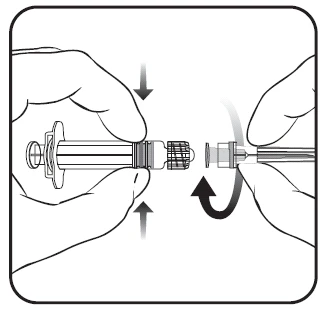
To attach the needle to the prefilled syringe, carefully follow the instructions shown in Figures 1 and 2. The prefilled syringe supplied with Priorix-Tetra may differ slightly from the one illustrated (it may lack a threaded connector for attaching the needle). In such a case, the needle should be secured without screwing.
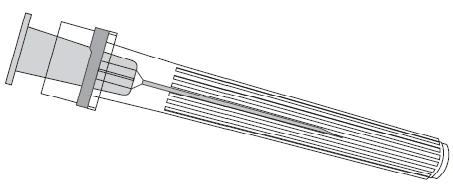
Needle
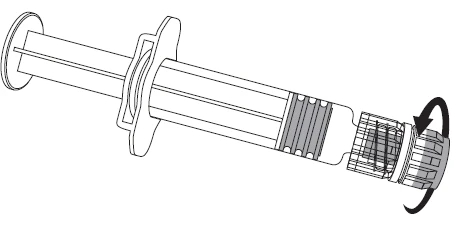
Prefilled syringe
Figure 2.
Figure 1.
Always hold the prefilled syringe by its barrel, not by the plunger or the Luer Lock Adaptor (LLA), and keep the needle aligned with the axis of the syringe (as shown in Figure 2). Failure to follow these instructions may cause misalignment of the LLA and leakage from the syringe.
If the LLA becomes detached during attachment of the needle, a new dose of vaccine (a new prefilled syringe and vial) must be used.
- Unscrew the cap of the prefilled syringe by turning it counterclockwise (as shown in Figure 1).
Regardless of whether the LLA rotates or not, proceed with the following instructions:
- Attach the needle to the prefilled syringe by gently connecting the needle hub to the LLA and turning it one-quarter turn clockwise until a click indicates secure locking (as shown in Figure 2).
- Remove the needle protective cap, which may require some force.
- Add the solvent to the powder. Then shake vigorously until the powder is completely dissolved.
- Withdraw the entire contents of the vial.
- A new needle must be used for administration. To do this, unscrew the current needle from the prefilled syringe and attach a new injection needle, following the procedure described in point 2.
After reconstitution, the vaccine should be administered immediately or stored refrigerated (2°C–8°C). If not used within 24 hours, it must be discarded.
Any unused medicinal product or waste material must be disposed of in accordance with local regulations.