Primene 10%
Poland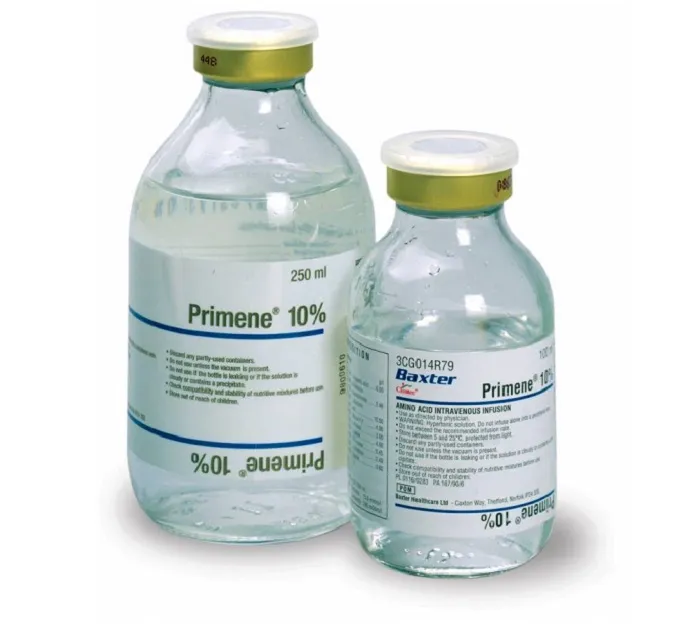
Table of Contents
Package leaflet: Information for the user
PRIMENE 10%, solution for infusion
Please read all of this leaflet carefully before using this medicine, because it contains
important information for the patient.
- Keep this leaflet, as you may need to read it again.
- If you have any further questions, ask your doctor or pharmacist.
- This medicine has been prescribed for a specific individual. Do not pass it on to others. This medicine may harm other people, even if their symptoms are the same.
- If you experience any adverse reactions, including any not listed in this leaflet, tell your doctor or pharmacist. See section 4.
Leaflet contents:
- What PRIMENE 10% is and what it is used for
- Important information before using PRIMENE 10%
- How to use PRIMENE 10%
- Possible side effects
- How to store PRIMENE 10%
- Contents of the pack and other information
1. What PRIMENE 10% is and what it is used for
PRIMENE 10% is a sterile solution containing 20 L-amino acids, quantitatively and qualitatively adapted to the protein requirements of infants:
- contains all essential and non-essential amino acids for infants;
- contains a relatively high amount of lysine;
- contains taurine;
- contains a relatively low amount of methionine;
- characterized by reduced content of phenylalanine and proline;
- essential amino acids constitute 47.5% of total amino acid content, and branched-chain amino acids 24%;
- clinical studies have shown that, with adequate energy supply, PRIMENE 10% supports satisfactory growth and weight gain, as well as satisfactory psychomotor development in infants;
- PRIMENE 10% does not contain electrolytes, to facilitate individualized treatment with electrolyte solutions.
Amino acids are building blocks which the body uses to produce proteins.
PRIMENE 10% may be part of nutritional mixtures containing carbohydrates, fats, electrolytes, trace elements, and vitamins, provided compatibility and stability with other components of the mixture are established.
PRIMENE 10% is indicated for use:
- in children, infants, and newborns (full-term or premature), with normal body weight or underweight, to provide nutrition (feeding) directly into the bloodstream (intravenously), when oral or enteral feeding is impossible, insufficient, or contraindicated. It is usually administered together with other solutions and nutritional components such as glucose, fats, minerals, and vitamins.
PRIMENE 10% must be used exclusively under specialized medical supervision.
2. Important information before using PRIMENE 10%
When not to use PRIMENE 10%
- if the patient is allergic (hypersensitive) to the active substances or to any of the other ingredients of this medicine (listed in section 6);
- in children with congenital disorders of metabolism of one or more amino acids.
If any of the above situations apply, PRIMENE 10% will not be administered.
Warnings and precautions
Before starting treatment with PRIMENE 10%, discuss this with the doctor or nurse.
When administering to newborns and children under 2 years of age, the solution (in the bottle and infusion set) must be protected from light until the end of the infusion. Exposure of PRIMENE 10% to light, particularly after addition of trace elements and (or) vitamins, may lead to the formation of peroxides and other degradation products, which can be minimized by protecting from light.
Allergic reactions
If any signs or symptoms of an allergic reaction occur (such as fever, sweating, trembling, headache, skin rash, or difficulty breathing), the infusion must be stopped immediately.
Formation of small particles in the lung blood vessels
Breathing difficulties may also indicate the formation of small particles blocking blood vessels in the lungs (pulmonary vascular precipitates). If breathing difficulties occur, inform the doctor or nurse. They will decide on the necessary actions.
Infection and sepsis
Certain medications and diseases may increase the risk of developing infection or sepsis (presence of bacteria in the blood). The risk of infection or sepsis is particularly increased after insertion of a tube (intravenous catheter) into the patient's vein. The doctor will closely monitor the patient for signs of infection.
Changes in blood chemistry
The doctor will check and monitor the patient's fluids, biochemical parameters, and other blood concentrations. Additional fluid accumulation in tissues and swelling (edema) may also occur. Parenteral nutrition should be initiated slowly and cautiously.
Hypertonic solution (high concentration of dissolved amino acids)
PRIMENE 10% is a solution containing a high concentration of dissolved amino acids. It may be administered into a vein in the arm or into a large vein in the chest. If given into a smaller vein in the arm, it may cause vein irritation. Speak with the doctor or nurse if the patient experiences discomfort at or around the injection site.
Monitoring and adjustment
The doctor will monitor the patient's condition at the beginning and during the infusion. Ensure the doctor is informed about any serious conditions affecting the body's ability to handle sugars, fats, proteins, and salt (metabolic disorders).
If any unusual symptoms occur, such as sweating, chills, bruising, or irregular heartbeat, the infusion should be stopped and the doctor or nurse informed immediately.
During administration, the doctor will regularly monitor the patient's blood parameters to assess effectiveness and ongoing safety of the treatment, especially if the patient has liver, kidney, adrenal, heart, or circulatory problems.
When to exercise particular caution when using PRIMENE 10%
- if there are serious restrictions on the amount of water administered, for example in cases of circulatory, respiratory, or kidney function disorders, PRIMENE 10% must be used with great caution;
- in cases of kidney failure, the amount of nitrogen administered must be adjusted according to the child's renal clearance;
- in cases of liver failure, monitoring of blood ammonia levels is recommended. Close monitoring of the infusion course, biochemical parameters, and the child's clinical condition (including monitoring of basic acid-base balance) is required.
PRIMENE 10% and other medicines
Inform the doctor about all medicines currently or recently taken by the patient, as well as any medicines the patient plans to take.
Interactions with other medicines are not known.
PRIMENE 10% may be part of nutritional mixtures containing sugars, fats, electrolytes, trace elements, and vitamins, provided the compatibility and stability of PRIMENE 10% with other mixture components are established.
Pregnancy and breastfeeding
PRIMENE 10% is indicated for use in children, infants, and newborns; therefore, there is no data on the use of PRIMENE 10% in pregnant or breastfeeding women. If the patient is pregnant or breastfeeding, suspects she may be pregnant, or is planning to have a child, she should consult her doctor before using this medicine.
Driving and operating machinery
PRIMENE 10% is indicated for use in children, infants, and newborns; therefore, there is no data on the effect of PRIMENE 10% on the ability to drive motor vehicles or operate mechanical equipment in motion.
3. How to use PRIMENE 10%
PRIMENE 10% may be administered to children, infants, and newborns (full-term or premature).
It is an infusion solution given through a plastic tube into a vein in the arm or into a large vein in the chest.
Dosage and duration of treatment
The physician will decide on the dose and how long the treatment will last. This depends on the patient's age, body weight, clinical condition, protein requirements, and the patient's ability to metabolize and utilize the components of PRIMENE 10%. Additional nutrition or protein may also be administered orally/intestinally.
Method of administration
When administering to newborns and children under 2 years of age, the solution (in the bottle and infusion set) must be protected from light until administration is complete (see section 2).
Dosage
Depending on body weight, age, and protein catabolism in the child:
1.5 to 3.5 g of amino acids / kg body weight / 24 hours, i.e., 0.23 to 0.53 g nitrogen / kg body weight / 24 hours or
15 to 35 ml of PRIMENE 10% / kg body weight / 24 hours.
The infusion rate should not exceed 0.05 ml/kg body weight/minute.
Routes of administration
- PRIMENE 10% alone should be administered via a central or peripheral vein;
- PRIMENE 10% used concurrently with other solutions or as part of a mixture should be administered, depending on the final osmolarity of the infused solution, via peripheral veins or one of the central veins.
Infusion rate and duration
Recommended infusion rates:
- Newborns and infants: continuous infusion (over 24 hours);
- Children: continuous infusion (over 24 hours) or cyclic infusion (over 8 to 12 hours per day).
The infusion rate should take into account the administered dose, characteristics of the infused solution, daily volume administered, and duration of infusion.
PRIMENE 10% is generally administered together with energy-providing substances matching the child's needs, either concurrently or as a component of nutritional mixtures.
PRIMENE 10% may be included as a component of nutritional mixtures containing sugars, fats, electrolytes, trace elements, and vitamins, provided their compatibility and stability have been previously verified.
Overdose of PRIMENE 10%
Symptoms
If an excessive dose of the medicinal product is administered or the infusion is too rapid, the patient may develop increased circulating blood volume, increased blood acidity, or elevated blood and urinary nitrogen levels. Clinical symptoms may include nausea, vomiting, tremor, confusion, and rapid heartbeat. In such cases, the infusion must be immediately stopped.
The physician will decide whether further interventions are necessary.
To prevent these events, the physician will regularly monitor the patient's condition and perform blood tests during treatment.
4. Possible adverse reactions
Like all medicines, this medicinal product may cause adverse reactions, although not everybody will experience them.
If you notice any changes in how you feel during or after treatment, you should immediately inform your doctor or nurse. Medical examinations performed during therapy should minimize the risk of adverse reactions.
If any unusual signs or symptoms of an allergic reaction occur, such as abnormally low or high blood pressure, development of blue or violet skin discoloration, facial or eyelid swelling, abnormally rapid heartbeat, difficulty breathing, vomiting, nausea, skin rash, elevated body temperature, excessive sweating, chills or tremor, the infusion must be stopped immediately.
The following adverse reactions have been reported during the use of similar products:
- elevated blood levels of ammonia and nitrogen-containing compounds;
- anaphylactic reactions, severe allergic shock (a rapidly progressing reaction which, if untreated, may be life-threatening);
- liver function disorders, abnormal blood test results for parameters indicating liver function;
- inflammation of the gallbladder, presence of gallstones in the gallbladder;
- increased blood acidity;
- formation of small particles blocking blood vessels in the lungs;
- phlebitis at the infusion site, vein irritation, pain, warmth, swelling and induration;
- in case of leakage of the infusion fluid into surrounding tissues, severe local reactions may occur: skin tissue necrosis, blistering, swelling, scarring, and skin discoloration.
Any changes in your condition during or after administration must be reported to your doctor or nurse immediately.
- in case of administration of an excessive amount of solution, in children with renal insufficiency, metabolic acidosis and increased blood urea nitrogen concentration may occur;
- amino acid solutions may accelerate the development of folic acid deficiency, which should be supplemented;
- intravenous injection into superficial veins may cause thrombophlebitis.
Reporting of adverse reactions
If any adverse reactions occur, including those not listed in this leaflet, you should inform your doctor or nurse. Adverse reactions can be reported directly to the Department of Monitoring Adverse Drug Reactions of the Office for Registration of Medicinal Products, Medical Devices and Biocidal Products
Al. Jerozolimskie 181C
PL 02-222 Warsaw
Tel.: + 48 22 49 21 301
Fax: + 48 22 49 21 309
e-mail: [email protected]
Adverse reactions can also be reported to the Marketing Authorisation Holder.
Reporting adverse reactions enables the collection of additional information on the safety of the medicinal product.
5. How to store PRIMENE 10% medication
Keep the medicine out of the sight and reach of children.
When used in newborns and children under 2 years of age, the solution (in the bottle and infusion set) must be protected from light until administration is completed (see section 2).
Do not use this medicine after the expiry date stated on the label and outer packaging.
The expiry date refers to the last day of the stated month.
Store below 25°C. Keep in the original packaging to protect from light.
Do not use if the bottle leaks, or if the solution is cloudy or contains a precipitate.
Any partially used containers must be discarded.
Medicines must not be disposed of via wastewater or household waste. Ask your pharmacist how to dispose of medicines no longer required. Such measures help protect the environment.
6. Contents of the packaging and other information
What the medicine PRIMENE 10% contains
Active substances of the medicine:
100 ml of infusion solution contains:
L-Isoleucine 0.670 g
L-Leucine 1.000 g
L-Valine 0.760 g
L-Lysine 1.100 g
L-Methionine 0.240 g
L-Phenylalanine 0.420 g
L-Threonine 0.370 g
L-Tryptophan 0.200 g
L-Arginine 0.840 g
L-Histidine 0.380 g
L-Alanine 0.800 g
L-Aspartic acid 0.600 g
L-Cysteine 0.189 g
L-Glutamic acid 1.000 g
Glycine 0.400 g
L-Proline 0.300 g
L-Serine 0.400 g
L-Tyrosine 0.045 g
L-Ornithine hydrochloride 0.318 g
Taurine 0.060 g
Total nitrogen: 15 g/l
Amino acids: 100 g/l
Chloride: 19 mmol/l
Other components of the medicine are: L-malic acid, water for injections
Osmolarity: 780 mOsm/l
What PRIMENE 10% looks like and contents of the pack
PRIMENE 10% is a clear, colourless or slightly yellow solution of amino acids, free from electrolytes.
Pack sizes:
Glass bottles: 100 ml, 250 ml, 500 ml and 1000 ml.
Marketing Authorisation Holder and Manufacturer
Marketing Authorisation Holder:
Baxter Polska Sp. z o.o.
ul. Kruczkowskiego 8
00-380 Warsaw
Poland
Manufacturer:
Bieffe Medital S.p.a
Via Nuova Provinciale
I-23034 Grosotto
Italy
For further information, contact the representative of the Marketing Authorisation Holder:
Baxter Polska Sp. z o.o.
ul. Kruczkowskiego 8
00-380 Warsaw
Poland
Tel.: 22 488 37 77
Baxter and Primene are registered trademarks of Baxter International Inc.