Polyvaccinum mite non-specific bacterial vaccine
Poland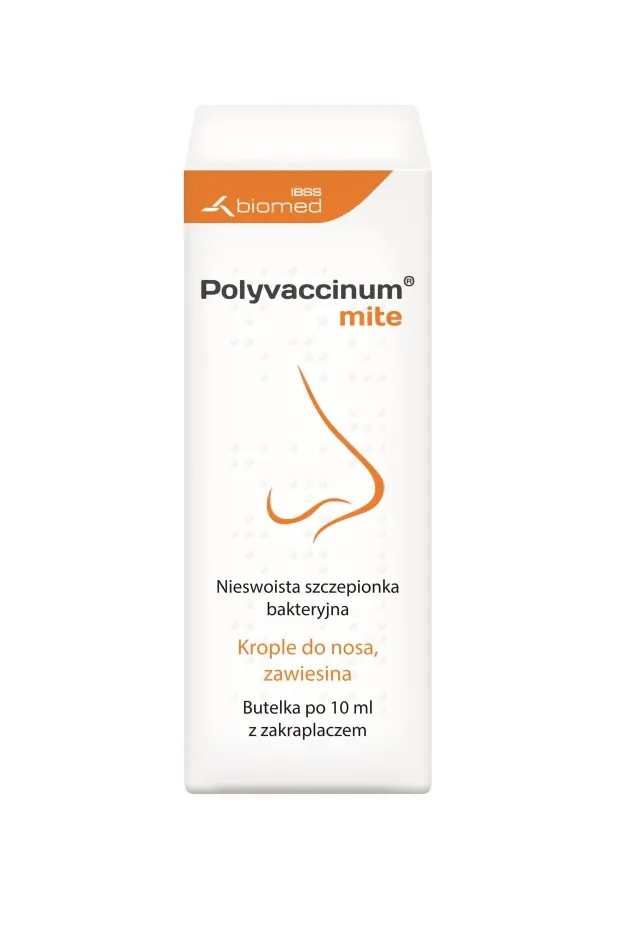
Table of Contents
- Package leaflet: Information for the patient
- 1. What Polyvaccinum mite vaccine is and what it is used for
- 2. Important information before using Polyvaccinum mite vaccine
- 3. How to use Polyvaccinum mite vaccine
- 4. Possible adverse reactions
- 5. How to store Polyvaccinum mite Nieswoista szczepionka bakteryjna
- 6. Contents of the pack and other information
Package leaflet: Information for the patient
Polyvaccinum mite, nasal drops, suspension
Non-specific bacterial vaccine
Inactivated bacteria: Staphylococcus aureus 50 million cells, Staphylococcus epidermidis 50 million cells, Streptococcus salivarius 10 million cells, Streptococcus pneumoniae 10 million cells, Streptococcus pyogenes 10 million cells, Escherichia coli 20 million cells, Klebsiella pneumoniae 10 million cells, Haemophilus influenzae 10 million cells, Corynebacterium pseudodiphtheriticum 20 million cells, Moraxella catarrhalis 10 million cells / 1 ml
Please read the entire leaflet carefully before using the vaccine, as it contains important information for the patient.
- Keep this leaflet for future reference.
- If you have any questions, consult your doctor or pharmacist.
- This vaccine has been prescribed for a specific individual. Do not share it with others. The vaccine may harm another person, even if their symptoms are the same.
- If any adverse reactions occur in the patient, including any adverse reactions not listed in this leaflet, inform your doctor or pharmacist. See section 4.
Table of contents
- What Polyvaccinum mite vaccine is and what it is used for
- Important information before using Polyvaccinum mite vaccine
- How to use Polyvaccinum mite vaccine
- Possible adverse reactions
- How to store Polyvaccinum mite vaccine
- Contents of the pack and other information
1. What Polyvaccinum mite vaccine is and what it is used for
Polyvaccinum mite in the form of nasal drops is a bacterial vaccine used prophylactically in recurrent infections of the upper respiratory tract in children from the age of 6 months, adolescents, and adults. The vaccine stimulates the immune system, as it contains inactivated bacteria that most commonly cause infections or are associated with inflammatory conditions of the upper respiratory tract.
The dosing schedule is provided in section 3.
2. Important information before using Polyvaccinum mite vaccine
When not to use Polyvaccinum mite vaccine:
- if the patient is allergic to the active substances or to any of the other ingredients of this medicine (listed in section 6),
- if the patient has any of the following conditions:
- infectious disease,
- circulatory failure,
- kidney or liver disease,
- proliferative disease of the hematopoietic system (hematopoietic system neoplasm),
- systemic disease (disease affecting several types of tissues and organs or involving the entire body),
- if the patient is taking immunosuppressive drugs (drugs that suppress the body's immune response).
Do not start vaccination if the patient is experiencing an acute illness.
Warnings and precautions
Vaccination should be preceded by a medical examination and a review of the patient's general health status and previously administered and documented vaccinations. Such procedures allow prediction of the risk of adverse reactions and possible adjustment of the dosing schedule.
Special caution is required if adverse reactions described in section 4 or any other concerning reactions occurred after a previous dose of Polyvaccinum mite vaccine.
The vaccine may be used during an infection if vaccination was initiated before the onset of infection.
The use of Polyvaccinum mite vaccine for the prevention of pneumonia is not recommended, as there are no clinical data confirming such an effect.
Polyvaccinum mite vaccine and other medicines
In patients undergoing immunosuppressive treatment (suppressing the immune system activity), the response to vaccination may be reduced. In such cases, the physician may decide to postpone vaccination until the end of therapy.
The vaccine may be administered during antibiotic therapy if the physician considers antibiotic administration necessary.
Inform the physician about all medicines currently or recently taken by the patient, as well as any medicines the patient plans to take.
Pregnancy and breastfeeding
There are no data on the use of the vaccine during pregnancy and breastfeeding.
If the patient is pregnant or breastfeeding, suspects she may be pregnant, or is planning to have a child, she should consult a physician before using this medicine.
Driving and operating machinery
The Polyvaccinum mite vaccine has no effect or has a negligible effect on the ability to drive and operate machinery.
Polyvaccinum mite vaccine contains 0.15 mg of benzalkonium chloride per 1 ml.
Benzalkonium chloride may cause irritation or swelling inside the nose, especially if used for a prolonged period.
3. How to use Polyvaccinum mite vaccine
Administer the vaccine intranasally, measuring the appropriate number of drops with the dropper.
Note: Before first use, gently shake the bottle and then, after removing the cap, press the dropper several times until the first drop appears (dropper activation). To ensure a consistent dose, the first 10 drops should be discarded. The dropper does not require reactivation before subsequent uses.
Instructions for use:
- Clean the nose.
- Gently shake the bottle to obtain a homogeneous suspension.
- Remove the protective cap from the dropper.
- Tilt the head backward.
- Administer the drops into the nasal cavity according to the dosing schedule presented in the table below.
- After use, wipe the dropper tip, then replace the protective cap.
The medicinal package should be used by only one patient.
Before administration, check the vaccine's expiry date on the packaging.
Do not use the vaccine after the expiry date has passed.
The treatment should be carried out twice a year, with a 6-month interval, for at least 2 years.
Administer the vaccine daily for 6 weeks.
If an upper respiratory tract infection occurs during vaccine administration, continue administration without increasing the dose.
The product does not replace anti-inflammatory treatment.
Do not initiate administration if the patient is experiencing an acute illness.
Dosage
Unless otherwise directed by a physician, follow the full vaccination cycle according to the dosing schedule presented in the table.
| Age group | Number of drops administered once | Daily amount of drops | Duration of administration (in weeks) | |||
| Morning | Evening | |||||
| Nasal cavity | Nasal cavity | |||||
| Right | Left | Right | Left | |||
| Children from 6 months to 3 years |
|
|
| 1 1 1 | 1 2 4 | Week I Weeks II and III Weeks IV, V, VI |
| Children from 3 years to 7 years |
|
| 1 1 2 | 1 1 2 | 2 4 6 | Week I Weeks II and III Weeks IV, V, VI |
| Children over 7 years, adolescents and adults | 1 1 2 | 1 1 2 | 1 2 2 | 1 2 2 | 4 6 8 | Weeks I and II Weeks III and IV Weeks V and VI |
The dosage depends on the patient's response. In patients who have been found to be hypersensitive (allergic) to the bacterial antigens contained in the vaccine, the physician may extend the period of lower dose administration.
Optimal prevention against recurrent upper respiratory tract infections is achieved after completing the full vaccination cycle according to the recommended dosing schedule.
Administration of a higher than recommended dose of Polyvaccinum mite bacterial vaccine
If the physician does not advise otherwise, continue dosing according to the recommended schedule.
Missed dose of Polyvaccinum mite bacterial vaccine
In case of doubt, consult your physician or pharmacist.
Discontinuation of Polyvaccinum mite bacterial vaccine
If you have any further questions regarding the use of this vaccine, consult your physician or pharmacist.
4. Possible adverse reactions
Like any vaccine, this vaccine may cause adverse reactions, although not everyone experiences them.
Frequency unknown (frequency cannot be determined from available data):
- Local reaction: irritation of the nasal mucosa – burning or itching sensation.
Reporting of adverse reactions
If any adverse reactions occur, including any adverse reactions not listed in this leaflet, inform a doctor, pharmacist, or nurse. Adverse reactions can be reported directly to the Department of Monitoring Adverse Drug Reactions at the Office for Registration of Medicinal Products, Medical Devices and Biocidal Products, Al. Jerozolimskie 181C, 02-222 Warsaw, phone: +48 22 49 21 301, fax: +48 22 49 21 309, website: https://smz.ezdrowie.gov.pl. Adverse reactions can also be reported to the marketing authorization holder. Reporting adverse reactions helps to provide more information on the safety of the vaccine.
5. How to store Polyvaccinum mite Nieswoista szczepionka bakteryjna
Store in a refrigerator (2°C - 8°C). After first opening, the vaccine may be stored at room temperature up to 25°C for a maximum of 6 weeks. After this period, the vaccine must be discarded.
The vaccine should be stored out of sight and reach of children.
Do not use the vaccine after the expiry date stated on the packaging.
The expiry date refers to the last day of the stated month.
Medicines must not be disposed of via wastewater or household waste. Ask your pharmacist how to dispose of medicines no longer in use. This will help protect the environment.
6. Contents of the pack and other information
What Polyvaccinum mite vaccine contains
The active substances of the vaccine are inactivated (killed) bacteria:
Staphylococcus aureus, Staphylococcus epidermidis – 50 million cells/1 ml each
Escherichia coli, Corynebacterium pseudodiphtheriticum – 20 million cells/1 ml each
Streptococcus salivarius, Streptococcus pneumoniae, Streptococcus pyogenes, Klebsiella pneumoniae, Haemophilus influenzae, Moraxella catarrhalis – 10 million cells/1 ml each
Other components are: benzalkonium chloride, sodium chloride, disodium phosphate dodecahydrate, sodium dihydrogen phosphate dihydrate, and water for injections.
What Polyvaccinum mite vaccine looks like and contents of the pack
The vaccine is an opalescent, colourless suspension.
Pack: one vial containing 10 ml of suspension with a dropper.
Marketing Authorisation Holder and Manufacturer
Institute of Biotechnology, Sera and Vaccines BIOMED Joint Stock Company
Al. Sosnowa 8
30-224 Kraków
Tel.: +48 12 37 69 200
Fax: +48 12 37 69 205
e-mail: [email protected]