Polvertic
Poland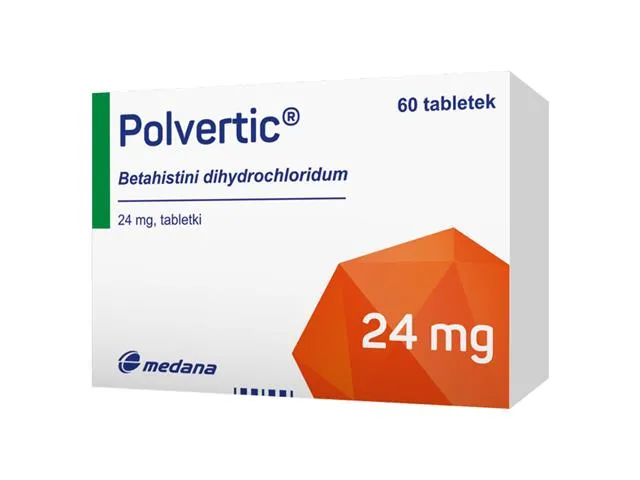
Table of Contents
Patient Information Leaflet
Polvertic, 24 mg, tablets
Betahistini dihydrochloridum
Read the entire leaflet before using this medicine, as it contains important information for the patient.
- Keep this leaflet for future reference.
- If you have any questions, consult your doctor or pharmacist.
- This medicine has been prescribed for a specific individual. Do not pass it on to others. The medicine may harm someone else, even if their symptoms are similar.
- If you experience any adverse reactions, including those not listed in this leaflet, inform your doctor or pharmacist. See section 4.
Table of Contents
- What Polvertic is and what it is used for
- Important information before taking Polvertic
- How to take Polvertic
- Possible side effects
- How to store Polvertic
- Contents of the pack and other information
1. What Polvertic is and what it is used for
Polvertic contains betahistine, which improves blood flow in the inner ear.
Polvertic is used for:
- treatment of Ménière's disease characterized by the following symptoms:
- vertigo (with nausea, vomiting)
- progressive hearing loss
- tinnitus
- symptomatic treatment of vestibular-origin vertigo.
2. Important information before taking Polvertic
When not to take Polvertic
- if the patient is allergic to betahistine or any of the other ingredients of this medicine (listed in section 6);
- if the patient has a chromaffin tumour of the adrenal gland (pheochromocytoma) – a rare tumour of the adrenal glands.
Warnings and precautions
Exercise particular caution when taking Polvertic:
- if the patient has gastric ulcer disease (peptic ulcer) or has previously suffered from gastric ulcer disease;
- if the patient has asthma;
- if the patient has urticaria, other types of skin rash, or allergic rhinitis, as betahistine may worsen these conditions;
- if the patient has low blood pressure.
If the patient has any of the above conditions, they should consult a doctor before taking betahistine.
Patients with the above conditions should remain under medical supervision during treatment.
Polvertic with other medicines
The term "interaction" means that drugs or other substances may alter each other's effects or increase the risk of adverse reactions when taken simultaneously.
To date, no interactions between betahistine and other drugs have been observed.
Betahistine may affect the action of antihistamines. Antihistamines are mainly used in the treatment of allergies, such as hay fever and motion sickness. If antihistamines are being used, the patient should consult a doctor or pharmacist before taking betahistine.
Inform your doctor or pharmacist about all medicines the patient is currently taking or has recently taken, as well as any medicines the patient plans to take.
Pregnancy and breastfeeding
It is unknown whether the use of betahistine during pregnancy is safe.
Avoid using this medicine during breastfeeding, as betahistine passes into breast milk.
If the patient is pregnant or breastfeeding, suspects she may be pregnant, or is planning to have a child, she should consult a doctor before using this medicine.
Driving and operating machinery
Betahistine has no effect or has a negligible effect on the ability to drive and operate machinery.
Polvertic contains lactose
One tablet contains 210 mg of monohydrate lactose.
If the patient has previously been diagnosed with intolerance to certain sugars, the patient should consult a doctor before taking this medicine.
3. How to use Polvertic
This medicine should always be taken as directed by a physician or pharmacist. If in doubt,
consult a physician or pharmacist.
The usual recommended dose is:
Adults
Half or one tablet twice daily.
It may take several weeks before improvement is observed.
Use in children and adolescents
Polvertic is not recommended for use in children and adolescents under 18 years of age.
Use in elderly patients
No dose adjustment is necessary in elderly patients.
Use in patients with renal and/or hepatic impairment
No dose adjustment is necessary in patients with renal and/or hepatic impairment.
How to take Polvertic
Tablets should preferably be taken with food.
Taking more Polvertic than recommended
If more medicine has been taken than recommended, medical advice should be sought immediately.
Symptoms of betahistine overdose include: nausea, vomiting, gastrointestinal disturbances,
coordination disorders, and – at higher doses – seizures.
Missed dose of Polvertic
Wait and take the next dose at the scheduled time. Do not take a double dose to make up for
a missed dose.
If you have any further questions regarding the use of this medicine, consult your physician
or pharmacist.
4. Possible adverse reactions
Like all medicines, this medicine can cause adverse reactions, although not everybody will experience them.
During treatment with betahistine, the following serious adverse reactions may occur:
- Allergic reactions, such as:
- swelling of the face, lips, tongue or neck, which may cause difficulty in breathing;
- red skin rash, skin inflammation with itching. If an allergic (hypersensitivity) reaction has occurred after taking this medicine, it should be discontinued immediately and medical advice should be sought.
Common adverse reactions (occur in less than 1 in 10 patients):
- Nausea and gastrointestinal disturbances.
Other adverse reactions:
- Headache, itching, rash, urticaria;
- Mild gastrointestinal disorders such as vomiting, stomach and intestinal pain, bloating, flatulence. These adverse reactions may resolve if the medicine is taken during a meal or after dose reduction.
Reporting of adverse reactions
If any adverse reactions occur, including any adverse reactions not listed
in this leaflet, inform your doctor or pharmacist. Adverse reactions can be reported
directly to the Department of Monitoring Adverse Drug Reactions of the Office for Registration of Medicinal Products, Medical Devices and Biocidal Products
Al. Jerozolimskie 181C
02-222 Warsaw
Tel.: + 48 22 49 21 301
Fax: + 48 22 49 21 309
Website: https://smz.ezdrowie.gov.pl
Adverse reactions can also be reported to the marketing authorization holder.
Reporting adverse reactions helps to provide more information on the safe use of the medicine.
5. How to store Polvertic
Store below 25 °C in the original packaging.
Keep the medicine out of sight and reach of children.
Do not use this medicine after the expiry date stated on the carton and blister pack following: EXP. The expiry date refers to the last day of the stated month.
The marking on the packaging following the abbreviation EXP indicates the expiry date, and following the abbreviation Lot/LOT indicates the batch number.
Medicines must not be disposed of via wastewater or household waste. Ask your pharmacist how to dispose of medicines no longer in use. This will help protect the environment.
6. Contents of the package and other information
What Polvertic contains
- The active substance is betahistine dihydrochloride. One tablet contains 24 mg of betahistine dihydrochloride.
- Other ingredients are: povidone K90, microcrystalline cellulose, lactose monohydrate, colloidal anhydrous silica, crospovidone (type A) and stearic acid.
What Polvertic looks like and contents of the pack
White or almost white, round, biconvex tablet with a score line on one side. The tablet can be divided into equal doses.
Carton pack containing 20, 30, 40, 50, 60, 100 or 120 tablets in blisters.
Not all pack sizes may be marketed.
Marketing Authorisation Holder and Manufacturer
Marketing Authorisation Holder
Zakłady Farmaceutyczne POLPHARMA S.A.
ul. Pelplińska 19, 83-200 Starogard Gdański
tel. + 48 22 364 61 01
Manufacturer
Catalent Germany Schorndorf GmbH
Steinbeisstrasse 1 und 2
Baden-Wuerttemberg
73614 Schorndorf
Germany
Zakłady Farmaceutyczne POLPHARMA S.A.
Medana Plant in Sieradz
ul. Władysława Łokietka 10, 98-200 Sieradz
Zakłady Farmaceutyczne POLPHARMA S.A.
Production Plant in Nowa Dęba
ul. Metalowca 2, 39-460 Nowa Dęba