Poltechdmsa
Poland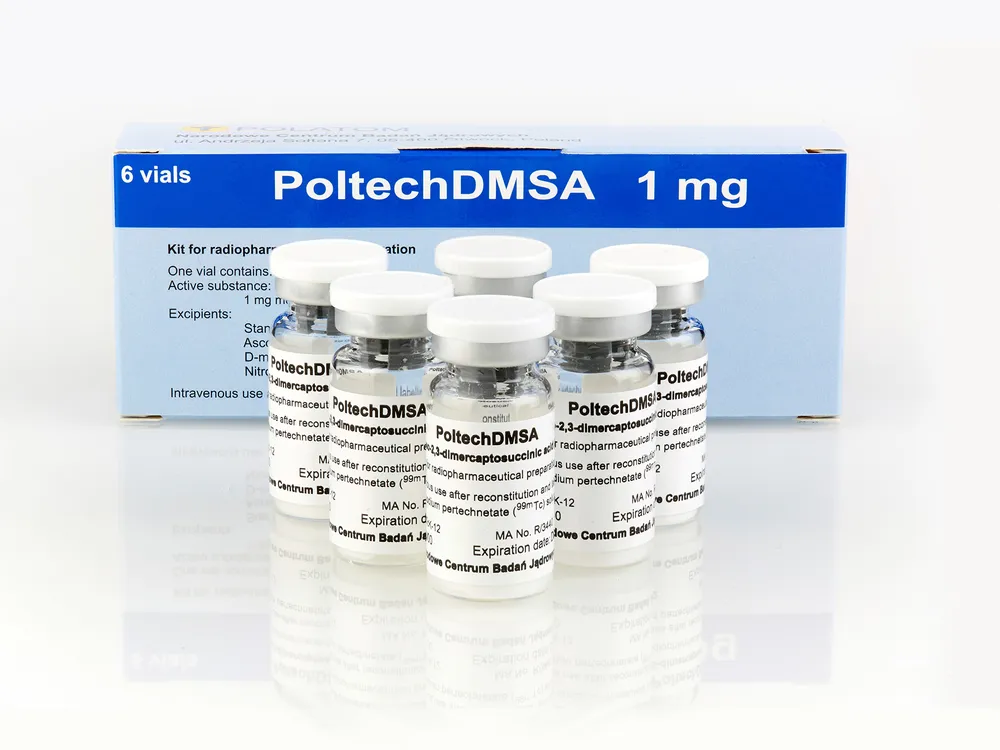
Table of Contents
Package leaflet: Information for the user
PoltechDMSA, 1 mg, kit for the preparation of a radiopharmaceutical preparation
meso-2,3-dimercaptosuccinic acid (DMSA)
Please read carefully all the information in this leaflet before the medicine is used, as it contains
important information for the patient.
- Keep this leaflet, so that you can read it again if necessary.
- If you have any doubts, please consult your treating physician or the nuclear medicine specialist supervising the examination.
- If the patient experiences any adverse reactions, including any not listed in this leaflet, inform the nuclear medicine specialist. See section 4.
Table of contents
- What PoltechDMSA kit is and what it is used for
- Important information before using PoltechDMSA kit
- How to use PoltechDMSA kit
- Possible side effects
- How to store PoltechDMSA kit
- Contents of the pack and other information
1. What PoltechDMSA kit is and what it is used for
PoltechDMSA is a radiopharmaceutical preparation intended solely for diagnostic use.
The radiopharmaceutical (radiopharmaceutical agent) PoltechDMSA, after radiolabelling (i.e. binding)
with radioactive technetium isotope ( Tc), is used in imaging diagnostics (scintigraphy) of the kidneys, particularly:
static kidney imaging, kidney localization, determination of functional kidney mass, morphological assessment of renal cortex, evaluation of individual kidney function.
Due to its binding with the radioactive isotope of technetium ( Tc), the use of PoltechDMSA
involves exposure to a small dose of radiation. Your treating physician and the nuclear medicine specialist
have determined that the benefits derived from the examination outweigh the potential risks associated with ionizing radiation.
2. Important information before using the PoltechDMSA kit
When not to use the PoltechDMSA kit
PoltechDMSA must not be administered if the patient is allergic to the active substance or to any of the other ingredients of this medicine (listed in section 6).
Warnings and precautions
Inform the nuclear medicine specialist physician in the following cases:
- if the patient has impaired kidney function,
- if the woman is pregnant or suspects she might be pregnant,
- if the woman is breastfeeding.
Administration of radiopharmaceuticals poses a risk of external ionizing radiation exposure or contamination due to urine spills, etc., to other individuals. Therefore, basic personal hygiene rules should be observed, and urine residues, etc., should be cleaned up for the time period recommended by the physician.
Special care must be taken when handling radiopharmaceuticals to avoid unnecessary exposure of personnel and patients.
Before administration of PoltechDMSA:
Drink plenty of water and ensure adequate hydration before the examination begins, in order to urinate as frequently as possible during the first hours after the procedure.
Children and adolescents
Inform the nuclear medicine specialist physician if the patient is under 18 years of age.
PoltechDMSA and other medicines
Inform your treating physician or the nuclear medicine specialist supervising the examination about all medicines currently taken or recently taken, including those available without a prescription, as well as any medicines the patient plans to take.
Medications affecting acid-base balance, such as ammonium chloride and sodium bicarbonate, the use of mannitol, and ACE inhibitors may influence the function of the organ under examination. Chemotherapeutic agents (methotrexate, cyclophosphamide, vincristine) may alter the biodistribution of the drug.
PoltechDMSA with food and drink
No special precautions are recommended.
Pregnancy and breastfeeding
Before administering the drug, inform the nuclear medicine specialist physician if:
- there is suspicion of pregnancy,
- menstruation has not occurred at the expected time,
- the woman is breastfeeding. In case of doubt, consultation with the treating physician or a nuclear medicine specialist supervising the examination is required.
If the patient is pregnant, it is important to inform the physician. The use of radiopharmaceuticals during pregnancy should be very carefully considered. The physician will only refer for a radiopharmaceutical-based examination during pregnancy if absolutely necessary.
In the case of breastfeeding and the simultaneous need to administer a radiopharmaceutical, the physician may recommend interruption of breastfeeding for 4 hours and emptying of the breasts during this time. The possibility of resuming breastfeeding should be discussed with the nuclear medicine specialist supervising the examination.
Driving and operating machinery
It is considered unlikely that PoltechDMSA would affect the ability to drive or operate machinery.
PoltechDMSA contains sodium
This medicine contains less than 1 mmol of sodium (23 mg) per vial; at this level, the medicine can be considered "sodium-free".
3. How to use PoltechDMSA kit
Radiopharmaceuticals may be administered only by authorized personnel.
There are strict regulations regarding the use, transfer, and disposal of radiopharmaceuticals.
The medicinal product PoltechDMSA must be used only under appropriate clinical conditions and only by appropriately qualified individuals. These individuals take special precautionary measures to ensure safe use of the medicinal product and will continuously monitor their actions.
The medicinal product is intended for intravenous administration.
The nuclear medicine specialist supervising the procedure decides the dose of the medicinal product to be administered in a given case. This will be the minimum dose necessary to obtain the required diagnostic information. Depending on the type of examination, the recommended dose ranges between 75 and 150 MBq. (MBq = megabecquerel, a unit of radioactivity measurement), although other doses may also be used.
Use in children and adolescents
In children and adolescents, the amount of medicinal product to be administered is determined based on the patient's body weight.
Administration of the medicinal product and performance of the examination
The ready-to-use injection solution will be administered intravenously before the examination. Depending on the type of examination, imaging may be performed several or up to several dozen hours after injection.
The radioactive preparation Tc-DMSA is intended for intravenous administration under strict supervision of qualified personnel.
During preparation of the medicinal product, the safety regulations for working with ionizing radiation must be strictly observed.
Duration of the procedure
Your doctor will inform you about the standard duration of the procedure.
After administration of PoltechDMSA, you should:
- avoid close contact with young children and pregnant women for 24 hours after injection,
- urinate frequently to eliminate the medicinal product from the body.
Your doctor will inform you if special precautionary measures are necessary after administration of the medicinal product.
In case of doubt, consult your treating physician or the nuclear medicine specialist supervising the examination.
Administration of a higher than recommended dose of PoltechDMSA
Overdose is practically impossible because the dose administered to the patient is strictly controlled by the nuclear medicine specialist supervising the examination. However, in the event of an overdose, the physician may recommend increased fluid intake to help eliminate the radiopharmaceutical from the body.
If you have any doubts regarding the use of the medicinal product, consult your physician or the nuclear medicine specialist supervising the examination.
4. Possible adverse reactions
Like all medicines, PoltechDMSA may cause adverse reactions, although not everyone experiences them.
Possible adverse reactions after administration of PoltechDMSA include: rash, itching, urticaria,
flushing, excessive sweating, periorbital swelling, conjunctivitis, laryngeal edema, cough, dyspnea,
abdominal pain, vomiting, nausea, excessive salivation, tongue swelling, low blood pressure, sudden
flushing, fainting, headache, dizziness, pallor, weakness, fatigue, injection site reaction.
These symptoms are usually mild in severity, and their exact frequency cannot be estimated based on
available data.
Administration of a radiopharmaceutical results in exposure to a small dose of ionizing radiation, which
is associated with a risk of inducing neoplastic diseases and congenital abnormalities.
Current evidence indicates a low probability of such adverse effects occurring in diagnostic procedures
in nuclear medicine.
Reporting of adverse reactions
If any adverse symptoms occur, including any adverse reactions not listed in this leaflet, inform your
physician or a nuclear medicine specialist. Adverse reactions can be reported directly to the Department of Monitoring of Adverse Drug Reactions at the Office for Registration of Medicinal Products, Medical Devices and Biocidal Products:
Al. Jerozolimskie 181 C
02-222 Warsaw
Tel.: + 48 22 49 21 301
Fax: + 48 22 49 21 309
e-mail: [email protected]
Adverse reactions may also be reported to the marketing authorization holder.
Reporting adverse reactions helps to provide more information on the safety of the medicine.
5. How to Store PoltechDMSA Kit
The patient will not be required to store this medicinal product.
Radiopharmaceuticals are stored exclusively by authorized personnel
under appropriate clinical conditions. Storage of radiopharmaceuticals must comply with
local regulations concerning radioactive substances.
The following information is intended for medical personnel only.
Do not use the medicinal product after the expiry date stated on the packaging.
6. Contents of the pack and other information
What PoltechDMSA contains
- The active substance is meso-2,3-dimercaptosuccinic acid.
- The other components are: tin(II) chloride dihydrate, ascorbic acid, D-mannitol, nitrogen.
What PoltechDMSA looks like and contents of the pack
A kit for the preparation of a radiopharmaceutical preparation.
White powder.
The kit is supplied in 10 ml glass vials with a rubber stopper and an aluminium cap, packed in a cardboard box.
Pack contents:
3 vials or 6 vials.
Each vial contains a lyophilisate for the preparation of an injection solution.
Marketing Authorisation Holder and Manufacturer
National Centre for Nuclear Research
Andrzeja Sołtana Street 7
05-400 Otwock
Tel.: 22 7180700
Fax: 22 7180350
e-mail: [email protected]
For further information, please contact your doctor or a representative of the Marketing Authorisation Holder.
The full Product Information (SmPC) for PoltechDMSA is included as a separate document inside the product packaging, providing healthcare professionals with additional scientific and practical information regarding the administration and use of this radiopharmaceutical.
4/4