Polstigminum
Poland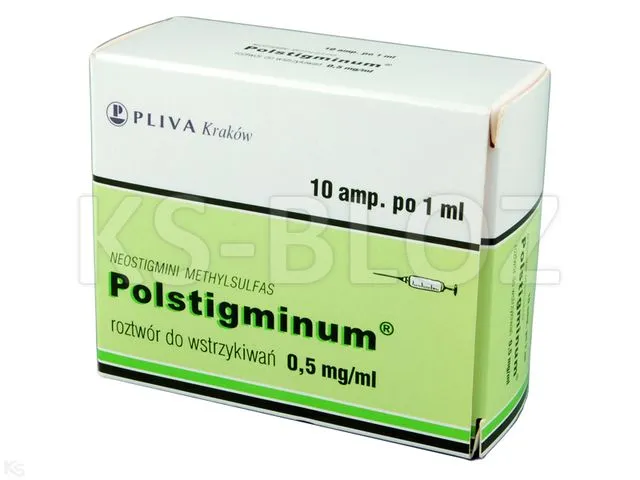
Table of Contents
- Package leaflet: Information for the patient
- 2. Important information before using Polstigminum
- 3. How to use Polstigminum
- 4. Possible adverse reactions
- 5. How to store Polstigminum
- 6. Contents of the packaging and other information
- The following information is intended exclusively for medical personnel or healthcare professionals:
Package leaflet: Information for the patient
POLSTIGMINUM, 0.5 mg/ml, solution for injection
(Neostigmini methylsulfas)
Please read all of this leaflet carefully before using this medicine, because it contains
important information for you.
- Keep this leaflet, as you may need to read it again.
- If you have any further questions, ask your doctor, pharmacist, or nurse.
- This medicine has been prescribed for a specific individual. Do not pass it on to others. It may harm other people even if their symptoms are the same.
- If you experience any adverse reactions, including any not listed in this leaflet, inform your doctor, pharmacist, or nurse. See section 4.
Table of contents
- What Polstigminum is and what it is used for
- Important information before using Polstigminum
- How to use Polstigminum
- Possible side effects
- How to store Polstigminum
- Contents of the pack and other information
1. What Polstigminum is and what it is used for
Polstigminum, 0.5 mg/ml, solution for injection contains neostigmine methylsulfate as the active substance, which enhances parasympathetic nervous system activity (a subdivision of the autonomic nervous system responsible for involuntary bodily functions, primarily associated with rest and improved digestion). It causes contraction of smooth muscles, increases intestinal peristalsis, constricts the pupils, enhances salivary secretion, and improves tone and contractility of skeletal muscles.
Indications:
- Symptomatic treatment of muscle fatigue (muscle weakness and fatigue of unknown cause) when oral administration of the drug is not possible;
- Prevention and treatment of postoperative gastrointestinal paralysis and postoperative urinary retention, after exclusion of mechanical causes of these pathological conditions;
- Reversal of neuromuscular blockade induced by non-depolarizing muscle relaxants.
2. Important information before using Polstigminum
When not to use Polstigminum, 0.5 mg/ml, solution for injection:
- If you are allergic to neostigmine or any of the other ingredients of this medicine (listed in section 6);
- If there is mechanical obstruction of the gastrointestinal or urinary tract, or peritonitis;
- In combination with depolarizing muscle relaxants such as suxamethonium, due to the risk of intensifying neuromuscular blockade and subsequent prolonged apnea.
Warnings and precautions
Before starting treatment with Polstigminum, 0.5 mg/ml, solution for injection, discuss this with your doctor, pharmacist, or nurse.
Neostigmine should be used with particular caution in patients with bronchial asthma, epilepsy, parkinsonism, recent myocardial infarction, bradycardia (slow heart rate) or other cardiac arrhythmias, hypotension, vagotonia (increased vagus nerve activity), hyperthyroidism, or gastric or duodenal ulcers.
During neostigmine treatment, the doctor must carefully differentiate between myasthenic crisis and cholinergic crisis caused by neostigmine overdose. In both cases, significant muscle weakness occurs, but the required treatment is completely different.
Use of Polstigminum, 0.5 mg/ml, solution for injection in children:
Dosage is determined by the doctor.
Use of Polstigminum, 0.5 mg/ml, solution for injection in patients with impaired kidney and/or liver function:
This medicine should be used with caution in patients with hepatic or renal impairment.
In renal impairment, the dose should be reduced. Dose adjustment is not required during renal replacement therapy.
Use of Polstigminum, 0.5 mg/ml, solution for injection in elderly patients:
No dose adjustment is required in this patient group.
Pregnancy and breastfeeding
If you are pregnant or breastfeeding, suspect you may be pregnant, or plan to become pregnant, consult your doctor before using this medicine.
Pregnancy
The decision to administer neostigmine during pregnancy is made by the physician. The drug may be used during pregnancy only if, in the physician’s opinion, the benefit to the mother outweighs the potential risk to the fetus.
Intravenous administration of acetylcholinesterase inhibitors to pregnant women may increase uterine contractility and induce premature labor.
Breastfeeding
There is no data available on the passage of neostigmine into human breast milk. Due to the risk of adverse effects in infants, Polstigminum should not be used during breastfeeding, or breastfeeding should be discontinued during treatment with this medicine.
Driving and operating machinery
During treatment with neostigmine, you should not drive or operate machinery.
Polstigminum, 0.5 mg/ml, solution for injection and other medicines
Neostigmine acts antagonistically to agents that block neuromuscular transmission.
It does not counteract, and may even potentiate, neuromuscular blockade induced by depolarizing muscle relaxants such as suxamethonium.
Certain aminoglycoside antibiotics (neomycin, streptomycin, kanamycin) may enhance the muscle-relaxing effect. These antibiotics may be administered to patients with muscle weakness only if absolutely necessary, and dosage must be appropriately adjusted.
Local anesthetics and certain general anesthetics (e.g., halothane, cyclopropane, enflurane, isoflurane, desflurane, sevoflurane), antiarrhythmic drugs (e.g., procainamide, quinidine), and other agents affecting neuromuscular transmission (e.g., ganglion-blocking agents such as hexamethonium or trimethaphan) may cause neuromuscular blockade as an adverse effect.
Inform your doctor or pharmacist about all medicines you are currently taking or have recently taken, as well as any medicines you plan to take.
Polstigminum contains less than 1 mmol (23 mg) of sodium per ampoule, meaning the medicine is considered "sodium-free".
3. How to use Polstigminum
The medicine is intended for intramuscular, intravenous, or subcutaneous administration.
The daily dose of neostigmine administered parenterally should not exceed 4–6 mg.
The dosage of the medicine is determined by the physician.
-
Symptomatic treatment of muscle weakness when oral formulation cannot be used:
Adults: Administer 0.5 mg of neostigmine methylsulfate 3 times daily by intramuscular or intravenous route. Subsequent doses should be adjusted according to the individual patient's response. The therapeutic dose usually ranges from 1 mg to 5 mg; in children, up to 2.5 mg.Children:
Transient neonatal myasthenia may be treated with 0.1 mg of neostigmine methylsulfate administered intramuscularly. Subsequent doses should be adjusted according to the individual patient's response, but typically range from 0.05–0.25 mg intramuscularly, with a maximum of 0.03 mg/kg intramuscularly every 2 to 4 hours.
Due to spontaneous remission of the disease in neonates, the daily dose should be tapered before complete discontinuation of the medicine.
Children up to 12 years of age:
The usually administered dose is 0.2–0.5 mg.
Subsequent doses should be adjusted according to the individual patient's response. -
Prevention of postoperative gastrointestinal paralysis and/or postoperative urinary retention:
Adults: It is recommended to administer 0.25 mg of neostigmine methylsulfate subcutaneously or intramuscularly as soon as possible after surgery. The dose should be repeated every 4 to 6 hours for the following 2 to 3 days. -
Treatment of postoperative gastrointestinal paralysis:
A single dose of 0.5 mg to 2 mg of neostigmine methylsulfate should be administered as a slow intravenous, subcutaneous, or intramuscular injection. Continuous intravenous infusion of neostigmine methylsulfate at a rate of 0.4–0.8 mg/h for 24 hours. -
Treatment of postoperative urinary retention:
Administer 0.5 mg of neostigmine methylsulfate subcutaneously or intramuscularly. If diuresis (urine excretion) does not occur within one hour, a urinary catheter should be inserted. If the patient has passed urine or the bladder has been emptied, continue administration by injecting 0.5 mg of neostigmine methylsulfate every 3 hours, at least five times. -
Reversal of neuromuscular blockade induced by non-depolarizing muscle relaxants:
Typically, a dose of 0.5 mg to 2 mg of neostigmine methylsulfate is administered as a slow intravenous injection; if necessary, the dose may be repeated up to a total dose of 5 mg of neostigmine methylsulfate.
Elderly patients:
There are no special dosage recommendations for neostigmine methylsulfate in elderly patients.
In case of administration of a higher than recommended dose of Polstigminum 0.5 mg/ml,
injection solution:
Overdose of neostigmine may cause cholinergic crisis, characterized by significant muscle weakness. The physician must differentiate between cholinergic and myasthenic crisis, which have similar clinical symptoms. In case of cholinergic crisis, immediately discontinue neostigmine and administer atropine.
4. Possible adverse reactions
Like all medicines, this medicine can cause adverse reactions, although they do not occur in everyone.
Adverse reactions of neostigmine are related to the enhancement of its pharmacological effects
(stimulation of the parasympathetic system) and most commonly include increased salivation and
muscle twitching. Less frequently, cramping abdominal pain and diarrhoea may occur. In addition,
during treatment with neostygmine, adverse reactions of varying frequency may occur affecting
various systems and organs:
The frequency of adverse reactions within individual systems and organs is given below using the
following convention: very common (>1/10); common (>1/100, <1/10); uncommon (>1/1,000, <1/100);
rare (>1/10,000, <1/1,000); very rare (<1/10,000); frequency not known (cannot be estimated from the
available data).
Cardiac disorders:
Frequency not known: cardiac arrhythmias (sinus bradycardia, tachycardia, atrioventricular block,
junctional rhythm), non-specific changes in ECG recording, cardiac arrest, fainting and hypotension.
Nervous system disorders:
Frequency not known: dizziness, ataxia, convulsions, loss of consciousness, somnolence, headache,
speech disorders.
Eye disorders:
Frequency not known: lacrimation, miosis, visual disturbances.
Respiratory, thoracic and mediastinal disorders:
Frequency not known: increased respiratory tract secretion, dyspnoea, bronchospasm, breathing
difficulties, respiratory arrest.
Gastrointestinal disorders:
Frequency not known: nausea, vomiting, bloating, salivation, increased peristalsis, diarrhoea.
Renal and urinary disorders:
Frequency not known: increased frequency of urination.
Musculoskeletal and connective tissue disorders:
Frequency not known: muscle cramps and twitching, joint pain.
General disorders and administration site conditions:
Frequency not known: increased sweating, skin flushing, weakness.
Immune system disorders:
Frequency not known: allergic reactions (e.g. rash, urticaria) and anaphylactic reactions.
Psychiatric disorders:
Frequency not known: restlessness, feeling of fear.
In some individuals during the use of Polstigminum, 0.5 mg/ml, solution for injection, other adverse
reactions may occur.
Reporting of adverse reactions
If any adverse reactions occur, including any adverse reactions not listed in this leaflet, inform a doctor
or pharmacist. Adverse reactions can be reported directly to the Department of Monitoring of Adverse
Drug Reactions of the Office for Registration of Medicinal Products, Medical Devices and Biocidal
Products
Al. Jerozolimskie 181C, 02-222 Warsaw
Tel.: +48 22 49 21 301
Fax: +48 22 49 21 309
Website: https://smz.ezdrowie.gov.pl
Adverse reactions can also be reported to the marketing authorization holder.
Reporting adverse reactions helps to provide more information on the safety of the medicine.
5. How to store Polstigminum
Keep the medicine out of sight and reach of children.
Store below 25°C and protect from light.
Do not use Polstigminum, 0.5 mg/ml, solution for injection after the expiry date stated on the container.
6. Contents of the packaging and other information
What Polstigminum contains:
1 ampoule (1 ml) contains: 0.5 mg of neostigmine methylsulfate and excipients: sodium chloride, concentrated hydrochloric acid, sodium hydroxide and water for injections.
What Polstigminum looks like and contents of the pack:
Colourless glass ampoules with a capacity of 1 ml, packed 10 units per cardboard box.
Marketing Authorisation Holder and Manufacturer
Marketing Authorisation Holder
Teva Pharmaceuticals Polska Sp. z o.o.
ul. Emilii Plater 53, 00-113 Warsaw
tel.: (22) 345 93 00
Manufacturer
Merckle GmbH,
Ludwig-Merckle-Strasse 3
89143 Blaubeuren
Germany
The following information is intended exclusively for medical personnel or healthcare professionals:
Due to the possibility of unexpected hypersensitivity to neostigmine, the physician should be prepared to administer atropine and initiate anti-shock treatment if necessary.
When administering high doses of neostigmine, simultaneous or prior injection of atropine sulfate is indicated. Separate syringes must be used for neostigmine and atropine.
When administering neostigmine intravenously, to prevent undesirable muscarinic effects, intravenous atropine sulfate should also be given (10 μg/kg iv every 3–10 minutes—until muscarinic symptoms subside), using a separate syringe. It is recommended to administer atropine several minutes before neostigmine rather than simultaneously.
The patient should be provided with pulmonary oxygenation and maintenance of airway patency until normal respiration is fully restored.
The optimal time for drug administration is during hyperventilation, when blood carbon dioxide concentration is low.
In patients with cardiovascular disorders or other serious diseases, the required dose of neostigmine should be carefully determined according to peripheral nerve stimulator response.
In case of bradycardia, heart rate should be increased to 80 beats per minute by prior administration of atropine.
Before administration, always check whether any change in clarity or color of the solution has occurred.