Polmatine
PolandTable of Contents
Patient Information Leaflet
Polmatine, 5 mg/dose, oral solution
Memantini hydrochloridum
Please read all of this leaflet carefully before taking this medicine, because it contains
important information for you.
- Keep this leaflet. You may need to read it again.
- If you have any further questions, ask your doctor or pharmacist.
- This medicine has been prescribed for you personally. Do not pass it on to others. It may harm them, even if their symptoms are the same as yours.
- If you experience any side effects, including any not listed in this leaflet, tell your doctor or pharmacist. See section 4.
Table of contents
- What Polmatine is and what it is used for
- Important information before taking Polmatine
- How to take Polmatine
- Possible side effects
- How to store Polmatine
- Contents of the pack and other information
1. What Polmatine is and what it is used for
What Polmatine is
Polmatine belongs to a group of medicines known as anti-dementia drugs.
Memory loss in Alzheimer's disease is caused by disturbances in the transmission of nerve impulses that carry information in the brain. In the brain there are so-called N-methyl-D-aspartate (NMDA) receptors, which are involved in the transmission of nerve signals important for learning and memory processes. Polmatine belongs to a group of medicines known as NMDA receptor antagonists. By acting on NMDA receptors, Polmatine improves the transmission of nerve impulses and memory.
What Polmatine is used for
Polmatine is used in the treatment of patients with moderate to severe Alzheimer's disease.
2. Important information before using Polmatine
When not to use Polmatine
- if the patient is allergic to memantine or any of the other ingredients of this medicine (listed in section 6).
Warnings and precautions
Before starting treatment with Polmatine, discuss the following with your doctor:
- if the patient has previously experienced epileptic seizures
- if the patient recently had a myocardial infarction, has congestive heart failure, or has uncontrolled hypertension (high blood pressure).
In the above situations, treatment with Polmatine should be carried out under strict medical supervision, with the treating physician regularly assessing the effects of ongoing therapy.
When administering memantine to patients with renal impairment (kidney problems), the treating physician should closely monitor kidney function and, if necessary, adjust the dosage accordingly.
Concomitant use of the following drugs should be avoided: amantadine (used to treat Parkinson's disease), ketamine (usually used as an anaesthetic), dextromethorphan (commonly used to treat cough), and other NMDA antagonists.
Children and adolescents
Polmatine is not recommended for use in children and adolescents under 18 years of age.
Polmatine with other medicines
Inform your doctor or pharmacist about all medicines the patient is currently taking or has recently taken, as well as any medicines the patient plans to use.
In particular, treatment with Polmatine may alter the effects of, and may necessitate dosage adjustments by the treating physician for the following medicines:
- amantadine, ketamine, dextromethorphan
- dantrolene, baclofen
- cimetidine, ranitidine
- procainamide, quinidine, quinine
- nicotine
- hydrochlorothiazide (and all combination medicines containing hydrochlorothiazide)
- anticholinergic agents (usually used to treat movement disorders or intestinal spasms)
- anticonvulsants (used to prevent or stop seizures)
- barbiturates (mainly used as sedatives)
- dopaminergic agonists (such as L-dopa, bromocriptine)
- neuroleptics (used to treat psychiatric disorders)
- oral anticoagulants.
If hospitalised, inform the doctor that the patient is taking Polmatine.
Polmatine with food and drink
Inform the treating physician if the patient has recently made or plans to make significant changes in diet (e.g. switching from a normal diet to a strict vegetarian diet), or if the patient has been diagnosed with renal tubular acidosis (RTA, excessive levels of acidic substances in the blood due to kidney dysfunction or severe urinary tract infections). In these situations, the doctor may need to adjust the dose of the medicine.
Pregnancy and breastfeeding
If the patient is pregnant or breastfeeding, suspects she may be pregnant, or is planning to have a baby, she should consult her doctor or pharmacist before using this medicine.
Women who are pregnant or planning to become pregnant should inform their treating physician before starting treatment. Memantine is not recommended for use in pregnant women.
Women taking Polmatine should not breastfeed.
Driving and operating machinery
The treating physician should advise the patient whether their condition allows them to drive or operate machinery safely.
Polmatine may additionally affect reaction speed, making driving or operating machinery inadvisable.
Polmatine contains sorbitol
This medicine contains 100 mg of sorbitol in each 1 ml of solution.
3. How to use Polmatine
This medicine should always be used as directed by the doctor. If in doubt, consult a doctor or pharmacist.
Recommended dose
One dose (one pump actuation) contains 5 mg of memantine hydrochloride.
The recommended dose of Polmatine for adults and elderly patients is four pump actuations, corresponding to 20 mg once daily.
To reduce the risk of adverse reactions, the dosage of the medicine should be increased gradually according to the following scheme:
| one dose (one pump actuation) |
| two doses (two pump actuations) |
| three doses (three pump actuations) |
| four doses (four pump actuations) |
The usual dosing starts with one dose (one pump actuation) once daily (1 x 5 mg) during the first week of treatment. In the second week, the dose should be increased to two doses (two pump actuations) once daily (1 x 10 mg), and in the third week of treatment, three doses (three pump actuations) once daily (1 x 15 mg) should be administered. Starting from the fourth week, it is recommended to administer four doses (four pump actuations) once daily (1 x 20 mg).
Dosing in patients with renal impairment
In patients with impaired kidney function, the appropriate dosage of the medicinal product should be determined by the treating physician. In such cases, regular monitoring of kidney function at specified intervals, according to the treating physician's recommendations, is necessary.
Method of administration
Polmatine should be taken orally once daily. For effective treatment, the medicinal product should be taken regularly at the same time each day. The solution should be taken with a small amount of water. The solution may be taken with food or independently of meals.
Detailed instructions for preparation and use of the medicinal product—see the end of this leaflet.
Duration of treatment
Treatment should be continued as long as beneficial effects are observed. The treating physician should regularly evaluate the course of therapy.
Use of a higher than recommended dose of Polmatine
- Generally, taking an excessive dose of Polmatine does not pose a health hazard. In such a case, intensified symptoms described in section 4, "Possible adverse reactions," may occur.
- In the case of significant overdose of Polmatine, contact the treating physician or another physician, as appropriate management may become necessary.
Missed dose of Polmatine
- If a patient forgets to take the medicinal product, they should take the next dose of Polmatine at the usual time.
- A double dose should not be taken to make up for the missed dose.
If you have any further questions regarding the use of this medicinal product, consult your physician or pharmacist.
4. Possible adverse reactions
Like all medicines, this medicine can cause adverse reactions, although not everyone will experience them.
Generally observed adverse reactions are mild to moderate in severity.
Common (occur in 1 to 10 out of 100 patients):
- Headache, somnolence, constipation, elevated liver enzyme levels, dizziness, balance disorders, shallow breathing, and high blood pressure.
Uncommon (occur in 1 to 10 out of 1,000 patients):
- Fatigue, fungal infections, confusion, hallucinations, vomiting, unsteady gait, heart failure, and blood clots in veins (venous thrombosis / embolism).
Rare (occur in less than 1 out of 10,000 patients):
- Seizures.
Unknown frequency (cannot be estimated from available data):
- Pancreatitis, hepatitis, and psychotic reactions.
Alzheimer's disease is associated with depression, suicidal thoughts, and suicide.
Such cases have been reported in patients treated with memantine.
Reporting of adverse reactions
If any adverse reactions occur, including any adverse reactions not listed in this leaflet, inform your doctor or pharmacist. Adverse reactions can be reported directly to the Department of Monitoring of Adverse Drug Reactions at the Office for Registration of Medicinal Products, Medical Devices and Biocidal Products
Al. Jerozolimskie 181C
02-222 Warsaw
Phone: +48 22 49 21 301
Fax: +48 22 49 21 309
Website: https://smz.ezdrowie.gov.pl
Adverse reactions can also be reported to the Marketing Authorisation Holder.
Reporting adverse reactions allows the collection of additional information regarding the safety of the medicine.
5. How to store Polmatine
Keep the medicine out of the sight and reach of children.
No special precautions regarding storage of the medicinal product are required.
The bottle with the attached pump should be stored and transported in an upright position only.
Do not use this medicine after the expiry date stated on the bottle label and carton after: EXP. The expiry date refers to the last day of the stated month.
The marking on the packaging following the abbreviation EXP indicates the expiry date, and following the abbreviation Lot indicates the batch number.
Medicines must not be disposed of via the sewage system or household waste. Ask a pharmacist how to dispose of medicines no longer in use. This will help protect the environment.
6. Contents of the pack and other information
What Polmatine contains
- The active substance is memantine hydrochloride. Each pump activation (one press of the pump) delivers 0.5 ml of solution containing 5 mg of memantine hydrochloride, equivalent to 4.16 mg of memantine.
- Other ingredients: potassium sorbate (E202), liquid sorbitol, non-crystallizing (E420), purified water.
What Polmatine looks like and contents of the pack
Polmatine oral solution is a clear, colourless or slightly yellowish solution.
Polmatine oral solution is available in 50 ml or 100 ml bottles.
Not all pack sizes may be marketed.
Marketing Authorisation Holder
Zakłady Farmaceutyczne POLPHARMA S.A.
ul. Pelplińska 19, 83-200 Starogard Gdański
tel. + 48 22 364 61 01
Manufacturer
Zakłady Farmaceutyczne POLPHARMA S.A.
Medana Branch in Sieradz
ul. Władysława Łokietka 10, 98-200 Sieradz
INSTRUCTIONS FOR PROPER USE OF THE PUMP DISPENSER
The solution must not be poured or dispensed directly into the mouth from the bottle or the pump dispenser.
The dose of the medicine should be measured using the pump into a spoon or a glass of water.
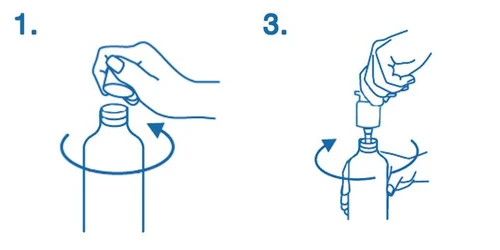
Removing the cap from the bottle:
Unscrew the cap in the counterclockwise direction and remove it (Fig. 1).
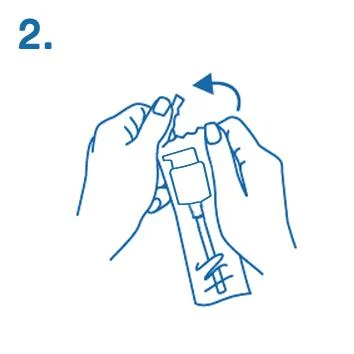
Attaching the dosing pump to the bottle:
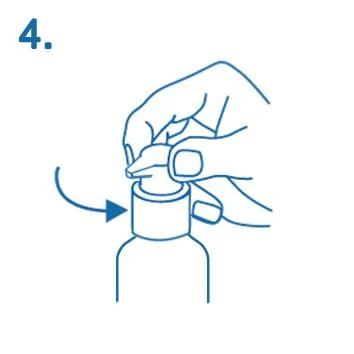
Remove the dosing pump from the plastic pouch (Fig. 2) and place it onto the bottle, carefully inserting the plastic tube into the bottle. Then hold the dosing pump firmly on the neck of the bottle and screw it clockwise until it stops (Fig. 3). The dosing pump should be attached only once, before first use, and must never be unscrewed afterwards.
Operation of the pump:
The pump head has two positions and can be easily turned:
counterclockwise to open it, or
clockwise to close it.
Do not press the pump when it is in the closed position. The pump dispenses solution only when in the open position. To open the pump, turn the head in the direction indicated by the arrow until it stops (approximately one-eighth of a full turn, Fig. 4). The dosing pump is then ready for use.
Preparing the dosing pump:
At first use, the dosing pump does not deliver the correct amount of oral solution.
Therefore, it must be properly prepared by pressing the pump head fully down five times in succession (Fig. 5).
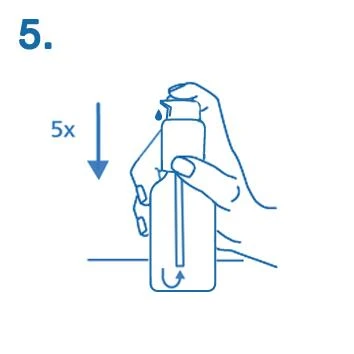
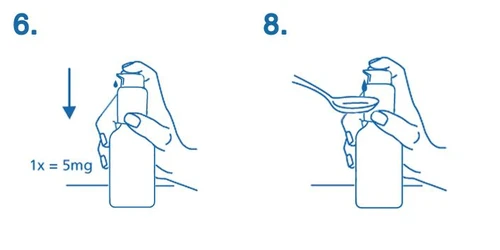
Any solution leaking from the pump should be discarded. After this, the next full press of the dosing pump (corresponding to one pump activation) will deliver the correct dose of medicine to the patient (Fig. 6).
Correct use of the dosing pump:
Place the bottle upright on a flat, horizontal surface, such as a table, and use only when in the upright position. Place a glass containing a small amount of water or a spoon under the pump nozzle, then press the pump head firmly but steadily (not too slowly) until resistance is felt (Fig. 7, Fig. 8).
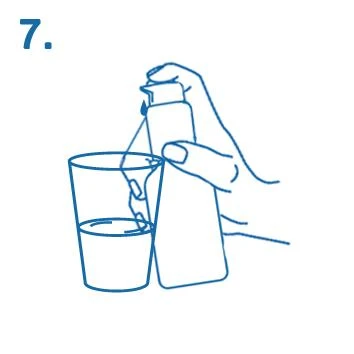
Then release the dosing pump head. The pump is now ready for the next press.
The dosing pump must only be used with Polmatine medicine solution and the supplied bottle.
The pump must not be used to dispense other substances nor connected to other containers.
If the pump does not function properly, consult your doctor or pharmacist.
After using Polmatine, close the dosing pump.